Thursday, 30 July 2026

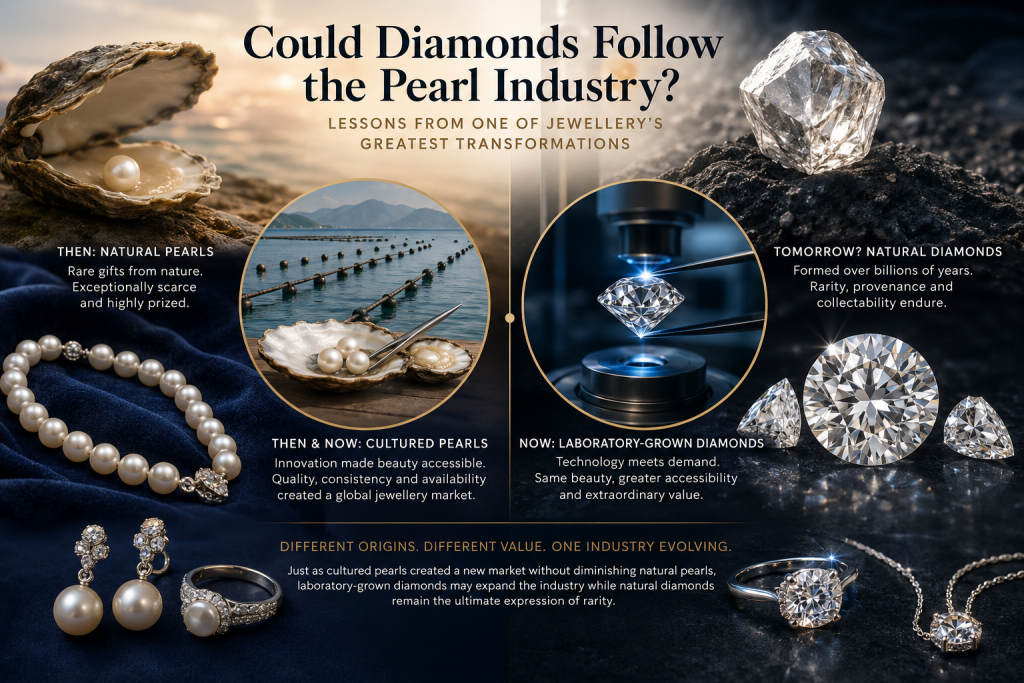
Could Diamonds Follow the Pearl Industry? Lessons from One of Jewellery's Greatest Transformations

 Could Diamonds Follow the Pearl Industrym, When Nature Could No Longer Meet Demand

For more than a century, natural diamonds have represented rarity, permanence and prestige. Yet today, the diamond industry is experiencing one of the most significant periods of change in its history. The rapid rise of laboratory-grown diamonds has challenged long-held assumptions about rarity, value and production.

While many compare laboratory-grown diamonds to synthetic gemstones, perhaps a more relevant comparison lies elsewhere. The transformation of the pearl industry offers an intriguing historical precedent.

Could diamonds be following a similar path?

When Nature Could No Longer Meet Demand

Before the early twentieth century, every pearl was natural.

Finding a single fine pearl required divers to open thousands of wild oysters, making exceptional pearls extraordinarily rare and valuable. As demand increased, natural oyster beds became depleted through over-harvesting, pollution and environmental change. The jewellery market faced an obvious problem: consumers wanted pearls, but nature simply could not supply them in sufficient quantity.

The solution came through cultured pearls.

By introducing a tiny nucleus into a living oyster, pearl farmers could encourage the oyster to produce a genuine pearl under controlled conditions. The process still relied on nature, but it dramatically increased consistency, availability and affordability.

Initially, cultured pearls were met with scepticism. Many believed they would destroy the value of natural pearls.

Instead, something quite different happened.

Two Markets Emerged

Rather than replacing natural pearls entirely, cultured pearls created an entirely new market.

Millions of consumers who had never been able to afford fine pearls suddenly could.

Natural pearls, however, became even rarer. As natural harvesting declined, truly exceptional natural pearls became increasingly desirable to collectors, museums and high-end jewellery houses.

Today, important natural pearl necklaces regularly achieve extraordinary auction results because of their rarity and historical significance.

The market effectively separated into two distinct categories:

  • Cultured pearls became the mainstream jewellery product.
  • Natural pearls became exceptional collector’s items.

Both markets survived—but they served different customers.

Diamonds May Be Facing a Similar Evolution

When Nature Could No Longer Meet Demand Before the early twentieth century, every pearl was natural.


Laboratory-grown diamonds are not imitation diamonds.

They possess the same crystal structure, chemical composition and optical properties as natural diamonds. Modern technology can produce exceptionally high-quality stones in a matter of weeks rather than over billions of years beneath the Earth’s surface.

Production efficiencies continue to improve.

Prices have fallen dramatically.

Quality has become increasingly consistent.

For many jewellery buyers, laboratory-grown diamonds offer larger sizes and higher specifications at significantly lower prices than natural diamonds.

This has fundamentally changed the entry-level diamond jewellery market.

The Difference is Rarity

Where the comparison becomes interesting is the concept of rarity.

Natural diamonds are finite geological creations formed over billions of years under immense heat and pressure.

Laboratory-grown diamonds can be manufactured repeatedly whenever production facilities are expanded.

This distinction mirrors the difference between natural and cultured pearls.

One derives its rarity from nature.

The other derives its availability from technology.

Neither is inherently “better” in every situation they simply satisfy different consumer priorities.

Luxury Has Always Valued Scarcity

History shows that luxury markets rarely disappear simply because a more affordable alternative becomes available.

Mechanical watches continue to thrive despite the accuracy of digital watches.

Original artworks remain valuable despite the existence of perfect reproductions.

Vintage wines command remarkable prices despite modern winemaking techniques.

Natural pearls retained their prestige after cultured pearls became mainstream.

Collectors often place a premium on objects that cannot simply be reproduced.

The same principle may continue to apply to exceptional natural diamonds.

Large, rare coloured diamonds, historically significant gemstones and stones with remarkable provenance are unlikely to lose their appeal simply because laboratory-grown diamonds become increasingly common.

Will Natural Diamonds Become More Exclusive?

As mining becomes more challenging and fewer new diamond deposits are discovered, the supply of natural diamonds may gradually tighten.

Several major mines are approaching the end of their productive lives, while fewer world-class discoveries have been made over the past two decades.

If production continues to decline while the finest stones remain desirable, natural diamonds could increasingly occupy a position similar to that of natural pearls—less common, more exclusive and primarily sought by collectors and connoisseurs.

Rather than competing directly with laboratory-grown diamonds, they may simply occupy a different market.

What Happens to Everyday Diamond Jewellery?

This may be where laboratory-grown diamonds reshape the industry most dramatically.

Consumers purchasing jewellery primarily for its appearance, design or sentimental value may increasingly choose laboratory-grown diamonds because they provide greater size and quality within a given budget.

Jewellery designers gain greater creative freedom.

Consumers gain more choice.

The overall market for diamond jewellery could even expand as affordability improves.

This is remarkably similar to what occurred with cultured pearls, which transformed pearls from an occasional luxury into an everyday jewellery category.

The Importance of Transparency

One lesson from the pearl industry is particularly relevant.

Consumers accepted cultured pearls because the industry clearly distinguished them from natural pearls.

Each category developed its own identity.

The same principle is essential for diamonds.

Natural and laboratory-grown diamonds are both genuine diamonds, but they have different origins, different rarity profiles and different market dynamics.

Clear disclosure, accurate grading and transparent terminology allow consumers to make informed purchasing decisions based on their own priorities rather than confusion or marketing.

The Future May Not Be Either-Or

The history of jewellery suggests that technological innovation rarely eliminates natural luxury products.

Instead, it often creates broader markets with distinct categories serving different needs.

Natural pearls and cultured pearls now coexist successfully.

It is entirely possible that natural and laboratory-grown diamonds will do the same.

Natural diamonds may increasingly represent geological rarity, heritage and long-term collectability.

Laboratory-grown diamonds may continue to dominate fashion jewellery, bridal markets and value-conscious consumers seeking exceptional visual beauty.

Rather than one replacing the other, both could become permanent parts of the modern jewellery landscape.

Conclusion

The transformation of the pearl industry demonstrates that innovation does not necessarily diminish the value of natural treasures. Instead, it can redefine their place within the luxury market.

Whether diamonds ultimately follow the same path remains to be seen, but the parallels are compelling. Laboratory-grown diamonds have undoubtedly changed accessibility and affordability, much as cultured pearls did generations ago.

History suggests that when technology makes luxury more accessible, the rarest natural examples often become even more distinctive.

For the jewellery industry, the future may not be about choosing between natural and laboratory-grown diamonds. Instead, it may be about recognising that each serves a different purpose, a different customer and a different definition of value.

As with pearls, the industry may simply be witnessing the emergence of two complementary markets one built on the rarity of nature, the other on the possibilities of technology.

Source: DCLA

Wednesday, 29 July 2026

From an $18 Billion Giant to a $1 Billion Sale: The Rise and Reinvention of De Beers

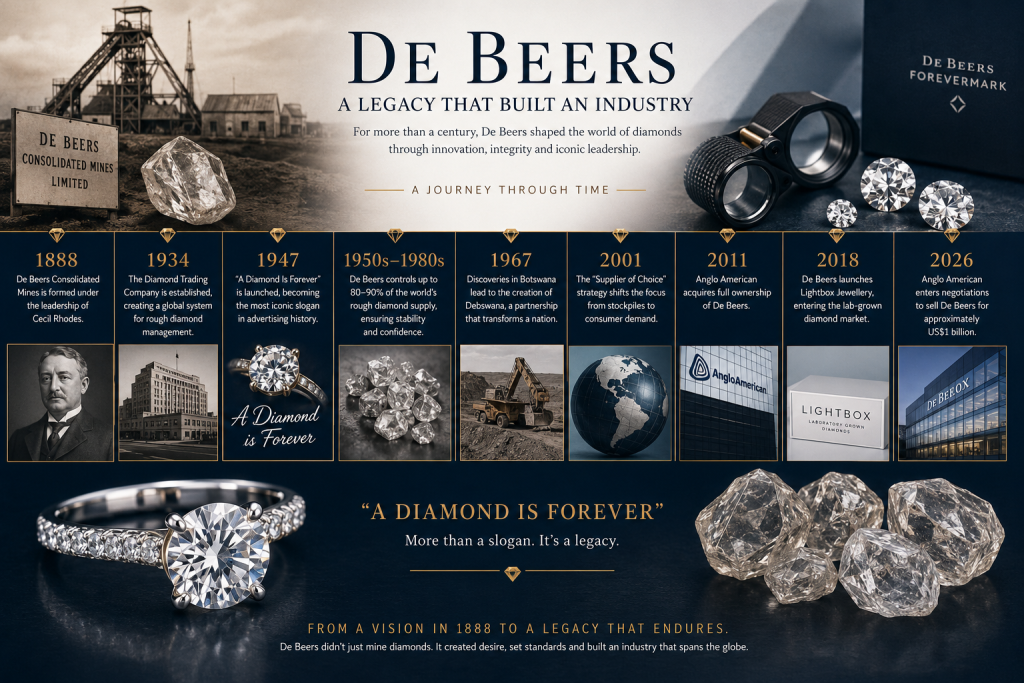
 De Beers was the undisputed leader of the global diamond industry.

For more than a century, De Beers was the undisputed leader of the global diamond industry. It transformed diamonds from a relatively rare luxury into the world’s most desired gemstone, creating the modern diamond market through visionary marketing, strict supply management and consumer confidence.

Today, that same company may be sold for as little as US$1 billion, marking one of the most remarkable reversals in the history of the luxury goods industry.

Anglo American Nears Historic Sale

Mining giant Anglo American is reportedly close to selling De Beers as it continues its restructuring following the failed takeover attempt by BHP in 2024.

According to reports, the preferred bidder is the Global Diamond Consortium (GDC), led by former De Beers Chief Executive Gareth Penny and backed by the governments of Namibia and Angola.

The proposed agreement would see GDC pay approximately US$750 million upfront, followed by a further US$250 million at a later stage. Additional performance-based payments may also form part of the final transaction, although negotiations remain ongoing and no final agreement has yet been reached.

The consortium also intends to inject approximately US$500 million into De Beers following the acquisition to strengthen operations and refocus the company on the mining and marketing of natural diamonds.

A Dramatic Fall in Valuation

The potential sale price is extraordinary considering De Beers’ former worth.

When Anglo American acquired the Oppenheimer family’s remaining stake in 2011, the transaction valued De Beers at nearly US$13 billion. During its strongest years, analysts estimated the company’s value exceeded US$18 billion.

However, a combination of falling rough diamond prices, weak Chinese luxury demand, changing consumer spending and the rapid emergence of laboratory-grown diamonds has dramatically reduced profitability across the sector.

Anglo has written down the value of De Beers three times in just three years, reducing its book value to approximately US$2.3 billion earlier this year.

The Company That Built the Modern Diamond Industry

The iconic slogan "A Diamond Is Forever"


While today’s headlines focus on declining valuations, they should not overshadow De Beers’ extraordinary contribution to the global diamond trade.

Few companies have influenced an entire industry as profoundly.

Throughout most of the twentieth century, De Beers controlled the overwhelming majority of the world’s rough diamond supply. Through the Central Selling Organisation (CSO), it managed production, stabilised prices and created confidence that diamonds would retain their value.

Perhaps even more influential was its marketing.

In 1947, De Beers launched the now legendary slogan:

“A Diamond Is Forever.”

That simple phrase fundamentally changed consumer behaviour.

It established the diamond engagement ring as the global symbol of love and commitment and remains one of the most successful advertising campaigns ever created.

For decades, De Beers also invested heavily in consumer education, retailer training, grading standards and worldwide promotional campaigns that helped grow demand across Europe, North America, Japan and later China.

Without De Beers, the global diamond jewellery market as we know it today would likely never have existed.

Botswana Remains Central

Any transaction must also satisfy the Government of Botswana, which owns 15% of De Beers and jointly owns Debswana, the partnership responsible for producing most of Botswana’s diamonds.

President Duma Boko has previously expressed interest in increasing Botswana’s ownership of De Beers, although recent reports suggest the country may instead accept a larger minority stake.

Botswana remains one of the world’s most important diamond-producing nations, and its future relationship with De Beers will be crucial to any successful acquisition.

Gareth Penny Returns

Leading the proposed acquisition is Gareth Penny, who served as Chief Executive of De Beers between 2006 and 2010.

During the Global Financial Crisis, Penny successfully guided the company through one of the most difficult periods in diamond history by temporarily suspending mining operations, reducing supply and securing approximately US$1 billion through a rights offering.

His return signals an intention to restore De Beers’ focus on natural diamonds while adapting to today’s very different market conditions.

Milestones in De Beers History

1888 – Cecil Rhodes consolidates South African diamond mining companies to form De Beers Consolidated Mines.

1934 – The Diamond Trading Company is established, laying the foundations for centralised rough diamond distribution.

1947 – The iconic slogan “A Diamond Is Forever” is created by advertising agency N.W. Ayer, forever changing the jewellery industry.

1950s–1980s – De Beers controls as much as 80–90% of the world’s rough diamond supply, creating unprecedented market stability.

1967 – Major discoveries in Botswana eventually lead to the formation of Debswana, transforming Botswana into one of Africa’s greatest economic success stories.

1990s – Increasing production outside the De Beers system begins reducing the company’s market dominance.

2001 – De Beers introduces its “Supplier of Choice” strategy, shifting from stockpiling diamonds to demand-driven marketing.

2011 – Anglo American acquires full ownership of De Beers after purchasing the Oppenheimer family’s stake.

2018 – De Beers launches Lightbox Jewellery to enter the laboratory-grown diamond market, recognising changing consumer trends.

2025 – Lightbox is wound down as De Beers recommits its strategy to natural diamonds.

2026 – Anglo American enters negotiations to sell De Beers for approximately US$1 billion.

A New Beginning Rather Than the End

Although the proposed valuation represents a dramatic decline from De Beers’ former glory, the company still possesses some of the world’s most recognised diamond brands, valuable mining assets and decades of expertise.

More importantly, De Beers leaves behind a legacy that reshaped the global jewellery industry. It pioneered diamond marketing, built international confidence in natural diamonds and helped establish universal grading standards that continue to underpin the modern trade.

The challenge for new ownership will not be rebuilding history—but adapting that remarkable legacy to a new generation of consumers in a market where natural diamonds must increasingly differentiate themselves through rarity, provenance and enduring value.

Source: DCLA

Tuesday, 28 July 2026

The Hidden Light Within Diamonds: How Fluorescence Can Enhance Beauty, Character and Value

 When people admire a diamond, they usually focus on the famous Four Cs carat, colour, clarity and cut. Yet one fascinating characteristic often overlooked by consumers is fluorescence. Far from being a flaw, fluorescence is a natural optical phenomenon that, in many diamonds, enhances their appearance and contributes to their individuality.

When people admire a diamond, they usually focus on the famous Four Cs carat, colour, clarity and cut. Yet one fascinating characteristic often overlooked by consumers is fluorescence. Far from being a flaw, fluorescence is a natural optical phenomenon that, in many diamonds, enhances their appearance and contributes to their individuality.

For gemmologists, fluorescence provides another layer of information about a diamond’s identity. For collectors and jewellery lovers, it can add an entirely different dimension of beauty particularly in rare coloured diamonds.

What is Diamond Fluorescence?

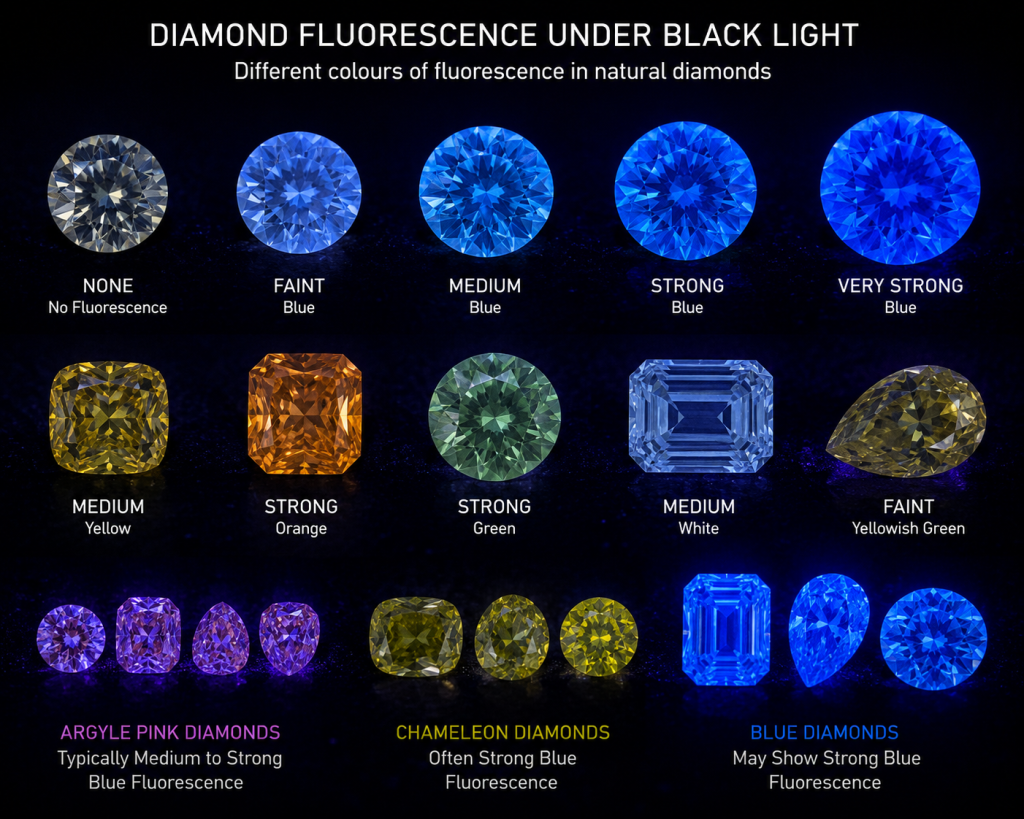
Fluorescence occurs when a diamond is exposed to ultraviolet (UV) light. Invisible ultraviolet rays excite trace structural defects within the diamond crystal, causing it to emit visible light. Once the UV source is removed, the glow disappears almost instantly.

Approximately 25–35% of natural diamonds exhibit some degree of fluorescence, while only around 10% display fluorescence strong enough to be easily observed.

The overwhelming majority fluoresce blue, although yellow, orange, white and even green fluorescence can occasionally occur.

This phenomenon has fascinated gemmologists for over a century and remains an important grading characteristic documented by leading laboratories such as the DCLA, GIA and other internationally recognised laboratories.

Nature’s Hidden Signature

Fluorescence is not an artificial treatment or enhancement. It is a natural characteristic formed deep within the Earth millions or even billions of years ago during a diamond’s crystallisation.

Different trace elements and atomic irregularities create different reactions to ultraviolet light, making fluorescence something of a natural fingerprint for each diamond.

In many cases, fluorescence remains completely invisible during everyday wear, only revealing itself under sunlight rich in ultraviolet radiation or beneath UV lamps.

The Blue Glow of White Diamonds

One of the most beneficial effects of fluorescence is seen in Cape-series white diamonds, particularly those in the H through M colour grades.

These diamonds contain a slight yellow body colour. Since blue is complementary to yellow on the colour spectrum, blue fluorescence can visually neutralise a portion of that warmth when the diamond is viewed in daylight.

The result is that many fluorescent diamonds appear:

  • Whiter
  • Brighter
  • Fresher
  • Slightly higher in colour than their laboratory grade may suggest

This effect is especially noticeable in outdoor lighting, where natural ultraviolet light is abundant.

For decades, experienced jewellers have recognised that a well-cut H, I, J or K colour diamond with medium blue fluorescence can face up remarkably white while offering excellent value compared with higher colour grades.

Only in a very small percentage of diamonds with very strong fluorescence can an undesirable oily or hazy appearance occur. Extensive studies have shown this affects only a minority of fluorescent diamonds, meaning fluorescence should be judged on the individual stone rather than by reputation alone.

Fluorescence and Fancy Coloured Diamonds

Fluorescence and Fancy Coloured Diamonds


While fluorescence can improve the appearance of white diamonds, it becomes even more intriguing in the world of fancy coloured diamonds.

Here, fluorescence often contributes to the personality and visual excitement of the stone.

The Legendary Argyle Pink Diamonds

Among the world’s most treasured gemstones are the famous Argyle Pink Diamonds from Western Australia.

Many of these extraordinary diamonds display medium to strong blue fluorescence despite possessing vivid pink body colour.

The blue fluorescence creates a remarkable contrast with the diamond’s natural pink hue. Under ultraviolet-rich lighting, the diamond can appear even more vibrant and alive, adding another dimension to its already exceptional beauty.

Researchers have long associated the fluorescence in Argyle diamonds with the unique geological conditions that produced their distinctive pink colour—conditions unlike those found in almost any other diamond deposit on Earth.

Rather than detracting from their value, fluorescence has become part of the fascinating character that collectors admire in these exceptionally rare gems.

The Magical Chameleon Diamond

Perhaps no diamond demonstrates the beauty of fluorescence more dramatically than the Chameleon Diamond.

These exceptionally rare diamonds possess the remarkable ability to temporarily change colour.

Normally appearing olive green, grey-green or yellowish-green, they can shift to warmer yellow tones after gentle heating or following prolonged storage in darkness.

Many Chameleon diamonds also exhibit an intense and often spectacular fluorescence under ultraviolet light.

This interaction between colour change and fluorescence creates one of the most captivating visual displays found in any gemstone.

Scientists continue to study the exact atomic mechanisms responsible for this behaviour, making Chameleon diamonds one of gemmology’s enduring mysteries.

Fluorescence Adds Personality

Every fluorescent diamond possesses its own unique response to ultraviolet light.

Some emit a soft blue glow.

Others display a vibrant electric blue.

Rare stones may fluoresce yellow, orange or even white.

For collectors, this individuality makes fluorescence another characteristic that distinguishes one diamond from another. It reminds us that no two natural diamonds are truly identical.

Understanding Fluorescence in Jewellery

When selecting a diamond, fluorescence should never be viewed in isolation.

Instead, it should be considered alongside:

  • Cut quality
  • Overall transparency
  • Colour
  • Clarity
  • Optical performance

A beautifully cut fluorescent diamond may appear more lively than a non-fluorescent equivalent, particularly in natural daylight.

In coloured diamonds, fluorescence often enhances the stone’s uniqueness and visual appeal, becoming part of its identity rather than a grading curiosity.

A Feature Worth Appreciating

For many years, fluorescence was misunderstood and sometimes unfairly discounted in the marketplace. Modern research and decades of gemmological observation have demonstrated that this perception is overly simplistic.

In many diamonds particularly those in the H to M colour range blue fluorescence can improve the apparent face-up colour. In rare fancy coloured diamonds such as Argyle Pinks and Chameleon diamonds, fluorescence contributes to the extraordinary visual characteristics that make these gems so highly prized.

Like fingerprints, inclusions and crystal growth patterns, fluorescence tells part of the story of a diamond’s geological journey.

It is one more reminder that natural diamonds are products of nature, each possessing characteristics that cannot be duplicated exactly.

Understanding fluorescence allows consumers to appreciate diamonds not simply for their colour or clarity, but for the remarkable optical phenomena hidden within them revealed only when nature shines a different kind of light.

Source: DCLA

Monday, 27 July 2026

The Art of Contrast: Why Mixing Coloured Diamonds Creates Extraordinary Jewellery

 The Importance of Colour Matching

For centuries, white diamonds have been regarded as the ultimate symbol of elegance and timeless beauty. Today, however, the world’s leading jewellery designers are embracing a more artistic approach combining white diamonds with rare coloured diamonds to create striking pieces that are as unique as they are valuable.

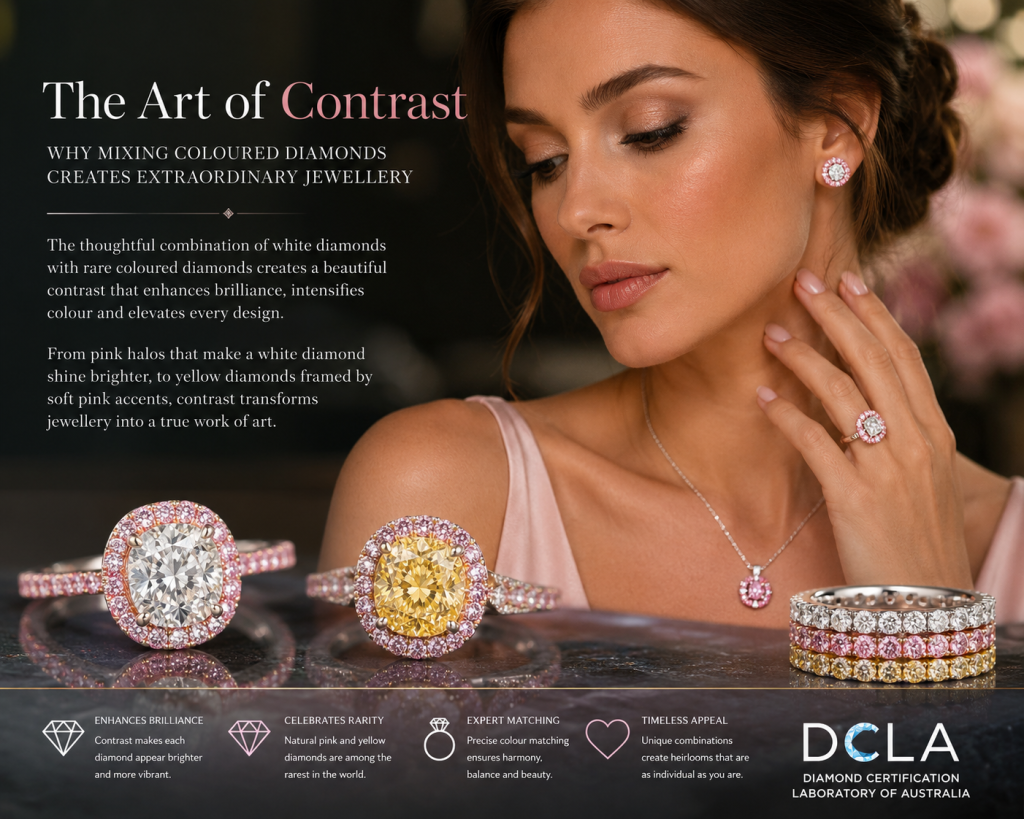
From delicate pink diamond halos surrounding a brilliant white centre stone to vivid yellow diamonds framed by soft pink accents, the thoughtful use of contrasting colours can transform an already beautiful diamond into an exceptional work of art.

The result is jewellery that is not only visually captivating but often far more distinctive than traditional all-white diamond designs.

Colour Creates Emotion

The human eye is naturally drawn to contrast.

Artists have understood this for centuries, using complementary colours to create depth, balance and visual impact. Jewellery designers apply the same principles when working with diamonds.

A perfectly colourless diamond surrounded by a halo of natural pink diamonds immediately appears brighter and more vibrant. The soft blush tones create warmth around the crisp white centre stone, producing a romantic and luxurious appearance that cannot be achieved with white diamonds alone.

Similarly, a rich yellow diamond surrounded by pink diamonds creates a dramatic contrast. The warmth of the yellow is enhanced by the cool undertones of the pink, allowing each colour to appear richer and more saturated.

Rather than competing with one another, the colours work together to produce greater visual intensity.

The Rise of Coloured Diamond Combinations

While coloured diamonds have always been prized by collectors, improvements in jewellery design and precision manufacturing have encouraged designers to use them in increasingly creative ways.

Some of today’s most sought-after combinations include:

  • A colourless diamond framed by a halo of natural pink diamonds.
  • Fancy Yellow diamonds surrounded by Argyle pink diamonds.
  • Fancy Intense Yellow centre stones with white diamond halos.
  • White diamonds accented with blue or champagne diamonds.
  • Pink diamonds paired with white pavé settings.
  • Three-stone rings featuring contrasting diamond colours.
  • Alternating white and coloured diamonds in eternity bands.

Each combination creates its own personality, allowing jewellery to become an expression of individual style rather than simply following tradition.

Pink Diamonds: Small Stones with Extraordinary Impact

Natural pink diamonds occupy a unique position within the diamond world.

Even very small pink diamonds possess remarkable rarity, particularly those originating from Australia’s now-closed Argyle Mine. Their limited availability has made them highly desirable among collectors and designers alike.

A halo of pink diamonds surrounding a larger white diamond allows jewellers to showcase this rarity without requiring a large pink centre stone.

The effect is remarkable.

The pink diamonds add warmth and sophistication while visually enhancing the brilliance of the colourless centre diamond.

Because the halo consists of numerous carefully matched stones, the overall impression is one of richness and refinement.

Yellow Diamonds Come Alive with Contrast

More Than Beauty, A Celebration of Rarity


Yellow diamonds are among the most popular naturally coloured diamonds available today.

When used as the centrepiece of a ring, they radiate warmth and vibrancy. However, surrounding a yellow diamond with carefully selected pink diamonds introduces an entirely new dimension.

The soft pink tones gently frame the yellow centre, making its colour appear deeper and more saturated. At the same time, the yellow diamond provides a striking focal point against the delicate pink border.

Many luxury jewellery houses have embraced this combination because it creates an appearance that is simultaneously elegant, modern and unmistakably distinctive.

More Than Beauty, A Celebration of Rarity

Combining different coloured diamonds is not simply a design trend.

It is often a celebration of rarity.

Natural fancy coloured diamonds account for only a very small percentage of all diamonds recovered worldwide. Finding matching stones with similar colour intensity, clarity and size requires exceptional expertise.

Every carefully matched halo represents countless hours of diamond selection.

The more precisely the colours complement one another, the more harmonious and valuable the finished piece becomes.

The Importance of Colour Matching

Creating a successful coloured diamond design involves far more than selecting attractive stones.

Professional jewellers carefully consider:

  • Colour hue
  • Colour intensity
  • Tone
  • Saturation
  • Diamond size
  • Cut precision
  • Overall symmetry

Even slight variations between pink diamonds can affect the appearance of a halo.

Likewise, white accent diamonds must be matched for colour and brilliance to ensure they enhance rather than distract from the centre stone.

This meticulous attention to detail is what separates exceptional jewellery from ordinary jewellery.

Precious Metals Complete the Design

The choice of metal plays an equally important role.

Platinum and white gold enhance the brilliance of colourless diamonds and provide a contemporary appearance.

Yellow gold intensifies the warmth of yellow diamonds while offering a classic, timeless aesthetic.

Rose gold has become increasingly popular for pink diamond jewellery, complementing the delicate blush tones and creating a seamless flow of colour throughout the design.

Some of the most sophisticated creations combine multiple precious metals, allowing each section of the ring to highlight a different coloured diamond.

A New Era of Personal Expression

Today’s clients are increasingly seeking jewellery that reflects their individuality.

Mixing coloured diamonds allows designers to create bespoke pieces that cannot be replicated simply by increasing diamond size or carat weight.

Whether choosing a white diamond embraced by a halo of rare pink diamonds or a radiant yellow diamond accented with white and pink stones, these combinations create jewellery that tells a story through colour, contrast and craftsmanship.

Beauty Enhanced by Contrast

The finest jewellery is rarely about excess it is about balance.

The careful pairing of white, pink and yellow diamonds demonstrates how contrast can enhance brilliance, intensify colour and elevate an already beautiful design into something truly extraordinary.

As coloured diamonds continue to capture the imagination of collectors and jewellery lovers around the world, their thoughtful combination with traditional white diamonds is redefining modern luxury.

When selected with care and expertly matched, contrasting diamond colours do more than create visual impact they create timeless pieces whose beauty lies not only in the rarity of the individual diamonds, but in the harmony they achieve together.

Source: DCLA

Luxury Diamond Jewellery Trends for 2026, The Return of Quality, Individuality and Timeless Style

  For years, fashion dictated what jewellery people wore. In 2026, that has changed. Today’s luxury jewellery buyers are no longer chasing f...