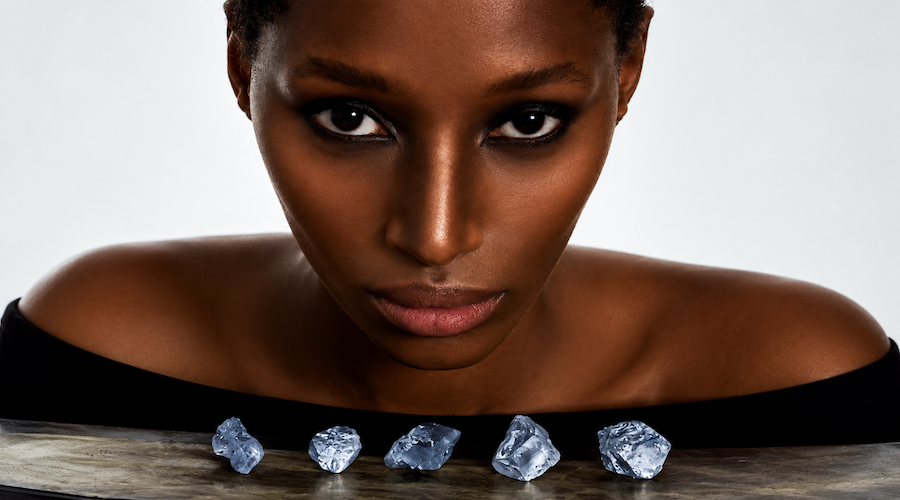
Lucara Diamond Corp. has announced the recovery of a remarkable 36.92 carat blue diamond from its wholly owned Karowe Diamond Mine in Botswana further reinforcing Karowe’s reputation as one of the world’s most prolific sources of rare and high-value diamonds.
The newly recovered stone is described as a high-quality Type IIb blue diamond, a category renowned for its extreme rarity, boron content, and exceptional optical properties. The diamond was recovered using X-ray Transmission (XRT) technology from stockpiled ore, highlighting the continued value embedded within Karowe’s surface material.
In addition to this notable discovery, Lucara reports that five diamonds exceeding 100 carats have been recovered year-to-date from the processing of stockpiles. These results underscore the consistent recovery profile of large, high-quality stones from the Karowe resource.
William Lamb, President and CEO of Lucara, commented that the recovery of this exceptional blue diamond further demonstrates the unique nature of the Karowe asset. He emphasised that such finds validate the strategic importance of stockpile processing as a meaningful contributor to ongoing production.
Since commencing operations in 2012, Karowe has established itself as a leading producer of large, high-value Type IIa diamonds. The mine remains the cornerstone of Lucara’s operations and future growth strategy.
Looking ahead, Karowe is undergoing a significant transition from open-pit to underground mining through the development of the Karowe Underground Project (UGP). This expansion is designed to unlock access to the highest-value portions of the orebody. Underground development ore is expected to begin supplementing stockpile feed by 2027, with full-scale underground production targeted for the first half of 2028.
This latest recovery not only highlights the enduring value of Karowe’s resource but also reinforces Botswana’s standing as a premier origin for some of the world’s most extraordinary diamonds.
A new Natural Diamond Council report reveals why record-breaking diamonds operate in a market beyond conventional valuation models
At the very top end of the diamond market, traditional pricing frameworks cease to function. Per-carat benchmarks, standard price lists, and even established scarcity models lose relevance when value is driven not by comparables, but by the willingness of elite buyers to secure assets of extreme rarity.
This rarefied segment is the focus of Record-Breaking Diamonds, a new report by the Natural Diamond Council (NDC), which examines the largest, most valuable natural diamonds ever discovered, cut, and sold. Drawing on mining data, gemmological research, and global auction results, the report offers a detailed analysis of how extraordinary rarity reshapes value within the natural diamond supply chain.
A Century Without a Challenger
One of the report’s most striking observations is the prolonged absence of truly massive diamonds following the 1905 discovery of the Cullinan in South Africa. Weighing an unprecedented 3,106.75 carats, the Cullinan established a benchmark that would stand unchallenged for more than 110 years. Until 2015, no gem-quality diamond exceeding 1,000 carats was recovered anywhere in the world.
That changed with the discovery of the 1,109-carat Lesedi La Rona at Botswana’s Karowe mine. Its recovery marked a turning point. Since then, at least nine rough diamonds weighing over 1,000 carats have been unearthed, including two exceptional finds exceeding 2,000 carats: the 2,488-carat Motswedi in 2024 and a 2,036-carat near-gem-quality rough diamond recovered in July 2025. Both originated from Karowe, with Motswedi now ranking as the second-largest gem-quality rough diamond ever discovered.
Technology, Not Abundance
The increased frequency of such discoveries does not signal a sudden abundance of large diamonds. Rather, it reflects a fundamental shift in extraction technology. The widespread adoption of X-ray Transmission (XRT) technology has transformed diamond recovery by identifying stones based on density before ore enters the crushing circuit. This significantly reduces the risk of fracturing large diamonds during processing.
Lucara Diamond Corp.’s Karowe mine — which installed XRT technology in 2015 and introduced a Mega Diamond Recovery (MDR) system two years later — accounts for the majority of exceptional stones recovered in the past decade. Other operations employing similar systems, including the Cullinan mine and Lesotho’s LetÅ¡eng deposit, have also reported a measurable increase in large, high-value diamonds.
Even so, diamonds weighing more than 1,000 carats remain extreme statistical outliers, even with the most advanced recovery methods.
The Superdeep Advantage
Size alone does not define value at this level. Many of the diamonds highlighted in the NDC report belong to the rare Type IIa category, meaning they contain no measurable nitrogen impurities. These chemically pure stones represent only a tiny fraction of global diamond production.
Some Type IIa diamonds form at extraordinary depths — between 360 and 750 kilometres beneath the Earth’s surface, according to the Gemological Institute of America (GIA). These “superdeep” diamonds belong to the CLIPPIR population (Cullinan-like, Large, Inclusion-poor, Pure, Prismatic, Irregular, Resorbed). Formed under extreme pressures in nitrogen-poor environments, they grow slowly and uninterrupted, resulting in unusually large, highly transparent crystals with minimal internal defects.
When Per-Carat Logic Breaks Down
In this ultra-exclusive segment, pricing behaves differently. Per-carat values no longer scale predictably with size. A defining example is Lucara’s 2016 sale of the 812.77-carat Constellation diamond, which achieved US$63.1 million — the highest price ever paid for a rough diamond. Its per-carat value far exceeded any precedent for an uncut stone, reflecting buyer confidence in its exceptional quality and cutting potential.
Colour, Rarity, and Market Psychology
In the polished market, the 59.60-carat CTF Pink Star remains the most expensive diamond ever sold at auction, achieving HKD 553 million (US$71.2 million) at Sotheby’s Hong Kong in 2017. While the headline price set the record, later sales demonstrated that per-carat value is often the more telling indicator of demand.
In 2022, the 11.15-carat Williamson Pink Star sold for HKD 453.2 million (US$57.7 million), equating to more than US$5 million per carat — the highest per-carat price ever achieved by a diamond.
A similar phenomenon is evident in the blue-diamond category. Despite selling six years apart, the 14.62-carat Oppenheimer Blue (Christie’s Geneva, 2016) and the 15.10-carat De Beers Blue (Sotheby’s Hong Kong, 2022) each realised US$57.5 million, underscoring how rarity and desirability can outweigh minor differences in size or clarity.
Yellow diamonds, by contrast, trade at a substantial discount to pinks and blues, even in exceptional sizes. While the leading pink and blue diamonds regularly exceed US$1 million per carat, none of the top five yellow diamonds have reached that level. The highest-ranked example, the 100.09-carat Graff Vivid Yellow, sold for US$16.8 million in 2014 — approximately US$168,000 per carat.
Diamonds Beyond the Market
Not all record-breaking diamonds remain commercial assets. Some are removed from circulation entirely and repositioned as cultural or institutional icons. The 45.52-carat Hope Diamond, donated by Harry Winston to the Smithsonian Institution in 1958, has been viewed by more than 100 million visitors, making it one of the most publicly encountered diamonds in history.
Similarly, the 140.64-carat Regent Diamond at the Louvre serves not as a tradable asset, but as a benchmark of scale, rarity, and historical significance. Such exhibition stones continue to influence market perception, anchoring contemporary record prices within a much longer narrative of natural-diamond rarity.
As the NDC report makes clear, when diamonds reach this echelon, value is no longer governed by price lists or formulas. Instead, it is shaped by geology, technology, history, and the enduring human desire to possess the truly irreplaceable.
Petra Diamonds today announced the recovery of a huge 41.82-carat Type IIb blue diamond at its Cullinan Mine, in South Africa.
The UK-based miner described the stone as being of “seemingly exceptional quality in terms of both its colour and clarity”.
The iconic Cullinan mine is known for recovering high-value blue stones.
Last April it sold a 14.76ct blue stone, of “exceptional color and clarity” for $8.2m.
In July 2021 it sold a 39.34-carat blue diamond for $40.18m. The Letlapa Tala collection of five blue diamonds sold in November 2020 for $40.36m.
And a 29.60-carat rough that was cut into the Blue Moon sold for $25.6m in February 2014. It was subsequently auctioned in 2015 for $48.5m to Hong Kong billionaire Joseph Lau, who renamed it the Blue Moon of Josephine.
Petra says it is in the process of analyzing the stone and deciding on a preferred method of the sale.
In October Petra Diamonds announced details of a $25m rights issue to keep the company afloat as it battles falling prices and production, together with rising debt and cash flow difficulties.
Revenue for FY2025 was $206m, down 33 per cent year-on-year from $309m and net debt increased to $264m.
The legendaryMellon Blue Diamonda 9.51-carat fancy vivid blue, internally flawless gem sold for$25.5 million USDatChristie’s Magnificent Jewels auctionin Geneva this week. The sale, held at the Four Seasons Hotel des Bergues, drew global attention from elite collectors and gem enthusiasts alike.
The Mellon Blue once belonged to renowned art collector Rachel Lambert “Bunny” Mellon, whose refined taste and cultural influence continue to shape the world of art and jewellery. Despite its exquisite pedigree, the price achieved represents a 22 percent decrease from its previous sale 11 years ago and a nearly 60 percent drop in real value when adjusted for inflation.
Originally auctioned at Sotheby’s in 2014 as part of Mellon’s estate collection, the diamond fetched $32.6 million USD, setting a world record for a blue diamond at that time. Adjusted for inflation, that sum equates to approximately $44.7 million in 2025.
Christie’s had estimated the gem between $20 million and $30 million, and the final sale once again highlighted the continuing prestige of exceptional coloured diamonds despite softer market conditions.
Rahul Kadakia, Christie’s Chairman of Global Luxury and President of Asia Pacific, remarked:
“It was a true honour to offer for sale the exquisite Mellon Blue Diamond here at Christie’s Geneva. It was another notable moment for Christie’s Luxury, evidencing the elite appetite amongst collectors for extraordinary and storied gems.”
The winning bidder, identified only as a collector from Hong Kong, continued the stone’s legacy of global fascination.
While the Mellon Blue once held the world record for a blue diamond, that benchmark has since been overtaken by two other remarkable stones:
The 14.62-carat Oppenheimer Blue, sold at Christie’s in 2016 for $57.5 million USD
The 15.10-carat De Beers Cullinan Blue, sold by Sotheby’s in 2022, also for $57.5 million USD
These historic sales underline the rarity and enduring appeal of fancy vivid blue diamonds, which represent less than 0.1 percent of all diamonds, and of those, fewer than 1 percent qualify as fancy vivid.
Bunny Mellon, who passed away in 2014 at age 103, was celebrated not only for her wealth being heiress to the Listerine and Mellon fortunes but also for her artistry and impeccable taste. She famously designed the White House Rose Garden and curated an impressive art collection that included two Rothko masterpieces, which together realised $76 million USD at auction.
When Christie’s announced the diamond’s return to auction earlier this year, Kadakia described the sale as a tribute to Mellon’s lasting influence, saying her legacy “elevates the Mellon Blue’s allure by tying it to her sophisticated aesthetic and cultural prominence.”
The auction itself was as heated as the competition literally with the auctioneer requesting the windows be opened mid-sale to cool the room as bidding intensified.
About DCLA: The Diamond Certification Laboratory of Australia (DCLA) is the official CIBJO-recognised diamond laboratory in Australia, specialising in independent diamond grading and certification. DCLA ensures the highest international standards of accuracy, integrity, and transparency in diamond evaluation.
A spectacular 6.95-carat fancy vivid purplish pink Golconda diamond will lead The Geneva Jewels Auction: V, as Phillips Geneva prepares to offer an extraordinary collection of jewels once owned by the legendary Vanderbilt family, once America’s richest dynasty.
Among the highlights is a Tiffany & Co. 42.68-carat sugarloaf Kashmir sapphire and diamond brooch, estimated at US$1 million to US$1.5 million, alongside a step-cut Kashmir sapphire and diamond ring weighing 18.09 carats (estimate US$2.2 million to US$2.8 million). The sale also features a stunning pair of brilliant-cut diamond ear studs, weighing 8.00 and 8.28 carats, both graded D colour, VVS1 clarity, with an estimate of US$600,000 to US$850,000.
The Vanderbilt name is synonymous with immense wealth and American industrial power. The family’s fortune began with Cornelius Vanderbilt, who, at age 16, borrowed $100 from his mother to start a ferry service in 1810. He later built a shipping and railroad empire that made him the richest man in the United States, worth about $100 million at his death in 1877 — equivalent to at least $185 billion today.
His son, William Henry Vanderbilt, further doubled that fortune to over $200 million (around $370 billion in today’s terms). However, the family’s wealth gradually dispersed over subsequent generations, with the combined net worth of the Vanderbilt descendants now estimated at around $200 million.
The Geneva Jewels Auction: V, featuring The Vanderbilt Family Jewels, will take place on 10 November at Phillips Geneva, marking a rare opportunity for collectors to acquire pieces linked to one of America’s most storied families.
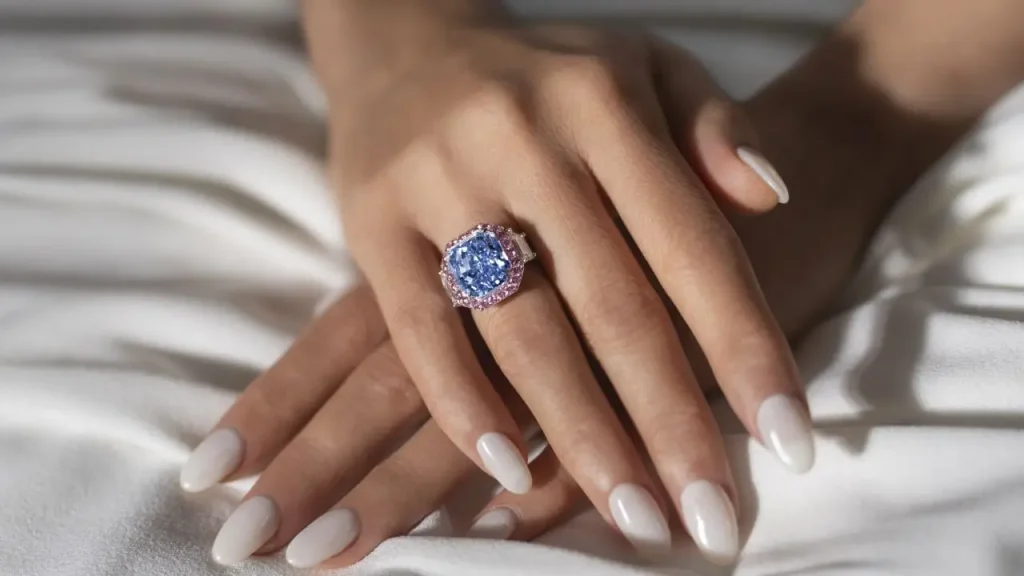
A rare 10.3-carat fancy vivid blue diamond, known as The Mediterranean Blue, has sold for an astonishing $21.5 million (17.9 million Swiss Francs) at Sotheby’s High Jewellery Auction in Geneva. This exceptional gemstone not only topped the auction but was also the headline piece of Sotheby’s week-long jewellery sales in Switzerland.
Intense Bidding War Over a Fancy Vivid Blue Diamond The auction, livestreamed globally, saw a fierce bidding battle that began at 9 million Swiss Francs. Within the first minute, the price surged to 13 million, eventually narrowing to two determined phone bidders. After two and a half minutes of competitive bidding, the final hammer price landed at 15 million Swiss Francs, with additional premiums pushing the total sale price to $21.5 million.
The winning bidder was represented by Frank Everett, Vice Chairman of Jewelry, Americas at Sotheby’s. The blue diamond had been estimated at $20 million prior to the auction.
From Cullinan Mine to Record Sale The Mediterranean Blue diamond was cut from a 31.94-carat rough blue diamond discovered in 2023 at the legendary Cullinan mine in South Africa, a source renowned for producing some of the world’s most important blue diamonds. Sotheby’s revealed that the rough stone underwent a full year of study before undergoing a meticulous six-month cutting and polishing process to achieve its final cushion modified brilliant-cut form.
Global Tour Boosted Demand Sotheby’s launched a worldwide exhibition tour of the blue diamond, beginning with its unveiling at their inaugural show in Abu Dhabi. It was then displayed across the Middle East, Asia, and the United States, generating significant interest from collectors and high-net-worth buyers. The gem was showcased alongside seven other ultra-rare diamonds and gemstones, with the total collection valued at over $100 million.
A Defining Stone of the Season Quig Bruning, Sotheby’s Head of Jewelry for the Americas & EMEA, described the diamond as a milestone for the season:
“It is undoubtedly the defining stone of the season and ranks among the top blue diamonds we have ever sold. The excitement it generated during its global tour reflects the increasing demand for rare, investment-grade diamonds and a growing flight to quality among collectors.”
A remarkable 10-carat blue diamond, dubbed the “Mediterranean Blue Diamond,” is expected to achieve up to $20 million when it goes under the hammer at Sotheby’s in Geneva on 13 May. The diamond, which boasts the highly coveted “fancy vivid blue” colour grade, represents one of the most prized and rare categories in the world of coloured diamonds.
Discovered in 2023 at South Africa’s famed Cullinan mine, the Mediterranean Blue was originally a rough diamond weighing an impressive 31.94 carats. What followed was an extraordinary journey — a full year of study, including precise analysis to maximise both beauty and value, and six months of planning and expert cutting to reveal the gem in its final cushion-shaped form.
Sotheby’s, which is overseeing the auction, describes the diamond as a standout in its class. Jessica Wyndham, head of high jewellery at Sotheby’s Geneva, remarked, “The market for coloured diamonds continues to go from strength to strength.” Indeed, blue diamonds of this size and calibre are vanishingly rare, and collectors around the world are likely to compete fiercely for the chance to own such an exceptional gem.
Fancy vivid blue is the highest grading for coloured diamonds, denoting a saturation and purity of colour that few stones ever achieve. The Mediterranean Blue, with its intense oceanic hue and exceptional clarity, is a testament to nature’s rarity and human craftsmanship.
Over the years, similar diamonds have fetched extraordinary prices. In 2016, the “Oppenheimer Blue,” a 14.62-carat fancy vivid blue diamond, sold for a staggering $68.7 million at Christie’s in Geneva, setting a world record for any fancy vivid blue diamond sold at auction. That same year, another exceptional blue stone — a 24.18-carat intense blue diamond also mined from the Cullinan site — sold for $25 million, reinforcing the global appetite for ultra-rare coloured diamonds.
The Cullinan mine, known for producing some of the world’s most famous diamonds — including parts of the Cullinan I and II, which are part of the British Crown Jewels — has once again proven its status as a source of legendary stones.
With demand for coloured diamonds surging, particularly among high-net-worth collectors and investors seeking portable, tangible assets, the upcoming sale of the Mediterranean Blue Diamond is expected to draw worldwide attention.
Its appearance at auction not only marks a rare opportunity to acquire a gem of unmatched beauty and provenance, but also reflects the continuing strength and allure of the coloured diamond market — where rarity and story combine to create lasting value.
Christie’s is preparing to showcase something truly extraordinary — The Golconda Blue, a 23.24 carat Fancy Vivid Blue diamond, set to headline the Magnificent Jewels auction in Geneva on 14 May. Held at the Four Seasons Hotel des Bergues, this remarkable stone carries an estimate of between $35 million and $50 million.
Mounted in a ring designed by the legendary JAR, The Golconda Blue is not only the largest Fancy Vivid Blue diamond ever offered at auction — it’s also one of the rarest and most historically significant diamonds in existence.
Its journey through history is as dazzling as the stone itself. Originally owned by Yeshwant Rao Holkar, the Maharaja of Indore — a prominent patron of art and fine jewellery in the 1920s and 1930s — the diamond was first set into a bracelet by Chaumet in 1923. A decade later, Mauboussin transformed it into a necklace worn by the Maharani, immortalised in a striking portrait by Bernard Boutet de Monvel.
In 1947, the diamond was acquired by none other than Harry Winston, who later sold it as a brooch to the Maharaja of Baroda. After years of being held privately, The Golconda Blue is now returning to the public eye for the first time in decades.
Rahul Kadakia, Christie’s international head of jewellery, called it “a once-in-a-lifetime opportunity,” noting the auction house’s long history with legendary Golconda diamonds such as the Archduke Joseph, the Princie, and the Wittelsbach.
The term Golconda itself refers to the legendary diamond mines of Eastern India, famous for producing some of the world’s most luminous, transparent, and pure gems. Among them are historic stones like the Koh-i-Noor, the Hope Diamond, and the Darya-i-Nur — and now, The Golconda Blue joins this rarefied list.
This sale is not just about a diamond. It’s about history, heritage, and the timeless allure of one of nature’s most breathtaking creations.
A 5.72 carat fancy intense blue diamond beat its high estimate and sold for $8.8m yesterday (10 December) at Christie’s New York.
The cushion brilliant cut VVS1 stone, set in a platinum ring with round diamonds, was the highlight of the Magnificent Jewels auction.
The price realized was $1,539,336 per carat. The pre-sale estimate was $6m to $8m.
The second highest price was for a pair of Harry Winston spinel and diamond earrings. They sold for $2,228,000—four times their high estimate of $600,000.
The sale raised a total of $49.2m, with 97 per cent of the 179 lots finding buyers.
Rahul Kadakia, Christie’s international head of jewelry, said: “Today’s sale in New York was a testament to the vibrant market for jewelry of the highest caliber with singular provenance.
“We were particularly pleased with the result of the top lot – a fantastic fancy intense blue diamond ring that sold for $8.8m.”
The Fancy Color Research Foundation gave the blue diamond a visual score of 8 out of 12 in its pre-sale analysis, noting its low color dispersion.
It said: “True Face-Up: Equivalent to that of a 9.15 carat which is ~59.9 per cent larger than the average
“Analysis: A Fancy Intense Blue Cushion brilliant-cut diamond, polished as a classic colorless diamond, probably manufactured during the 1960s or 1970s.
“The diamond’s inner-grade is very strong, and modifying its facet alignment could increase its saturation to vivid. No significant gray undertone is present in the color.”
A legal battle over the Idol’s Eye, a 70.21 carat very light blue, eye shaped Golconda diamond, began on Monday (11 November) at the High Court, London.
Two branches of Qatar’s royal family are in dispute over the value of the gem – which could be anywhere between $10m and $27m.
The disagreement is between Qipco, a private investment company run by art collector Sheikh Hamad bin Abdullah al-Thani – a cousin of Qatar’s ruler Sheikh Tamim bin Hamad Al Thani – and Elanus Holdings, a company linked to the family of former culture minister Sheikh Saud bin Mohammed Al Thani.
Elanus loaned the diamond to Qipco in 2014 for 20 years, with an option to buy but the two sides disagree over the value of the stone. It is reported to be worth at least $10m, but according to a Reuter’s report, Elanus’s diamond expert has valued it at $27m.
Qipco says Elanus offered to sell the gem in February 2020, but then pulled out. Elanus disputes this.
Qipco is asking the High Court to force Elanus to go through with the sale.
The Idol’s Eye has a long and complex history. It was recovered in 1600 in the Kollur Mine, part of the Golconda Sultanate in southern India, was initially owned by Prince Rahab of Persia, and was auctioned by Christie’s London in 1865.
It has changed hands many times and has, at various stages, been owned by Harry Winston and Laurence Graff.
A stunning platinum ring featuring a 5.02 carat blue diamond is set to headline Christie’s Hong Kong auction later this month, with an estimated value of up to US $10.3 million (HKD 80 million).
The centerpiece is an internally flawless, fancy deep blue marquise brilliant-cut diamond, graded by the Gemological Institute of America (GIA).
Dating back to 1923, the ring is listed in the auction catalog as “property of a lady,” though further details about the owner remain undisclosed.
This exquisite piece will lead the highly anticipated 124-lot Magnificent Jewels live sale on October 29, alongside a pair of diamond “Oriental Sunrise” earrings.
These earrings showcase two fancy vivid orange yellow diamonds (12.20 carats and 11.96 carats) and share the same US $10.3 million (HKD 80 million) high estimate.
A “Toi et Moi” ring featuring blue and pink diamonds – both over 5.0-cts – sold for $3.7m (ã3m) almost double its high estimate, at Bonhams London.
The ring was crafted and signed by Mouawad, the Geneva-based jeweler to royalty and high society, which was founded in 1890. It carried a pre-sale estimate of $1.3m to $1.9m (ã1m to ã1.5m).
The radiant-cut fancy intense blue diamond, weighing 5.03 carats, is obliquely-set with a radiant-cut fancy purple-pink diamond, weighing 5.13 carats. The gallery and shoulders are pave-set with brilliant-cut diamonds of pink and blue tint.
The 113-lot sale, on 13 June, made a total of ã6,590,562, with 78 per cent sold by lot and 99 per cent sold by value.
Christie’s has auctioned one of the rarest blue diamonds in the world for a staggering $44 million.
On Tuesday, the stone called the “Bleu Royal” went under the hammer as one of the highlights of the auction house’s Luxury Week sale in Geneva, far outstripping the presale estimate. It is the first time the stone has been sold at auction, having been in private hands for the past half century.
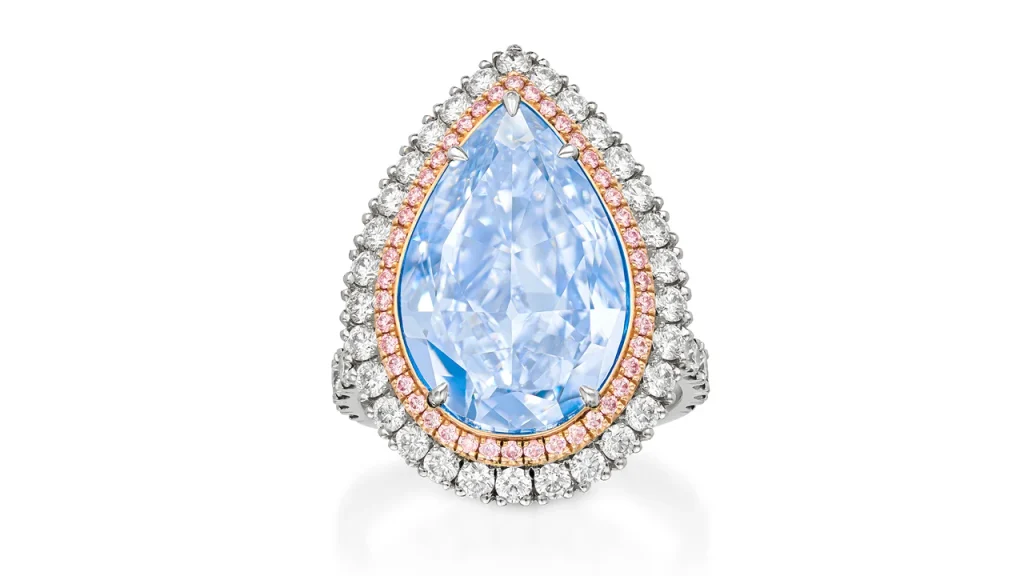
Set into a ring, the 17.61 carat, pear shaped diamond is considered the largest internally flawless vivid blue diamond to have ever come to auction, and had a presale estimate of $35 million. At the sale, it eventually realised $43.8 million, making it the most expensive jewel sold at auction this year.
A rare 11.16 carats fancy vivid blue diamond could fetch between 22 to 25 million Swiss francs ($24 to $28 million) when it goes under Sotheby’s hammer next week in Geneva.
Named the Bulgari Laguna Blu, the pear-shape cut diamond boasts a rich blue hue that the auction house qualifies as “extraordinary” and “mesmerizing”.
It is the highest grade blue diamond ever graded by the Gemological Institute of America (GIA) and the third-largest pear-shaped fancy vivid blue diamond to ever go for sale on an auction, according to Olivier Wagner, head of jewellery at Sotheby’s Geneva.
The gem, first exhibited at the famous Met Gala fashion show in New York on Monday, is expected to attract the interest from global collectors.
A 3.01-carat, fancy-vivid-blue diamond ring, carrying a high estimate of $6.3 million was among a number of headline items that failed to find buyers at Sotheby’s Geneva auction.
Sotheby’s withdrew the stone from Tuesday’s Magnificent Jewels and Noble Jewels Part II at the request of the consigner, it told Rapaport News Wednesday. The sale, which achieved a total of $12.4 million, was the auction house’s first live event since the onset of the coronavirus pandemic, and followed Part I, which took place online.
An oval-shaped, 21.56-carat, D-color, VVS1-clarity diamond ring by Lorraine Schwartz, valued at $1.5 million to $2 million, also went unsold. Other colored diamonds were not purchased, including a duet ring set with a pear-shaped, 3.03-carat, fancy-intense-blue diamond and a pear-shaped, 2.82-carat, D-color, VVS1-clarity diamond, as well as a step-cut, fancy-vivid-yellow diamond ring weighing 16.43 carats.
Meanwhile, the top-selling lot at the sale was a marquise-shaped, 7-carat, fancy-intense-pink diamond ring, which was auctioned for the first time after spending 30 years in a private collection. The piece sold for $2.8 million, within its $2.4 million to $3.4 million estimate.
Other notable items included a pear-shaped, 5.29-carat, fancy-grey-blue diamond ring, which garnered $2.1 million, beating its $1.2 million high estimate. A pair of cushion-shaped, D-color, VVS2-clarity diamond earrings, weighing 13.50 carats and 13.52 carats, fetched $1.5 million against an estimate of $1.2 million to $1.8 million.
Sapphires also proved popular, with a cushion-shaped, 105.89-carat ring going for $1.7 million, more than double its $670,000 high estimate. A cushion-shaped, 16.11-carat sapphire ring bracketed by diamonds also sailed past its $490,000 upper valuation, achieving $524,000.
A 3.01-carat, fancy-vivid-blue diamond ring, carrying a high estimate of $6.3 million was among a number of headline items that failed to find buyers at Sotheby’s Geneva auction.
Sotheby’s withdrew the stone from Tuesday’s Magnificent Jewels and Noble Jewels Part II at the request of the consigner, it told Rapaport News Wednesday. The sale, which achieved a total of $12.4 million, was the auction house’s first live event since the onset of the coronavirus pandemic, and followed Part I, which took place online.
An oval-shaped, 21.56-carat, D-color, VVS1-clarity diamond ring by Lorraine Schwartz, valued at $1.5 million to $2 million, also went unsold. Other colored diamonds were not purchased, including a duet ring set with a pear-shaped, 3.03-carat, fancy-intense-blue diamond and a pear-shaped, 2.82-carat, D-color, VVS1-clarity diamond, as well as a step-cut, fancy-vivid-yellow diamond ring weighing 16.43 carats.
Meanwhile, the top-selling lot at the sale was a marquise-shaped, 7-carat, fancy-intense-pink diamond ring, which was auctioned for the first time after spending 30 years in a private collection. The piece sold for $2.8 million, within its $2.4 million to $3.4 million estimate.
Other notable items included a pear-shaped, 5.29-carat, fancy-grey-blue diamond ring, which garnered $2.1 million, beating its $1.2 million high estimate. A pair of cushion-shaped, D-color, VVS2-clarity diamond earrings, weighing 13.50 carats and 13.52 carats, fetched $1.5 million against an estimate of $1.2 million to $1.8 million.
Sapphires also proved popular, with a cushion-shaped, 105.89-carat ring going for $1.7 million, more than double its $670,000 high estimate. A cushion-shaped, 16.11-carat sapphire ring bracketed by diamonds also sailed past its $490,000 upper valuation, achieving $524,000.
Fancy blue diamonds out performed other major color categories in price terms during the first quarter, the Fancy Color Research Foundation said.
Prices for fancy blues jumped 5% year on year for the three months ending March 31, according to the FCRF, which released its quarterly Fancy Color Diamond Index on Monday.
By contrast, prices of fancy pink diamonds declined 1.7%, while the index for yellows slipped 0.6%, the organization said. The overall index for fancy color diamonds edged up 0.1%.
Vivid blues and vivid pinks weighing 2 carats showed the best performance in their respective color categories during the quarter.
The Fancy Color Diamond Index tracks prices of fancy yellow, pink and blue diamonds in Hong Kong, New York and Tel Aviv.
Fancy blue diamonds out performed other major color categories in
price terms during the first quarter, the Fancy Color Research
Foundation said.
Prices for fancy blues jumped 5% year on year for the three months
ending March 31, according to the FCRF, which released its quarterly
Fancy Color Diamond Index on Monday.
By contrast, prices of fancy pink diamonds declined 1.7%, while the
index for yellows slipped 0.6%, the organization said. The overall index
for fancy color diamonds edged up 0.1%.
Vivid blues and vivid pinks weighing 2 carats showed the best
performance in their respective color categories during the quarter.
The Fancy Color Diamond Index tracks prices of fancy yellow, pink and blue diamonds in Hong Kong, New York and Tel Aviv.
Fancy colour diamonds will lead Magnificent Jewels sale on Wednesday.
Topping the sale is a Fancy Vivid Blue Diamond ring designed by Graff Jewellers. Estimated price is $6.5 million – $8.5 million USD.
The two Vivid blue Diamonds weighing approximately 3.36 and 2.71 carats with VVS2 and VS1 clarity grades are set in a crossover design, In a platinum setting.
Fancy colour diamonds will lead Magnificent Jewels sale on Wednesday.
Topping the sale is a Fancy Vivid Blue Diamond ring designed by
Graff Jewellers. Estimated price is $6.5 million – $8.5 million USD.
The two Vivid blue Diamonds weighing approximately 3.36 and 2.71
carats with VVS2 and VS1 clarity grades are set in a crossover design,
In a platinum setting.