Showing posts with label Golconda diamond. Show all posts

Tuesday, 21 October 2025

The Louvre heist brings Golconda diamonds in the spotlight

Louvre diamonds heist

On Sunday, October 19, 2025, the world’s most famous museum became the scene of a real-life thriller. Paris’ The Louvre’s Apollo Gallery, home to priceless crown jewels and some of the most extraordinary diamonds ever mined, was brazenly targeted by masked thieves. Using a mechanical ladder and cutting through reinforced glass panes, the robbers reached the gallery around 9:30 a.m. local time and disappeared in 7 minutes with their haul.

What makes this heist especially fascinating is the connection to Andhra Pradesh’s Golconda mines, historically the source of some of the world’s most coveted diamonds. Several of these legendary stones, including the Regent, Hortensia, and Sancy, are housed in the Apollo Gallery of the Louvre.

Golconda diamonds on display at the Louvre
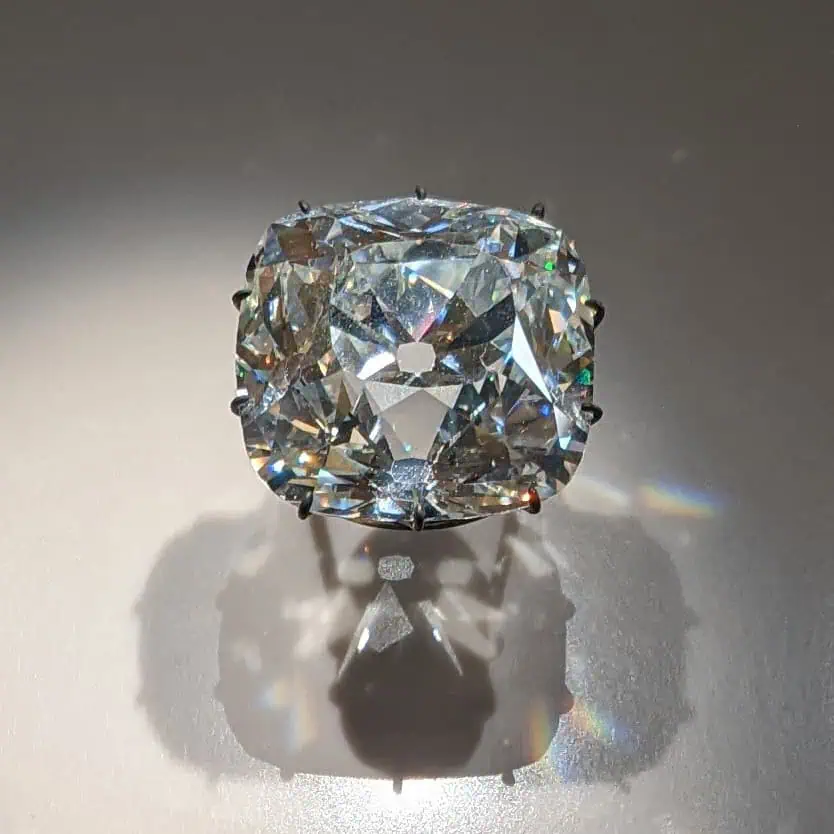
The most famous of the Golconda gems in the Apollo Gallery is the Regent Diamond, weighing 140 carats. This legendary stone was once embedded in Napoleon’s coronation sword and has a dramatic history. It was smuggled out of India by an enslaved man, who hid the diamond in his leg to secure his escape, only to be fatally attacked by the merchant who purchased it. Despite its storied past and supposed curse, officials have confirmed that the Regent was not stolen during the recent heist, according to the BBC.
The Louvre heist brings Golconda diamonds in the spotlight

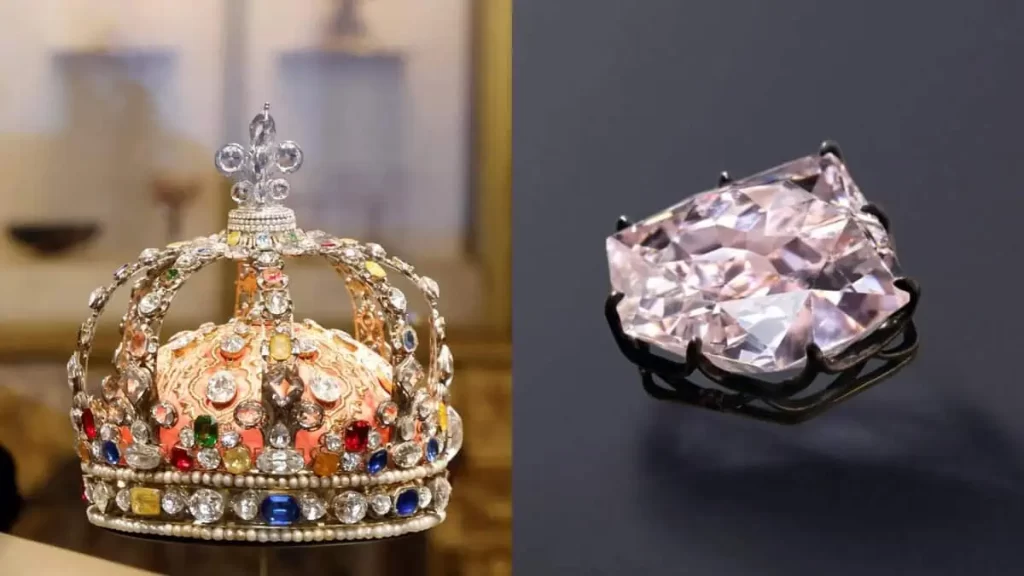
Another historic gem, the Hortensia Diamond, is a 20-carat pink diamond renowned for its rare hue. Its status following the robbery remains uncertain, adding a layer of intrigue to the heist.

Beyond these, several other diamonds in the Apollo Gallery, including those set in tiaras and necklaces, are believed to have been mined in Golconda, India. During the 18th and 19th centuries, India was the world’s largest supplier of natural diamonds, and these stones reflect the country’s historic significance in the global luxury and jewellery world.

Indian internet calls for reclamation
The Louvre heist has reignited conversations about repatriation, which means the idea of returning cultural treasures to their countries of origin. India, with its centuries-old legacy of diamond mining and craftsmanship, has seen many of its prized Golconda gems travel to European royal collections.

Since news of the robbery broke, netizens on X and Instagram have been vocal about India reclaiming its historic treasures. Posts and threads highlight the legendary journey of diamonds like the Regent, Hortensia, and more from the mines of Golconda to European royal courts. Many users argue that these jewels are not just luxury items but symbols of India’s rich heritage that belong at home. Others have called the heist a reminder of why cultural artefacts should be protected, and, if possible, returned to their country of origin.

Source: DCLA

Tuesday, 7 October 2025

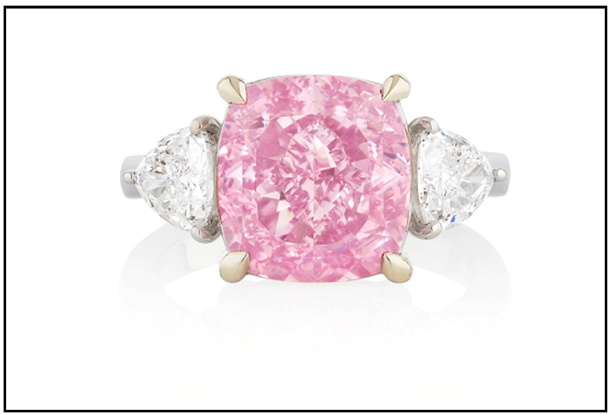
6.95-Carat Pink Diamond to Headline Vanderbilt Family Jewels Auction in Geneva

fancy vivid purplish pink diamond

A spectacular 6.95-carat fancy vivid purplish pink Golconda diamond will lead The Geneva Jewels Auction: V, as Phillips Geneva prepares to offer an extraordinary collection of jewels once owned by the legendary Vanderbilt family, once America’s richest dynasty.

Among the highlights is a Tiffany & Co. 42.68-carat sugarloaf Kashmir sapphire and diamond brooch, estimated at US$1 million to US$1.5 million, alongside a step-cut Kashmir sapphire and diamond ring weighing 18.09 carats (estimate US$2.2 million to US$2.8 million). The sale also features a stunning pair of brilliant-cut diamond ear studs, weighing 8.00 and 8.28 carats, both graded D colour, VVS1 clarity, with an estimate of US$600,000 to US$850,000.

The Vanderbilt name is synonymous with immense wealth and American industrial power. The family’s fortune began with Cornelius Vanderbilt, who, at age 16, borrowed $100 from his mother to start a ferry service in 1810. He later built a shipping and railroad empire that made him the richest man in the United States, worth about $100 million at his death in 1877 — equivalent to at least $185 billion today.

His son, William Henry Vanderbilt, further doubled that fortune to over $200 million (around $370 billion in today’s terms). However, the family’s wealth gradually dispersed over subsequent generations, with the combined net worth of the Vanderbilt descendants now estimated at around $200 million.

The Geneva Jewels Auction: V, featuring The Vanderbilt Family Jewels, will take place on 10 November at Phillips Geneva, marking a rare opportunity for collectors to acquire pieces linked to one of America’s most storied families.

Source: DCLA

Wednesday, 13 November 2024

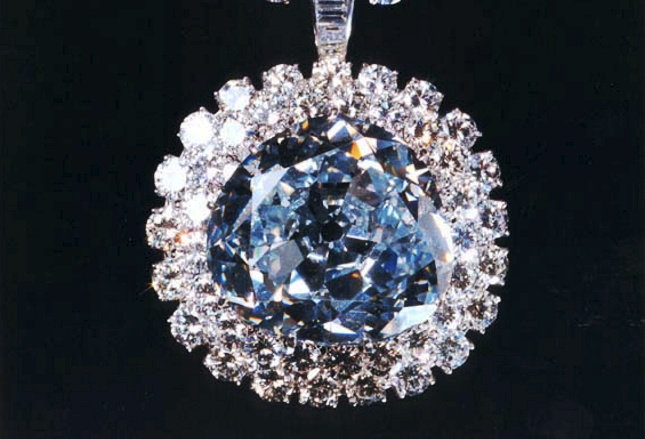
Qatari Royal Family in Court over Idol’s Eye Diamond

A legal battle over the Idol's Eye, a 70.21-carat very light blue, eye-shaped Golconda diamond, began on Monday (11 November) at the High Court, London.

A legal battle over the Idol’s Eye, a 70.21 carat very light blue, eye shaped Golconda diamond, began on Monday (11 November) at the High Court, London.

Two branches of Qatar’s royal family are in dispute over the value of the gem – which could be anywhere between $10m and $27m.

The disagreement is between Qipco, a private investment company run by art collector Sheikh Hamad bin Abdullah al-Thani – a cousin of Qatar’s ruler Sheikh Tamim bin Hamad Al Thani – and Elanus Holdings, a company linked to the family of former culture minister Sheikh Saud bin Mohammed Al Thani.

Elanus loaned the diamond to Qipco in 2014 for 20 years, with an option to buy but the two sides disagree over the value of the stone. It is reported to be worth at least $10m, but according to a Reuter’s report, Elanus’s diamond expert has valued it at $27m.

Qipco says Elanus offered to sell the gem in February 2020, but then pulled out. Elanus disputes this.

Qipco is asking the High Court to force Elanus to go through with the sale.

The Idol’s Eye has a long and complex history. It was recovered in 1600 in the Kollur Mine, part of the Golconda Sultanate in southern India, was initially owned by Prince Rahab of Persia, and was auctioned by Christie’s London in 1865.

It has changed hands many times and has, at various stages, been owned by Harry Winston and Laurence Graff.

Source: DCLA

How Efforts to Control the Diamond Trade Are Hurting the Very Communities They Were Supposed to Protect

For more than two decades, global policies aimed at restricting the flow of diamonds from conflict zones most notably through the “blood dia...