Showing posts with label fancy-vivid-blue. Show all posts

Wednesday, 28 January 2026

For the World’s Most Exceptional Diamonds, Price Lists Simply Don’t Apply

 World’s Most Exceptional Diamonds

A new Natural Diamond Council report reveals why record-breaking diamonds operate in a market beyond conventional valuation models

At the very top end of the diamond market, traditional pricing frameworks cease to function. Per-carat benchmarks, standard price lists, and even established scarcity models lose relevance when value is driven not by comparables, but by the willingness of elite buyers to secure assets of extreme rarity.

This rarefied segment is the focus of Record-Breaking Diamonds, a new report by the Natural Diamond Council (NDC), which examines the largest, most valuable natural diamonds ever discovered, cut, and sold. Drawing on mining data, gemmological research, and global auction results, the report offers a detailed analysis of how extraordinary rarity reshapes value within the natural diamond supply chain.

World’s Most Exceptional Diamonds

A Century Without a Challenger

One of the report’s most striking observations is the prolonged absence of truly massive diamonds following the 1905 discovery of the Cullinan in South Africa. Weighing an unprecedented 3,106.75 carats, the Cullinan established a benchmark that would stand unchallenged for more than 110 years. Until 2015, no gem-quality diamond exceeding 1,000 carats was recovered anywhere in the world.

That changed with the discovery of the 1,109-carat Lesedi La Rona at Botswana’s Karowe mine. Its recovery marked a turning point. Since then, at least nine rough diamonds weighing over 1,000 carats have been unearthed, including two exceptional finds exceeding 2,000 carats: the 2,488-carat Motswedi in 2024 and a 2,036-carat near-gem-quality rough diamond recovered in July 2025. Both originated from Karowe, with Motswedi now ranking as the second-largest gem-quality rough diamond ever discovered.

Technology, Not Abundance

The increased frequency of such discoveries does not signal a sudden abundance of large diamonds. Rather, it reflects a fundamental shift in extraction technology. The widespread adoption of X-ray Transmission (XRT) technology has transformed diamond recovery by identifying stones based on density before ore enters the crushing circuit. This significantly reduces the risk of fracturing large diamonds during processing.

Lucara Diamond Corp.’s Karowe mine — which installed XRT technology in 2015 and introduced a Mega Diamond Recovery (MDR) system two years later — accounts for the majority of exceptional stones recovered in the past decade. Other operations employing similar systems, including the Cullinan mine and Lesotho’s LetÅ¡eng deposit, have also reported a measurable increase in large, high-value diamonds.

Even so, diamonds weighing more than 1,000 carats remain extreme statistical outliers, even with the most advanced recovery methods.

World’s Most Exceptional Diamonds

The Superdeep Advantage

Size alone does not define value at this level. Many of the diamonds highlighted in the NDC report belong to the rare Type IIa category, meaning they contain no measurable nitrogen impurities. These chemically pure stones represent only a tiny fraction of global diamond production.

Some Type IIa diamonds form at extraordinary depths — between 360 and 750 kilometres beneath the Earth’s surface, according to the Gemological Institute of America (GIA). These “superdeep” diamonds belong to the CLIPPIR population (Cullinan-like, Large, Inclusion-poor, Pure, Prismatic, Irregular, Resorbed). Formed under extreme pressures in nitrogen-poor environments, they grow slowly and uninterrupted, resulting in unusually large, highly transparent crystals with minimal internal defects.

When Per-Carat Logic Breaks Down

In this ultra-exclusive segment, pricing behaves differently. Per-carat values no longer scale predictably with size. A defining example is Lucara’s 2016 sale of the 812.77-carat Constellation diamond, which achieved US$63.1 million — the highest price ever paid for a rough diamond. Its per-carat value far exceeded any precedent for an uncut stone, reflecting buyer confidence in its exceptional quality and cutting potential.

Colour, Rarity, and Market Psychology

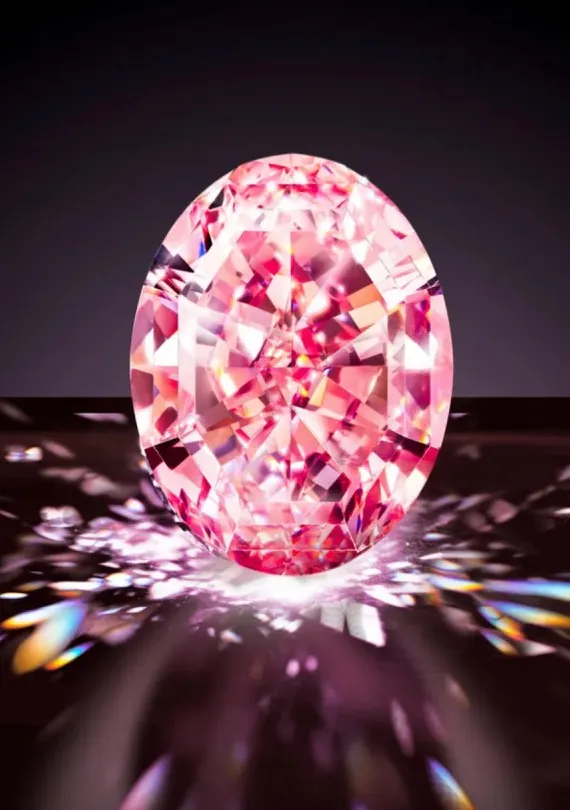
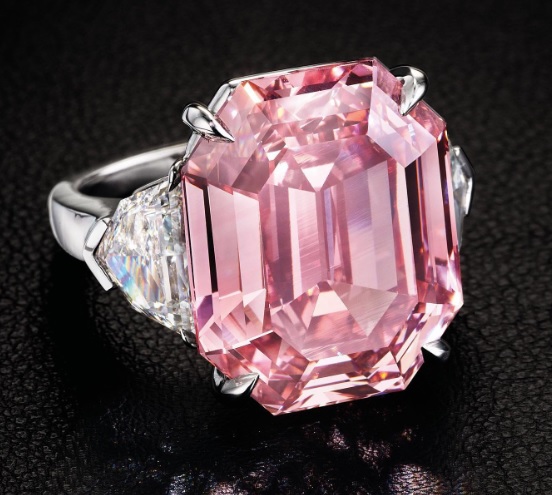
In the polished market, the 59.60-carat CTF Pink Star remains the most expensive diamond ever sold at auction, achieving HKD 553 million (US$71.2 million) at Sotheby’s Hong Kong in 2017. While the headline price set the record, later sales demonstrated that per-carat value is often the more telling indicator of demand.

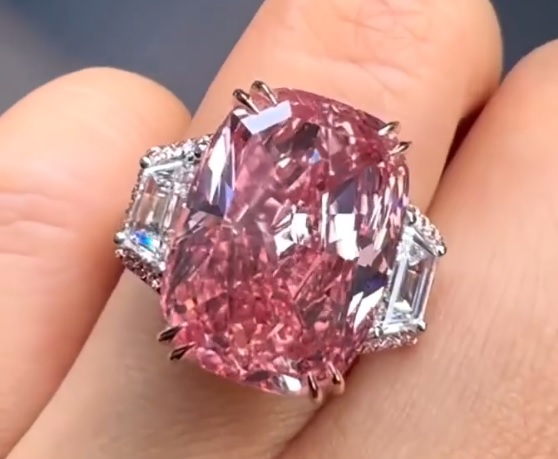
In 2022, the 11.15-carat Williamson Pink Star sold for HKD 453.2 million (US$57.7 million), equating to more than US$5 million per carat — the highest per-carat price ever achieved by a diamond.

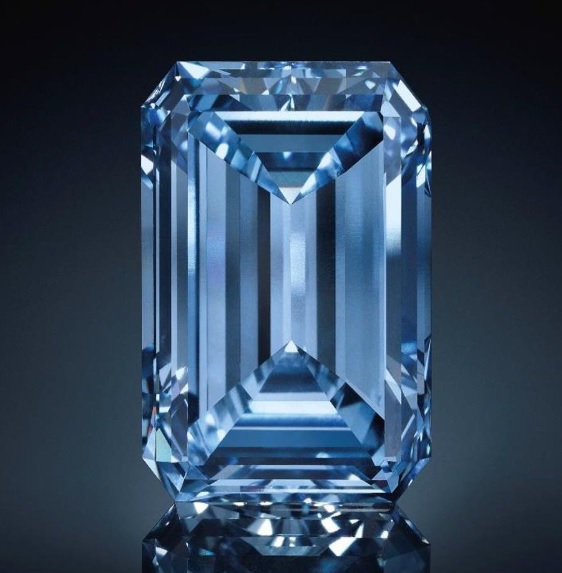
A similar phenomenon is evident in the blue-diamond category. Despite selling six years apart, the 14.62-carat Oppenheimer Blue (Christie’s Geneva, 2016) and the 15.10-carat De Beers Blue (Sotheby’s Hong Kong, 2022) each realised US$57.5 million, underscoring how rarity and desirability can outweigh minor differences in size or clarity.

Yellow diamonds, by contrast, trade at a substantial discount to pinks and blues, even in exceptional sizes. While the leading pink and blue diamonds regularly exceed US$1 million per carat, none of the top five yellow diamonds have reached that level. The highest-ranked example, the 100.09-carat Graff Vivid Yellow, sold for US$16.8 million in 2014 — approximately US$168,000 per carat.

Diamonds Beyond the Market

Not all record-breaking diamonds remain commercial assets. Some are removed from circulation entirely and repositioned as cultural or institutional icons. The 45.52-carat Hope Diamond, donated by Harry Winston to the Smithsonian Institution in 1958, has been viewed by more than 100 million visitors, making it one of the most publicly encountered diamonds in history.

Similarly, the 140.64-carat Regent Diamond at the Louvre serves not as a tradable asset, but as a benchmark of scale, rarity, and historical significance. Such exhibition stones continue to influence market perception, anchoring contemporary record prices within a much longer narrative of natural-diamond rarity.

As the NDC report makes clear, when diamonds reach this echelon, value is no longer governed by price lists or formulas. Instead, it is shaped by geology, technology, history, and the enduring human desire to possess the truly irreplaceable.

Source: DCLA

Sunday, 18 January 2026

The Farnese Blue Diamond: Three Centuries Through Europe’s Royal Courts

 The Farnese Blue Diamond

The Farnese Blue occupies a rare position among historic natural diamonds. It is not merely a gemstone with provenance, but a silent participant in more than three centuries of European political power, dynastic ambition, revolution, and exile. For most of its existence, it remained known only to a small circle of royal descendants, absent from public record and scholarly examination.

That secrecy ended in 2018 when the 6.16-carat pear-shaped natural Fancy Dark Gray-Blue diamond appeared unexpectedly at Sotheby’s Geneva. Its emergence stunned historians and gem specialists alike. Offered publicly for the first time in its recorded history, the Farnese Blue achieved USD $6.7 million—well above estimate—before being acquired by an anonymous buyer. With that sale, one of Europe’s most historically significant diamonds passed from royal custody into the modern market.


A Golconda Diamond of Exceptional Origin

The Farnese Blue originated in the legendary Golconda mines of India, the world’s most important diamond source for over a millennium. Long before Brazil or South Africa entered the diamond trade, Golconda supplied every known diamond in existence. The Hope Diamond, the Koh-i-Noor, the Regent, and the Wittelsbach-Graff all share this same geographic origin near present-day Hyderabad.

Golconda diamonds travelled ancient trade routes linking Asia and Europe, where merchants competed for stones prized for their exceptional clarity, colour, and crystalline structure. Their rarity and value ensured they were acquired almost exclusively by royalty and the most powerful figures of their time. The Farnese Blue belongs firmly within this elite lineage.


A Queen Without a Dowry: Entry Into Spanish Royal History

Elisabeth Farnese, Queen consort of Spain. In 1715, King Philip V of Spain

The Farnese Blue first entered recorded European history through Elisabeth Farnese, Queen consort of Spain. In 1715, King Philip V of Spain grandson of Louis XIV required a new queen. The political climate demanded a bride of royal blood, but without excessive dynastic influence.

Elisabeth, a princess of the Duchy of Parma and a descendant of Pope Paul III, met these requirements precisely. However, Spain’s finances had been devastated by the War of the Spanish Succession, and her father was unable to provide a traditional royal dowry.

To compensate, Spain turned to its global colonies. In August 1715, the so-called “Golden Fleet” departed Cuba carrying gold bullion and precious gemstones gathered for the royal wedding. A hurricane in the Gulf of Florida destroyed nearly the entire fleet, consigning its riches to the sea.

One extraordinary diamond survived.

The governor of the Philippine Islands presented a pear-shaped blue diamond to the new queen. That stone would become known as the Farnese Blue.


Three Centuries in Royal Exile

From that moment onward, the Farnese Blue passed quietly through Europe’s most powerful royal houses. Elisabeth Farnese bore seven children and worked tirelessly to secure dynastic influence across the continent. The diamond was likely entrusted to her son Philip, founder of the House of Bourbon-Parma.

It subsequently passed through successive generations: to Ferdinand, to King Louis of Etruria, and then to Charles Louis (King Louis II), who mounted the diamond as a tie pin. Political upheaval forced him into exile under the title Comte de Villafranca, yet he retained the diamond throughout his life.

Upon his death in 1883, the Farnese Blue passed to his grandson Robert, the last ruling Duke of Parma. After losing his throne, Robert sought refuge with his cousin, Emperor Franz Joseph of Austria, taking the diamond with him.

The stone later passed to Prince Elia and his wife, Archduchess Maria Anna of Austria. Her meticulous jewellery inventories proved invaluable to history, preserving the diamond’s provenance with remarkable clarity. Among her collection was a tiara containing diamonds once owned by Marie Antoinette. She incorporated the Farnese Blue still set as a tie pin into that tiara and wore it frequently.


Reemergence at Sotheby’s: From Royal Secrecy to Public Record

Following the collapse of the Austrian Empire in 1918, the Farnese Blue disappeared once again from public view. For decades, it remained absent from scholarship and gemological examination.

Its reappearance in 2018 marked a pivotal moment. Now mounted within a colourless diamond halo on a detachable pin, the Farnese Blue was examined and graded by the Gemological Institute of America for the first time. It received an official classification as a natural Fancy Dark Gray-Blue diamond with SI1 clarity.

That same year, Sotheby’s offered the stone at auction for the first time in its three-hundred-year history. The result confirmed what experts already understood: a natural diamond of exceptional rarity, when paired with uninterrupted, well-documented royal provenance, transcends its material value.

The Farnese Blue stands today as one of the most extraordinary surviving diamonds of European royal history an enduring witness to the rise and fall of empires, preserved through centuries by those who understood its significance long before the modern world was permitted to see it.

Tuesday, 11 November 2025

Rare ‘Mellon Blue’ Diamond Fetches $25.5 Million at Christie’s Geneva – Market Reflects Shifting Demand for Coloured Diamonds

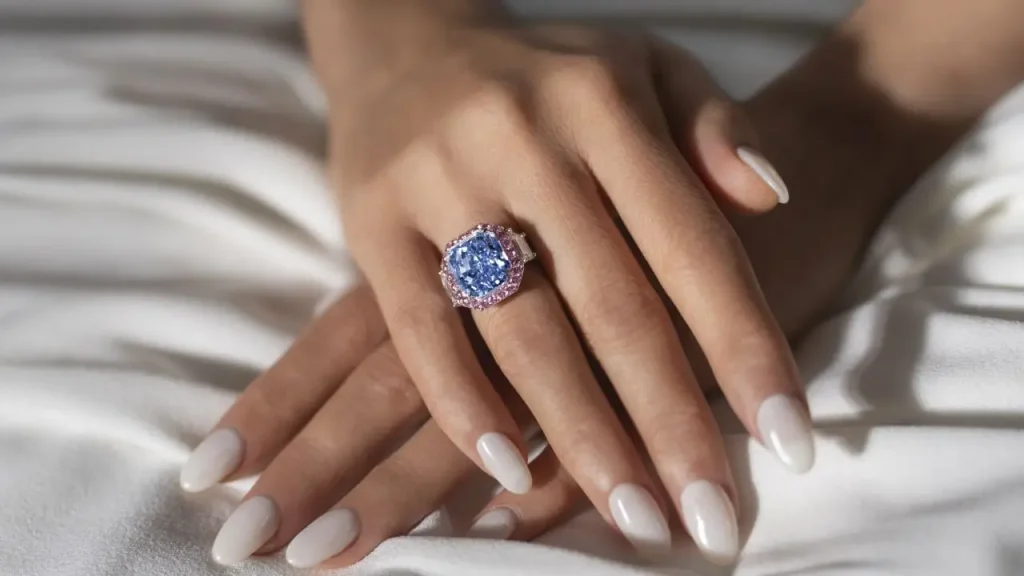
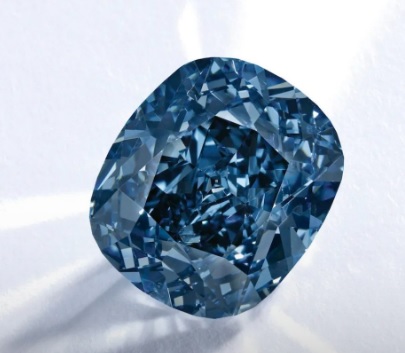
The legendary Mellon Blue Diamond a 9.51-carat fancy vivid blue, internally flawless gem

The legendary Mellon Blue Diamond a 9.51-carat fancy vivid blue, internally flawless gem sold for $25.5 million USD at Christie’s Magnificent Jewels auction in Geneva this week. The sale, held at the Four Seasons Hotel des Bergues, drew global attention from elite collectors and gem enthusiasts alike.

The Mellon Blue once belonged to renowned art collector Rachel Lambert “Bunny” Mellon, whose refined taste and cultural influence continue to shape the world of art and jewellery. Despite its exquisite pedigree, the price achieved represents a 22 percent decrease from its previous sale 11 years ago and a nearly 60 percent drop in real value when adjusted for inflation.

Originally auctioned at Sotheby’s in 2014 as part of Mellon’s estate collection, the diamond fetched $32.6 million USD, setting a world record for a blue diamond at that time. Adjusted for inflation, that sum equates to approximately $44.7 million in 2025.

Christie’s had estimated the gem between $20 million and $30 million, and the final sale once again highlighted the continuing prestige of exceptional coloured diamonds despite softer market conditions.

Rahul Kadakia, Christie’s Chairman of Global Luxury and President of Asia Pacific, remarked:

“It was a true honour to offer for sale the exquisite Mellon Blue Diamond here at Christie’s Geneva. It was another notable moment for Christie’s Luxury, evidencing the elite appetite amongst collectors for extraordinary and storied gems.”

The winning bidder, identified only as a collector from Hong Kong, continued the stone’s legacy of global fascination.

While the Mellon Blue once held the world record for a blue diamond, that benchmark has since been overtaken by two other remarkable stones:

  • The 14.62-carat Oppenheimer Blue, sold at Christie’s in 2016 for $57.5 million USD
  • The 15.10-carat De Beers Cullinan Blue, sold by Sotheby’s in 2022, also for $57.5 million USD

These historic sales underline the rarity and enduring appeal of fancy vivid blue diamonds, which represent less than 0.1 percent of all diamonds, and of those, fewer than 1 percent qualify as fancy vivid.

Bunny Mellon, who passed away in 2014 at age 103, was celebrated not only for her wealth being heiress to the Listerine and Mellon fortunes but also for her artistry and impeccable taste. She famously designed the White House Rose Garden and curated an impressive art collection that included two Rothko masterpieces, which together realised $76 million USD at auction.

When Christie’s announced the diamond’s return to auction earlier this year, Kadakia described the sale as a tribute to Mellon’s lasting influence, saying her legacy “elevates the Mellon Blue’s allure by tying it to her sophisticated aesthetic and cultural prominence.”

The auction itself was as heated as the competition literally with the auctioneer requesting the windows be opened mid-sale to cool the room as bidding intensified.


About DCLA: The Diamond Certification Laboratory of Australia (DCLA) is the official CIBJO-recognised diamond laboratory in Australia, specialising in independent diamond grading and certification. DCLA ensures the highest international standards of accuracy, integrity, and transparency in diamond evaluation.

Monday, 14 April 2025

The Golconda Blue: The Largest Fancy Vivid Blue Diamond Ever Seen at Auction

Christie’s is preparing to showcase something truly extraordinary

Christie’s is preparing to showcase something truly extraordinary — The Golconda Blue, a 23.24 carat Fancy Vivid Blue diamond, set to headline the Magnificent Jewels auction in Geneva on 14 May. Held at the Four Seasons Hotel des Bergues, this remarkable stone carries an estimate of between $35 million and $50 million.

Mounted in a ring designed by the legendary JAR, The Golconda Blue is not only the largest Fancy Vivid Blue diamond ever offered at auction — it’s also one of the rarest and most historically significant diamonds in existence.

Its journey through history is as dazzling as the stone itself. Originally owned by Yeshwant Rao Holkar, the Maharaja of Indore — a prominent patron of art and fine jewellery in the 1920s and 1930s — the diamond was first set into a bracelet by Chaumet in 1923. A decade later, Mauboussin transformed it into a necklace worn by the Maharani, immortalised in a striking portrait by Bernard Boutet de Monvel.

In 1947, the diamond was acquired by none other than Harry Winston, who later sold it as a brooch to the Maharaja of Baroda. After years of being held privately, The Golconda Blue is now returning to the public eye for the first time in decades.

Rahul Kadakia, Christie’s international head of jewellery, called it “a once-in-a-lifetime opportunity,” noting the auction house’s long history with legendary Golconda diamonds such as the Archduke Joseph, the Princie, and the Wittelsbach.

The term Golconda itself refers to the legendary diamond mines of Eastern India, famous for producing some of the world’s most luminous, transparent, and pure gems. Among them are historic stones like the Koh-i-Noor, the Hope Diamond, and the Darya-i-Nur — and now, The Golconda Blue joins this rarefied list.

This sale is not just about a diamond. It’s about history, heritage, and the timeless allure of one of nature’s most breathtaking creations.

Source: DCLA

Wednesday, 11 December 2024

5.72-ct Blue Diamond Sells for $8.8m

5.72 carat fancy intense blue diamond

A 5.72 carat fancy intense blue diamond beat its high estimate and sold for $8.8m yesterday (10 December) at Christie’s New York.

The cushion brilliant cut VVS1 stone, set in a platinum ring with round diamonds, was the highlight of the Magnificent Jewels auction.

The price realized was $1,539,336 per carat. The pre-sale estimate was $6m to $8m.

The second highest price was for a pair of Harry Winston spinel and diamond earrings. They sold for $2,228,000—four times their high estimate of $600,000.

The sale raised a total of $49.2m, with 97 per cent of the 179 lots finding buyers. 

Rahul Kadakia, Christie’s international head of jewelry, said: “Today’s sale in New York was a testament to the vibrant market for jewelry of the highest caliber with singular provenance.

“We were particularly pleased with the result of the top lot – a fantastic fancy intense blue diamond ring that sold for $8.8m.”

The Fancy Color Research Foundation gave the blue diamond a visual score of 8 out of 12 in its pre-sale analysis, noting its low color dispersion.

It said: “True Face-Up: Equivalent to that of a 9.15 carat which is ~59.9 per cent larger than the average

“Analysis: A Fancy Intense Blue Cushion brilliant-cut diamond,  polished as a classic colorless diamond, probably manufactured during the 1960s or 1970s. 

“The diamond’s inner-grade is very strong, and modifying its facet alignment could increase its saturation to vivid. No significant gray undertone is present in the color.”

Source: DCLA

Wednesday, 13 November 2024

Qatari Royal Family in Court over Idol’s Eye Diamond

A legal battle over the Idol's Eye, a 70.21-carat very light blue, eye-shaped Golconda diamond, began on Monday (11 November) at the High Court, London.

A legal battle over the Idol’s Eye, a 70.21 carat very light blue, eye shaped Golconda diamond, began on Monday (11 November) at the High Court, London.

Two branches of Qatar’s royal family are in dispute over the value of the gem – which could be anywhere between $10m and $27m.

The disagreement is between Qipco, a private investment company run by art collector Sheikh Hamad bin Abdullah al-Thani – a cousin of Qatar’s ruler Sheikh Tamim bin Hamad Al Thani – and Elanus Holdings, a company linked to the family of former culture minister Sheikh Saud bin Mohammed Al Thani.

Elanus loaned the diamond to Qipco in 2014 for 20 years, with an option to buy but the two sides disagree over the value of the stone. It is reported to be worth at least $10m, but according to a Reuter’s report, Elanus’s diamond expert has valued it at $27m.

Qipco says Elanus offered to sell the gem in February 2020, but then pulled out. Elanus disputes this.

Qipco is asking the High Court to force Elanus to go through with the sale.

The Idol’s Eye has a long and complex history. It was recovered in 1600 in the Kollur Mine, part of the Golconda Sultanate in southern India, was initially owned by Prince Rahab of Persia, and was auctioned by Christie’s London in 1865.

It has changed hands many times and has, at various stages, been owned by Harry Winston and Laurence Graff.

Source: DCLA

Thursday, 10 October 2024

5 carat Blue Diamond with $10m US Estimate

5 carat Blue Diamond with $10m US Estimate

A stunning platinum ring featuring a 5.02 carat blue diamond is set to headline Christie’s Hong Kong auction later this month, with an estimated value of up to US $10.3 million (HKD 80 million).

The centerpiece is an internally flawless, fancy deep blue marquise brilliant-cut diamond, graded by the Gemological Institute of America (GIA).

Dating back to 1923, the ring is listed in the auction catalog as “property of a lady,” though further details about the owner remain undisclosed.

This exquisite piece will lead the highly anticipated 124-lot Magnificent Jewels live sale on October 29, alongside a pair of diamond “Oriental Sunrise” earrings.

These earrings showcase two fancy vivid orange yellow diamonds (12.20 carats and 11.96 carats) and share the same US $10.3 million (HKD 80 million) high estimate.

Source: DCLA

Monday, 17 June 2024

Blue and Pink Diamond Ring Fetches $3.7m

Blue and Pink Diamond Ring

A “Toi et Moi” ring featuring blue and pink diamonds – both over 5.0-cts – sold for $3.7m (£3m) almost double its high estimate, at Bonhams London.

The ring was crafted and signed by Mouawad, the Geneva-based jeweler to royalty and high society, which was founded in 1890. It carried a pre-sale estimate of $1.3m to $1.9m (£1m to £1.5m).

The radiant-cut fancy intense blue diamond, weighing 5.03 carats, is obliquely-set with a radiant-cut fancy purple-pink diamond, weighing 5.13 carats. The gallery and shoulders are pave-set with brilliant-cut diamonds of pink and blue tint.

The 113-lot sale, on 13 June, made a total of £6,590,562, with 78 per cent sold by lot and 99 per cent sold by value.

Source: DCLA

Sunday, 3 December 2023

Christie's sells rare blue diamond for over $40m USD


The 17.61 carat, pear-shaped Bleu Royal diamond, set in a ring, fetched $43.8 million

The 17.61 carat, pear-shaped Bleu Royal diamond, set in a ring, fetched $43.8 million, they said.

It is the “largest internally flawless fancy vivid blue gem” ever to appear for sale in auction history, Christie’s said.

Part of a private collection for 50 years, it was the first time the Bleu Royal was sold at an auction.

“This diamond is amongst the rarest to have been unearthed,” the auction house said in a statement.

Christie’s said only three fancy vivid blue diamonds over 10 carats had appeared for sale in its 250-year auction history, in 2010, 2014 and 2016.

Source: DCLA

Sunday, 12 July 2020

Three exceptional diamonds sell at auctions.


The first a heart shaped gem was a 5.04 carat fancy vivid blue heart modified brilliant cut diamond with VS2 clarity. The stone is mounted on a platinum ring flanked by two pear-shaped diamonds. It achieved more than $10.5 million USD, making it the top lot at the Sotheby’s auction.
The second was a 4.49 carat heart modified brilliant cut, internally flawless, fancy vivid pink diamond. It’s mounted on an 18k white gold ring flanked by pear shaped diamonds. It achieved more than $8.1 million USD. at the high end of its estimate, making it the number three lot of the sale.
The buyer or buyers for both lots is unknown at this time and there is no indication whether a single person purchased both fancy colored diamonds.
A 12.11-carat fancy intense blue diamond sold for $15.9 million
A 12.11-carat fancy intense blue diamond sold for $15.9 million CHRISTIE’S
A 12.11 carat fancy intense blue diamond sold for $15.9 million USD at Christie’s Hong Kong Magnificent Jewels auction. The internally flawless marquise shaped, brilliant cut gem was sold during a long, drawn out bidding process that was gradually narrowed down to two phone bidders, as seen through the auction house’s live stream.
It blew past its $12.3 million high estimate with a hammer price of $13.6 million which doesn’t include the buyer’s premium. The price per carat was $1.31 million.
Source: DCLA

Three exceptional diamonds sell at auctions.


The first a heart shaped gem was a 5.04 carat fancy vivid blue heart modified brilliant cut diamond with VS2 clarity. The stone is mounted on a platinum ring flanked by two pear-shaped diamonds. It achieved more than $10.5 million USD, making it the top lot at the Sotheby’s auction.
The second was a 4.49 carat heart modified brilliant cut, internally flawless, fancy vivid pink diamond. It’s mounted on an 18k white gold ring flanked by pear shaped diamonds. It achieved more than $8.1 million USD. at the high end of its estimate, making it the number three lot of the sale.
The buyer or buyers for both lots is unknown at this time and there is no indication whether a single person purchased both fancy colored diamonds.
A 12.11-carat fancy intense blue diamond sold for $15.9 million
A 12.11-carat fancy intense blue diamond sold for $15.9 million CHRISTIE’S
A 12.11 carat fancy intense blue diamond sold for $15.9 million USD at Christie’s Hong Kong Magnificent Jewels auction. The internally flawless marquise shaped, brilliant cut gem was sold during a long, drawn out bidding process that was gradually narrowed down to two phone bidders, as seen through the auction house’s live stream.
It blew past its $12.3 million high estimate with a hammer price of $13.6 million which doesn’t include the buyer’s premium. The price per carat was $1.31 million.
Source: DCLA

Wednesday, 24 June 2020

No Buyer for 3ct. Blue Diamond at Sotheby’s


A 3.01-carat, fancy-vivid-blue diamond ring, carrying a high estimate of $6.3 million was among a number of headline items that failed to find buyers at Sotheby’s Geneva auction.
Sotheby’s withdrew the stone from Tuesday’s Magnificent Jewels and Noble Jewels Part II at the request of the consigner, it told Rapaport News Wednesday. The sale, which achieved a total of $12.4 million, was the auction house’s first live event since the onset of the coronavirus pandemic, and followed Part I, which took place online.
An oval-shaped, 21.56-carat, D-color, VVS1-clarity diamond ring by Lorraine Schwartz, valued at $1.5 million to $2 million, also went unsold. Other colored diamonds were not purchased, including a duet ring set with a pear-shaped, 3.03-carat, fancy-intense-blue diamond and a pear-shaped, 2.82-carat, D-color, VVS1-clarity diamond, as well as a step-cut, fancy-vivid-yellow diamond ring weighing 16.43 carats.
Meanwhile, the top-selling lot at the sale was a marquise-shaped, 7-carat, fancy-intense-pink diamond ring, which was auctioned for the first time after spending 30 years in a private collection. The piece sold for $2.8 million, within its $2.4 million to $3.4 million estimate.
Other notable items included a pear-shaped, 5.29-carat, fancy-grey-blue diamond ring, which garnered $2.1 million, beating its $1.2 million high estimate. A pair of cushion-shaped, D-color, VVS2-clarity diamond earrings, weighing 13.50 carats and 13.52 carats, fetched $1.5 million against an estimate of $1.2 million to $1.8 million.
Sapphires also proved popular, with a cushion-shaped, 105.89-carat ring going for $1.7 million, more than double its $670,000 high estimate. A cushion-shaped, 16.11-carat sapphire ring bracketed by diamonds also sailed past its $490,000 upper valuation, achieving $524,000.
Source: Diamonds.net

No Buyer for 3ct. Blue Diamond at Sotheby’s


A 3.01-carat, fancy-vivid-blue diamond ring, carrying a high estimate of $6.3 million was among a number of headline items that failed to find buyers at Sotheby’s Geneva auction.
Sotheby’s withdrew the stone from Tuesday’s Magnificent Jewels and Noble Jewels Part II at the request of the consigner, it told Rapaport News Wednesday. The sale, which achieved a total of $12.4 million, was the auction house’s first live event since the onset of the coronavirus pandemic, and followed Part I, which took place online.
An oval-shaped, 21.56-carat, D-color, VVS1-clarity diamond ring by Lorraine Schwartz, valued at $1.5 million to $2 million, also went unsold. Other colored diamonds were not purchased, including a duet ring set with a pear-shaped, 3.03-carat, fancy-intense-blue diamond and a pear-shaped, 2.82-carat, D-color, VVS1-clarity diamond, as well as a step-cut, fancy-vivid-yellow diamond ring weighing 16.43 carats.
Meanwhile, the top-selling lot at the sale was a marquise-shaped, 7-carat, fancy-intense-pink diamond ring, which was auctioned for the first time after spending 30 years in a private collection. The piece sold for $2.8 million, within its $2.4 million to $3.4 million estimate.
Other notable items included a pear-shaped, 5.29-carat, fancy-grey-blue diamond ring, which garnered $2.1 million, beating its $1.2 million high estimate. A pair of cushion-shaped, D-color, VVS2-clarity diamond earrings, weighing 13.50 carats and 13.52 carats, fetched $1.5 million against an estimate of $1.2 million to $1.8 million.
Sapphires also proved popular, with a cushion-shaped, 105.89-carat ring going for $1.7 million, more than double its $670,000 high estimate. A cushion-shaped, 16.11-carat sapphire ring bracketed by diamonds also sailed past its $490,000 upper valuation, achieving $524,000.
Source: Diamonds.net

Monday, 12 November 2018

8ct. Bulgari Blue Diamond to Lead Christie’s New York


A Bulgari diamond ring will be the top lot at next month’s Christie’s New York auction, with a presale estimate of $13 million to $18 million.

The cushion-cut, 8.08-carat, fancy-vivid-blue piece will go under the hammer at the Magnificent Jewels sale on December 5, the auction house said last week.

The stone is one of a number of colored diamonds on offer, including a heart-shaped, 15.56-carat, fancy-intense-pink diamond-pendant necklace estimated at $9.5 million to $12 million.

Christie’s will also offer a pair of earrings weighing a combined 77.71 carats from the 187.7-carat Diavik Foxfire, North America’s largest known gem-quality rough diamond.

The earrings are valued at $1 million to $3 million, with the buyer getting something extra for the money: a trip to the Diavik diamond mine in Canada’s Northwest Territories, where Rio Tinto unearthed the stone in 2015.

Other notable lots include a 28.70-carat, D-color, VVS2-clarity, type IIa diamond ring from the estate of art collector Lee Vandervelde. Proceeds from the piece, estimated at $1.5 million to $2.5 million, will benefit the Los Angeles-based Children’s Hospital and Children’s Institute.

An Old European-cut, 15.19-carat, D-color, internally flawless diamond ring will also go under the hammer with a presale estimate of $1.5 million to $1.8 million.

An 8.09-carat fancy-vivid-yellow diamond ring by Gillot & Co. will also be up for auction, as will signed pieces from Bulgari, Cartier, Harry Winston, Tiffany & Co., Van Cleef & Arpels, Suzanne Belperron and René Boivin.
The auction house will preview the jewels between November 30 and December 4, ahead of the sale.

Image: The 8.08-carat Bulgari blue diamond ring. (Christie’s)

Source: DCLA

8ct. Bulgari Blue Diamond to Lead Christie’s New York


A Bulgari diamond ring will be the top lot at next month’s Christie’s New York auction, with a presale estimate of $13 million to $18 million.

The cushion-cut, 8.08-carat, fancy-vivid-blue piece will go under the hammer at the Magnificent Jewels sale on December 5, the auction house said last week.

The stone is one of a number of colored diamonds on offer, including a heart-shaped, 15.56-carat, fancy-intense-pink diamond-pendant necklace estimated at $9.5 million to $12 million.

Christie’s will also offer a pair of earrings weighing a combined 77.71 carats from the 187.7-carat Diavik Foxfire, North America’s largest known gem-quality rough diamond.

The earrings are valued at $1 million to $3 million, with the buyer getting something extra for the money: a trip to the Diavik diamond mine in Canada’s Northwest Territories, where Rio Tinto unearthed the stone in 2015.

Other notable lots include a 28.70-carat, D-color, VVS2-clarity, type IIa diamond ring from the estate of art collector Lee Vandervelde. Proceeds from the piece, estimated at $1.5 million to $2.5 million, will benefit the Los Angeles-based Children’s Hospital and Children’s Institute.

An Old European-cut, 15.19-carat, D-color, internally flawless diamond ring will also go under the hammer with a presale estimate of $1.5 million to $1.8 million.

An 8.09-carat fancy-vivid-yellow diamond ring by Gillot & Co. will also be up for auction, as will signed pieces from Bulgari, Cartier, Harry Winston, Tiffany & Co., Van Cleef & Arpels, Suzanne Belperron and René Boivin.
The auction house will preview the jewels between November 30 and December 4, ahead of the sale.

Image: The 8.08-carat Bulgari blue diamond ring. (Christie’s)

Source: DCLA

Gems set to retain sheen, view cloudy for diamonds after US tariff cut

  Washington’s reciprocal tariff reduction is expected to help India’s gems and jewellery exporters regain lost ground in the US market, aft...