Tuesday, 30 June 2020

GIA to Reopen New York Lab


The Gemological Institute of America (GIA) is reopening its New York grading laboratory Monday following a three-month shutdown due to the coronavirus.
“As restrictions are lifted and the global gem and jewelry industry begins to recover, we are safely reopening GIA locations, returning staff to work and preparing to engage in our mission-driven activities,” GIA CEO Susan Jacques said Thursday. “We are strictly following government regulations and guidelines, implementing new processes, and adapting our facilities to keep everyone who comes to GIA — staff, clients, students and visitors — healthy and safe.”
With the 47th Street venue back in action, all 11 of the GIA’s laboratories will have unlocked their doors. The 10 other sites are steadily increasing their hours and adding extra shifts to meet growing demand for their services, the GIA said.
Meanwhile, its gemological schools in Taipei and Hong Kong are open, and all other GIA educational centers will welcome back on-campus students “in the near future,” it said.
The organization closed most of its sites in March as the virus spread, and gradually reopened them as lockdown restrictions eased. It will continue to monitor local-government and health rules in each location and adjust its services as necessary.
Source: DCLA

GIA to Reopen New York Lab


The Gemological Institute of America (GIA) is reopening its New York grading laboratory Monday following a three-month shutdown due to the coronavirus.
“As restrictions are lifted and the global gem and jewelry industry begins to recover, we are safely reopening GIA locations, returning staff to work and preparing to engage in our mission-driven activities,” GIA CEO Susan Jacques said Thursday. “We are strictly following government regulations and guidelines, implementing new processes, and adapting our facilities to keep everyone who comes to GIA — staff, clients, students and visitors — healthy and safe.”
With the 47th Street venue back in action, all 11 of the GIA’s laboratories will have unlocked their doors. The 10 other sites are steadily increasing their hours and adding extra shifts to meet growing demand for their services, the GIA said.
Meanwhile, its gemological schools in Taipei and Hong Kong are open, and all other GIA educational centers will welcome back on-campus students “in the near future,” it said.
The organization closed most of its sites in March as the virus spread, and gradually reopened them as lockdown restrictions eased. It will continue to monitor local-government and health rules in each location and adjust its services as necessary.
Source: DCLA

Monday, 29 June 2020

Petra Diamonds Puts Itself Up for Sale


Financially troubled Petra Diamonds, which owns three diamond mines in South Africa and one in Tanzania, is putting itself up for sale.
Founded in 1997, Petra owns the Finsch, Cullinan, and Koffiefontein mines in South Africa, as well as the Williamson mine in Tanzania, which is currently under care and maintenance. All those properties were purchased from their original owner, De Beers.
Bidders can express interest in all or part of its assets. Rothschild & Co. is acting as strategic adviser of the transaction. So far, no offers have been received.
In March, the company launched a strategic review of its finances, particularly looking at the $650 million outstanding 7.25% senior secured notes that are due for repayment on May 1, 2022.
In its most recent financial results, for the third quarter ending March 31, revenue fell 32%, due in part to weak sales at its March tender, which was affected by the COVID-19 pandemic.
Petra is not the only miner having trouble in the age of COVID-19. In April, Dominion Diamond filed for insolvency protection in Canada.
Source: DCLA

Petra Diamonds Puts Itself Up for Sale


Financially troubled Petra Diamonds, which owns three diamond mines in South Africa and one in Tanzania, is putting itself up for sale.
Founded in 1997, Petra owns the Finsch, Cullinan, and Koffiefontein mines in South Africa, as well as the Williamson mine in Tanzania, which is currently under care and maintenance. All those properties were purchased from their original owner, De Beers.
Bidders can express interest in all or part of its assets. Rothschild & Co. is acting as strategic adviser of the transaction. So far, no offers have been received.
In March, the company launched a strategic review of its finances, particularly looking at the $650 million outstanding 7.25% senior secured notes that are due for repayment on May 1, 2022.
In its most recent financial results, for the third quarter ending March 31, revenue fell 32%, due in part to weak sales at its March tender, which was affected by the COVID-19 pandemic.
Petra is not the only miner having trouble in the age of COVID-19. In April, Dominion Diamond filed for insolvency protection in Canada.
Source: DCLA

Origin of British Crown Jewels’ diamond revealed


The famous Cullinan diamond, which is now the centrepiece of the British Crown Jewels, likely originated in Earth’s lower mantle, right beneath the rigid and stable continental plates, where the mantle is slowly moving or convecting.
The finding is part of ongoing research carried out by Evan Smith and Wuyi Wang at the Gemological Institute of America. The new insight was presented by Smith at the virtual 2020 Goldschmidt Conference organized by US-based Geochemical Society and the European Association of Geochemistry.
Smith and his team concluded that the Cullinan diamond was likely formed in the lower mantle and can be considered a ‘super-deep’ stone after examining an analog, large 124-carat diamond from Gem Diamonds’ (LON: GEMD) Letšeng mine in Lesotho.
According to the researchers, recent analyses of this walnut-sized diamond revealed that it contains remains of an important element: bridgmanite.
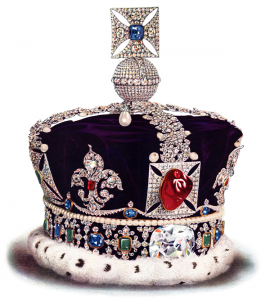
The Cullinan II or the Second Star of Africa, a diamond that weighs 317.4 carats, is mounted in the Imperial State Crown. 
“Finding these remnants of the elusive mineral bridgmanite is significant. It’s very common in the deep Earth, at the extreme pressure conditions of the lower mantle, below a depth of 660 kilometres, even deeper than most super-deep diamonds,” Smith said in his presentation. “Bridgmanite doesn’t exist in the upper mantle, or at the surface. What we actually see in the diamonds when they reach the surface is not bridgmanite, but the minerals left when it breaks down as the pressure decreases. Finding these minerals trapped in a diamond means that the diamond itself must have crystallized at a depth where bridgmanite exists, very deep within the Earth.”
By aiming a laser at the tiny inclusions trapped inside the diamond, the researchers found that the way the light scattered (using a Raman spectrometer) was characteristic of bridgmanite breakdown products.
The Letšeng mine diamond is so pure that it doesn’t contain nitrogen in its crystal structure. This characteristic classifies it as a ‘Clippir’ diamond, which is the same category as that of the Cullinan diamond.
“What is special about this one is that it is the first Clippir diamond for which we can firmly assign a lower mantle origin, that is, below 660 kilometres,” Smith said. “Previously, we had known that Clippir diamonds are super-deep and speculated that their depth of origin might span 360 to 750 kilometres depth, but we hadn’t actually seen any that were definitely from the deeper end of this window.”
In the researcher’s view, this finding gives a better idea of exactly where Clippir diamonds come from and also shows that there is some overlap in the birthplace for Clippir diamonds and type IIb diamonds, such as the famous Hope diamond. This rare blue gem was owned by monarchs, bankers, heiresses and thieves until it landed at the Smithsonian National Museum of Natural History in Washington DC.
The overlap that Smith refers to points to a previous study in which the researcher showed that the Hope and other IIb diamonds originate in Earth’s deep mantle and that the boron that gives them a blue hue comes from the bottom of the oceans. To get into the diamond, the element is first dragged hundreds of kilometres by plate tectonics down into the mantle.
“It shows that there is a gigantic recycling route that brings elements from Earth’s surface down into the Earth, and then occasionally returns beautiful diamonds to the surface, as passengers in volcanic eruptions,” Smith said.
Source: DCLA

Origin of British Crown Jewels’ diamond revealed


The famous Cullinan diamond, which is now the centrepiece of the British Crown Jewels, likely originated in Earth’s lower mantle, right beneath the rigid and stable continental plates, where the mantle is slowly moving or convecting.
The finding is part of ongoing research carried out by Evan Smith and Wuyi Wang at the Gemological Institute of America. The new insight was presented by Smith at the virtual 2020 Goldschmidt Conference organized by US-based Geochemical Society and the European Association of Geochemistry.
Smith and his team concluded that the Cullinan diamond was likely formed in the lower mantle and can be considered a ‘super-deep’ stone after examining an analog, large 124-carat diamond from Gem Diamonds’ (LON: GEMD) Letšeng mine in Lesotho.
According to the researchers, recent analyses of this walnut-sized diamond revealed that it contains remains of an important element: bridgmanite.
The Cullinan II or the Second Star of Africa, a diamond that weighs 317.4 carats, is mounted in the Imperial State Crown. 
“Finding these remnants of the elusive mineral bridgmanite is significant. It’s very common in the deep Earth, at the extreme pressure conditions of the lower mantle, below a depth of 660 kilometres, even deeper than most super-deep diamonds,” Smith said in his presentation. “Bridgmanite doesn’t exist in the upper mantle, or at the surface. What we actually see in the diamonds when they reach the surface is not bridgmanite, but the minerals left when it breaks down as the pressure decreases. Finding these minerals trapped in a diamond means that the diamond itself must have crystallized at a depth where bridgmanite exists, very deep within the Earth.”
By aiming a laser at the tiny inclusions trapped inside the diamond, the researchers found that the way the light scattered (using a Raman spectrometer) was characteristic of bridgmanite breakdown products.
The Letšeng mine diamond is so pure that it doesn’t contain nitrogen in its crystal structure. This characteristic classifies it as a ‘Clippir’ diamond, which is the same category as that of the Cullinan diamond.
“What is special about this one is that it is the first Clippir diamond for which we can firmly assign a lower mantle origin, that is, below 660 kilometres,” Smith said. “Previously, we had known that Clippir diamonds are super-deep and speculated that their depth of origin might span 360 to 750 kilometres depth, but we hadn’t actually seen any that were definitely from the deeper end of this window.”
In the researcher’s view, this finding gives a better idea of exactly where Clippir diamonds come from and also shows that there is some overlap in the birthplace for Clippir diamonds and type IIb diamonds, such as the famous Hope diamond. This rare blue gem was owned by monarchs, bankers, heiresses and thieves until it landed at the Smithsonian National Museum of Natural History in Washington DC.
The overlap that Smith refers to points to a previous study in which the researcher showed that the Hope and other IIb diamonds originate in Earth’s deep mantle and that the boron that gives them a blue hue comes from the bottom of the oceans. To get into the diamond, the element is first dragged hundreds of kilometres by plate tectonics down into the mantle.
“It shows that there is a gigantic recycling route that brings elements from Earth’s surface down into the Earth, and then occasionally returns beautiful diamonds to the surface, as passengers in volcanic eruptions,” Smith said.
Source: DCLA

Thursday, 25 June 2020

No Buyer for 3ct. Blue Diamond at Sotheby’s


A 3.01-carat, fancy-vivid-blue diamond ring, carrying a high estimate of $6.3 million was among a number of headline items that failed to find buyers at Sotheby’s Geneva auction.
Sotheby’s withdrew the stone from Tuesday’s Magnificent Jewels and Noble Jewels Part II at the request of the consigner, it told Rapaport News Wednesday. The sale, which achieved a total of $12.4 million, was the auction house’s first live event since the onset of the coronavirus pandemic, and followed Part I, which took place online.
An oval-shaped, 21.56-carat, D-color, VVS1-clarity diamond ring by Lorraine Schwartz, valued at $1.5 million to $2 million, also went unsold. Other colored diamonds were not purchased, including a duet ring set with a pear-shaped, 3.03-carat, fancy-intense-blue diamond and a pear-shaped, 2.82-carat, D-color, VVS1-clarity diamond, as well as a step-cut, fancy-vivid-yellow diamond ring weighing 16.43 carats.
Meanwhile, the top-selling lot at the sale was a marquise-shaped, 7-carat, fancy-intense-pink diamond ring, which was auctioned for the first time after spending 30 years in a private collection. The piece sold for $2.8 million, within its $2.4 million to $3.4 million estimate.
Other notable items included a pear-shaped, 5.29-carat, fancy-grey-blue diamond ring, which garnered $2.1 million, beating its $1.2 million high estimate. A pair of cushion-shaped, D-color, VVS2-clarity diamond earrings, weighing 13.50 carats and 13.52 carats, fetched $1.5 million against an estimate of $1.2 million to $1.8 million.
Sapphires also proved popular, with a cushion-shaped, 105.89-carat ring going for $1.7 million, more than double its $670,000 high estimate. A cushion-shaped, 16.11-carat sapphire ring bracketed by diamonds also sailed past its $490,000 upper valuation, achieving $524,000.
Source: Diamonds.net

No Buyer for 3ct. Blue Diamond at Sotheby’s


A 3.01-carat, fancy-vivid-blue diamond ring, carrying a high estimate of $6.3 million was among a number of headline items that failed to find buyers at Sotheby’s Geneva auction.
Sotheby’s withdrew the stone from Tuesday’s Magnificent Jewels and Noble Jewels Part II at the request of the consigner, it told Rapaport News Wednesday. The sale, which achieved a total of $12.4 million, was the auction house’s first live event since the onset of the coronavirus pandemic, and followed Part I, which took place online.
An oval-shaped, 21.56-carat, D-color, VVS1-clarity diamond ring by Lorraine Schwartz, valued at $1.5 million to $2 million, also went unsold. Other colored diamonds were not purchased, including a duet ring set with a pear-shaped, 3.03-carat, fancy-intense-blue diamond and a pear-shaped, 2.82-carat, D-color, VVS1-clarity diamond, as well as a step-cut, fancy-vivid-yellow diamond ring weighing 16.43 carats.
Meanwhile, the top-selling lot at the sale was a marquise-shaped, 7-carat, fancy-intense-pink diamond ring, which was auctioned for the first time after spending 30 years in a private collection. The piece sold for $2.8 million, within its $2.4 million to $3.4 million estimate.
Other notable items included a pear-shaped, 5.29-carat, fancy-grey-blue diamond ring, which garnered $2.1 million, beating its $1.2 million high estimate. A pair of cushion-shaped, D-color, VVS2-clarity diamond earrings, weighing 13.50 carats and 13.52 carats, fetched $1.5 million against an estimate of $1.2 million to $1.8 million.
Sapphires also proved popular, with a cushion-shaped, 105.89-carat ring going for $1.7 million, more than double its $670,000 high estimate. A cushion-shaped, 16.11-carat sapphire ring bracketed by diamonds also sailed past its $490,000 upper valuation, achieving $524,000.
Source: Diamonds.net

Tuesday, 23 June 2020

Hong Kong August Shows Canceled


The Hong Kong Trade Development Council (HKTDC) has called off this year’s jewelry fairs, scheduled for August, after quarantine rules made the events inaccessible to overseas participants.
The HKTDC initially postponed the Hong Kong International Diamond, Gem & Pearl Show and the Hong Kong International Jewellery Show from March to August because of the coronavirus. On June 2, the municipality extended its 14-day compulsory quarantine for arrivals until September 18, as it’s still working to prevent a second wave. That forced the HKTDC to cancel the events entirely.
“The extension of this restriction means that overseas exhibitors and buyers will have great difficulty joining the [shows] if they were to run from August 3 to 6 as scheduled,” the council said Thursday in an announcement on its website. “In consultation with industry representatives, it has been decided that the next jewelry shows will be held in March 2021.”
The 2021 Hong Kong International Diamond, Gem & Pearl Show, for loose-stone exhibitors, will take place from March 1 to 5 at AsiaWorld-Expo. The Hong Kong International Jewellery Show, which focuses on finished jewelry, will run from March 3 to 7 at the Hong Kong Convention and Exhibition Centre. The council is also consulting with industry members about other promotional options to help companies do business in the current conditions, it said.
Meanwhile, Informa hasn’t confirmed whether its Jewellery & Gem World Hong Kong show will go ahead as planned from September 13 to 19. On June 4, the company said it would monitor the situation and work on “potential alternatives that will enable us to deliver the B2B [business-to-business] experience that you expect and deserve in a safe environment before the end of the year.”
The pandemic has forced the cancellation of most trade shows this year, with JCK Las Vegas and Baselworld also falling victim.
Source: DCLA

Hong Kong August Shows Canceled


The Hong Kong Trade Development Council (HKTDC) has called off this year’s jewelry fairs, scheduled for August, after quarantine rules made the events inaccessible to overseas participants.
The HKTDC initially postponed the Hong Kong International Diamond, Gem & Pearl Show and the Hong Kong International Jewellery Show from March to August because of the coronavirus. On June 2, the municipality extended its 14-day compulsory quarantine for arrivals until September 18, as it’s still working to prevent a second wave. That forced the HKTDC to cancel the events entirely.
“The extension of this restriction means that overseas exhibitors and buyers will have great difficulty joining the [shows] if they were to run from August 3 to 6 as scheduled,” the council said Thursday in an announcement on its website. “In consultation with industry representatives, it has been decided that the next jewelry shows will be held in March 2021.”
The 2021 Hong Kong International Diamond, Gem & Pearl Show, for loose-stone exhibitors, will take place from March 1 to 5 at AsiaWorld-Expo. The Hong Kong International Jewellery Show, which focuses on finished jewelry, will run from March 3 to 7 at the Hong Kong Convention and Exhibition Centre. The council is also consulting with industry members about other promotional options to help companies do business in the current conditions, it said.
Meanwhile, Informa hasn’t confirmed whether its Jewellery & Gem World Hong Kong show will go ahead as planned from September 13 to 19. On June 4, the company said it would monitor the situation and work on “potential alternatives that will enable us to deliver the B2B [business-to-business] experience that you expect and deserve in a safe environment before the end of the year.”
The pandemic has forced the cancellation of most trade shows this year, with JCK Las Vegas and Baselworld also falling victim.
Source: DCLA

Friday, 19 June 2020

3-Carat Blue Diamond Could Fetch $6.3 Million At Sotheby’s Geneva Auction


Live jewelry auctions are returning with the first one being held in Geneva by Sotheby’s on June 23 offering a diverse collection of statement diamonds, colored gems and historic jewels.
Sotheby’s Part II Magnificent Jewels & Nobel Jewels – Geneva sale was originally scheduled for May but was postponed due to the novel coronavirus pandemic. The effects of the worldwide spread of this infectious disease is still being felt as dramatically reduced travel and freight shipments have hampered the efforts of jewelry specialists to assess gems and jewels. Most likely because of this and the scheduling changes the sale consists of only 48 lots, far fewer than usual for a live international auction. However, there will be a strong and varied selection gems and jewels.
The live sale is accompanied by an online auction, Sotheby’s Part I Magnificent Jewels & Nobel Jewels – Geneva, with 178 lots dating from the 19th century through to the present day. It includes jewels from renowned jewelry houses, including Sterlé, Suzanne Belperron, René Boivin and Hemmerle. This sale has begun and will run till June 24.
Not surprisingly colored diamonds are among the top lots in live sale, with blues, pinks and yellows dominating. The auction is led by a 3.01-carat fancy vivid blue step-cut, diamond. The colored gem set on a ring has a clarity grade of VS1 (very small inclusions), according to the Gemological Institute of America report. Its estimate is $4.3 – $6.3 million.Most Popular In: Watches & Jewelry
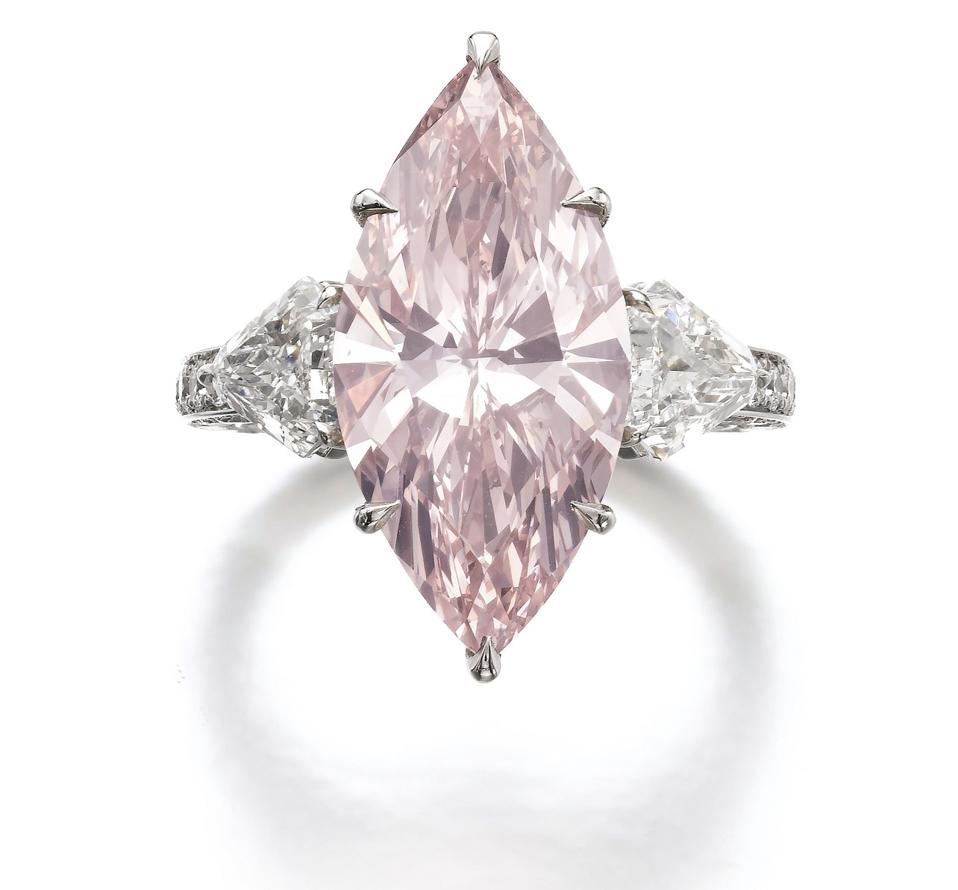
7-carat fancy intense light pink diamond, estimate: $2.5 – $3.5 million
7-carat fancy intense light pink diamond, estimate: $2.5 – $3.5 million SOTHEBY’S
It’s followed by a 7-carat marquise-shaped fancy intense pink diamond. It received a clarity grade of VVS2 (very, very small inclusions) by the GIA. It is set on a ring flanked by fancy-shaped diamonds and with a shank lined with brilliant-cut diamonds. It’s the first time this diamond has come to auction in more than 30 years, where it has been kept in the same private collection. Its estimate is $2.5 – $3.5 million.
There’s also a selection of large, colorless diamonds led by a 21.56-carat D color, VVS1 clarity diamond by Lorraine Schwartz, an American bespoke high jewelry designer with a large celebrity clientele. The gem has excellent polish and symmetry, according to the GIA report.
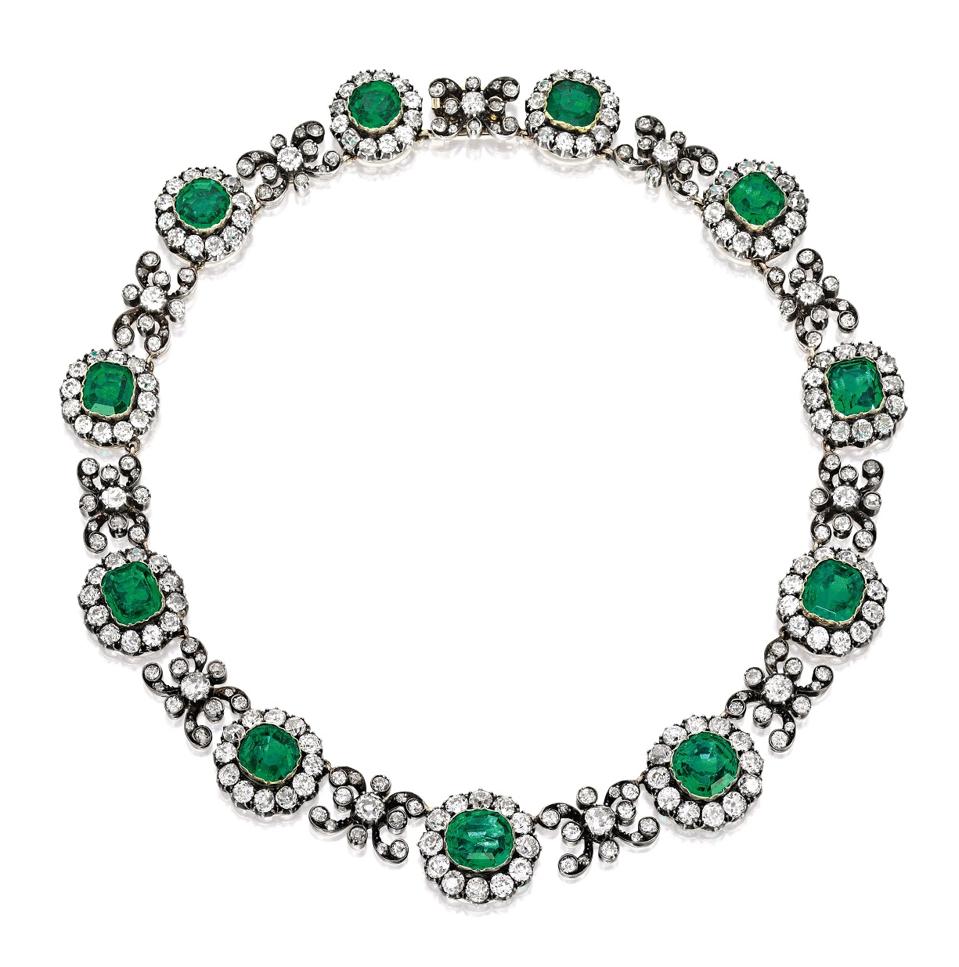
The Duchess of Manchester's emerald and diamond necklace, estimate: $300,000 - $400,000
The Duchess of Manchester’s emerald and diamond necklace, estimate: $300,000 – $400,000 SOTHEBY’S
Among the noble jewels in the sale, the standout is an emerald and diamond necklace owned by Consuelo Montagu (1853-1909), Duchess of Manchester, which was given to her as a wedding gift. Born in New York to parents of Cuban descent, she was known for her match-making skills, inspiring her wealthy friends to find suitable husbands in the United Kingdom, according to the auction house. Her ability to bring together American fortunes with noble titles led to the coining of the phrase “Million Dollar Princesses.” This antique jewel was displayed at the Victoria & Albert Museum in London for 22 years. Its estimate is $300,000 – $400,000.
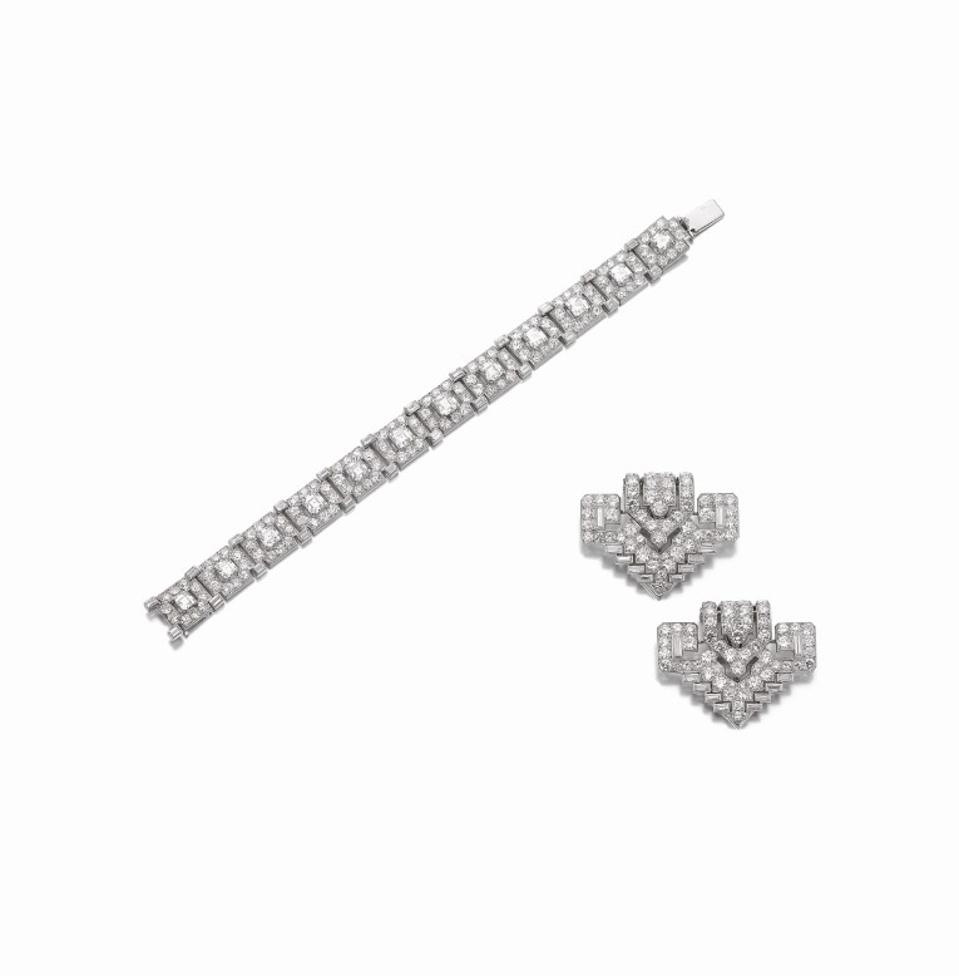
Cartier diamond bracelet and pair of diamond clips, circa 1930
Cartier diamond bracelet and pair of diamond clips, circa 1930 SOTHEBY’S
In addition, there’s a collection of jewels owned by Baroness Bachofen von Echt (1877 – 1959), a New York native who became German nobility through marriage. Pieces from her collection includes a diamond bracelet (estimate $100,000 – $150,000) and diamond clips (estimate $60,000 – $100,000), both made by Cartier, along with creations by Verdura and Hemmerle.
Two impressive sapphires are included in the sale. The first is a 105.58-carat Ceylon sapphire set on a gold ring. The gem is accompanied by reports from the Swiss Gemmological Institute (SSEF) and from Gübelin that both state that there are no indications of heating, with “a few minor nicks and chips consistent with normal wear.” Its estimate is $500,000 – $700,000.
16.11-carat Kashmir sapphire, estimate: $300,000 - $500,000
16.11-carat Kashmir sapphire, estimate: $300,000 – $500,000 SOTHEBY’S
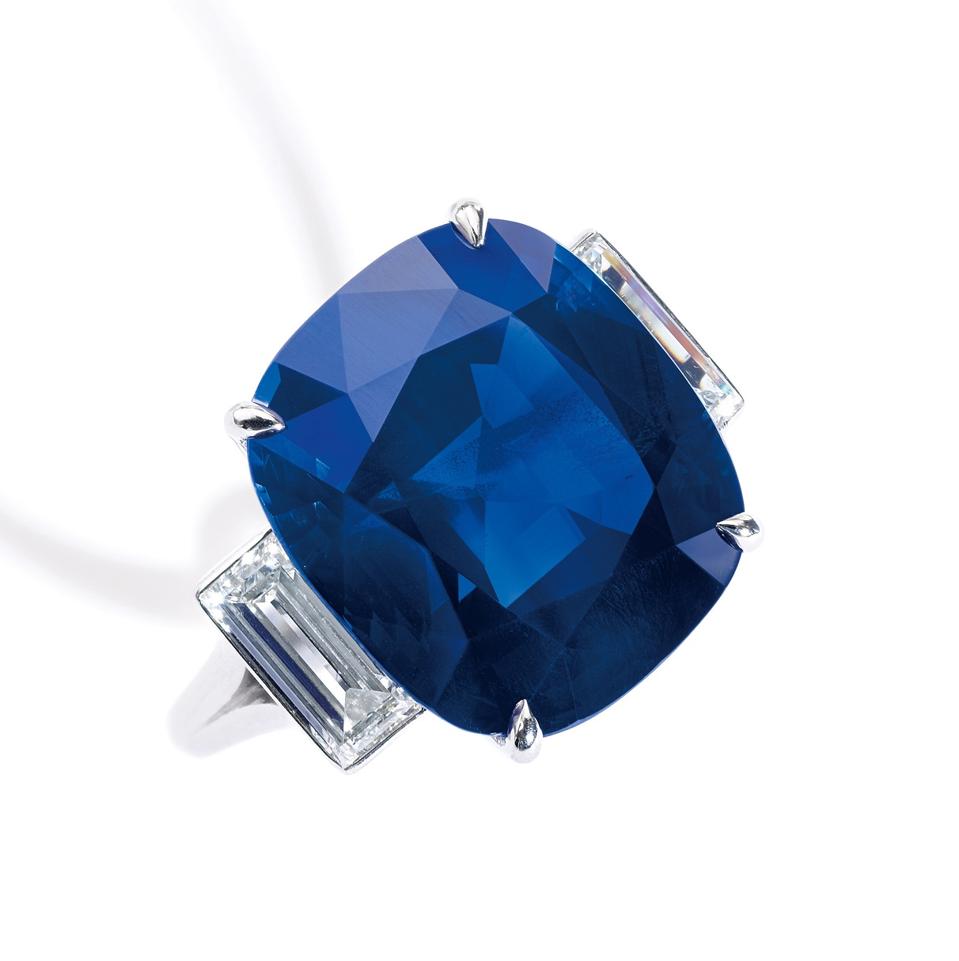
The second is a 16.11-carat Kashmir sapphire set on an 18k gold and diamond ring. The gem is accompanied by two reports from the Swiss Gemmological Institute and from Gübelin that both state that there are no indications of heating and in “very good condition.” Its estimate is $300,000 – $500,000
The continued importance of signed jewels is evident in this sale with pieces from historic and contemporary jewelry houses, including Bulgari, Cartier, Fred, Furst. Harry Winston, Hemmerle, René Bovin, Tiffany & Co. and Van Cleef & Arpels.
Cartier diamond bracelet, Course de Feuillage, 1926, estimate: $200,000 - $300,000
Cartier diamond bracelet, Course de Feuillage, 1926, estimate: $200,000 – $300,000 SOTHEBY’S
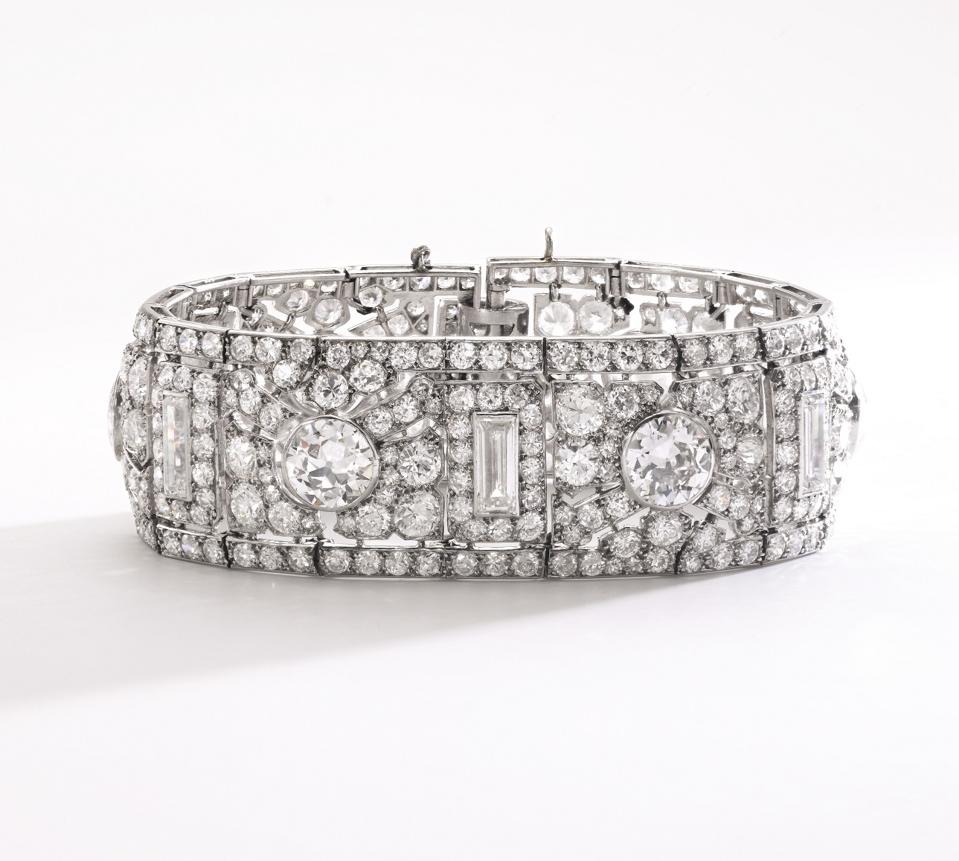
One of the standouts in this group is a Cartier diamond and platinum bracelet, Course de Feuillage, 1926. The entire bracelet is set with circular-, single-cut and baguette diamonds that combines geometric shapes with the stylized representation of leaves. Its estimate is $200,000 – $300,000.
Source: DCLA

3-Carat Blue Diamond Could Fetch $6.3 Million At Sotheby’s Geneva Auction


Live jewelry auctions are returning with the first one being held in Geneva by Sotheby’s on June 23 offering a diverse collection of statement diamonds, colored gems and historic jewels.
Sotheby’s Part II Magnificent Jewels & Nobel Jewels – Geneva sale was originally scheduled for May but was postponed due to the novel coronavirus pandemic. The effects of the worldwide spread of this infectious disease is still being felt as dramatically reduced travel and freight shipments have hampered the efforts of jewelry specialists to assess gems and jewels. Most likely because of this and the scheduling changes the sale consists of only 48 lots, far fewer than usual for a live international auction. However, there will be a strong and varied selection gems and jewels.
The live sale is accompanied by an online auction, Sotheby’s Part I Magnificent Jewels & Nobel Jewels – Geneva, with 178 lots dating from the 19th century through to the present day. It includes jewels from renowned jewelry houses, including Sterlé, Suzanne Belperron, René Boivin and Hemmerle. This sale has begun and will run till June 24.
Not surprisingly colored diamonds are among the top lots in live sale, with blues, pinks and yellows dominating. The auction is led by a 3.01-carat fancy vivid blue step-cut, diamond. The colored gem set on a ring has a clarity grade of VS1 (very small inclusions), according to the Gemological Institute of America report. Its estimate is $4.3 – $6.3 million.Most Popular In: Watches & Jewelry
7-carat fancy intense light pink diamond, estimate: $2.5 – $3.5 million
7-carat fancy intense light pink diamond, estimate: $2.5 – $3.5 million SOTHEBY’S
It’s followed by a 7-carat marquise-shaped fancy intense pink diamond. It received a clarity grade of VVS2 (very, very small inclusions) by the GIA. It is set on a ring flanked by fancy-shaped diamonds and with a shank lined with brilliant-cut diamonds. It’s the first time this diamond has come to auction in more than 30 years, where it has been kept in the same private collection. Its estimate is $2.5 – $3.5 million.
There’s also a selection of large, colorless diamonds led by a 21.56-carat D color, VVS1 clarity diamond by Lorraine Schwartz, an American bespoke high jewelry designer with a large celebrity clientele. The gem has excellent polish and symmetry, according to the GIA report.
The Duchess of Manchester's emerald and diamond necklace, estimate: $300,000 - $400,000
The Duchess of Manchester’s emerald and diamond necklace, estimate: $300,000 – $400,000 SOTHEBY’S
Among the noble jewels in the sale, the standout is an emerald and diamond necklace owned by Consuelo Montagu (1853-1909), Duchess of Manchester, which was given to her as a wedding gift. Born in New York to parents of Cuban descent, she was known for her match-making skills, inspiring her wealthy friends to find suitable husbands in the United Kingdom, according to the auction house. Her ability to bring together American fortunes with noble titles led to the coining of the phrase “Million Dollar Princesses.” This antique jewel was displayed at the Victoria & Albert Museum in London for 22 years. Its estimate is $300,000 – $400,000.
Cartier diamond bracelet and pair of diamond clips, circa 1930
Cartier diamond bracelet and pair of diamond clips, circa 1930 SOTHEBY’S
In addition, there’s a collection of jewels owned by Baroness Bachofen von Echt (1877 – 1959), a New York native who became German nobility through marriage. Pieces from her collection includes a diamond bracelet (estimate $100,000 – $150,000) and diamond clips (estimate $60,000 – $100,000), both made by Cartier, along with creations by Verdura and Hemmerle.
Two impressive sapphires are included in the sale. The first is a 105.58-carat Ceylon sapphire set on a gold ring. The gem is accompanied by reports from the Swiss Gemmological Institute (SSEF) and from Gübelin that both state that there are no indications of heating, with “a few minor nicks and chips consistent with normal wear.” Its estimate is $500,000 – $700,000.
16.11-carat Kashmir sapphire, estimate: $300,000 - $500,000
16.11-carat Kashmir sapphire, estimate: $300,000 – $500,000 SOTHEBY’S
The second is a 16.11-carat Kashmir sapphire set on an 18k gold and diamond ring. The gem is accompanied by two reports from the Swiss Gemmological Institute and from Gübelin that both state that there are no indications of heating and in “very good condition.” Its estimate is $300,000 – $500,000
The continued importance of signed jewels is evident in this sale with pieces from historic and contemporary jewelry houses, including Bulgari, Cartier, Fred, Furst. Harry Winston, Hemmerle, René Bovin, Tiffany & Co. and Van Cleef & Arpels.
Cartier diamond bracelet, Course de Feuillage, 1926, estimate: $200,000 - $300,000
Cartier diamond bracelet, Course de Feuillage, 1926, estimate: $200,000 – $300,000 SOTHEBY’S
One of the standouts in this group is a Cartier diamond and platinum bracelet, Course de Feuillage, 1926. The entire bracelet is set with circular-, single-cut and baguette diamonds that combines geometric shapes with the stylized representation of leaves. Its estimate is $200,000 – $300,000.
Source: DCLA

Thursday, 18 June 2020

Dominion Diamond sues partner in Diavik mine


Canada’s Dominion Diamond Mines is suing Rio Tinto’s subsidiary DDMI, its associate in the iconic Diavik mine, for alleged breach of contract and acting against the best interests of the partnership.
The lawsuit, filed on Tuesday in the Supreme Court of British Columbia, alleges that Diavik Diamond Mines, which owns 60% of Diavik, has operated the mine in a manner that shows “willful misconduct and gross negligence.”
Rio’s subsidiary runs the Canadian Artic diamond mine, but takes regular payments from Dominion to cover the corresponding 40% share of the costs. The partners then divide up the diamonds produced at Diavik and sell them separately.
“DDMI has continued to maintain full operations at the Diavik mine without taking into account the disruptions to the diamond industry caused by the covid-19 and, in particular, without taking into account Dominion’s circumstances,” the suit alleges.
“DDMI has done so knowing that Dominion has no ability to pay for such cash calls because it cannot materially monetize diamond inventories to pay for them,” it notes.
DOMINION DIAMOND, WHICH IS FIGHTING BANKRUPTCY, ALLEGES DDMI IS MANAGING DIAVIK TO THE BENEFIT OF ITS MAJORITY OWNER, RIO TINTO
A spokesperson for Rio Tinto told mining.com the company would be “vigorously” defending Dominion’s “baseless claims” in court.
“We regret Dominion filing what are baseless claims against us,” the source said. “We remain focused on managing the mine safely just as we continue to protect Diavik’s interests in Dominion’s insolvency proceedings and the jobs of the more than 1,120 people who work at Diavik.”
The two companies are already tangled up in separate legal proceedings relating to Dominion filing for creditor protection in April.
The diamond miner said at the time that the covid-19 pandemic had had a “devastating impact” on the global diamond mining industry, particularly in the company.
Dominion signed in May a letter of intent to sell its stake in Diavik mine, in the Northwest Territories, as well as the neighbouring Ekati mine to a firm controlled by its parent company, the Washington Companies, for $126 million.
Under the deal, which is subject to a court-supervised bidding process, the privately held Montana-based conglomerate would also provide Dominion with up to $84 million in short-term debtor-in-possession financing.
The Toronto-based diamond miner was hoping to reach an agreement with Rio Tinto on Diavik, which is scheduled to close in 2025, with cleanup costs estimated at $365.3 million.
The global miner, however, said on Monday it did not intend to take full control of the Canadian Arctic diamond mine.
Shattered dreams
The coronavirus pandemic squashed diamond miners’ dawning hopes of a recovery in a sector already reeling from weak prices and demand since late 2018.
De Beers, the world’s largest producer by value, cut 2020 production guidance by a fifth last month after earlier cancelling its April sales event.
Russia’s Alrosa, the world’s top diamond producer by output, saw sales for rough and polished diamonds drop to $15.6 million. The figure stood in stark contrast to the $152.8 million the diamond miner fetched in March and the $405 million in January.
DOMINION IS SEEKING DAMAGES, COSTS, AND A RULING THAT THE JOINT VENTURE AGREEMENT HAS BEEN BROKEN. NO CASH VALUE WAS GIVEN IN THE FILING
Lucara Diamond, another Canadian company, posted earlier this month a net loss of $3.2 million, or $0.01 a share, for the first three months of the year.
The figure was in sharp contrast with the $7.4 million in net income, or $0.02 in earning per share the miner reported in the same period last year.
South Africa’s Petra Diamonds recently delayed interest payments to borrow $21 million in new debt, a crucial move to keep the company afloat.
Investment banks are increasingly reluctant to extend credit to diamond producers, as inventory is not being sold and defaults are possible, analysts have warned.
“We are concerned about an oversupply of rough diamonds following the reopening of economies, as a lot of inventory could potentially be flooded into the system and the market might not be able to absorb all of it, resulting in increased pricing pressure,” Citi said in an early May note.
Source: DCLA

Dominion Diamond sues partner in Diavik mine


Canada’s Dominion Diamond Mines is suing Rio Tinto’s subsidiary DDMI, its associate in the iconic Diavik mine, for alleged breach of contract and acting against the best interests of the partnership.
The lawsuit, filed on Tuesday in the Supreme Court of British Columbia, alleges that Diavik Diamond Mines, which owns 60% of Diavik, has operated the mine in a manner that shows “willful misconduct and gross negligence.”
Rio’s subsidiary runs the Canadian Artic diamond mine, but takes regular payments from Dominion to cover the corresponding 40% share of the costs. The partners then divide up the diamonds produced at Diavik and sell them separately.
“DDMI has continued to maintain full operations at the Diavik mine without taking into account the disruptions to the diamond industry caused by the covid-19 and, in particular, without taking into account Dominion’s circumstances,” the suit alleges.
“DDMI has done so knowing that Dominion has no ability to pay for such cash calls because it cannot materially monetize diamond inventories to pay for them,” it notes.
DOMINION DIAMOND, WHICH IS FIGHTING BANKRUPTCY, ALLEGES DDMI IS MANAGING DIAVIK TO THE BENEFIT OF ITS MAJORITY OWNER, RIO TINTO
A spokesperson for Rio Tinto told mining.com the company would be “vigorously” defending Dominion’s “baseless claims” in court.
“We regret Dominion filing what are baseless claims against us,” the source said. “We remain focused on managing the mine safely just as we continue to protect Diavik’s interests in Dominion’s insolvency proceedings and the jobs of the more than 1,120 people who work at Diavik.”
The two companies are already tangled up in separate legal proceedings relating to Dominion filing for creditor protection in April.
The diamond miner said at the time that the covid-19 pandemic had had a “devastating impact” on the global diamond mining industry, particularly in the company.
Dominion signed in May a letter of intent to sell its stake in Diavik mine, in the Northwest Territories, as well as the neighbouring Ekati mine to a firm controlled by its parent company, the Washington Companies, for $126 million.
Under the deal, which is subject to a court-supervised bidding process, the privately held Montana-based conglomerate would also provide Dominion with up to $84 million in short-term debtor-in-possession financing.
The Toronto-based diamond miner was hoping to reach an agreement with Rio Tinto on Diavik, which is scheduled to close in 2025, with cleanup costs estimated at $365.3 million.
The global miner, however, said on Monday it did not intend to take full control of the Canadian Arctic diamond mine.
Shattered dreams
The coronavirus pandemic squashed diamond miners’ dawning hopes of a recovery in a sector already reeling from weak prices and demand since late 2018.
De Beers, the world’s largest producer by value, cut 2020 production guidance by a fifth last month after earlier cancelling its April sales event.
Russia’s Alrosa, the world’s top diamond producer by output, saw sales for rough and polished diamonds drop to $15.6 million. The figure stood in stark contrast to the $152.8 million the diamond miner fetched in March and the $405 million in January.
DOMINION IS SEEKING DAMAGES, COSTS, AND A RULING THAT THE JOINT VENTURE AGREEMENT HAS BEEN BROKEN. NO CASH VALUE WAS GIVEN IN THE FILING
Lucara Diamond, another Canadian company, posted earlier this month a net loss of $3.2 million, or $0.01 a share, for the first three months of the year.
The figure was in sharp contrast with the $7.4 million in net income, or $0.02 in earning per share the miner reported in the same period last year.
South Africa’s Petra Diamonds recently delayed interest payments to borrow $21 million in new debt, a crucial move to keep the company afloat.
Investment banks are increasingly reluctant to extend credit to diamond producers, as inventory is not being sold and defaults are possible, analysts have warned.
“We are concerned about an oversupply of rough diamonds following the reopening of economies, as a lot of inventory could potentially be flooded into the system and the market might not be able to absorb all of it, resulting in increased pricing pressure,” Citi said in an early May note.
Source: DCLA

Wednesday, 17 June 2020

A Diamond’s Secret Inner Light


During this unprecedented time, there has never been a more meaningful moment to overcome challenges, to make a connection to products that are symbolic, and to maintain a positive outlook. That’s the idea behind the movement to promote fluorescent diamonds, a naturally occurring characteristic that occurs in 25–35% of diamonds.
Simply put, fluorescence is the presence of nitrogen in carbon that, when exposed to UV, or black, light, emits an inner glow, primarily blue in color. In the past, the fine jewelry industry misjudged these naturally occurring characteristics as flaws and a reason to discount the gems using milkiness as the main argument. But milky fluorescent diamonds are extremely rare, and the vast majority of fluorescent diamonds are not milky.
In fact, fluorescence is a valuable identifying feature of natural diamonds and can add to the aesthetic beauty of the stones. HRD Antwerp, a European authority in diamond certification, conducted a study in 2018 and found that fluorescence, under normal conditions and even when outdoors, has a positive influence on the color of diamonds. And jewelers are taking advantage of optical attributes, specifically glow-in-the-dark characteristics, for their designs. You won’t see the underlying pattern until the right conditions are met—a secret that the consumer may choose to share with others, or not.
Rebecca Foerster, president of the Alrosa, USA Inc., an affiliate of the world’s largest diamond mine, Russia-based Alrosa Group of Companies, is on the forefront of changing the industry’s perception of fluorescence. The company is developing a new line of fluorescent diamonds in commercial quantities, launching a brand.
“It’s a new story to tell, a new customer experience, and a business opportunity,” says Foerster, adding that Alrosa’s consumer studies reveal the majority of respondents said they would be willing to pay premium prices for fluorescent stones. “Our values may realign, our priorities may shift, and what better time to apply this same kind of thinking and perspective to diamonds? We need today’s consumer to find new ways to connect to natural diamonds.”
One might question whether promoting fluorescent diamonds during a pandemic is a viable opportunity. However, historically, diamonds do well in times of crisis, as people turn to more symbolic and emotional purchases. And the concept of inner light certainly resonates in a time of darkness.
The venture is also supported by ongoing science and gemological research on fluorescence. Jason Quick, executive director of American Gem Society Laboratories, explains: “One of the ways we like to think about fluorescence is to compare with fancy color diamonds; both phenomena are due to very interesting optical centers within the crystal lattice that absorb or interact with light at different wavelengths. Is a fancy vivid pink diamond due to something that went wrong during its natural formation? Or is it due to a natural process that went amazingly, beautifully right? Likewise, fluorescence can also be viewed and appreciated as a cool natural phenomenon adding character and dimension to the diamond.”
As the industry grapples with the current pandemic, Alrosa believes fluorescence is the way of the future. “We believe fluorescence is relevant, especially during what we are experiencing today,” says Foerster. “We must all look inside ourselves and find our inner light, for positive energy and moving forward.”
Source: DCLA

A Diamond’s Secret Inner Light


During this unprecedented time, there has never been a more meaningful moment to overcome challenges, to make a connection to products that are symbolic, and to maintain a positive outlook. That’s the idea behind the movement to promote fluorescent diamonds, a naturally occurring characteristic that occurs in 25–35% of diamonds.
Simply put, fluorescence is the presence of nitrogen in carbon that, when exposed to UV, or black, light, emits an inner glow, primarily blue in color. In the past, the fine jewelry industry misjudged these naturally occurring characteristics as flaws and a reason to discount the gems using milkiness as the main argument. But milky fluorescent diamonds are extremely rare, and the vast majority of fluorescent diamonds are not milky.
In fact, fluorescence is a valuable identifying feature of natural diamonds and can add to the aesthetic beauty of the stones. HRD Antwerp, a European authority in diamond certification, conducted a study in 2018 and found that fluorescence, under normal conditions and even when outdoors, has a positive influence on the color of diamonds. And jewelers are taking advantage of optical attributes, specifically glow-in-the-dark characteristics, for their designs. You won’t see the underlying pattern until the right conditions are met—a secret that the consumer may choose to share with others, or not.
Rebecca Foerster, president of the Alrosa, USA Inc., an affiliate of the world’s largest diamond mine, Russia-based Alrosa Group of Companies, is on the forefront of changing the industry’s perception of fluorescence. The company is developing a new line of fluorescent diamonds in commercial quantities, launching a brand.
“It’s a new story to tell, a new customer experience, and a business opportunity,” says Foerster, adding that Alrosa’s consumer studies reveal the majority of respondents said they would be willing to pay premium prices for fluorescent stones. “Our values may realign, our priorities may shift, and what better time to apply this same kind of thinking and perspective to diamonds? We need today’s consumer to find new ways to connect to natural diamonds.”
One might question whether promoting fluorescent diamonds during a pandemic is a viable opportunity. However, historically, diamonds do well in times of crisis, as people turn to more symbolic and emotional purchases. And the concept of inner light certainly resonates in a time of darkness.
The venture is also supported by ongoing science and gemological research on fluorescence. Jason Quick, executive director of American Gem Society Laboratories, explains: “One of the ways we like to think about fluorescence is to compare with fancy color diamonds; both phenomena are due to very interesting optical centers within the crystal lattice that absorb or interact with light at different wavelengths. Is a fancy vivid pink diamond due to something that went wrong during its natural formation? Or is it due to a natural process that went amazingly, beautifully right? Likewise, fluorescence can also be viewed and appreciated as a cool natural phenomenon adding character and dimension to the diamond.”
As the industry grapples with the current pandemic, Alrosa believes fluorescence is the way of the future. “We believe fluorescence is relevant, especially during what we are experiencing today,” says Foerster. “We must all look inside ourselves and find our inner light, for positive energy and moving forward.”
Source: DCLA

Can Diamonds Be Damaged? Understanding Chips, Abrasions, Burns and Diamond Repairs

  Diamonds are famous for being exceptionally hard. In fact, diamond ranks 10 on the Mohs scale of hardness , making it highly resistant to ...