Showing posts with label Diamond fluorescence. Show all posts

Wednesday, 29 July 2026

The Hidden Light Within Diamonds: How Fluorescence Can Enhance Beauty, Character and Value

 When people admire a diamond, they usually focus on the famous Four Cs carat, colour, clarity and cut. Yet one fascinating characteristic often overlooked by consumers is fluorescence. Far from being a flaw, fluorescence is a natural optical phenomenon that, in many diamonds, enhances their appearance and contributes to their individuality.

When people admire a diamond, they usually focus on the famous Four Cs carat, colour, clarity and cut. Yet one fascinating characteristic often overlooked by consumers is fluorescence. Far from being a flaw, fluorescence is a natural optical phenomenon that, in many diamonds, enhances their appearance and contributes to their individuality.

For gemmologists, fluorescence provides another layer of information about a diamond’s identity. For collectors and jewellery lovers, it can add an entirely different dimension of beauty particularly in rare coloured diamonds.

What is Diamond Fluorescence?

Fluorescence occurs when a diamond is exposed to ultraviolet (UV) light. Invisible ultraviolet rays excite trace structural defects within the diamond crystal, causing it to emit visible light. Once the UV source is removed, the glow disappears almost instantly.

Approximately 25–35% of natural diamonds exhibit some degree of fluorescence, while only around 10% display fluorescence strong enough to be easily observed.

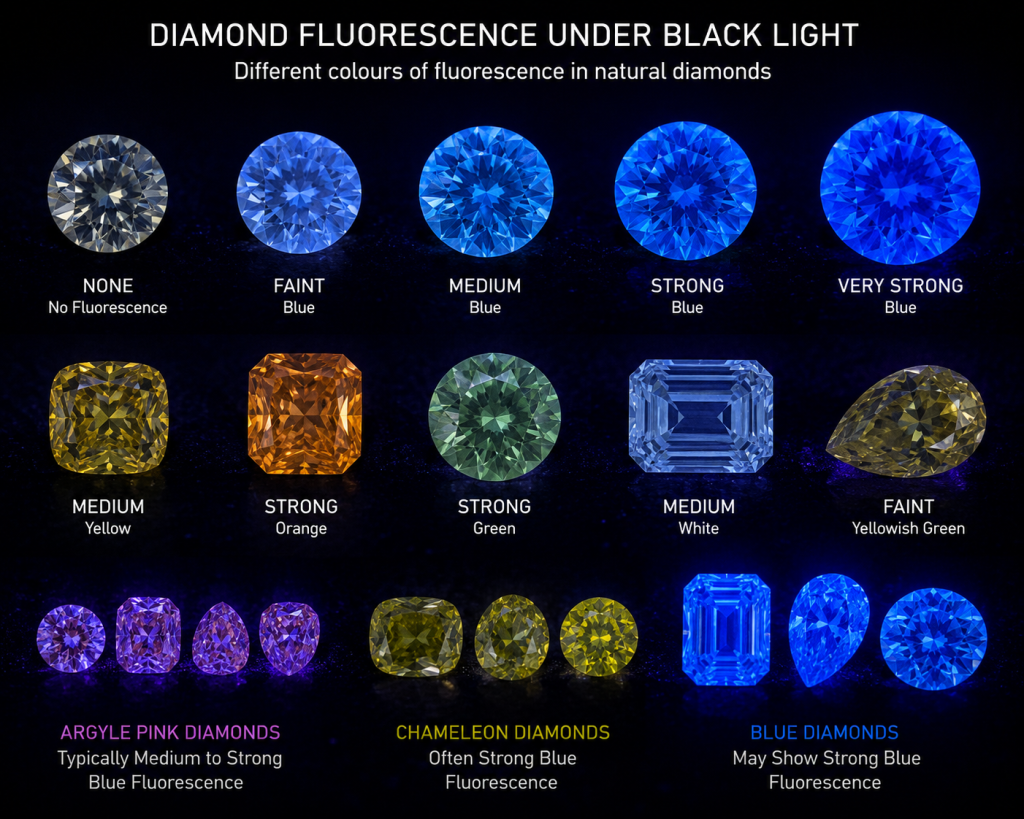
The overwhelming majority fluoresce blue, although yellow, orange, white and even green fluorescence can occasionally occur.

This phenomenon has fascinated gemmologists for over a century and remains an important grading characteristic documented by leading laboratories such as the DCLA, GIA and other internationally recognised laboratories.

Nature’s Hidden Signature

Fluorescence is not an artificial treatment or enhancement. It is a natural characteristic formed deep within the Earth millions or even billions of years ago during a diamond’s crystallisation.

Different trace elements and atomic irregularities create different reactions to ultraviolet light, making fluorescence something of a natural fingerprint for each diamond.

In many cases, fluorescence remains completely invisible during everyday wear, only revealing itself under sunlight rich in ultraviolet radiation or beneath UV lamps.

The Blue Glow of White Diamonds

One of the most beneficial effects of fluorescence is seen in Cape-series white diamonds, particularly those in the H through M colour grades.

These diamonds contain a slight yellow body colour. Since blue is complementary to yellow on the colour spectrum, blue fluorescence can visually neutralise a portion of that warmth when the diamond is viewed in daylight.

The result is that many fluorescent diamonds appear:

  • Whiter
  • Brighter
  • Fresher
  • Slightly higher in colour than their laboratory grade may suggest

This effect is especially noticeable in outdoor lighting, where natural ultraviolet light is abundant.

For decades, experienced jewellers have recognised that a well-cut H, I, J or K colour diamond with medium blue fluorescence can face up remarkably white while offering excellent value compared with higher colour grades.

Only in a very small percentage of diamonds with very strong fluorescence can an undesirable oily or hazy appearance occur. Extensive studies have shown this affects only a minority of fluorescent diamonds, meaning fluorescence should be judged on the individual stone rather than by reputation alone.

Fluorescence and Fancy Coloured Diamonds

Fluorescence and Fancy Coloured Diamonds


While fluorescence can improve the appearance of white diamonds, it becomes even more intriguing in the world of fancy coloured diamonds.

Here, fluorescence often contributes to the personality and visual excitement of the stone.

The Legendary Argyle Pink Diamonds

Among the world’s most treasured gemstones are the famous Argyle Pink Diamonds from Western Australia.

Many of these extraordinary diamonds display medium to strong blue fluorescence despite possessing vivid pink body colour.

The blue fluorescence creates a remarkable contrast with the diamond’s natural pink hue. Under ultraviolet-rich lighting, the diamond can appear even more vibrant and alive, adding another dimension to its already exceptional beauty.

Researchers have long associated the fluorescence in Argyle diamonds with the unique geological conditions that produced their distinctive pink colour—conditions unlike those found in almost any other diamond deposit on Earth.

Rather than detracting from their value, fluorescence has become part of the fascinating character that collectors admire in these exceptionally rare gems.

The Magical Chameleon Diamond

Perhaps no diamond demonstrates the beauty of fluorescence more dramatically than the Chameleon Diamond.

These exceptionally rare diamonds possess the remarkable ability to temporarily change colour.

Normally appearing olive green, grey-green or yellowish-green, they can shift to warmer yellow tones after gentle heating or following prolonged storage in darkness.

Many Chameleon diamonds also exhibit an intense and often spectacular fluorescence under ultraviolet light.

This interaction between colour change and fluorescence creates one of the most captivating visual displays found in any gemstone.

Scientists continue to study the exact atomic mechanisms responsible for this behaviour, making Chameleon diamonds one of gemmology’s enduring mysteries.

Fluorescence Adds Personality

Every fluorescent diamond possesses its own unique response to ultraviolet light.

Some emit a soft blue glow.

Others display a vibrant electric blue.

Rare stones may fluoresce yellow, orange or even white.

For collectors, this individuality makes fluorescence another characteristic that distinguishes one diamond from another. It reminds us that no two natural diamonds are truly identical.

Understanding Fluorescence in Jewellery

When selecting a diamond, fluorescence should never be viewed in isolation.

Instead, it should be considered alongside:

  • Cut quality
  • Overall transparency
  • Colour
  • Clarity
  • Optical performance

A beautifully cut fluorescent diamond may appear more lively than a non-fluorescent equivalent, particularly in natural daylight.

In coloured diamonds, fluorescence often enhances the stone’s uniqueness and visual appeal, becoming part of its identity rather than a grading curiosity.

A Feature Worth Appreciating

For many years, fluorescence was misunderstood and sometimes unfairly discounted in the marketplace. Modern research and decades of gemmological observation have demonstrated that this perception is overly simplistic.

In many diamonds particularly those in the H to M colour range blue fluorescence can improve the apparent face-up colour. In rare fancy coloured diamonds such as Argyle Pinks and Chameleon diamonds, fluorescence contributes to the extraordinary visual characteristics that make these gems so highly prized.

Like fingerprints, inclusions and crystal growth patterns, fluorescence tells part of the story of a diamond’s geological journey.

It is one more reminder that natural diamonds are products of nature, each possessing characteristics that cannot be duplicated exactly.

Understanding fluorescence allows consumers to appreciate diamonds not simply for their colour or clarity, but for the remarkable optical phenomena hidden within them revealed only when nature shines a different kind of light.

Source: DCLA

Monday, 23 November 2020

Luminous Diamonds’ Debut Collection Celebrates Your Inner Glow


The new fine jewelry company is a leader in rare fluorescent stones.

All diamonds shimmer when light hits them. Under master hands, they are cut into interesting shapes that spark joy. Gems from Luminous Diamonds, a new fine jewelry brand, however, have an attribute that many precious stones don’t: They glow.

luminous diamonds

Luminous Diamonds’ parent company, Alrosa, is a leader in sourcing fluorescent stones, which are formed under unique geological conditions that leave trace elements during the carbon crystallization process. As a result, Luminous Diamonds shine extra bright in the sun and, most intriguingly, emit a blue glow under UV light.

luminous diamonds

“These diamonds are stunning, luminous, and make a statement,” says Rebecca Foerster, Alrosa’s president of North America. “They reflect the way modern women wear confidence like a rare jewel, and they dare us all to stand out by sharing our inner selves. Greatness in people, like diamonds, is made under pressure. When a woman follows her own inner light, others see it. Our diamonds are an enduring reminder of this light.”

luminous diamonds

To highlight this point, Luminous Diamonds enlisted female leaders from disparate industries to model its debut collection in a campaign titled Greatness Under Pressure. They are WNBA athlete Skylar Diggins-Smith, attorney and travel writer Cynthia Andrew, violinist Ezinma Ramsay, gender-fluid advocate Elliott Sailors, model Denise Bidot, and photographer Marian Moneymaker.

luminous diamonds

The 28-piece collection consists of brilliants and pavé diamonds on open-work hexagon settings. They include long necklaces with pendants, crawler and chandelier earrings, and bracelets. Each design comes with an illuminator charm that emits UV light so you can get that inner glow all the time.

Source: DCLA

Luminous Diamonds’ Debut Collection Celebrates Your Inner Glow


The new fine jewelry company is a leader in rare fluorescent stones.

All diamonds shimmer when light hits them. Under master hands, they are cut into interesting shapes that spark joy. Gems from Luminous Diamonds, a new fine jewelry brand, however, have an attribute that many precious stones don’t: They glow.

luminous diamonds

Luminous Diamonds’ parent company, Alrosa, is a leader in sourcing fluorescent stones, which are formed under unique geological conditions that leave trace elements during the carbon crystallization process. As a result, Luminous Diamonds shine extra bright in the sun and, most intriguingly, emit a blue glow under UV light.

luminous diamonds

“These diamonds are stunning, luminous, and make a statement,” says Rebecca Foerster, Alrosa’s president of North America. “They reflect the way modern women wear confidence like a rare jewel, and they dare us all to stand out by sharing our inner selves. Greatness in people, like diamonds, is made under pressure. When a woman follows her own inner light, others see it. Our diamonds are an enduring reminder of this light.”

luminous diamonds

To highlight this point, Luminous Diamonds enlisted female leaders from disparate industries to model its debut collection in a campaign titled Greatness Under Pressure. They are WNBA athlete Skylar Diggins-Smith, attorney and travel writer Cynthia Andrew, violinist Ezinma Ramsay, gender-fluid advocate Elliott Sailors, model Denise Bidot, and photographer Marian Moneymaker.

luminous diamonds

The 28-piece collection consists of brilliants and pavé diamonds on open-work hexagon settings. They include long necklaces with pendants, crawler and chandelier earrings, and bracelets. Each design comes with an illuminator charm that emits UV light so you can get that inner glow all the time.

Source: DCLA

Wednesday, 17 June 2020

A Diamond’s Secret Inner Light


During this unprecedented time, there has never been a more meaningful moment to overcome challenges, to make a connection to products that are symbolic, and to maintain a positive outlook. That’s the idea behind the movement to promote fluorescent diamonds, a naturally occurring characteristic that occurs in 25–35% of diamonds.
Simply put, fluorescence is the presence of nitrogen in carbon that, when exposed to UV, or black, light, emits an inner glow, primarily blue in color. In the past, the fine jewelry industry misjudged these naturally occurring characteristics as flaws and a reason to discount the gems using milkiness as the main argument. But milky fluorescent diamonds are extremely rare, and the vast majority of fluorescent diamonds are not milky.
In fact, fluorescence is a valuable identifying feature of natural diamonds and can add to the aesthetic beauty of the stones. HRD Antwerp, a European authority in diamond certification, conducted a study in 2018 and found that fluorescence, under normal conditions and even when outdoors, has a positive influence on the color of diamonds. And jewelers are taking advantage of optical attributes, specifically glow-in-the-dark characteristics, for their designs. You won’t see the underlying pattern until the right conditions are met—a secret that the consumer may choose to share with others, or not.
Rebecca Foerster, president of the Alrosa, USA Inc., an affiliate of the world’s largest diamond mine, Russia-based Alrosa Group of Companies, is on the forefront of changing the industry’s perception of fluorescence. The company is developing a new line of fluorescent diamonds in commercial quantities, launching a brand.
“It’s a new story to tell, a new customer experience, and a business opportunity,” says Foerster, adding that Alrosa’s consumer studies reveal the majority of respondents said they would be willing to pay premium prices for fluorescent stones. “Our values may realign, our priorities may shift, and what better time to apply this same kind of thinking and perspective to diamonds? We need today’s consumer to find new ways to connect to natural diamonds.”
One might question whether promoting fluorescent diamonds during a pandemic is a viable opportunity. However, historically, diamonds do well in times of crisis, as people turn to more symbolic and emotional purchases. And the concept of inner light certainly resonates in a time of darkness.
The venture is also supported by ongoing science and gemological research on fluorescence. Jason Quick, executive director of American Gem Society Laboratories, explains: “One of the ways we like to think about fluorescence is to compare with fancy color diamonds; both phenomena are due to very interesting optical centers within the crystal lattice that absorb or interact with light at different wavelengths. Is a fancy vivid pink diamond due to something that went wrong during its natural formation? Or is it due to a natural process that went amazingly, beautifully right? Likewise, fluorescence can also be viewed and appreciated as a cool natural phenomenon adding character and dimension to the diamond.”
As the industry grapples with the current pandemic, Alrosa believes fluorescence is the way of the future. “We believe fluorescence is relevant, especially during what we are experiencing today,” says Foerster. “We must all look inside ourselves and find our inner light, for positive energy and moving forward.”
Source: DCLA

A Diamond’s Secret Inner Light


During this unprecedented time, there has never been a more meaningful moment to overcome challenges, to make a connection to products that are symbolic, and to maintain a positive outlook. That’s the idea behind the movement to promote fluorescent diamonds, a naturally occurring characteristic that occurs in 25–35% of diamonds.
Simply put, fluorescence is the presence of nitrogen in carbon that, when exposed to UV, or black, light, emits an inner glow, primarily blue in color. In the past, the fine jewelry industry misjudged these naturally occurring characteristics as flaws and a reason to discount the gems using milkiness as the main argument. But milky fluorescent diamonds are extremely rare, and the vast majority of fluorescent diamonds are not milky.
In fact, fluorescence is a valuable identifying feature of natural diamonds and can add to the aesthetic beauty of the stones. HRD Antwerp, a European authority in diamond certification, conducted a study in 2018 and found that fluorescence, under normal conditions and even when outdoors, has a positive influence on the color of diamonds. And jewelers are taking advantage of optical attributes, specifically glow-in-the-dark characteristics, for their designs. You won’t see the underlying pattern until the right conditions are met—a secret that the consumer may choose to share with others, or not.
Rebecca Foerster, president of the Alrosa, USA Inc., an affiliate of the world’s largest diamond mine, Russia-based Alrosa Group of Companies, is on the forefront of changing the industry’s perception of fluorescence. The company is developing a new line of fluorescent diamonds in commercial quantities, launching a brand.
“It’s a new story to tell, a new customer experience, and a business opportunity,” says Foerster, adding that Alrosa’s consumer studies reveal the majority of respondents said they would be willing to pay premium prices for fluorescent stones. “Our values may realign, our priorities may shift, and what better time to apply this same kind of thinking and perspective to diamonds? We need today’s consumer to find new ways to connect to natural diamonds.”
One might question whether promoting fluorescent diamonds during a pandemic is a viable opportunity. However, historically, diamonds do well in times of crisis, as people turn to more symbolic and emotional purchases. And the concept of inner light certainly resonates in a time of darkness.
The venture is also supported by ongoing science and gemological research on fluorescence. Jason Quick, executive director of American Gem Society Laboratories, explains: “One of the ways we like to think about fluorescence is to compare with fancy color diamonds; both phenomena are due to very interesting optical centers within the crystal lattice that absorb or interact with light at different wavelengths. Is a fancy vivid pink diamond due to something that went wrong during its natural formation? Or is it due to a natural process that went amazingly, beautifully right? Likewise, fluorescence can also be viewed and appreciated as a cool natural phenomenon adding character and dimension to the diamond.”
As the industry grapples with the current pandemic, Alrosa believes fluorescence is the way of the future. “We believe fluorescence is relevant, especially during what we are experiencing today,” says Foerster. “We must all look inside ourselves and find our inner light, for positive energy and moving forward.”
Source: DCLA

Tuesday, 3 March 2020

Alrosa steps up efforts to brighten fluorescent diamond sales


Russia’s Alrosa the world’s top diamond miner by volume, is betting on a new strategy to boost its sales amid an industry-wide slowdown that has hit small companies the hardest.
The state-owned company is now selling naturally occurring fluorescent diamonds mixed with others. At the same time, it’s holding talks with global jewellery retailers about jointly marketing its ‘Luminous Diamonds’ brand, which uses the glowing stones.
Fluorescence, a bluish glow produced by ultraviolet rays (UV), is a characteristic of 25% to 35% of diamonds, according to the Gemological Institute of America (GIA).
The feature has traditionally been seen as a negative attribute as it can make a diamond appear “milky” or “oily” in direct sun or UV light. Alrosa’s marketing efforts are centred on changing those perceptions.
Glowing diamonds are most common in Russia and Canada due to their proximity to the Arctic, where they are usually found.
GfK market research agency recently conducted a study involving over 4,000 jewellery consumers to determine how they perceived fluorescent diamonds.
The survey revealed that 74% of the respondents in the US didn’t know what they were or were poorly informed about them. When educated, however, over 82% of respondents said they would consider buying a diamond with such a feature. And almost 60% of customers, mostly millennials, expressed their willingness to pay as much as 15% more to obtain a fluorescent diamond.
About half of all diamonds produced globally have some fluorescence, but those in which the feature is “strong”  —  the focus of Alrosa’s campaign —  represent as much as 5-10% of global supply.
Global demand for all types of diamonds fell between 2018 and 2019, affecting small stones producers the most, due to an oversupply in that segment that dragged prices down.
Increasing demand for synthetic diamonds also weighed on prices. Man-made stones require less investment than mined ones and can offer more attractive margins.
Big companies have not been immune to the downward trend. De Beers, the world’s No. 1 diamond miner, reported in February its worst set of earnings since Anglo American acquired it in 2012.
Source: DCLA

Alrosa steps up efforts to brighten fluorescent diamond sales


Russia’s Alrosa the world’s top diamond miner by volume, is betting on a new strategy to boost its sales amid an industry-wide slowdown that has hit small companies the hardest.
The state-owned company is now selling naturally occurring fluorescent diamonds mixed with others. At the same time, it’s holding talks with global jewellery retailers about jointly marketing its ‘Luminous Diamonds’ brand, which uses the glowing stones.
Fluorescence, a bluish glow produced by ultraviolet rays (UV), is a characteristic of 25% to 35% of diamonds, according to the Gemological Institute of America (GIA).
The feature has traditionally been seen as a negative attribute as it can make a diamond appear “milky” or “oily” in direct sun or UV light. Alrosa’s marketing efforts are centred on changing those perceptions.
Glowing diamonds are most common in Russia and Canada due to their proximity to the Arctic, where they are usually found.
GfK market research agency recently conducted a study involving over 4,000 jewellery consumers to determine how they perceived fluorescent diamonds.
The survey revealed that 74% of the respondents in the US didn’t know what they were or were poorly informed about them. When educated, however, over 82% of respondents said they would consider buying a diamond with such a feature. And almost 60% of customers, mostly millennials, expressed their willingness to pay as much as 15% more to obtain a fluorescent diamond.
About half of all diamonds produced globally have some fluorescence, but those in which the feature is “strong”  —  the focus of Alrosa’s campaign —  represent as much as 5-10% of global supply.
Global demand for all types of diamonds fell between 2018 and 2019, affecting small stones producers the most, due to an oversupply in that segment that dragged prices down.
Increasing demand for synthetic diamonds also weighed on prices. Man-made stones require less investment than mined ones and can offer more attractive margins.
Big companies have not been immune to the downward trend. De Beers, the world’s No. 1 diamond miner, reported in February its worst set of earnings since Anglo American acquired it in 2012.
Source: DCLA

Tuesday, 7 November 2017

Diamond fluorescence

There is common misconception that a diamond exhibiting fluorescence under ultra violet light has some kind of colour defect or transparency issue.

This NOT true at all. The naturally occurring fluorescence phenomenon is a unique completely hidden feature, which is present to some level in approximately 30% of all diamonds.

The effect is seen in Diamonds which have Carbon bonds which include boron.

Boron causes the diamond to glow when held under a powerful ultra violet light also known as blacklight.

The amount of boron in the Carbon bond making up the diamond will determine the level of fluorescence.  Fluorescence is rated by the Laboratory as Very Strong, Strong, Medium, Faint, None. This relates to the strength of the fluorescent glow under ultra violet light.

Read More: DCLA

Diamond fluorescence

There is common misconception that a diamond exhibiting fluorescence under ultra violet light has some kind of colour defect or transparency issue.

This NOT true at all. The naturally occurring fluorescence phenomenon is a unique completely hidden feature, which is present to some level in approximately 30% of all diamonds.

The effect is seen in Diamonds which have Carbon bonds which include boron.

Boron causes the diamond to glow when held under a powerful ultra violet light also known as blacklight.

The amount of boron in the Carbon bond making up the diamond will determine the level of fluorescence.  Fluorescence is rated by the Laboratory as Very Strong, Strong, Medium, Faint, None. This relates to the strength of the fluorescent glow under ultra violet light.

Read More: DCLA

Fancy Colour Diamonds, From Hollywood Statement to the Ultimate Collectable

  For generations, the traditional diamond engagement ring has been dominated by the classic colourless stone. But the world of exceptional ...