Showing posts with label Dominion Diamond Mines. Show all posts

Thursday, 23 July 2026

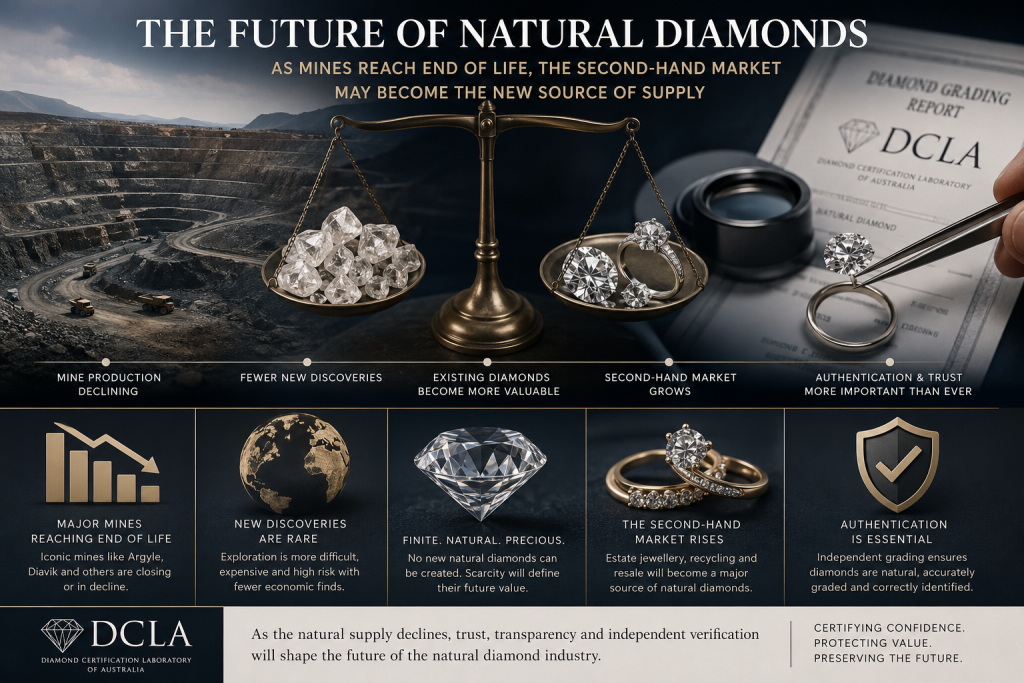
The Future of Natural Diamonds: As Global Mines Reach End of Life, Will the Second-Hand Market Become the New Source of Supply?

 For more than 150 years, the world's natural diamond industry has relied on a steady pipeline of newly mined diamonds entering the market. However, that era is rapidly changing. Many of the world's most productive diamond mines are approaching the end of their economic lives, exploration success has slowed dramatically, and few major new discoveries are expected to replace the enormous production that is disappearing.

For more than 150 years, the world’s natural diamond industry has relied on a steady pipeline of newly mined diamonds entering the market. However, that era is rapidly changing. Many of the world’s most productive diamond mines are approaching the end of their economic lives, exploration success has slowed dramatically, and few major new discoveries are expected to replace the enormous production that is disappearing.

This raises an important question for the jewellery industry, collectors, and consumers alike:

Where will tomorrow’s natural diamonds come from?

The World’s Largest Diamond Mines Are Running Out

Many of the world’s iconic diamond mines are now in decline or nearing closure.

Examples include:

  • Argyle Mine (Australia) – Closed in 2020 after producing more than 865 million carats over its 37-year life. Argyle supplied around 90% of the world’s rare pink diamonds and was once one of the highest-volume producers globally. Its closure permanently removed a significant source of natural diamonds from the market.
  • Diavik Mine (Canada) – Scheduled to cease production around 2026–2027 after two decades of operation.
  • Ekati Mine (Canada) – Although still operating, reserves continue to decline and production has fallen significantly from its peak.
  • Venetia Open Pit (South Africa) – Transitioning to underground mining to extend its life, but at considerably lower production levels and substantially higher operating costs.
  • Jwaneng (Botswana) – Often described as the richest diamond mine in the world, it continues to produce exceptional diamonds, although maintaining production requires increasingly expensive underground expansion projects.
  • Orapa (Botswana) – One of the world’s largest diamond mines by area, but also a mature operation facing the realities of ageing reserves.

Few major discoveries have emerged over the past twenty years that are capable of replacing the millions of carats these operations once produced.

New Discoveries Are Becoming Increasingly Rare

Diamond exploration is an expensive, high-risk undertaking.

Unlike previous decades, when rich kimberlite pipes were discovered in Australia, Canada, Russia and southern Africa, today’s exploration companies face:

  • Much deeper geological targets
  • Increasing environmental approvals
  • Higher capital costs
  • Greater political uncertainty
  • Reduced investor appetite

Even when a new deposit is found, bringing it into commercial production can take well over a decade and require investments measured in billions of dollars.

The result is a steadily shrinking pipeline of new natural diamonds.

Fewer Diamonds Does Not Mean Lower Demand

Although consumer preferences continue to evolve, natural diamonds remain highly sought after for fine jewellery, investment-grade stones and rare collector pieces.

Unlike laboratory-grown diamonds, every natural diamond is a finite geological resource formed between one and three billion years ago. Once mined, no new natural diamonds can be manufactured.

As mining output declines, the existing inventory of polished natural diamonds becomes increasingly important.

The Rise of the Secondary Market

Historically, relatively few diamonds returned to the market.

Natural diamonds were commonly passed through generations as family heirlooms or remained in jewellery collections for decades.

However, several factors are beginning to change this:

  • An ageing population transferring wealth
  • Estate jewellery entering the market
  • Increased recycling by professional jewellers
  • Specialist diamond buying companies
  • Greater consumer awareness of resale value
  • Online marketplaces making resale easier

Over time, previously owned natural diamonds may become one of the largest sources of supply for the jewellery trade.

Much like antique watches, rare coins and fine art, existing natural diamonds may circulate repeatedly between owners while no meaningful replacement supply enters the market.

Recycling Diamonds Is Not New

The diamond trade has quietly recycled diamonds for centuries.

Antique European jewellery has often been dismantled and remounted multiple times as fashions changed.

Victorian diamonds became Edwardian jewellery.

Edwardian diamonds became Art Deco pieces.

Art Deco diamonds have been reset into modern engagement rings.

The diamond itself may have changed settings numerous times while remaining the same natural gemstone throughout its life.

This process is likely to accelerate as newly mined diamonds become increasingly scarce.

Authentication Will Become More Important Than Ever

As more diamonds enter the secondary market, authentication will become increasingly critical.

Consumers will want certainty that the diamond they are purchasing is:

  • Natural rather than laboratory-grown
  • Correctly identified
  • Accurately graded
  • Free from undisclosed treatments
  • Properly documented

This places greater importance on independent laboratory grading.

Professional laboratories such as DCLA play an essential role in verifying the identity and quality of diamonds entering both the primary and secondary markets. Independent examination provides confidence for buyers, sellers, insurers and future owners alike.

The Growing Challenge of Laboratory-Grown Substitution

One emerging concern is the increasing number of natural diamond certificates being fraudulently paired with laboratory-grown diamonds or simulants.

As DCLA has previously reported, certificates can be separated from the original stone, creating opportunities for deliberate substitution. As secondary market activity increases, verifying that the diamond matches its accompanying grading report will become essential.

Independent examination helps protect both consumers and the integrity of the natural diamond market.

A Market That Could Resemble Fine Art

Natural diamonds possess one characteristic that laboratory-grown diamonds can never replicate—true geological scarcity.

As mine production continues to decline, natural diamonds may increasingly resemble other finite luxury assets such as fine art, vintage automobiles and rare watches.

Their value will not simply depend on beauty or craftsmanship, but also on rarity, provenance and authenticated identity.

The second-hand market is therefore likely to evolve from an occasional source of supply into a fundamental pillar of the global natural diamond industry.

Looking Ahead

The natural diamond industry is entering a period of structural change.

Mine production is expected to continue declining over the coming decades, while new discoveries remain scarce and increasingly difficult to develop. Existing polished diamonds already in private ownership represent an enormous reservoir of future supply.

As these stones gradually re-enter the marketplace through resale, estate collections and jewellery recycling, confidence in independent authentication will become more important than ever.

For laboratories such as DCLA, this evolving landscape reinforces a central responsibility: ensuring every diamond can be accurately identified, independently graded and matched to its rightful documentation. In a future where existing natural diamonds become an increasingly valuable and finite resource, trust will be as important as the diamonds themselves.

Disclaimer: This article is intended for general industry information and commentary. Market conditions, mine production and future supply forecasts are subject to change. DCLA encourages consumers and members of the jewellery trade to obtain independent laboratory verification when buying, selling or re-entering natural diamonds into the marketplace.

Wednesday, 17 June 2020

Dominion Diamond sues partner in Diavik mine


Canada’s Dominion Diamond Mines is suing Rio Tinto’s subsidiary DDMI, its associate in the iconic Diavik mine, for alleged breach of contract and acting against the best interests of the partnership.
The lawsuit, filed on Tuesday in the Supreme Court of British Columbia, alleges that Diavik Diamond Mines, which owns 60% of Diavik, has operated the mine in a manner that shows “willful misconduct and gross negligence.”
Rio’s subsidiary runs the Canadian Artic diamond mine, but takes regular payments from Dominion to cover the corresponding 40% share of the costs. The partners then divide up the diamonds produced at Diavik and sell them separately.
“DDMI has continued to maintain full operations at the Diavik mine without taking into account the disruptions to the diamond industry caused by the covid-19 and, in particular, without taking into account Dominion’s circumstances,” the suit alleges.
“DDMI has done so knowing that Dominion has no ability to pay for such cash calls because it cannot materially monetize diamond inventories to pay for them,” it notes.
DOMINION DIAMOND, WHICH IS FIGHTING BANKRUPTCY, ALLEGES DDMI IS MANAGING DIAVIK TO THE BENEFIT OF ITS MAJORITY OWNER, RIO TINTO
A spokesperson for Rio Tinto told mining.com the company would be “vigorously” defending Dominion’s “baseless claims” in court.
“We regret Dominion filing what are baseless claims against us,” the source said. “We remain focused on managing the mine safely just as we continue to protect Diavik’s interests in Dominion’s insolvency proceedings and the jobs of the more than 1,120 people who work at Diavik.”
The two companies are already tangled up in separate legal proceedings relating to Dominion filing for creditor protection in April.
The diamond miner said at the time that the covid-19 pandemic had had a “devastating impact” on the global diamond mining industry, particularly in the company.
Dominion signed in May a letter of intent to sell its stake in Diavik mine, in the Northwest Territories, as well as the neighbouring Ekati mine to a firm controlled by its parent company, the Washington Companies, for $126 million.
Under the deal, which is subject to a court-supervised bidding process, the privately held Montana-based conglomerate would also provide Dominion with up to $84 million in short-term debtor-in-possession financing.
The Toronto-based diamond miner was hoping to reach an agreement with Rio Tinto on Diavik, which is scheduled to close in 2025, with cleanup costs estimated at $365.3 million.
The global miner, however, said on Monday it did not intend to take full control of the Canadian Arctic diamond mine.
Shattered dreams
The coronavirus pandemic squashed diamond miners’ dawning hopes of a recovery in a sector already reeling from weak prices and demand since late 2018.
De Beers, the world’s largest producer by value, cut 2020 production guidance by a fifth last month after earlier cancelling its April sales event.
Russia’s Alrosa, the world’s top diamond producer by output, saw sales for rough and polished diamonds drop to $15.6 million. The figure stood in stark contrast to the $152.8 million the diamond miner fetched in March and the $405 million in January.
DOMINION IS SEEKING DAMAGES, COSTS, AND A RULING THAT THE JOINT VENTURE AGREEMENT HAS BEEN BROKEN. NO CASH VALUE WAS GIVEN IN THE FILING
Lucara Diamond, another Canadian company, posted earlier this month a net loss of $3.2 million, or $0.01 a share, for the first three months of the year.
The figure was in sharp contrast with the $7.4 million in net income, or $0.02 in earning per share the miner reported in the same period last year.
South Africa’s Petra Diamonds recently delayed interest payments to borrow $21 million in new debt, a crucial move to keep the company afloat.
Investment banks are increasingly reluctant to extend credit to diamond producers, as inventory is not being sold and defaults are possible, analysts have warned.
“We are concerned about an oversupply of rough diamonds following the reopening of economies, as a lot of inventory could potentially be flooded into the system and the market might not be able to absorb all of it, resulting in increased pricing pressure,” Citi said in an early May note.
Source: DCLA

Dominion Diamond sues partner in Diavik mine


Canada’s Dominion Diamond Mines is suing Rio Tinto’s subsidiary DDMI, its associate in the iconic Diavik mine, for alleged breach of contract and acting against the best interests of the partnership.
The lawsuit, filed on Tuesday in the Supreme Court of British Columbia, alleges that Diavik Diamond Mines, which owns 60% of Diavik, has operated the mine in a manner that shows “willful misconduct and gross negligence.”
Rio’s subsidiary runs the Canadian Artic diamond mine, but takes regular payments from Dominion to cover the corresponding 40% share of the costs. The partners then divide up the diamonds produced at Diavik and sell them separately.
“DDMI has continued to maintain full operations at the Diavik mine without taking into account the disruptions to the diamond industry caused by the covid-19 and, in particular, without taking into account Dominion’s circumstances,” the suit alleges.
“DDMI has done so knowing that Dominion has no ability to pay for such cash calls because it cannot materially monetize diamond inventories to pay for them,” it notes.
DOMINION DIAMOND, WHICH IS FIGHTING BANKRUPTCY, ALLEGES DDMI IS MANAGING DIAVIK TO THE BENEFIT OF ITS MAJORITY OWNER, RIO TINTO
A spokesperson for Rio Tinto told mining.com the company would be “vigorously” defending Dominion’s “baseless claims” in court.
“We regret Dominion filing what are baseless claims against us,” the source said. “We remain focused on managing the mine safely just as we continue to protect Diavik’s interests in Dominion’s insolvency proceedings and the jobs of the more than 1,120 people who work at Diavik.”
The two companies are already tangled up in separate legal proceedings relating to Dominion filing for creditor protection in April.
The diamond miner said at the time that the covid-19 pandemic had had a “devastating impact” on the global diamond mining industry, particularly in the company.
Dominion signed in May a letter of intent to sell its stake in Diavik mine, in the Northwest Territories, as well as the neighbouring Ekati mine to a firm controlled by its parent company, the Washington Companies, for $126 million.
Under the deal, which is subject to a court-supervised bidding process, the privately held Montana-based conglomerate would also provide Dominion with up to $84 million in short-term debtor-in-possession financing.
The Toronto-based diamond miner was hoping to reach an agreement with Rio Tinto on Diavik, which is scheduled to close in 2025, with cleanup costs estimated at $365.3 million.
The global miner, however, said on Monday it did not intend to take full control of the Canadian Arctic diamond mine.
Shattered dreams
The coronavirus pandemic squashed diamond miners’ dawning hopes of a recovery in a sector already reeling from weak prices and demand since late 2018.
De Beers, the world’s largest producer by value, cut 2020 production guidance by a fifth last month after earlier cancelling its April sales event.
Russia’s Alrosa, the world’s top diamond producer by output, saw sales for rough and polished diamonds drop to $15.6 million. The figure stood in stark contrast to the $152.8 million the diamond miner fetched in March and the $405 million in January.
DOMINION IS SEEKING DAMAGES, COSTS, AND A RULING THAT THE JOINT VENTURE AGREEMENT HAS BEEN BROKEN. NO CASH VALUE WAS GIVEN IN THE FILING
Lucara Diamond, another Canadian company, posted earlier this month a net loss of $3.2 million, or $0.01 a share, for the first three months of the year.
The figure was in sharp contrast with the $7.4 million in net income, or $0.02 in earning per share the miner reported in the same period last year.
South Africa’s Petra Diamonds recently delayed interest payments to borrow $21 million in new debt, a crucial move to keep the company afloat.
Investment banks are increasingly reluctant to extend credit to diamond producers, as inventory is not being sold and defaults are possible, analysts have warned.
“We are concerned about an oversupply of rough diamonds following the reopening of economies, as a lot of inventory could potentially be flooded into the system and the market might not be able to absorb all of it, resulting in increased pricing pressure,” Citi said in an early May note.
Source: DCLA

Sunday, 16 December 2018

552 Carat Yellow Diamond Is The Largest Ever Found In Canada


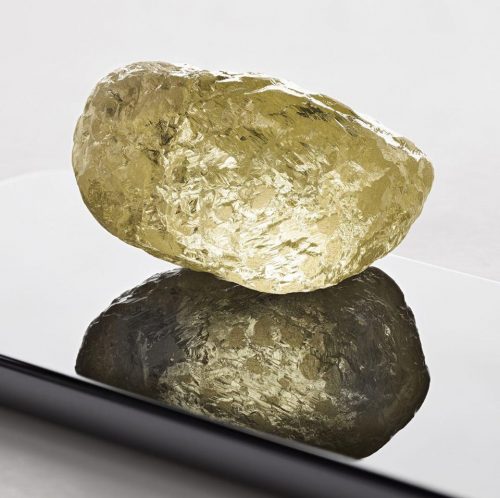
Finding exceptionally large diamonds is rare. Finding extra large diamonds in fancy colors is even more rare. As such, the announcement by  Dominion Diamond Mines that it has unearthed  the largest known diamond ever found in North America is big news.

 Found in October at the Diavik Diamond Mine in  Calgary, Canada, the Canadamark yellow diamond weighs in at 552 carats and beats the previous record (held by the Diavik Foxfire diamond) of 187.7 carats that was also found at the same mine.

Dominion Diamond Mines ULC sources responsibly mined diamonds and owns 40 percent of Diavik.

 The Diavik Diamond Mine is just shy of 150 miles south of the Arctic Circle in the Northwest Territories of Canada, and has produced several important stones in the past. This newest discovery measures about 1-1/2 inches in diameter and more than 2 inches in height. The color and texture are unique geologically speaking, as such a large and rare yellow diamond doesn’t usually form in the region. According to Dominion Diamond Mines’ release, “Abrasion markings on the stone’s surface attest to the difficult journey it underwent during recovery, and the fact that it remains intact is remarkable.”

The Canadamark(TM) program by Dominion Diamond Mines ensures that all diamonds bearing its logo are rigorously tracked from mine to polished gem in order to offer final consumers  full transparency of the supply chain. Once the rough is cut, the diamonds will  be certified as Canadamark(TM).

In the case of the previously found Diavik Foxfire diamonds,  rather than sell it in the rough, the stone was  cut and polished  — yielding a 37.87-carat brilliant-cut pear shaped diamond and a 36.80 carat brilliant-cut pear shape. Both of these stones sold recently at a Christie’s auction for $1.3 million.  It is expected that Dominion Diamond Mines will take the same approach with the 552-carat Canadamark(TM) yellow diamond. The yield could be several larger sized diamonds that Foxfire, or could be similar sizes but more of them.  It is impossible to know, as a rough diamond must be carefully studied before being cut to determine the perfect size and shape of the finished, polished stones that will show off their most beautiful color and brilliance.

Certain other fancy yellow  diamonds have made history. In fact, among the world’s largest yellow diamonds is the 439.86 carat light-yellow diamond that was found by DeBeers in 1888 and later cut into a 234.65-carat cushion-cut stone.  The Tiffany Yellow Diamond is also one of  the largest ever discovered. It weighted 287.42 carats in the rough when it was found in 1878 in the Kimberly Mine in South Africa. It was eventually cut in to the 128.54-carat cushion known a the Tiffany Yellow Diamond.

According to  a release issued by Dominion Diamond Mines, Kyle Washington, Chairman, says  “This incredible discovery showcases what is truly spectacular about Canadamark diamonds. “The color and texture of the diamond are a unique example of the journey that natural diamonds take from their formation until we unearth them. Our Diavik Mine has produced some of the most beautiful diamonds in the world, and this one certainly tops the list.”

Souce: DCLA

552 Carat Yellow Diamond Is The Largest Ever Found In Canada


Finding exceptionally large diamonds is rare. Finding extra large diamonds in fancy colors is even more rare. As such, the announcement by  Dominion Diamond Mines that it has unearthed  the largest known diamond ever found in North America is big news.

 Found in October at the Diavik Diamond Mine in  Calgary, Canada, the Canadamark yellow diamond weighs in at 552 carats and beats the previous record (held by the Diavik Foxfire diamond) of 187.7 carats that was also found at the same mine.

Dominion Diamond Mines ULC sources responsibly mined diamonds and owns 40 percent of Diavik.

 The Diavik Diamond Mine is just shy of 150 miles south of the Arctic Circle in the Northwest Territories of Canada, and has produced several important stones in the past. This newest discovery measures about 1-1/2 inches in diameter and more than 2 inches in height. The color and texture are unique geologically speaking, as such a large and rare yellow diamond doesn’t usually form in the region. According to Dominion Diamond Mines’ release, “Abrasion markings on the stone’s surface attest to the difficult journey it underwent during recovery, and the fact that it remains intact is remarkable.”

The Canadamark(TM) program by Dominion Diamond Mines ensures that all diamonds bearing its logo are rigorously tracked from mine to polished gem in order to offer final consumers  full transparency of the supply chain. Once the rough is cut, the diamonds will  be certified as Canadamark(TM).

In the case of the previously found Diavik Foxfire diamonds,  rather than sell it in the rough, the stone was  cut and polished  — yielding a 37.87-carat brilliant-cut pear shaped diamond and a 36.80 carat brilliant-cut pear shape. Both of these stones sold recently at a Christie’s auction for $1.3 million.  It is expected that Dominion Diamond Mines will take the same approach with the 552-carat Canadamark(TM) yellow diamond. The yield could be several larger sized diamonds that Foxfire, or could be similar sizes but more of them.  It is impossible to know, as a rough diamond must be carefully studied before being cut to determine the perfect size and shape of the finished, polished stones that will show off their most beautiful color and brilliance.

Certain other fancy yellow  diamonds have made history. In fact, among the world’s largest yellow diamonds is the 439.86 carat light-yellow diamond that was found by DeBeers in 1888 and later cut into a 234.65-carat cushion-cut stone.  The Tiffany Yellow Diamond is also one of  the largest ever discovered. It weighted 287.42 carats in the rough when it was found in 1878 in the Kimberly Mine in South Africa. It was eventually cut in to the 128.54-carat cushion known a the Tiffany Yellow Diamond.

According to  a release issued by Dominion Diamond Mines, Kyle Washington, Chairman, says  “This incredible discovery showcases what is truly spectacular about Canadamark diamonds. “The color and texture of the diamond are a unique example of the journey that natural diamonds take from their formation until we unearth them. Our Diavik Mine has produced some of the most beautiful diamonds in the world, and this one certainly tops the list.”

Souce: DCLA

Natural or Laboratory-Grown? How Can You Tell What Diamond Is in Your Ring?

  Buying a diamond is a significant investment, and for many people, understanding exactly what they own is just as important as the beauty ...