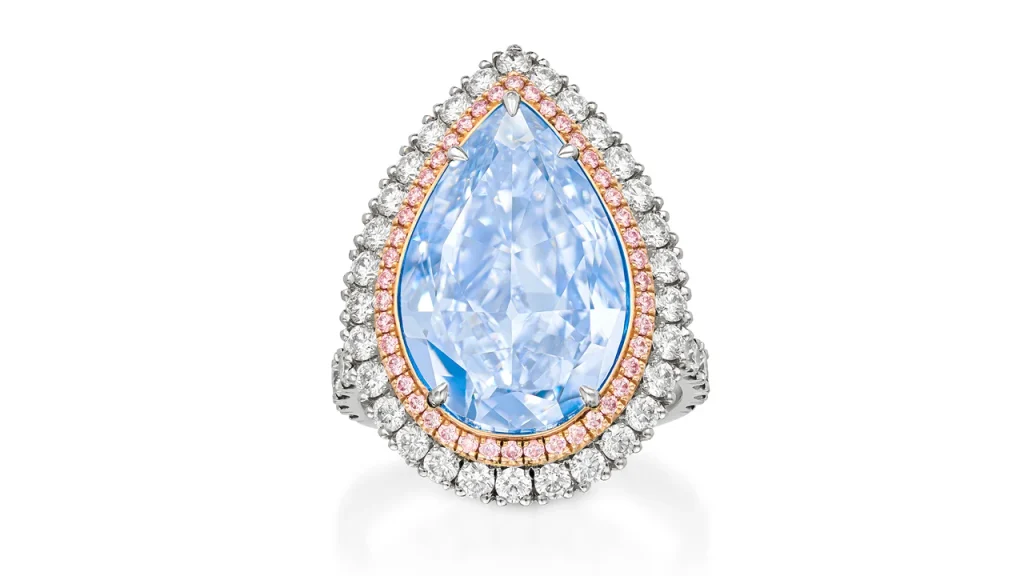
Showing posts with label blue diamond. Show all posts

Monday, 27 July 2026

The Art of Contrast: Why Mixing Coloured Diamonds Creates Extraordinary Jewellery

 The Importance of Colour Matching

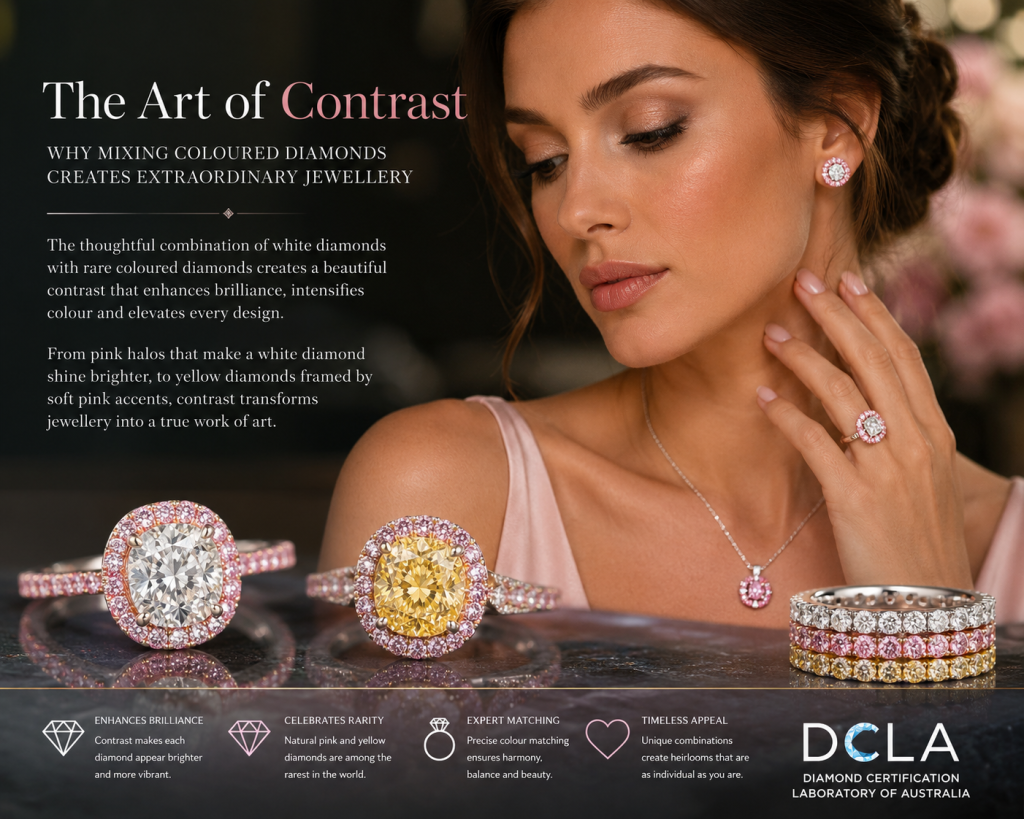
For centuries, white diamonds have been regarded as the ultimate symbol of elegance and timeless beauty. Today, however, the world’s leading jewellery designers are embracing a more artistic approach combining white diamonds with rare coloured diamonds to create striking pieces that are as unique as they are valuable.

From delicate pink diamond halos surrounding a brilliant white centre stone to vivid yellow diamonds framed by soft pink accents, the thoughtful use of contrasting colours can transform an already beautiful diamond into an exceptional work of art.

The result is jewellery that is not only visually captivating but often far more distinctive than traditional all-white diamond designs.

Colour Creates Emotion

The human eye is naturally drawn to contrast.

Artists have understood this for centuries, using complementary colours to create depth, balance and visual impact. Jewellery designers apply the same principles when working with diamonds.

A perfectly colourless diamond surrounded by a halo of natural pink diamonds immediately appears brighter and more vibrant. The soft blush tones create warmth around the crisp white centre stone, producing a romantic and luxurious appearance that cannot be achieved with white diamonds alone.

Similarly, a rich yellow diamond surrounded by pink diamonds creates a dramatic contrast. The warmth of the yellow is enhanced by the cool undertones of the pink, allowing each colour to appear richer and more saturated.

Rather than competing with one another, the colours work together to produce greater visual intensity.

The Rise of Coloured Diamond Combinations

While coloured diamonds have always been prized by collectors, improvements in jewellery design and precision manufacturing have encouraged designers to use them in increasingly creative ways.

Some of today’s most sought-after combinations include:

  • A colourless diamond framed by a halo of natural pink diamonds.
  • Fancy Yellow diamonds surrounded by Argyle pink diamonds.
  • Fancy Intense Yellow centre stones with white diamond halos.
  • White diamonds accented with blue or champagne diamonds.
  • Pink diamonds paired with white pavĂ© settings.
  • Three-stone rings featuring contrasting diamond colours.
  • Alternating white and coloured diamonds in eternity bands.

Each combination creates its own personality, allowing jewellery to become an expression of individual style rather than simply following tradition.

Pink Diamonds: Small Stones with Extraordinary Impact

Natural pink diamonds occupy a unique position within the diamond world.

Even very small pink diamonds possess remarkable rarity, particularly those originating from Australia’s now-closed Argyle Mine. Their limited availability has made them highly desirable among collectors and designers alike.

A halo of pink diamonds surrounding a larger white diamond allows jewellers to showcase this rarity without requiring a large pink centre stone.

The effect is remarkable.

The pink diamonds add warmth and sophistication while visually enhancing the brilliance of the colourless centre diamond.

Because the halo consists of numerous carefully matched stones, the overall impression is one of richness and refinement.

Yellow Diamonds Come Alive with Contrast

More Than Beauty, A Celebration of Rarity


Yellow diamonds are among the most popular naturally coloured diamonds available today.

When used as the centrepiece of a ring, they radiate warmth and vibrancy. However, surrounding a yellow diamond with carefully selected pink diamonds introduces an entirely new dimension.

The soft pink tones gently frame the yellow centre, making its colour appear deeper and more saturated. At the same time, the yellow diamond provides a striking focal point against the delicate pink border.

Many luxury jewellery houses have embraced this combination because it creates an appearance that is simultaneously elegant, modern and unmistakably distinctive.

More Than Beauty, A Celebration of Rarity

Combining different coloured diamonds is not simply a design trend.

It is often a celebration of rarity.

Natural fancy coloured diamonds account for only a very small percentage of all diamonds recovered worldwide. Finding matching stones with similar colour intensity, clarity and size requires exceptional expertise.

Every carefully matched halo represents countless hours of diamond selection.

The more precisely the colours complement one another, the more harmonious and valuable the finished piece becomes.

The Importance of Colour Matching

Creating a successful coloured diamond design involves far more than selecting attractive stones.

Professional jewellers carefully consider:

  • Colour hue
  • Colour intensity
  • Tone
  • Saturation
  • Diamond size
  • Cut precision
  • Overall symmetry

Even slight variations between pink diamonds can affect the appearance of a halo.

Likewise, white accent diamonds must be matched for colour and brilliance to ensure they enhance rather than distract from the centre stone.

This meticulous attention to detail is what separates exceptional jewellery from ordinary jewellery.

Precious Metals Complete the Design

The choice of metal plays an equally important role.

Platinum and white gold enhance the brilliance of colourless diamonds and provide a contemporary appearance.

Yellow gold intensifies the warmth of yellow diamonds while offering a classic, timeless aesthetic.

Rose gold has become increasingly popular for pink diamond jewellery, complementing the delicate blush tones and creating a seamless flow of colour throughout the design.

Some of the most sophisticated creations combine multiple precious metals, allowing each section of the ring to highlight a different coloured diamond.

A New Era of Personal Expression

Today’s clients are increasingly seeking jewellery that reflects their individuality.

Mixing coloured diamonds allows designers to create bespoke pieces that cannot be replicated simply by increasing diamond size or carat weight.

Whether choosing a white diamond embraced by a halo of rare pink diamonds or a radiant yellow diamond accented with white and pink stones, these combinations create jewellery that tells a story through colour, contrast and craftsmanship.

Beauty Enhanced by Contrast

The finest jewellery is rarely about excess it is about balance.

The careful pairing of white, pink and yellow diamonds demonstrates how contrast can enhance brilliance, intensify colour and elevate an already beautiful design into something truly extraordinary.

As coloured diamonds continue to capture the imagination of collectors and jewellery lovers around the world, their thoughtful combination with traditional white diamonds is redefining modern luxury.

When selected with care and expertly matched, contrasting diamond colours do more than create visual impact they create timeless pieces whose beauty lies not only in the rarity of the individual diamonds, but in the harmony they achieve together.

Source: DCLA

Wednesday, 17 June 2026

The Heart of Eternity Diamond: The Extraordinary Blue Diamond That Could Redefine Rarity

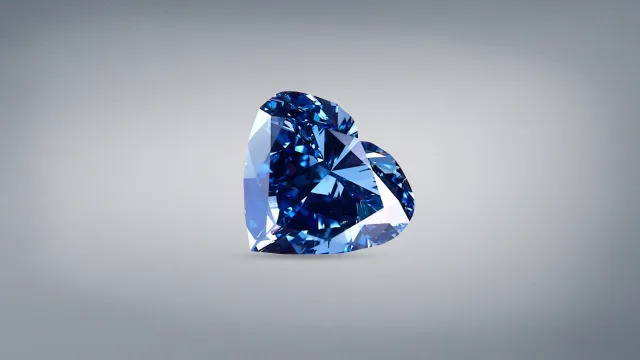
 Among the world’s most exceptional gemstones, few diamonds capture the imagination quite like the Heart of Eternity Diamond. A 27.64 carat Fancy Vivid Blue heart shaped diamond

Among the world’s most exceptional gemstones, few diamonds capture the imagination quite like the Heart of Eternity Diamond. A 27.64 carat Fancy Vivid Blue heart shaped diamond, this extraordinary gem represents one of the rarest combinations in the diamond world: exceptional size, intense colour, remarkable clarity, and a story filled with mystery, intrigue, and immense value.

Blue diamonds are among the rarest natural diamonds ever discovered. Their colour comes from trace amounts of boron trapped within the diamond crystal structure during formation deep beneath the Earth’s surface. Unlike traditional colourless diamonds, where rarity is often measured by size and clarity, coloured diamonds are judged by the strength and beauty of their colour, with vivid blues commanding extraordinary premiums.

The Heart of Eternity Diamond sits at the highest level of this category, officially graded Fancy Vivid Blue by the Gemological Institute of America (GIA), placing it among the finest blue diamonds ever evaluated.

A Diamond Born from One of the World’s Most Famous Mines

The story of the Heart of Eternity Diamond begins at the legendary Cullinan Diamond Mine in South Africa, formerly known as the Premier Diamond Mine.

This historic mine has produced some of the most important diamonds in history, including the famous Cullinan Diamond, discovered in 1905. The Cullinan Diamond weighed an extraordinary 3,106 carats in rough form and was later cut into nine major diamonds, many of which became part of the British Crown Jewels.

The same geological conditions that created the Cullinan Diamond also produced some of the world’s most valuable blue diamonds, including the Heart of Eternity.

A Gemstone From a Category of Extreme Rarity

At 27.64 carats, the Heart of Eternity is not the largest blue diamond ever discovered, but its combination of size, colour, and shape places it in a category occupied by only a handful of legendary stones.

Natural blue diamonds represent only a tiny fraction of all diamonds mined worldwide. Within that group, stones with a vivid blue colour, significant carat weight, and exceptional quality are almost impossible to replace.

The heart shape adds another layer of uniqueness. While round brilliant diamonds dominate the market for maximum brilliance, a perfectly executed heart shaped diamond requires exceptional rough material and highly skilled cutting to preserve both beauty and weight.

The Mystery Behind the Diamond

The Heart of Eternity Diamond was revealed to the world in the late 1990s after being cut from a much larger rough blue diamond. It became part of the collection of De Beers, which showcased the stone as one of the most remarkable examples of natural blue diamond beauty.

The diamond later attracted significant attention when reports linked it to private ownership and high profile collectors. Like many of the world’s greatest diamonds, its current ownership has remained surrounded by secrecy, adding to its legendary status.

A Value That Could Reach Historic Levels Today

When exceptional blue diamonds appear at auction, they frequently achieve some of the highest prices ever recorded for gemstones.

The famous Blue Moon of Josephine, a 12.03 carat Fancy Vivid Blue diamond, sold for more than US$48 million in 2015, setting a record price per carat at the time.

The Heart of Eternity Diamond is more than twice the size of the Blue Moon of Josephine, while also possessing the highly desirable Fancy Vivid Blue classification. If a diamond of this quality entered the market today, many experts believe it could command a valuation reaching hundreds of millions of dollars.

Why the Heart of Eternity Matters to the Diamond World

The Heart of Eternity Diamond represents more than just a beautiful gemstone. It is a geological miracle, created over billions of years under extreme conditions, then transformed by human craftsmanship into a piece of natural art.

For diamond professionals and collectors, stones like the Heart of Eternity demonstrate why exceptional natural diamonds remain among the world’s most sought after assets. Their rarity cannot be manufactured, their history cannot be replicated, and their value is driven by the simple reality that there are only a few truly exceptional examples in existence.

At DCLA, the study, grading, and understanding of diamonds is built around recognising these unique characteristics. Every extraordinary diamond tells a story, from its formation deep within the Earth to the moment it is revealed as one of nature’s rarest creations.

Monday, 27 April 2026

Geneva Set to Dazzle as Rare Blue Diamonds Headline May Auctions


6.03-Carat Fancy Vivid Blue Diamond

The global diamond market will turn its attention to Sotheby’s and Christie’s this May, as two exceptional blue diamonds each representing the pinnacle of rarity and natural beauty prepare to go under the hammer in Geneva.


Sotheby’s to Offer 6.03-Carat Fancy Vivid Blue Diamond

A 6.03-carat cushion-shaped fancy vivid blue diamond is expected to achieve up to CHF 9.5 million (approximately USD $12.2 million) at Sotheby’s High Jewellery auction on May 12 in Geneva.

The diamond is graded internally flawless and classified as a Type IIb stone a category that includes some of the rarest and most chemically pure diamonds in the world. Type IIb diamonds are distinguished by the presence of boron, which imparts their highly sought-after blue colour and exceptional optical properties.

This important piece will headline a broader offering of high jewellery from renowned maisons including Van Cleef & Arpels, Bucherer, and Cartier, alongside a curated selection of coloured diamonds and rare gemstones.


“The Ocean Dream” Returns to Christie’s

The Ocean Dream Diamond


Also commanding global attention is the reappearance of the legendary “Ocean Dream,” a 5.50-carat fancy vivid blue-green diamond, set to headline Christie’s Magnificent Jewels auction on May 13 at the Four Seasons Hotel des Bergues in Geneva.

Certified by the Gemological Institute of America, the Ocean Dream holds the distinction of being the largest known fancy vivid blue-green diamond in the world. Its unique hue reminiscent of tropical seawater places it among the rarest colour expressions ever documented in natural diamonds.

Unlike the Type IIb blue offered at Sotheby’s, the Ocean Dream is classified as a Type Ia diamond. While Type Ia stones account for approximately 95% of all natural diamonds, they are rarely associated with such intense and unusual colour saturation, making this specimen an extraordinary anomaly.

The diamond, cut into a distinctive triangular shape, originated from an 11.70-carat rough discovered in Central Africa during the 1990s. It is expected to achieve between CHF 7 million and CHF 10 million (USD $8.9 million to $12.7 million).


A Stone of Museum-Level Importance

The Ocean Dream first gained international recognition during the 2003 “Splendor of Diamonds” exhibition at the Smithsonian National Museum of Natural History, where it was showcased among eight of the rarest diamonds ever discovered.

Max Fawcett, Global Head of Jewellery at Christie’s, has described the stone as “an exceptional jewel of profound rarity and allure,” underscoring its importance not only within the auction market but also in the broader gemological landscape.

This upcoming sale marks the diamond’s second appearance at auction. It was previously sold by Christie’s in 2014 for CHF 7.7 million, achieving approximately $1.4 million per carat at the lower end of its estimate at the time.


Market Significance

The simultaneous offering of two world-class blue diamonds each representing different diamond types and colour origins highlights continued strength at the top end of the coloured diamond market. For collectors and investors alike, these stones underscore the enduring appeal of rarity, provenance, and gemological significance.

As Geneva once again becomes the focal point of the high jewellery world, the results of these sales will provide further insight into pricing dynamics for the rarest natural diamonds, particularly as supply remains constrained and global demand for exceptional stones continues to grow.

Source: DCLA

Tuesday, 17 March 2026

LUCARA RECOVERS EXCEPTIONAL 36.92 CARAT BLUE DIAMOND FROM KAROWE


36.92 CARAT BLUE DIAMOND

Lucara Diamond Corp. has announced the recovery of a remarkable 36.92 carat blue diamond from its wholly owned Karowe Diamond Mine in Botswana further reinforcing Karowe’s reputation as one of the world’s most prolific sources of rare and high-value diamonds.

The newly recovered stone is described as a high-quality Type IIb blue diamond, a category renowned for its extreme rarity, boron content, and exceptional optical properties. The diamond was recovered using X-ray Transmission (XRT) technology from stockpiled ore, highlighting the continued value embedded within Karowe’s surface material.

In addition to this notable discovery, Lucara reports that five diamonds exceeding 100 carats have been recovered year-to-date from the processing of stockpiles. These results underscore the consistent recovery profile of large, high-quality stones from the Karowe resource.

William Lamb, President and CEO of Lucara, commented that the recovery of this exceptional blue diamond further demonstrates the unique nature of the Karowe asset. He emphasised that such finds validate the strategic importance of stockpile processing as a meaningful contributor to ongoing production.

Since commencing operations in 2012, Karowe has established itself as a leading producer of large, high-value Type IIa diamonds. The mine remains the cornerstone of Lucara’s operations and future growth strategy.

Looking ahead, Karowe is undergoing a significant transition from open-pit to underground mining through the development of the Karowe Underground Project (UGP). This expansion is designed to unlock access to the highest-value portions of the orebody. Underground development ore is expected to begin supplementing stockpile feed by 2027, with full-scale underground production targeted for the first half of 2028.

This latest recovery not only highlights the enduring value of Karowe’s resource but also reinforces Botswana’s standing as a premier origin for some of the world’s most extraordinary diamonds.

Source: DCLA

Sunday, 18 January 2026

The Farnese Blue Diamond: Three Centuries Through Europe’s Royal Courts

 The Farnese Blue Diamond

The Farnese Blue occupies a rare position among historic natural diamonds. It is not merely a gemstone with provenance, but a silent participant in more than three centuries of European political power, dynastic ambition, revolution, and exile. For most of its existence, it remained known only to a small circle of royal descendants, absent from public record and scholarly examination.

That secrecy ended in 2018 when the 6.16-carat pear-shaped natural Fancy Dark Gray-Blue diamond appeared unexpectedly at Sotheby’s Geneva. Its emergence stunned historians and gem specialists alike. Offered publicly for the first time in its recorded history, the Farnese Blue achieved USD $6.7 million—well above estimate—before being acquired by an anonymous buyer. With that sale, one of Europe’s most historically significant diamonds passed from royal custody into the modern market.


A Golconda Diamond of Exceptional Origin

The Farnese Blue originated in the legendary Golconda mines of India, the world’s most important diamond source for over a millennium. Long before Brazil or South Africa entered the diamond trade, Golconda supplied every known diamond in existence. The Hope Diamond, the Koh-i-Noor, the Regent, and the Wittelsbach-Graff all share this same geographic origin near present-day Hyderabad.

Golconda diamonds travelled ancient trade routes linking Asia and Europe, where merchants competed for stones prized for their exceptional clarity, colour, and crystalline structure. Their rarity and value ensured they were acquired almost exclusively by royalty and the most powerful figures of their time. The Farnese Blue belongs firmly within this elite lineage.


A Queen Without a Dowry: Entry Into Spanish Royal History

Elisabeth Farnese, Queen consort of Spain. In 1715, King Philip V of Spain

The Farnese Blue first entered recorded European history through Elisabeth Farnese, Queen consort of Spain. In 1715, King Philip V of Spain grandson of Louis XIV required a new queen. The political climate demanded a bride of royal blood, but without excessive dynastic influence.

Elisabeth, a princess of the Duchy of Parma and a descendant of Pope Paul III, met these requirements precisely. However, Spain’s finances had been devastated by the War of the Spanish Succession, and her father was unable to provide a traditional royal dowry.

To compensate, Spain turned to its global colonies. In August 1715, the so-called “Golden Fleet” departed Cuba carrying gold bullion and precious gemstones gathered for the royal wedding. A hurricane in the Gulf of Florida destroyed nearly the entire fleet, consigning its riches to the sea.

One extraordinary diamond survived.

The governor of the Philippine Islands presented a pear-shaped blue diamond to the new queen. That stone would become known as the Farnese Blue.


Three Centuries in Royal Exile

From that moment onward, the Farnese Blue passed quietly through Europe’s most powerful royal houses. Elisabeth Farnese bore seven children and worked tirelessly to secure dynastic influence across the continent. The diamond was likely entrusted to her son Philip, founder of the House of Bourbon-Parma.

It subsequently passed through successive generations: to Ferdinand, to King Louis of Etruria, and then to Charles Louis (King Louis II), who mounted the diamond as a tie pin. Political upheaval forced him into exile under the title Comte de Villafranca, yet he retained the diamond throughout his life.

Upon his death in 1883, the Farnese Blue passed to his grandson Robert, the last ruling Duke of Parma. After losing his throne, Robert sought refuge with his cousin, Emperor Franz Joseph of Austria, taking the diamond with him.

The stone later passed to Prince Elia and his wife, Archduchess Maria Anna of Austria. Her meticulous jewellery inventories proved invaluable to history, preserving the diamond’s provenance with remarkable clarity. Among her collection was a tiara containing diamonds once owned by Marie Antoinette. She incorporated the Farnese Blue still set as a tie pin into that tiara and wore it frequently.


Reemergence at Sotheby’s: From Royal Secrecy to Public Record

Following the collapse of the Austrian Empire in 1918, the Farnese Blue disappeared once again from public view. For decades, it remained absent from scholarship and gemological examination.

Its reappearance in 2018 marked a pivotal moment. Now mounted within a colourless diamond halo on a detachable pin, the Farnese Blue was examined and graded by the Gemological Institute of America for the first time. It received an official classification as a natural Fancy Dark Gray-Blue diamond with SI1 clarity.

That same year, Sotheby’s offered the stone at auction for the first time in its three-hundred-year history. The result confirmed what experts already understood: a natural diamond of exceptional rarity, when paired with uninterrupted, well-documented royal provenance, transcends its material value.

The Farnese Blue stands today as one of the most extraordinary surviving diamonds of European royal history an enduring witness to the rise and fall of empires, preserved through centuries by those who understood its significance long before the modern world was permitted to see it.

Tuesday, 13 January 2026

Petra Recovers Huge 41.82-ct Blue Diamond

 Petra  41.82-carat Type IIb blue diamond

Petra Diamonds today announced the recovery of a huge 41.82-carat Type IIb blue diamond at its Cullinan Mine, in South Africa.

The UK-based miner described the stone as being of “seemingly exceptional quality in terms of both its colour and clarity”.

The iconic Cullinan mine is known for recovering high-value blue stones.

Last April it sold a 14.76ct blue stone, of “exceptional color and clarity” for $8.2m.

In July 2021 it sold a 39.34-carat blue diamond for $40.18m. The Letlapa Tala collection of five blue diamonds sold in November 2020 for $40.36m.

And a 29.60-carat rough that was cut into the Blue Moon sold for $25.6m in February 2014. It was subsequently auctioned in 2015 for $48.5m to Hong Kong billionaire Joseph Lau, who renamed it the Blue Moon of Josephine.

Petra says it is in the process of analyzing the stone and deciding on a preferred method of the sale.

In October Petra Diamonds announced details of a $25m rights issue to keep the company afloat as it battles falling prices and production, together with rising debt and cash flow difficulties.

Revenue for FY2025 was $206m, down 33 per cent year-on-year from $309m and net debt increased to $264m.

Source: DCLA

Thursday, 8 May 2025

Rare 10-Carat Blue Diamond Could Fetch $20 Million at Sotheby’s Geneva Auction

Mediterranean Blue Diamond

A remarkable 10-carat blue diamond, dubbed the “Mediterranean Blue Diamond,” is expected to achieve up to $20 million when it goes under the hammer at Sotheby’s in Geneva on 13 May. The diamond, which boasts the highly coveted “fancy vivid blue” colour grade, represents one of the most prized and rare categories in the world of coloured diamonds.

Discovered in 2023 at South Africa’s famed Cullinan mine, the Mediterranean Blue was originally a rough diamond weighing an impressive 31.94 carats. What followed was an extraordinary journey — a full year of study, including precise analysis to maximise both beauty and value, and six months of planning and expert cutting to reveal the gem in its final cushion-shaped form.

Sotheby’s, which is overseeing the auction, describes the diamond as a standout in its class. Jessica Wyndham, head of high jewellery at Sotheby’s Geneva, remarked, “The market for coloured diamonds continues to go from strength to strength.” Indeed, blue diamonds of this size and calibre are vanishingly rare, and collectors around the world are likely to compete fiercely for the chance to own such an exceptional gem.

Mediterranean Blue Diamond

Fancy vivid blue is the highest grading for coloured diamonds, denoting a saturation and purity of colour that few stones ever achieve. The Mediterranean Blue, with its intense oceanic hue and exceptional clarity, is a testament to nature’s rarity and human craftsmanship.

Over the years, similar diamonds have fetched extraordinary prices. In 2016, the “Oppenheimer Blue,” a 14.62-carat fancy vivid blue diamond, sold for a staggering $68.7 million at Christie’s in Geneva, setting a world record for any fancy vivid blue diamond sold at auction. That same year, another exceptional blue stone — a 24.18-carat intense blue diamond also mined from the Cullinan site — sold for $25 million, reinforcing the global appetite for ultra-rare coloured diamonds.

The Cullinan mine, known for producing some of the world’s most famous diamonds — including parts of the Cullinan I and II, which are part of the British Crown Jewels — has once again proven its status as a source of legendary stones.

With demand for coloured diamonds surging, particularly among high-net-worth collectors and investors seeking portable, tangible assets, the upcoming sale of the Mediterranean Blue Diamond is expected to draw worldwide attention.

Its appearance at auction not only marks a rare opportunity to acquire a gem of unmatched beauty and provenance, but also reflects the continuing strength and allure of the coloured diamond market — where rarity and story combine to create lasting value.

Source: DCLA

Monday, 14 April 2025

The Golconda Blue: The Largest Fancy Vivid Blue Diamond Ever Seen at Auction

Christie’s is preparing to showcase something truly extraordinary

Christie’s is preparing to showcase something truly extraordinary — The Golconda Blue, a 23.24 carat Fancy Vivid Blue diamond, set to headline the Magnificent Jewels auction in Geneva on 14 May. Held at the Four Seasons Hotel des Bergues, this remarkable stone carries an estimate of between $35 million and $50 million.

Mounted in a ring designed by the legendary JAR, The Golconda Blue is not only the largest Fancy Vivid Blue diamond ever offered at auction — it’s also one of the rarest and most historically significant diamonds in existence.

Its journey through history is as dazzling as the stone itself. Originally owned by Yeshwant Rao Holkar, the Maharaja of Indore — a prominent patron of art and fine jewellery in the 1920s and 1930s — the diamond was first set into a bracelet by Chaumet in 1923. A decade later, Mauboussin transformed it into a necklace worn by the Maharani, immortalised in a striking portrait by Bernard Boutet de Monvel.

In 1947, the diamond was acquired by none other than Harry Winston, who later sold it as a brooch to the Maharaja of Baroda. After years of being held privately, The Golconda Blue is now returning to the public eye for the first time in decades.

Rahul Kadakia, Christie’s international head of jewellery, called it “a once-in-a-lifetime opportunity,” noting the auction house’s long history with legendary Golconda diamonds such as the Archduke Joseph, the Princie, and the Wittelsbach.

The term Golconda itself refers to the legendary diamond mines of Eastern India, famous for producing some of the world’s most luminous, transparent, and pure gems. Among them are historic stones like the Koh-i-Noor, the Hope Diamond, and the Darya-i-Nur — and now, The Golconda Blue joins this rarefied list.

This sale is not just about a diamond. It’s about history, heritage, and the timeless allure of one of nature’s most breathtaking creations.

Source: DCLA

Wednesday, 11 December 2024

5.72-ct Blue Diamond Sells for $8.8m

5.72 carat fancy intense blue diamond

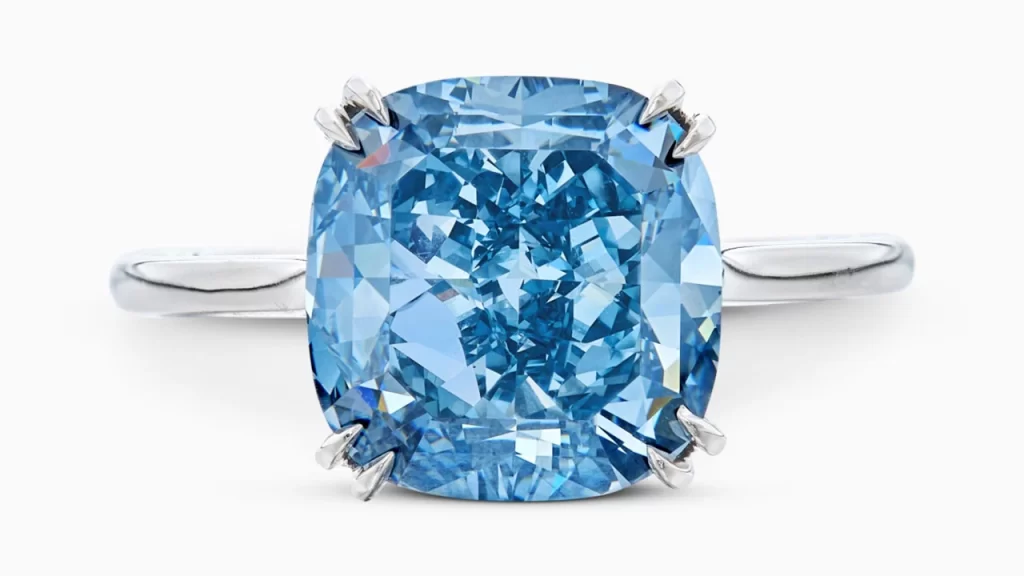
A 5.72 carat fancy intense blue diamond beat its high estimate and sold for $8.8m yesterday (10 December) at Christie’s New York.

The cushion brilliant cut VVS1 stone, set in a platinum ring with round diamonds, was the highlight of the Magnificent Jewels auction.

The price realized was $1,539,336 per carat. The pre-sale estimate was $6m to $8m.

The second highest price was for a pair of Harry Winston spinel and diamond earrings. They sold for $2,228,000—four times their high estimate of $600,000.

The sale raised a total of $49.2m, with 97 per cent of the 179 lots finding buyers. 

Rahul Kadakia, Christie’s international head of jewelry, said: “Today’s sale in New York was a testament to the vibrant market for jewelry of the highest caliber with singular provenance.

“We were particularly pleased with the result of the top lot – a fantastic fancy intense blue diamond ring that sold for $8.8m.”

The Fancy Color Research Foundation gave the blue diamond a visual score of 8 out of 12 in its pre-sale analysis, noting its low color dispersion.

It said: “True Face-Up: Equivalent to that of a 9.15 carat which is ~59.9 per cent larger than the average

“Analysis: A Fancy Intense Blue Cushion brilliant-cut diamond,  polished as a classic colorless diamond, probably manufactured during the 1960s or 1970s. 

“The diamond’s inner-grade is very strong, and modifying its facet alignment could increase its saturation to vivid. No significant gray undertone is present in the color.”

Source: DCLA

Wednesday, 13 November 2024

Qatari Royal Family in Court over Idol’s Eye Diamond

A legal battle over the Idol's Eye, a 70.21-carat very light blue, eye-shaped Golconda diamond, began on Monday (11 November) at the High Court, London.

A legal battle over the Idol’s Eye, a 70.21 carat very light blue, eye shaped Golconda diamond, began on Monday (11 November) at the High Court, London.

Two branches of Qatar’s royal family are in dispute over the value of the gem – which could be anywhere between $10m and $27m.

The disagreement is between Qipco, a private investment company run by art collector Sheikh Hamad bin Abdullah al-Thani – a cousin of Qatar’s ruler Sheikh Tamim bin Hamad Al Thani – and Elanus Holdings, a company linked to the family of former culture minister Sheikh Saud bin Mohammed Al Thani.

Elanus loaned the diamond to Qipco in 2014 for 20 years, with an option to buy but the two sides disagree over the value of the stone. It is reported to be worth at least $10m, but according to a Reuter’s report, Elanus’s diamond expert has valued it at $27m.

Qipco says Elanus offered to sell the gem in February 2020, but then pulled out. Elanus disputes this.

Qipco is asking the High Court to force Elanus to go through with the sale.

The Idol’s Eye has a long and complex history. It was recovered in 1600 in the Kollur Mine, part of the Golconda Sultanate in southern India, was initially owned by Prince Rahab of Persia, and was auctioned by Christie’s London in 1865.

It has changed hands many times and has, at various stages, been owned by Harry Winston and Laurence Graff.

Source: DCLA

Thursday, 10 October 2024

5 carat Blue Diamond with $10m US Estimate

5 carat Blue Diamond with $10m US Estimate

A stunning platinum ring featuring a 5.02 carat blue diamond is set to headline Christie’s Hong Kong auction later this month, with an estimated value of up to US $10.3 million (HKD 80 million).

The centerpiece is an internally flawless, fancy deep blue marquise brilliant-cut diamond, graded by the Gemological Institute of America (GIA).

Dating back to 1923, the ring is listed in the auction catalog as “property of a lady,” though further details about the owner remain undisclosed.

This exquisite piece will lead the highly anticipated 124-lot Magnificent Jewels live sale on October 29, alongside a pair of diamond “Oriental Sunrise” earrings.

These earrings showcase two fancy vivid orange yellow diamonds (12.20 carats and 11.96 carats) and share the same US $10.3 million (HKD 80 million) high estimate.

Source: DCLA

Jewellery Costs vs Selling Prices: How to Buy Smart, Protect Your Investment, and Know Your Options When It’s Time to Sell

  Understanding the Difference Between What Jewellery Costs and What It Is Worth Buying a piece of jewellery is often an emotional decision....