Showing posts with label diamond. Show all posts

Tuesday, 9 December 2025

How Efforts to Control the Diamond Trade Are Hurting the Very Communities They Were Supposed to Protect

Control the Diamond Trade Are Hurting the Very Communities They Were Supposed to Protect

For more than two decades, global policies aimed at restricting the flow of diamonds from conflict zones most notably through the “blood diamond” narrative have reshaped the way diamonds are traded. These measures were intended to protect vulnerable communities in Africa from exploitation and violence. But today, the ripple effects of those same restrictions are being felt thousands of kilometres away, exposing the fragility of a supply chain that depends on the livelihoods of millions.

In India’s diamond capital of Surat, where an estimated 80% of the world’s diamonds are cut and polished, workers like Alpesh Bhai once saw diamonds as a pathway out of poverty. The industry offered stability, income, and, for the first time, the promise of private education for their children.

That progress has since been jeopardised.

A Perfect Storm of Restrictions and Sanctions

First, sanctions targeting Russian rough diamonds disrupted supply a supply which, for India, had been essential. Then came the imposition of 50% United States tariffs on polished diamonds, compounding the downturn.

The intention behind these measures from conflict-diamond controls in Africa to punitive trade tools against Russia has been to hold powerful actors accountable. Instead, the burden has fallen hardest on those with the least power in the chain: cutters, polishers, and their families.

Alpesh, once earning enough to support education for his two young daughters, saw his salary cut nearly in half before losing his job altogether. Private schooling quickly became unaffordable. He withdrew his children and moved them into a public school where learning opportunities are significantly limited.

“I’ve come back to where I started,” he said a sentiment now echoed across Surat.

The Human Cost Behind Supply Chain Pressure

Surat’s diamond sector employs over 600,000 people, many migrants from rural Gujarat who rely entirely on this trade. Layoffs, pay cuts, and reduced working hours have affected close to 400,000 workers.

Families are leaving the city. Children are dropping out of school. In the most tragic cases, mounting financial pressure has led to a rise in worker suicides.

Community leaders describe the situation as unprecedented. “The industry was always a ladder out of poverty,” one union representative explained. “Now that ladder is shaking for many, it’s disappearing.”

A Stark Reminder for the Diamond World

Conversations about responsible sourcing must include responsibility to all those in the value chain including cutters and polishers who transform rough diamonds into the beautiful stones valued globally.

Policies crafted to protect African workers from exploitation have, ironically, become a new form of harm both in Africa, where mining communities still struggle, and now in India, where workers are paying the price for geopolitical decisions far beyond their control.

As the global diamond market continues to evolve, one thing is clear:

Ensuring the ethical integrity of diamonds must not stop at the mine.
It must extend to every skilled hand that shapes them and every child whose future depends on this industry.

DCLA Transparent Certification and Shared Responsibility

Monday, 8 December 2025

Florentine Diamond: Austrian Government Weighs Legal Claim

137.27-carat Florentine Diamond

Austria has convened a panel of experts to assess whether the government has a legitimate claim to the 137.27-carat Florentine Diamond, which resurfaced last month after vanishing for a century.

The newly established Florentine Commission will examine whether the gem belongs to the Austrian state or remains the private property of the Habsburg family.

The diamond, set in a brooch, was taken to Switzerland in 1918, along with other royal jewels, as the Austro-Hungarian Empire collapsed and the imperial family fled into exile. Empress Zita, widow of Emperor Karl I, later deposited the collection in a bank vault in Quebec, Canada – an act kept secret for generations.

Only two of her sons, Robert and Rodolphe, were told of its location, under instructions that the hiding place must remain undisclosed for 100 years after Karl’s death in 1922.

With the diamond’s whereabouts finally revealed, the central question is who owns it.

The First Austrian Republic, created in 1919 after the fall of the monarchy, claimed all Habsburg assets under the Habsburg Law. However, it remains unclear whether that law extended to property already removed from Austrian territory.

The Florentine Commission held its first meeting last Thursday (4 December) and is expected to issue its findings by fall 2026. In a statement the Austrian government described the jewels as having been “taken from the treasury” and “taken abroad”.

The Habsburg family’s position depends on whether the diamonds can be proven to have been classified as personal possessions before the monarchy was abolished. Conversely, Austria must show that the Florentine Diamond was officially part of the state regalia—and that the 1919 law applied to items no longer inside Austria.

The family has said it does not plan to sell the Florentine Diamond, but intends for it to go on public display at a museum in Canada.

Source: IDEX

Sunday, 12 October 2025

Best Jewelry and Watch Results at Sotheby’s Paris for Seven Years

Best Jewelry and Watch Results at Sotheby's

Sotheby’s sales of fine jewelry and watches in Paris raised over $10.9m (EUR 9.3m) last week – the best results for the twin events since 2018.

It was the fourth consecutive white glove sale – an auction in which no lot is left unsold – for fine watches, and nearly half the 269 jewelry lots exceeded their pre-auction high estimates.

Sotheby’s said the results demonstrated “continued strength in the market” and confirmed the strong and growing position of its jewelry department on the international stage.

Notable highlights included a 10.68 carat Kashmir sapphire and diamond ring that sold for $761,000 (EUR 698,500) – more than twice its high estimate -and a Burmese sapphire and diamond Cartier ring with an 18.25-carat sapphire that realized $609,000 (EUR 558,800).

Two lots sold for more than five times their high estimates a diamond pendant that fetched $45,400 / EUR 43,000   (estimate $6,300 to $8,400 / EUR 6,000 to 8,000) and a pair of deGrisogono black and white diamond earrings that sold for $40,000 / EUR 38,000 (estimate $5,300-$7,400 / EUR 5,000 to 7,000).

A Cartier yellow gold wristwatch with bracelet gifted to Joseph Losey, the American film and theater director, by his close friend Elizabeth Taylor and accompanied by an unsigned cigar box gifted by another friend the famous French actor Alain Delon, circa 1967, sold for $111,000 (EUR 95,250).

Source: DCLA

Thursday, 18 September 2025

Diamond selling processes are outdated and hurting producers, trader says

Diamond selling processes are outdated

The sale of diamonds through tenders and auctions is opaque and inefficient and should be revamped for producers to earn more and to survive the current price slump, a leading gem trader said on Thursday.

Oded Mansori, co-founder and managing partner of Belgian gem trader HB Antwerp, said the impact on producers could be reduced by doing away with inefficiencies in the industry.

The diamond market is currently going through a prolonged downturn with demand hurt by global economic uncertainty and the rising popularity of lab-grown stones.

Producer countries such as Botswana have been hard hit by lower revenues, while miners such Burgundy and Lesotho’s biggest diamond mine Letseng have had to lay off workers.

“For years, miners relied on tenders and auctions, systems that look efficient on paper but in practice resemble a casino,” Mansori said in a statement, as the industry battles a crisis considered to be its deepest in history.

“Rough stones are pushed into opaque markets where value is anyone’s guess. When global demand softens, as it has in cycles over the last decade, producers are left exposed. Workers pay the price, while shareholders watch assets decline,” he added.

Rough diamonds are typically sold through a competitive bidding system where buyers place confidential bids on individual stones or parcels.

Mansori, whose company operates a profit-sharing model with miner Lucara Diamond Corp, says producers’ revenues should be tied to the eventual polished value of its stones “rather than gambling on rough sales in opaque auctions”.

Under its partnership with Lucara, HB Antwerp buys stones of 10.8 carat quality and above from the Toronto-listed company’s Karowe Mine in central Botswana at prices based on the estimated polished value of each diamond.

HB Antwerp accounted for 72% of Lucara’s $74-million diamond revenue in the six months to June 30, up from 65% the year before.

The trader says producers can earn up to 40% more revenue if they sell through this model.

Source: DCLA

Thursday, 11 September 2025

Indian Diamond Smuggler Jailed in Vietnam

Indian Diamond Smuggler Jailed in Vietnam

An Indian national has been jailed for seven years in Vietnam after he admitted smuggling diamonds worth $320,000 into the country.

Dapale Alkesh Kashinath, 28, said he’d been paid INR 10,000 ($120) by his employer, a Mumbai-based diamond company, to take the stones into the country without declaring them at customs.

Vietnam charges import duties of up to 27 per cent on polished diamonds and jewelry. VAT and other taxes may also apply.

It was Kashinath’s sixth or seventh smuggling trip. He would meet buyers at hotels and hand over the goods once they’d supplied coded and symbols agreed in advance with his employer.

He was apprehended at Tan Son Nhat International (pictured), Vietnam’s largest airport, in Ho Chi Minh City in October 2024.

X-rays of luggage revealed he had 15 plastic bags, containing 362 natural diamonds, hidden inside two candy boxes.

Kashinath was sentenced to seven years in prison last Friday (5 September) at Ho Chi Minh City People’s Court. An application to pay a fine instead was rejected.

Source: DCLA

Sunday, 7 September 2025

Why Old Mine Cut Diamonds Are Back in Vogue

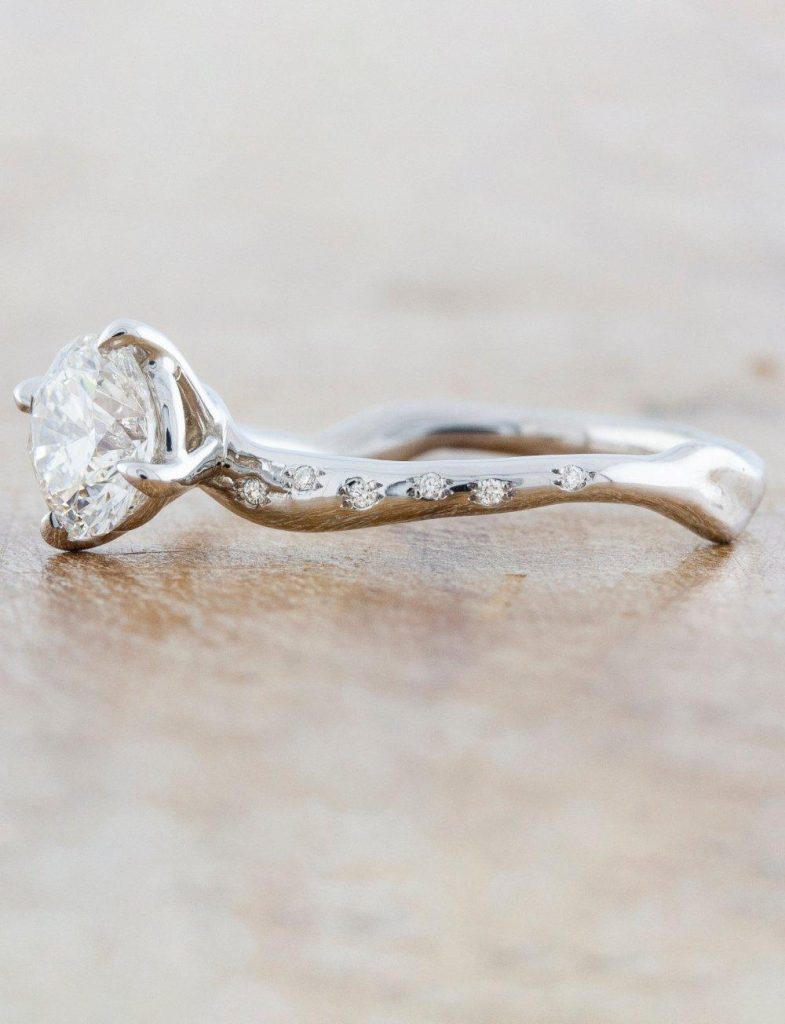
Old Mine Cut Diamonds

In a world where modern technology has made diamond cutting more precise than ever, there has been a surprising revival of one of the oldest styles in diamond history – the old mine cut. Once considered outdated compared to today’s brilliant cuts, these antique gems are now finding favour among collectors, jewellery designers, and couples searching for something truly unique.

A Glimpse into History

The old mine cut originated in the 18th and 19th centuries, long before advanced cutting technology existed. Cut by hand, often by candlelight, each stone carries its own distinctive character. With their cushion-like shapes, high crowns, and larger culets, old mine cuts reflect the craftsmanship of a bygone era. These diamonds were the predecessor to today’s modern round brilliant and are often set in antique or Victorian-era jewellery.

The Allure of Imperfection

Unlike modern cuts that maximise sparkle through precision, old mine cut diamonds are celebrated for their individuality. Their facets were designed for softer, romantic light sources like candlelight, giving them a warmer, more subtle glow. For many buyers, this charm lies in their imperfections – no two are exactly alike.

Sustainability and Authenticity

As sustainability becomes increasingly important in jewellery, old mine cut diamonds are seen as an eco-conscious choice. They are recycled treasures, requiring no new mining, which makes them especially appealing to ethically minded consumers. Owning one also means owning a tangible piece of history – a connection to a time when diamonds were cut entirely by hand.

Modern Designers Embrace the Vintage Appeal

Jewellery houses and bespoke designers are incorporating old mine cut diamonds into contemporary settings, blending antique beauty with modern design. Their romantic look pairs well with minimalist mountings, allowing the character of the stone to shine through. Many brides-to-be are also choosing them for engagement rings, preferring their vintage charm over mass-produced, uniform cuts.

A Market on the Rise

With limited supply and growing demand, old mine cut diamonds are becoming more sought after. Collectors appreciate their rarity, while younger generations value their individuality and authenticity. This resurgence has pushed prices higher, making them not just a sentimental choice, but also a potentially wise investment.

The revival of old mine cut diamonds reflects a broader trend in the jewellery world: a desire for uniqueness, sustainability, and authenticity. Far from being a relic of the past, these antique diamonds are back in vogue – and for many, they represent the perfect blend of history and timeless beauty.

Source: DCLA


Sunday, 3 August 2025

Diamond Ring that Flashes Color Smartphone Alerts

Diamond Ring that Flashes Color Smartphone Alerts

A “quiet tech” diamond ring flashes different colors to alert the wearer to smartphone activity.

The 1.5-ct emerald-cut CVD lab grown stone is set in a white gold bezel, and will be available for pre-order in the third quarter of 2025 at around $3,000, with products expected to be delivered in mid-2026.

French startup Spktrl, which developed the Bluetooth-enabled, AI-powered device, says it’s the first of its kind. There are other smart rings on the market, but they function as health and fitness trackers.

The sole function of Light Ring is to discreetly signal priority smartphone notifications, helping reduce digital distractions.

Built-in artificial intelligence learns user habits over time to refine which alerts activate the ring.

Spktrl was founded by Katia de Lasteyrie, a former innovation lead for LVMH’s watches and jewelry division.

“Our technology isn’t designed to replace phones or make you faster but to give you back control,” she said.

“The stone is the interface, and the color is the language. Personalized to each user, our ring communicates important messages in a novel way that is truly mindful of their time and attention,”

Source: DCLA

Monday, 16 June 2025

Second Biggest Diamond in Brazil’s History

A 647-carat diamond recovered in Brazil is the country's second biggest and has been valued at just over $3m.

A 647-carat diamond recovered in Brazil is the country’s second biggest and has been valued at just over $3m.

The brown-colored gem was unearthed late last month in the Douradinho river bed, home to mining companies and artisanal miners (known locally as garimpeiros) in the rural area of Coromandel, in the southeast of the country.

Large diamond finds are rare in modern Brazil and generate significant local excitement and economic activity, especially in towns with a mining tradition like Coromandel.

“Everyone was euphoric because Coromandel has a lot of mining activity,” said a spokesman for the Coromandel municipality. “It has been a long time since a diamond of this size was discovered.”

The record for Brazil’s largest diamond is still held by the 726.6-carat President Vargas diamond, discovered in the same region back in 1938.

Brazil was the world’s top producer of diamonds from 1730 to 1870, but is now responsible for less than 1 per cent of global production, mostly from alluvial deposits.

According to the Brazilian news website Click Petroleo e Gas, the gem has already been sold.

Source: DCLA

Tuesday, 10 June 2025

Karelian clears key hurdle for EU’s first diamond mine

EU’s first diamond mine

Karelian Diamond Resources has registered its Lahtojoki mining concession in the Finnish land registry, advancing its plan to develop what could become the European Union’s first diamond mine.

This registration, handled by the Finnish mining authority TUKES, allows the company to proceed with further development plans for the Lahtojoki diamond deposit.

TUKES had previously approved the concession and is also responsible for issuing the mining certificate.

Karelian noted that a hearing on compensation matters related to the project has been postponed until the Fall of 2025, potentially impacting the timeline for full-scale operations.

Lahtojoki is known for its high-quality gem diamonds, including rare pink and coloured stones that can fetch up to 20 times more than typical colourless gems. The company believes the diamondiferous kimberlite pipe has the potential to support a profitable, low strip ratio open-pit operation.

The Dublin-based company is simultaneously exploring and advancing other assets in Finland, containing nickel, copper and platinum group elements. It is also advancing exploration at a site in the Kuhmo region where it aims to discover the source of a rare green diamond it found in 2022.

Source: Mining.com

Sunday, 1 June 2025

World’s Longest Diamond-Stud Necklace

World's Longest Diamond-Stud Necklace

Jewelers based in Dubai have set a world record with a diamond-stud necklace that’s 108 meters long.

Amaar Jewels was officially certified by Guinness World Records after crafting the piece from 650 grams of rose gold and more 600 hand-set lab grown diamonds.

It took 60 days to make what Amaar called “one continuous masterpiece”.

The necklace was displayed for the first time at the the 55th Watch and Jewellery Middle East Show (WJMES), which opened on 28 May at Expo Centre Sharjah, UAE, with more than 500 exhibitors 1,800 designers and manufacturers and over 80,000 visitors expected.

Source: DCLA

Thursday, 3 April 2025

Bombshell: Trump’s 26% Tariffs on Indian Exports

India's diamond industry is in shock today after the US imposed 26 per cent reciprocal tariffs on all its exports.

India’s diamond industry is in shock today after the US imposed 26 per cent reciprocal tariffs on all its exports.

That’s almost double the 13.3 per cent predicted by India’s Global Trade Research Initiative before yesterday’s news (2 April).

Traders, manufacturers, exporters and others in India’s diamond industry are still struggling to process the scale of the announcement, made by President Donald Trump in what he called his Liberation Day speech, outlining tariffs that would boost domestic industry and “make America wealthy again”.

He said US tariffs would be roughly half those charged by each of its trade partners. India charges the US 52 per cent, he said, a figure that includes currency manipulation.

“The [gems and jewellery] trade is expected to come at a standstill as US importers will assess whether to place orders with Indian jewellery exporters,” said Kirit Bhansali, chairman of the Gem and Jewellery Export Promotion Council, reacting to the news.

“The tariff is higher than expected,” Colin Shah, managing director of Kama Jewelry. “It is quite severe and will affect exports.”

The US represents over 30 per cent of all India’s gem and jewelry exports, worth $10bn a year. Exports of loose diamonds to the US which currently attract no import duty – and gold jewelry, which is charged at 5.5 per cent to 7 per cent. The US has a trade deficit of $46bn with India.

Trump announced a raft of tariffs on trade partners around the world, claiming the US had been losing out for decades.

“They (India) are charging us 52 per cent and we charge almost nothing for years and years and decades,” said Trump during his announcement.

For decades, the president said, the US “has been looted, pillaged, raped and plundered by nations near and far, both friend and foe alike”.

The White House said India imposed “uniquely burdensome” non-tariff barriers. Removing them would increase US exports by at least $5.3bn annually.

The US announced a baseline tariff of 10 per cent on all countries (except Canada and Mexico), to be implemented on 5 April. Additional tariffs (as high as 49 per cent for Cambodia) will be introduced on 9 April for targeted countries.

Source: DCLA

Tuesday, 7 January 2025

Jennifer Lopez settles divorce with $5M green diamond ring from Ben Affleck

ennifer Lopez, who recently settled down things with ex-husband Ben Affleck, has reportedly walked away from her divorce, holding onto dazzling green diamond worth $5 million.

Jennifer Lopez, who recently settled down things with ex-husband Ben Affleck, has reportedly walked away from her divorce, holding onto dazzling green diamond worth $5 million.

Daily Mail has revealed that the 55 year old star will be keeping her stunning green diamond engagement ring from ex-lover.

The ring is a real showstopper, featuring a big green diamond in the center which is framed by two long baguette cut diamonds and finished.

When Ben proposed to Jennifer, she gushed about the green gem, calling it her symbol of luck and the new beginnings in her life.

Jennifer Lopez settles divorce with $5M green diamond ring from Ben Affleck
As per TMZ, the Atlas star is said to be keeping all the things and jewelry given by the Batman actor.

However, insiders further suggested that Lopez sees the piece of art more than just a ring, as it may be her way of holding on to cherished memories while also turning the page to a new chapter.

Jennifer Lopez and her ex-beau Ben Affleck have finally called it quits after giving their romance a second chance. The pair, who tied the knot back in 2022, tried to make things work out between them but they didn’t work in their favor.

Source: DCLA

Monday, 9 December 2024

Power Revolution: The Everlasting Diamond Battery

The Everlasting Diamond Battery

Scientists in the UK have produced the world’s first diamond battery.

They say they’re a safe and sustainable alternative to lithium ion – and will last for an incredible 5,000 years.

They look like a conventional watch battery, but are much thinner and destined to power pacemakers, hearing aids and other healthcare devices, as well as satellites, deep space missions and remote sensors.

Nuclear fusion experts at the government’s UK Atomic Energy Authority (UKAEA), working with the University of Bristol, have developed the ever-lasting batteries using lab grown diamonds and an ultra-thin slice of radioactive material, the isotope known as carbon-14.

Neil Fox of the School of Chemistry at the University of Bristol said: “Carbon-14 was chosen as a source material because it emits a short-range radiation, which is quickly absorbed by any solid material.

“This would make it dangerous to ingest or touch with your naked skin, but safely held within diamond, no short-range radiation can escape.”

The semiconductor properties of the diamond convert the radioactivity into electricity, and it’s so hard that it prevents the radioactivity from escaping.

Source: DCLA

Wednesday, 1 May 2024

IDEX Price Report for 1 May: Prices Show Signs of Stabilizing


IDEX Price Report for 1 May: Prices Show Signs of Stabilizing
A diamond held by dop is polished on rotating automatic cast iron lap

Prices showed signs of stabilizing during April, with an even mix of increases and decreases in many sizes, especially fancy cuts. Overall there were more clusters of price rises than we have seen of late.

It’s too early to positively identify a clear upward trend, but the “end of the lab grown boom” is arguably having an impact. Lab grown prices are now so low – in some case just 10 per cent of natural – that many jewelers are opting not to stock them in inventory and are only buying them on consignment.

In addition the G7 sanctions, in place since 1 March, are now starting to bite, and to slowly push up prices.

They have effectively restored the De Beers monopoly, although its rough production is down by almost a quarter so far this year (as is Rio Tinto’s) and rough sales remain sluggish (down 18 per cent on last year). Meanwhile polished exports from India fell by 27 per cent during March to $1.2bn

Highlighted changes

Rounds

1.00-1.24 ct. D-F / VVS2-VS1 +4-5%, F-I / IF-VVS1 -1-7%

2.00-2.99 ct. D-G / VVS2-VS2 +2.5-5%, G-N / IF-VVS1 -2-5%

4.00-4.99 ct. E-I / VS1-2 +1-4%, K-M / VS2-SI1 -1-2%

Fancy Cuts

1.25-1.49 ct. D-I / VVS1-SI1 -1-6.5%

1.50-1.99 ct. D-E / VVS1-VS2 +1-5%, I-J / IF-VS2 -4.5-5.5%

2.00-2.99 ct. D-H / VVS2-VS2 +2.5-3%, H-N / IF-VVS1 -2-5%

Source: DCLA

Sunday, 28 January 2024

Strong Demand Sends Ekati Rough Sales Surging

Strong Demand Sends Ekati Rough Sales Surging

Revenue from the Ekati deposit’s rough production soared during the fourth quarter as demand for its goods strengthened, according to owner Burgundy Diamond Mines.

Sales from the Canadian mine rose 37% year on year to $166 million for the three months that ended December 31, Burgundy reported last week. Sales volume jumped 41% to 1.8 million carats, from 1.3 million carats a year before, outweighing a 2% drop in the average price to $93 per carat.

Output increased 19% to 1.2 million carats for the October-to-December period. During the quarter, Burgundy held four auctions, including one for special stones. The miner sold all of its available inventory during those auctions, it noted.

“Each of our four auctions during the December quarter were oversubscribed due to significant customer demand,” said Burgundy CEO Kim Truter. “This has put us in a strong position with a healthy cash balance to fund the upcoming winter-road resupply and to commence the important work activities to extend the mine life at Ekati.”

Burgundy is currently retrieving ore from two sites at Ekati: an open-pit operation at Sable and an underground one at Misery. It is also working on extending Sable underground and is optimizing the Point Lake area.

Burgundy purchased Ekati from Arctic Canadian Diamond Company for $136 million in March.

Source: DCLA

Monday, 7 August 2023

US Blocks $26m of India Diamond Payments to Russia


US Blocks $26m of India Diamond Payments to Russia

The US has reportedly blocked $26m of payments made by Indian businesses attempting to buy rough diamonds from Russia.

OFAC, the Office of Foreign Assets Control, is said to have instructed banks in recent months to halt the transfer of funds, mostly from UAE subsidiaries of Indian companies.

Neither India nor the UAE has sanctioned rough diamonds from Russia. The US has, although its ban does not apply to diamonds cut and polished outside Russia.

Leaders of the G7 nations concluded their summit in Hiroshima, Japan, in May without the clear mandate to fully sanction Russian diamonds that many had expected.

The US is believed to have halted the bank transfers over suspicions they were being made to sanctioned entities in Russia, but industry representatives in India insist otherwise.

The Gem & Jewellery Export Promotion Council (GJEPC) is lobbying the Indian Ministry of Commerce and the Indian embassy in the UAE to resolve matters.

Vipul Shah, chairman of the Gem and Jewellery Export Promotion Council (GJEPC), told Economic Times: “We are trying to explain to OFAC that the payments were made to non-sanctioned entities and even to some Russian entities well before the sanctions came into place. There is very little direct import of diamonds from Russia.”

The $26m of blocked purchases represent only a small proportion of the average $1.3bn of rough a month that India has been importing from all sources (GJEPC figures for April to June).

Source: DCLA

Wednesday, 26 July 2023

The gold, diamond, and ruby ring that Tupac Shakur wore days before his death sold at auction for over $1 million

Tupac Shakur’s custom crown-shaped ring

Tupac Shakur’s custom crown-shaped ring, which he wore shortly before he died, sold for nearly $1.02 million Tuesday, becoming the most valuable hip-hop artifact ever sold at auction.

Sotheby’s in New York sold the ring as part of a large sale of hip-hop artifacts, including autographed letters from Shakur and a demo tape for his single “Trapped,” per a press release from the auction house. Prior to auction, the ring was estimated to sell between $200,000 to $300,000.

The lots, meant to commemorate the 50th anniversary of the musical genre, also included memorabilia from many other memorable names — Mos Def, De La Soul, and Wu-Tang Clan, to name a few.

The 14-Karat gold ring, encrusted with diamonds and rubies, features an inscription on the side that reads “Pac & Dada 1996” — a reference to his engagement to actress Kidada Jones.

According to the press release, Yaasmyn Fula, the artist’s godmother, offered the ring for auction, telling Sotheby’s it was custom designed by Pac and assembled by jewelers in New York City following his months behind bars and his newly signed deal with Death Row Records.

“Reflecting his recent affinity for Niccolo Machiavelli’s political manifesto ‘The Prince’ (Tupac would start going by “Makaveli” after reading The Prince while incarcerated), Tupac modeled his design after the crowns of the medieval kings of Europe in ‘an act of self-coronation,’ according to Fula, a celebration of survival through a tumultuous year in an oft tumultuous life,” per the press release.

The ring also appeared on his finger during the September 4, 1996, MTV Video Music Awards — his last public appearance before his tragic murder three days later in Las Vegas.

Source: DCLA

Sunday, 23 July 2023

DCLA THE HOME OF DIAMOND KNOWLEDGE

 This advice will give you a few tips to help you along the way.

Sell Diamonds


TIP #1 Diamonds are usually given to display love, making the sentimental value higher to the seller than the actual value to a buyer. Should you be in the market to sell your diamond, make sure you are ready to part with the diamond before beginning the process.

TIP #2 Be sure of the quality and authenticity of what you are trying to sell. Make sure of the quality and the grade of the stone. This is most important for the ultimate value of the diamond. There have been many instances where a seller is committed to selling their diamond only to find out the quality isn’t as described when originally purchased.

There are Jewellers or services available, who will give an unbiased assessment of your stone. But it is far more valuable in the long run to get a report from a recognised Laboratory.

It is also recommended to verify the report matches the Laser inscription before placing your diamond on the market, to assure your diamond is the same stone should it not sell.

TIP #3 Now that you have an accurate report of the quality, make sure you get a realistic selling value. Believing the diamond holds a higher value than it truly possesses will lead to a challenging, frustrating experience which can be dragged out.

An appraiser can assist you with determining a fair selling, price so you can avoid this pitfall. Diamonds are priced in US dollars, so your diamonds price will be affected when converted to your local currency.

A good way to see current retail values is to visit online stores like dcladiamondexchange.com.au or bluenile.com.

TIP #4 There are many ways to sell a preloved diamond or diamond jewellery. Research your selling options to make an educated decision that works best for you. Be it an online market or exploring options through a local jeweller or dealer, be sure you are using the best option for your needs.

Example, if time is not of the essence, an online market or an auction house could be the best way forward. If you want a quick sale, visiting your local dealer may be the best option.

DCLA Diamond Laboratory provides an internationally recognised and respected report to any seller or prospective buyer.

DCLA will provide you with an experience expert to advise you and give you the accurate value protecting you when selling. Our goal is to provide you with as much knowledge as possible.

Visit www.dcla.com.au for information advice or to make an appointment.

Tuesday, 18 July 2023

Petra’s Sales Slide Amid Large-Stone Scarcity


Petra’s Sales Slide Amid Large-Stone Scarcity

Petra Diamonds’ sales dropped 44% for the full fiscal year as the miner recovered a lower proportion of high-value stones and pushed off its final tender due to low demand.

Revenue fell to $328.4 million for the 12 months ending June 30, the company reported Tuesday. Sales volume decreased 34% to 2.3 million carats.

The company, which operates the Cullinan, Finsch and Koffiefontein mines in South Africa, as well as the Williamson mine in Tanzania, attributed the decline to a drop in the number of large and exceptional diamonds it sold during the year. The segment contributed only $12.6 million in revenue for the year, compared to $89.1 million in fiscal 2022.

Petra also postponed its sixth and final tender of the financial year as a result of lower rough prices and deferred the sale of 75,900 carats of predominantly higher-value stones from its fifth tender, it explained. A drop in production also hit sales, as the miner had lower availability of rough to offer.

In the fourth fiscal quarter, from April to June, Petra’s rough prices grew 2% on a like-for-like basis versus the same period a year ago, it said. Meanwhile, the miner’s inventories increased to 715,200 carats at the end of the quarter as a result of the deferrals, up from 381,700 on June 30, 2022.

“Our strong balance sheet and flexible sales process enabled us to postpone the majority of our…rough-diamond sales [for the sixth tender] into fiscal year 2024 on the back of what we believe to be a temporary slowdown in demand for rough diamonds,” said Petra CEO Richard Duffy. “We continue to expect a supportive diamond market in the medium to longer terms as a result of the structural supply deficit, which will benefit our strong growth profile.”

Production fell 20% to 2.7 million carats for the fiscal year due to the recovery of lower-grade ore at Cullinan and Finsch. That total was just under the miner’s previous guidance of between 2.75 million and 2.85 million carats for the year.

Petra now expects output for the new fiscal year ending June 2024 to be between 2.9 million and 3.2 million carats, down from the 3 million to 3.3 million carats it previously forecast. It has also lowered its guidance for fiscal 2025 to the 3.4 million and 3.7 million carat range, rather than the 3.6 million to 3.9 million carats it originally estimated. The decrease is the result of a slower-than-expected ramp-up at both Cullinan and Finsch following a delay in work to extend the mines, Petra added.

Source: DCLA

Wednesday, 22 March 2023

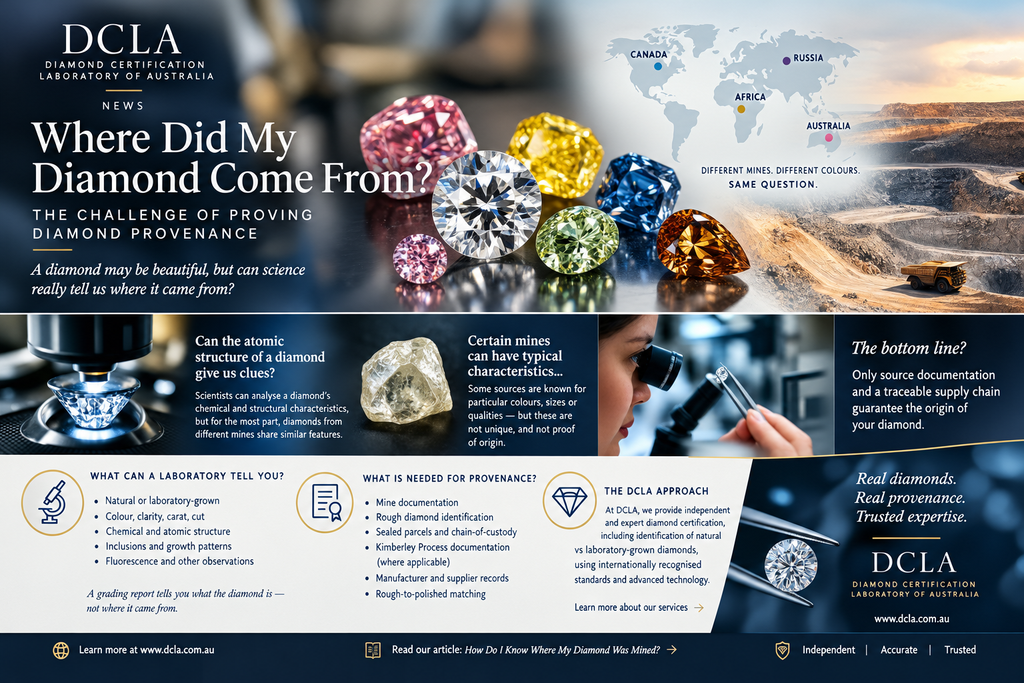
How do I know where my diamond was mined ?


It can be challenging to determine the exact location where a diamond was mined, but there are several ways to get an idea of its origin:

1. Diamond certificate: A diamond certificate or grading report from a reputable laboratory such as GIA, AGS,HRD, IGI or DCLA will provide information about the diamond's characteristics, including its colour, clarity, and carat weight. Some certificates may also include information about the diamond's origin or a statement that the diamond is of natural origin.

2. Inscription: Some diamonds may have a laser inscription on the girdle (the thin outer edge) of the diamond that identifies the diamond's report and sometimes brand origin or other information about the diamond. The inscription is a laser inscription or a micro-inscription that can only be viewed under magnification.

3. Jewellers and diamond dealers: An experienced jeweller or diamond dealer may be able to provide information about the diamond's origin based on their knowledge and experience in the industry.

4. Diamond tracing programs: Some diamond companies offer programs that trace the origin of their diamonds from the mine to the consumer. For example, the De Beers Group has a program called Tracr that provides a digital certificate of a diamond's journey from mine to retailer. It's important to note that not all diamonds can be traced to their exact origin, but the above methods can provide some information about a diamond's potential source. Diamonds can be found in various places around the world, but the most famous diamond sources are:

1. Botswana: Botswana is the world's leading producer of diamonds by value and is responsible for about 25% of the world's diamond supply.

2. Russia: Russia is the world's largest diamond producer by volume, accounting for about 27% of global diamond production. The majority of diamonds mined in Russia come from the Yakutia region in northeastern Russia.

3. Canada: Canada is the world's third-largest diamond producer, and its diamond mines are known for producing high-quality gemstones. The majority of Canada's diamond mines are located in the Northwest Territories.

4. Australia: Australia is known for producing some of the world's most valuable pink and red diamonds. The Argyle Diamond Mine in Western Australia was the world's largest source of pink diamonds until its closure in 2020.

5. South Africa: South Africa is one of the earliest sources of diamonds, and the country's Kimberley region is famous for its diamond mines. The Cullinan Diamond, the largest rough diamond ever found, was discovered in South Africa in 1905.


Source: Certin 

How Efforts to Control the Diamond Trade Are Hurting the Very Communities They Were Supposed to Protect

For more than two decades, global policies aimed at restricting the flow of diamonds from conflict zones most notably through the “blood dia...