Showing posts with label Laboratory-Grown rough diamond. Show all posts

Monday, 23 November 2026

Are Laboratory-Grown Diamonds Really Greener Than Natural Diamonds?

 Are Lab-Grown Diamonds Really Greener Than Natural Diamonds?

The energy, environmental costs and marketing claims behind the laboratory-grown diamond industry

Laboratory-grown diamonds are increasingly marketed as the environmentally friendly alternative to natural diamonds. The message is simple: no mining, less environmental damage and a greener way to produce a diamond.

But is that really the full story?

The answer is considerably more complicated than the marketing suggests. And when we look at the electricity, manufacturing processes, carbon emissions and wider economic contribution of the diamond industry, the claim that laboratory-grown diamonds are automatically greener than natural diamonds becomes much harder to defend.

At DCLA, we believe environmental claims should be supported by evidence, not simply by marketing.

The energy required to grow a diamond

A laboratory-grown diamond does not simply appear inside a machine. It is manufactured through an industrial process requiring specialised equipment, controlled environments and substantial amounts of energy.

There are two principal methods used to produce gem-quality laboratory-grown diamonds.

HPHT – High Pressure High Temperature

This process recreates the extreme conditions required for diamond crystallisation, using pressures of several gigapascals and temperatures generally around 1,300–1,600°C. Specialised presses, heating systems and cooling equipment operate throughout the growing cycle.

CVD – Chemical Vapour Deposition

This process uses carbon-containing gases, commonly methane and hydrogen, inside a controlled chamber. Energy is used to create and maintain the plasma environment in which carbon atoms gradually deposit onto a diamond seed.

Depending on the equipment, the growth process can continue for days or weeks.

Both methods require significant industrial infrastructure. The equipment itself represents a substantial capital investment, while electricity, cooling, gases, maintenance and other operating costs all contribute to the final production cost.

The important question is not simply how a diamond is grown, but how much energy is required and where that energy comes from.

What does the scientific research actually tell us?

A particularly interesting peer-reviewed study published in 2021 in the scientific journal Energies, titled A Comparative Analysis of Energy and Water Consumption of Mined versus Synthetic Diamonds, examined the energy requirements of natural diamond mining and laboratory production.

The researchers reported the following electricity consumption per carat of rough diamond:

Production methodEnergy consumption
Natural diamonds – ALROSA96 kWh
Natural diamonds – De Beers150 kWh
Laboratory HPHT36 kWh
Laboratory CVD – IIa Technology77 kWh
Laboratory CVD – Ekati143 kWh
Laboratory CVD – researchers’ equipment215 kWh

These figures reveal something important.

Some laboratory-grown production methods can use less electricity per carat than the mining operations examined. However, other CVD processes can consume considerably more.

The study also highlights how dramatically energy consumption can vary depending on equipment, cooling systems, production capacity and manufacturing conditions.

It would therefore be incorrect to claim that every laboratory-grown diamond consumes more electricity than every natural diamond.

But it would be equally misleading to assume that laboratory-grown diamonds are automatically the environmentally superior option.

The research is available here:

Read the full scientific study – MDPI, Energies (2021).

Where does the electricity actually come from?

This is where the environmental debate becomes particularly important.

China and India are major centres of laboratory-grown diamond manufacturing. Both countries continue to rely significantly on fossil fuels for electricity generation, particularly coal.

A manufacturer may operate sophisticated diamond-growing equipment, but if that equipment is powered by electricity generated from coal, the environmental footprint must reflect that reality.

Electricity consumption alone does not tell the complete story. The source of that electricity is equally important.

A laboratory using genuinely renewable electricity may have a substantially different carbon footprint from an otherwise identical facility relying on a coal-intensive electricity grid.

This is why consumers should be asking manufacturers some straightforward questions:

  • Where was the diamond manufactured?
  • How much electricity was required to grow it?
  • What proportion of that electricity came from renewable sources?
  • Are the environmental claims independently verified?
  • Does the reported carbon footprint include the entire manufacturing process?

Without this information, describing a laboratory-grown diamond as environmentally friendly is an assumption, not a demonstrated fact.

Can carbon credits really make a diamond green?

Another area deserving scrutiny is the growing use of carbon credits and renewable energy certificates in environmental marketing.

Some manufacturers promote their green credentials by purchasing carbon credits, investing in renewable energy or claiming to offset their electricity consumption.

But there is an important distinction between actually reducing emissions and compensating for emissions generated elsewhere.

Purchasing a carbon credit does not change the electricity physically consumed by a diamond-growing facility.

Likewise, purchasing renewable energy certificates does not automatically mean that the manufacturing equipment itself was powered directly by renewable electricity.

Some renewable energy agreements and carbon credit programmes can make a genuine contribution to reducing emissions. However, the claims must be transparent, independently verified and properly accounted for.

Consumers should be able to distinguish between a manufacturer genuinely reducing its environmental footprint and one relying primarily on offsetting arrangements to support a green marketing message.

Buying an environmental credit is not the same as eliminating the environmental impact of production.

Natural diamonds contribute more than just a beautiful stone

There is another important part of this comparison that is frequently overlooked.

Natural diamond mining is not simply about extracting a precious stone from the ground. In many producing countries, the industry supports thousands of jobs, government revenue, infrastructure, education, healthcare and entire communities.

Botswana provides one of the clearest examples of the economic importance of natural diamond mining. Diamonds have played a major role in the country’s development and international trade.

South Africa, Namibia and Canada also have established diamond industries that contribute to employment and economic activity.

Mining undoubtedly has an environmental footprint. Land disturbance, water consumption, energy use, waste management and rehabilitation are all important considerations.

Responsible mining requires substantial investment in environmental management and ongoing rehabilitation.

However, a meaningful comparison must look beyond the immediate extraction of a diamond.

It should consider the complete environmental and economic lifecycle of both products, including the machinery, electricity, raw materials, manufacturing infrastructure, transportation and wider social contribution.

A laboratory-grown diamond may avoid the direct land disturbance associated with mining, but it still requires industrial manufacturing, equipment, energy and resources.

The environmental discussion should recognise both sides.

Are laboratory-grown diamonds actually bad?

Absolutely not.

Laboratory-grown diamonds have an important place in today’s diamond industry and will continue to play a significant role in the future.

They are genuine diamonds, with essentially the same chemical composition and crystal structure as natural diamonds. They offer consumers another choice, particularly when size and affordability are important considerations.

Technology has also created new opportunities beyond jewellery, including advanced industrial, scientific and technological applications.

At DCLA, we recognise both natural and laboratory-grown diamonds as important parts of the modern diamond industry.

Our position is straightforward: consumers should know exactly what they are purchasing, understand the differences and have access to independent, accurate information.

We have previously explored these differences in our articles:

What Is a Diamond? Natural vs Laboratory-Grown – Structure, Science and Pricing.

The Diamond You Choose: Natural Rarity or Laboratory-Grown Quality.

The difference between marketing and science

The diamond industry is changing rapidly, and consumers are entitled to question the environmental claims being made by manufacturers and retailers.

A laboratory-grown diamond is not automatically sustainable simply because it has not been mined.

Equally, a natural diamond should not automatically be considered environmentally responsible simply because it was formed naturally.

Both industries have environmental responsibilities.

The real comparison requires transparent, independently verified lifecycle assessments that consider electricity consumption, energy sources, water, materials, manufacturing, mining, transportation and emissions.

A 2024 research paper published in Humanities and Social Sciences Communications examined the environmental impacts of the global diamond industry and modelled possible future sustainability pathways. Its findings also demonstrate why the discussion needs to consider more than one environmental indicator.

Read the 2024 scientific research – The Environmental Impacts and Sustainable Pathways of the Global Diamond Industry.

DCLA: Knowledge, transparency and independent assessment

At DCLA, our responsibility is to provide accurate, independent diamond identification and grading.

Whether a diamond is natural or laboratory-grown, consumers deserve to know what they own.

The two categories have different origins, market characteristics and histories. Understanding those differences is essential when making an informed purchasing decision.

Our laboratory uses advanced diamond testing technology to examine and identify diamonds, including distinguishing natural stones from laboratory-grown material.

You can learn more about our diamond identification and grading technology or explore our independent diamond grading reports.

The bottom line is simple. Laboratory-grown diamonds have a legitimate future, but calling them green does not automatically make them environmentally superior to natural diamonds.

The electricity must come from somewhere. The manufacturing process has a footprint. Carbon credits do not erase physical consumption, and the contribution of natural diamond mining to producing countries should not be ignored.

Consumers deserve facts, not slogans.

DCLA – Diamond Certification Laboratory of Australia

Knowledge. Experience. Transparency.

Friday, 31 July 2026

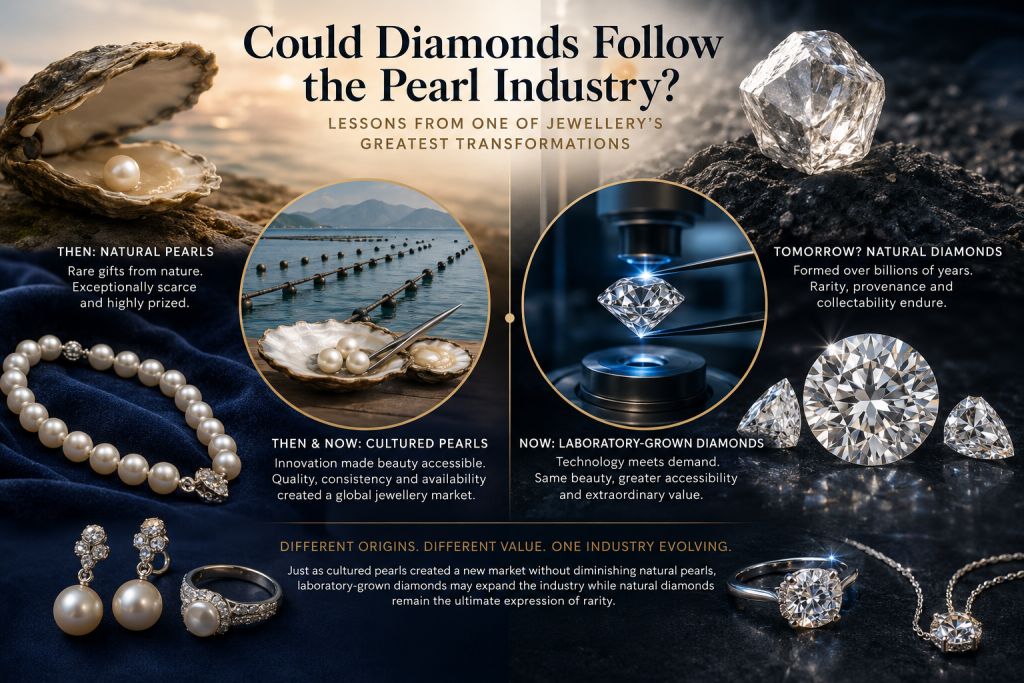
Could Diamonds Follow the Pearl Industry? Lessons from One of Jewellery's Greatest Transformations

 Could Diamonds Follow the Pearl Industrym, When Nature Could No Longer Meet Demand

For more than a century, natural diamonds have represented rarity, permanence and prestige. Yet today, the diamond industry is experiencing one of the most significant periods of change in its history. The rapid rise of laboratory-grown diamonds has challenged long-held assumptions about rarity, value and production.

While many compare laboratory-grown diamonds to synthetic gemstones, perhaps a more relevant comparison lies elsewhere. The transformation of the pearl industry offers an intriguing historical precedent.

Could diamonds be following a similar path?

When Nature Could No Longer Meet Demand

Before the early twentieth century, every pearl was natural.

Finding a single fine pearl required divers to open thousands of wild oysters, making exceptional pearls extraordinarily rare and valuable. As demand increased, natural oyster beds became depleted through over-harvesting, pollution and environmental change. The jewellery market faced an obvious problem: consumers wanted pearls, but nature simply could not supply them in sufficient quantity.

The solution came through cultured pearls.

By introducing a tiny nucleus into a living oyster, pearl farmers could encourage the oyster to produce a genuine pearl under controlled conditions. The process still relied on nature, but it dramatically increased consistency, availability and affordability.

Initially, cultured pearls were met with scepticism. Many believed they would destroy the value of natural pearls.

Instead, something quite different happened.

Two Markets Emerged

Rather than replacing natural pearls entirely, cultured pearls created an entirely new market.

Millions of consumers who had never been able to afford fine pearls suddenly could.

Natural pearls, however, became even rarer. As natural harvesting declined, truly exceptional natural pearls became increasingly desirable to collectors, museums and high-end jewellery houses.

Today, important natural pearl necklaces regularly achieve extraordinary auction results because of their rarity and historical significance.

The market effectively separated into two distinct categories:

  • Cultured pearls became the mainstream jewellery product.
  • Natural pearls became exceptional collector’s items.

Both markets survived—but they served different customers.

Diamonds May Be Facing a Similar Evolution

When Nature Could No Longer Meet Demand Before the early twentieth century, every pearl was natural.


Laboratory-grown diamonds are not imitation diamonds.

They possess the same crystal structure, chemical composition and optical properties as natural diamonds. Modern technology can produce exceptionally high-quality stones in a matter of weeks rather than over billions of years beneath the Earth’s surface.

Production efficiencies continue to improve.

Prices have fallen dramatically.

Quality has become increasingly consistent.

For many jewellery buyers, laboratory-grown diamonds offer larger sizes and higher specifications at significantly lower prices than natural diamonds.

This has fundamentally changed the entry-level diamond jewellery market.

The Difference is Rarity

Where the comparison becomes interesting is the concept of rarity.

Natural diamonds are finite geological creations formed over billions of years under immense heat and pressure.

Laboratory-grown diamonds can be manufactured repeatedly whenever production facilities are expanded.

This distinction mirrors the difference between natural and cultured pearls.

One derives its rarity from nature.

The other derives its availability from technology.

Neither is inherently “better” in every situation they simply satisfy different consumer priorities.

Luxury Has Always Valued Scarcity

History shows that luxury markets rarely disappear simply because a more affordable alternative becomes available.

Mechanical watches continue to thrive despite the accuracy of digital watches.

Original artworks remain valuable despite the existence of perfect reproductions.

Vintage wines command remarkable prices despite modern winemaking techniques.

Natural pearls retained their prestige after cultured pearls became mainstream.

Collectors often place a premium on objects that cannot simply be reproduced.

The same principle may continue to apply to exceptional natural diamonds.

Large, rare coloured diamonds, historically significant gemstones and stones with remarkable provenance are unlikely to lose their appeal simply because laboratory-grown diamonds become increasingly common.

Will Natural Diamonds Become More Exclusive?

As mining becomes more challenging and fewer new diamond deposits are discovered, the supply of natural diamonds may gradually tighten.

Several major mines are approaching the end of their productive lives, while fewer world-class discoveries have been made over the past two decades.

If production continues to decline while the finest stones remain desirable, natural diamonds could increasingly occupy a position similar to that of natural pearls—less common, more exclusive and primarily sought by collectors and connoisseurs.

Rather than competing directly with laboratory-grown diamonds, they may simply occupy a different market.

What Happens to Everyday Diamond Jewellery?

This may be where laboratory-grown diamonds reshape the industry most dramatically.

Consumers purchasing jewellery primarily for its appearance, design or sentimental value may increasingly choose laboratory-grown diamonds because they provide greater size and quality within a given budget.

Jewellery designers gain greater creative freedom.

Consumers gain more choice.

The overall market for diamond jewellery could even expand as affordability improves.

This is remarkably similar to what occurred with cultured pearls, which transformed pearls from an occasional luxury into an everyday jewellery category.

The Importance of Transparency

One lesson from the pearl industry is particularly relevant.

Consumers accepted cultured pearls because the industry clearly distinguished them from natural pearls.

Each category developed its own identity.

The same principle is essential for diamonds.

Natural and laboratory-grown diamonds are both genuine diamonds, but they have different origins, different rarity profiles and different market dynamics.

Clear disclosure, accurate grading and transparent terminology allow consumers to make informed purchasing decisions based on their own priorities rather than confusion or marketing.

The Future May Not Be Either-Or

The history of jewellery suggests that technological innovation rarely eliminates natural luxury products.

Instead, it often creates broader markets with distinct categories serving different needs.

Natural pearls and cultured pearls now coexist successfully.

It is entirely possible that natural and laboratory-grown diamonds will do the same.

Natural diamonds may increasingly represent geological rarity, heritage and long-term collectability.

Laboratory-grown diamonds may continue to dominate fashion jewellery, bridal markets and value-conscious consumers seeking exceptional visual beauty.

Rather than one replacing the other, both could become permanent parts of the modern jewellery landscape.

Conclusion

The transformation of the pearl industry demonstrates that innovation does not necessarily diminish the value of natural treasures. Instead, it can redefine their place within the luxury market.

Whether diamonds ultimately follow the same path remains to be seen, but the parallels are compelling. Laboratory-grown diamonds have undoubtedly changed accessibility and affordability, much as cultured pearls did generations ago.

History suggests that when technology makes luxury more accessible, the rarest natural examples often become even more distinctive.

For the jewellery industry, the future may not be about choosing between natural and laboratory-grown diamonds. Instead, it may be about recognising that each serves a different purpose, a different customer and a different definition of value.

As with pearls, the industry may simply be witnessing the emergence of two complementary markets one built on the rarity of nature, the other on the possibilities of technology.

Source: DCLA

Tuesday, 21 July 2026

Nature vs Technology: Why Large Natural Diamonds Are Exceptionally Rare While Large Laboratory-Grown Diamonds Are Increasingly Common

 Large Diamonds Are Exceptionally Rare

For billions of years, nature has been producing diamonds deep beneath the Earth’s surface under immense pressure and temperatures exceeding 1,000°C. Every natural diamond is the result of a geological journey unlike any other gemstone, carrying with it a unique record of the Earth’s history.

Today, laboratory-grown diamonds are manufactured in controlled environments over a period of weeks rather than billions of years. While they possess the same crystal structure as diamond, the economics of their production are almost the complete inverse of nature.

Nature’s Ratio: Large Diamonds Are Exceptionally Rare

Natural diamond deposits follow a remarkably predictable size distribution.

The overwhelming majority of diamonds recovered from mines around the world are small crystals. As crystal size increases, rarity increases exponentially. Large gem-quality rough diamonds are exceptionally uncommon because their growth requires an uninterrupted geological environment over immense periods of time. Even minor changes in pressure, temperature, or surrounding chemistry can halt growth or fracture a developing crystal.

This means that:

  • Small diamonds make up the vast majority of natural production.
  • Medium-sized diamonds are considerably less common.
  • Large diamonds are exceptionally rare.
  • Very large, high-quality diamonds are among the rarest natural materials on Earth.

This natural scarcity is why diamonds above several carats increase dramatically in value. Their rarity is not created by marketing—it is governed by geology.

Laboratory Production: The Reverse Distribution

Laboratory-grown diamonds operate under a completely different economic model.

Manufacturers begin with a tiny diamond seed and grow additional carbon onto it using either High Pressure High Temperature (HPHT) or Chemical Vapour Deposition (CVD) technology.

Unlike mining, where large diamonds are rarely discovered, laboratory production often aims to grow the largest crystal economically possible.

The production costs of a laboratory-grown diamond are concentrated in operating the equipment rather than discovering the crystal. Once a growth cycle has begun, extending growth to produce a larger crystal is frequently more profitable than manufacturing numerous small stones.

As a result:

  • Larger laboratory-grown rough is increasingly common.
  • Multiple large diamonds can be produced from a single manufacturing facility every month.
  • Production volumes are limited primarily by equipment capacity and electricity costs rather than geological rarity.

In many modern factories, larger diamonds are actually preferred because they provide greater manufacturing flexibility and can be cut into multiple finished stones.

The distribution therefore becomes almost the reverse of nature.

Why Large Natural Diamonds Are Exceptionally Rare


Billions of Years vs Several Weeks

Natural diamonds typically formed between one and three billion years ago within the Earth’s mantle at depths approaching 150 to 250 kilometres.

Their growth occurred slowly under constantly changing geological conditions before volcanic eruptions transported them to the Earth’s surface through kimberlite and lamproite pipes.

Laboratory-grown diamonds, by comparison, are produced in controlled chambers over several weeks.

Every variable—including temperature, pressure, gas composition and growth rate—is carefully managed by technicians rather than nature.

A Record of Earth’s History

One of the most fascinating differences lies within the crystal itself.

Natural diamonds contain microscopic traces of the environment in which they formed. These include tiny amounts of nitrogen, boron, hydrogen and numerous other trace elements that became incorporated into the crystal lattice over geological time.

Many natural diamonds also contain microscopic mineral inclusions originating from deep within the Earth’s mantle. These tiny crystals provide scientists with valuable information about regions of the Earth that can never be directly sampled.

In effect, every natural diamond is a geological time capsule.

Laboratory-grown diamonds, however, are produced from highly purified carbon sources under carefully controlled conditions. Their objective is consistency rather than geological complexity.

Consequently, laboratory-grown diamonds are composed almost entirely of carbon, with very low levels of naturally occurring trace elements. Depending on the manufacturing process, they may instead exhibit characteristics associated with their production, including metallic catalyst residues in some HPHT-grown diamonds or growth-related structural features in CVD-grown diamonds.

Rather than recording billions of years of Earth’s geological history, laboratory-grown diamonds primarily reflect the manufacturing process used to create them.

Why These Differences Matter

Although natural and laboratory-grown diamonds share the same fundamental crystal structure and hardness, their origin is entirely different.

Natural diamonds represent an irreplaceable finite resource created by geological processes that cannot be replicated by nature within any human timescale. Their rarity is determined by billions of years of Earth history and the extremely low probability of large crystal formation.

Laboratory-grown diamonds represent an impressive technological achievement. They are manufactured products whose supply is governed by industrial capacity, advances in production technology and manufacturing costs.

Understanding these differences is essential when assessing rarity, long-term availability and market value. As laboratory production continues to expand, large laboratory-grown diamonds are expected to become increasingly accessible, while large natural diamonds will remain among the rarest and most sought-after treasures ever created by nature.

The DCLA Perspective

At the Diamond Certification Laboratory of Australia (DCLA), every diamond is identified and graded according to internationally recognised gemmological standards. Whether natural or laboratory-grown, accurate identification allows consumers, jewellers and collectors to make informed decisions based on origin, rarity and value.

While both categories have their place within today’s jewellery market, they should never be considered equivalent in terms of geological origin. One is a remarkable product of Earth’s natural history, while the other is a remarkable achievement of modern science.

Understanding that distinction remains fundamental to informed purchasing and responsible disclosure throughout the diamond industry.

Source: DCLA

Wednesday, 18 February 2026

What Is a Diamond? Natural vs Laboratory-Grown – Structure, Science and Pricing

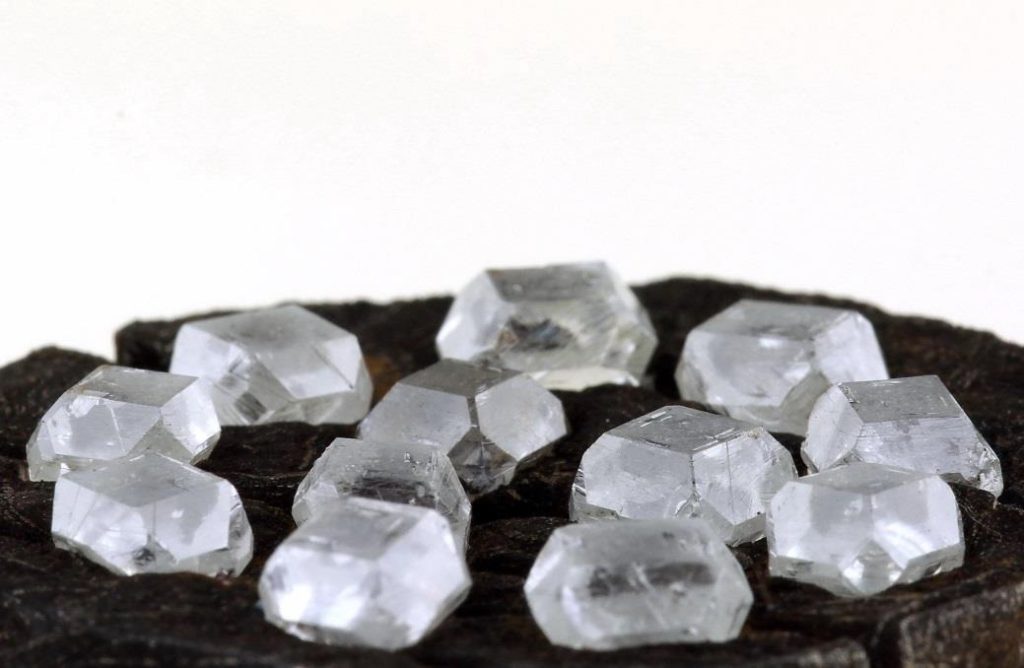
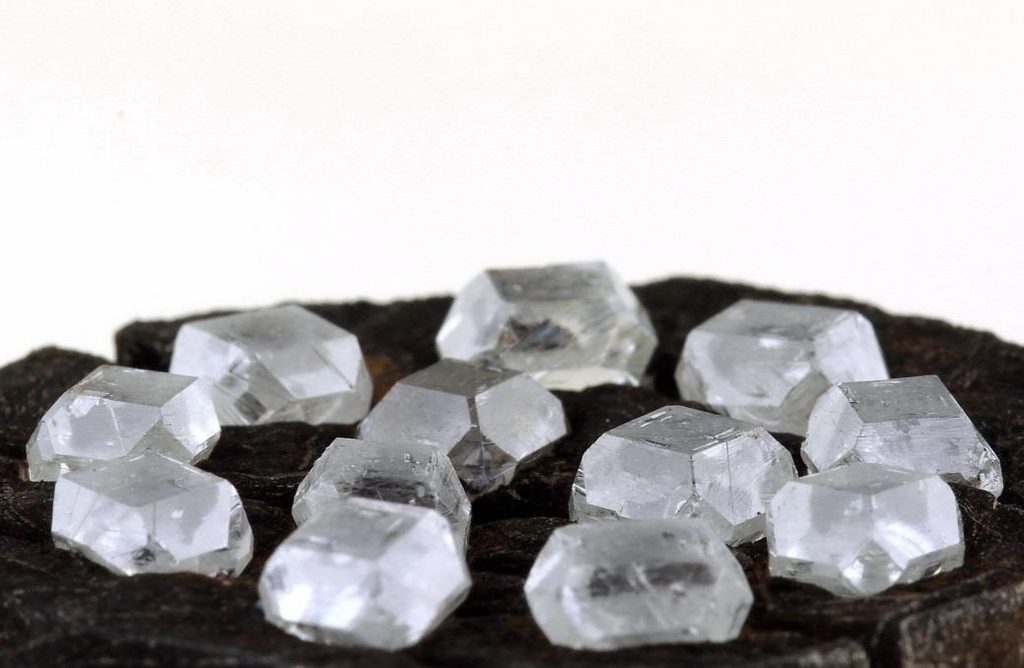
 Laboratory-Grown rough diamond

A diamond is a solid form of the element carbon in which the atoms are arranged in a crystal structure known as diamond cubic. In this structure, each carbon atom is bonded to four others in a rigid tetrahedral arrangement (sp³ bonding), forming one of the strongest natural materials known.

In its pure form, diamond is:

  • Colourless
  • Odourless and tasteless
  • Extremely hard
  • A poor conductor of electricity
  • Insoluble in water
  • Chemically inert under most conditions

Although graphite is the stable form of carbon at room temperature and pressure, diamond is metastable and converts to graphite at an almost negligible rate over geological time.


The Physical and Optical Properties of Diamond

Diamond possesses extraordinary properties:

  • Highest hardness of any natural material (Mohs 10)
  • Highest thermal conductivity of any natural substance
  • Extremely high refractive index (~2.42)
  • High optical dispersion, creating the “fire” in gemstones
  • Very low thermal expansion
  • Exceptional chemical resistance
  • High electrical resistance

Because the crystal lattice is extremely rigid, only very small amounts of impurities can enter the structure. These trace elements or structural defects create colour:

  • Nitrogen → Yellow
  • Boron → Blue
  • Crystal defects → Brown
  • Radiation exposure → Green
  • Plastic deformation → Pink, red, purple

How Natural Diamonds Form

Natural mined rough Diamonds


Most natural diamonds are between 1 and 3.5 billion years old.

They formed deep within the Earth’s mantle at depths of 150–250 km, and occasionally as deep as 800 km, under extreme pressure and temperature. Carbon-bearing fluids replaced minerals with crystallised carbon.

They were later transported rapidly to the surface via volcanic eruptions and deposited in igneous rocks known as:

  • Kimberlite
  • Lamproite

Historically, diamonds were first mined in ancient India along the Penner, Krishna and Godavari rivers, and have been known for at least 3,000 years.

The word diamond comes from the Ancient Greek “adámas”, meaning unbreakable or invincible.


The Discovery That Diamond Is Carbon

In 1772, Antoine Lavoisier demonstrated that when a diamond burns in oxygen, it produces carbon dioxide.

Later, in 1797, Smithson Tennant proved that diamond and graphite release the same gas when burned, confirming that both are forms (allotropes) of pure carbon.


Laboratory-Grown Diamonds

Synthetic diamonds are created using two main methods:

1. HPHT (High Pressure High Temperature)

Replicates natural mantle conditions using pressures above 5 GPa and temperatures above 1,300°C.

2. CVD (Chemical Vapour Deposition)

Carbon-rich gases are broken down in a plasma chamber, allowing carbon atoms to deposit layer by layer onto a diamond seed crystal.

Chemically, physically and optically, laboratory-grown diamonds are the same as natural diamonds. Both are pure carbon in the diamond cubic structure.

They are distinguished using advanced gemmological techniques such as:

  • Spectroscopy
  • Growth pattern analysis
  • Inclusion study
  • Thermal conductivity testing

Hardness, Toughness and Durability

Diamond is the hardest known natural material, but it is not indestructible.

  • It has excellent resistance to scratching.
  • It has cleavage planes, meaning it can split if struck in certain directions.
  • Toughness (resistance to breakage) is good for a ceramic but lower than many metals.

Its durability makes it ideal for engagement rings and daily wear jewellery.


Natural vs Laboratory-Grown Diamonds: Pricing Comparison (2026 Market Overview)

Although structurally identical, pricing between natural and lab-grown diamonds differs dramatically due to rarity and supply dynamics.

Natural Diamonds

  • Finite geological supply
  • Mining costs, exploration, labour and environmental compliance
  • Graded and traded based on rarity
  • Price stability linked to long-term scarcity

In today’s market, a high-quality 1.00 carat natural diamond (G colour, VS clarity) typically trades wholesale in the range of USD $4,500–$7,000, depending on cut quality and certification.

Premium stones (D–F colour, IF–VVS clarity) command significantly higher prices.

Laboratory-Grown Diamonds

  • Mass-producible in controlled environments
  • Increasing global production capacity
  • Rapid technological efficiency gains
  • No geological rarity

The same 1.00 carat equivalent (G colour, VS clarity) laboratory-grown diamond now trades between USD $300–$600.

Retail prices decline as production scales.


Why the Price Gap Exists

The key difference is not chemistry — it is rarity and supply economics.

Natural diamonds:

  • Formed over billions of years
  • Limited global deposits
  • High capital-intensive extraction

Laboratory diamonds:

  • Manufactured within weeks
  • Scalable production
  • Compete with industrial cost structures

As production increases, laboratory diamond pricing behaves more like a manufactured product than a rare natural asset.


Investment and Resale Considerations

Natural diamonds retain secondary market value more effectively due to:

  • Limited supply
  • Established global trading networks
  • Long-term historical demand

Laboratory-grown diamonds currently have minimal resale value in secondary markets due to continuous price decline and expanding supply.


A diamond, whether natural or laboratory-grown, is one of nature’s most extraordinary materials — a crystal of pure carbon arranged in a tetrahedral lattice that produces unmatched hardness, brilliance and thermal conductivity.

However, while they are chemically identical, their market dynamics are fundamentally different.

Natural diamonds derive value from geological rarity and billions of years of formation.

Laboratory-grown diamonds derive value from technology, efficiency and accessibility.

Understanding this distinction is essential for anyone buying, selling or investing in diamonds today.

Source: DCLA

Angola Moves to Secure 10% Stake in De Beers for US$180 Million

  A major shift in the global diamond industry as African diamond-producing nations seek greater ownership and influence over one of the wor...