A jeweler has been arrested in New Jersey, USA, over allegations that he misrepresented lab grown diamonds as natural.
Justin T. Wentzel, 43, owner of Ice Storm Jewelry, over-valued three items of diamond jewelry by as much as $23,800, according to local police.
A victim made a complaint in June and Wentzel was arrested on 7 August after he was asked to attend police headquarters.
“Mr. Wentzel was charged with theft by deception, criminal simulation, and falsifying or tampering with a record,” said Mount Olive Township Police Department, in a statement.
“Through the course of the investigation, it was determined that Mr. Wentzel sold lab grown diamonds as genuine diamonds and over valued the worth and price of the jewelry by as much as $23,800.”
In Surat, India’s famed “Diamond City”, where 14 out of every 15 natural diamonds are cut and polished, a deepening crisis is unfolding.
For Kalpesh Patel, a 35-year-old owner of a small diamond cutting and polishing unit, this year’s Diwali could mark more than just a festival of lights — it may signal the lights going out on his eight-year-old business. Patel employs 40 workers transforming rough stones into polished gems destined primarily for the United States. But with the recent announcement by US President Donald Trump of a 50% tariff on imports from India — taking the total duty on cut and polished diamonds to 52.1% — the industry’s already fragile state may tip into collapse.
The US is India’s largest export market for diamonds, accounting for over one-third of total shipments. In the 2024–25 financial year, India exported $4.8 billion worth of cut and polished diamonds to the US, out of a total $13.2 billion worldwide. For many small and medium-sized manufacturers in Surat, Ahmedabad, and Rajkot — employing more than two million people — this trade lifeline is now under severe threat.
An Industry Already Under Pressure
The tariffs arrive on top of multiple recent challenges. The COVID-19 pandemic slowed global luxury demand, the Russia-Ukraine conflict restricted access to rough diamonds, and the G7 ban on Russian stones further strained supply chains. Salaries for many diamond workers in Gujarat have already been halved in recent years, with some forced into poverty-level incomes. Tragically, industry unions report dozens of suicides linked to the ongoing downturn.
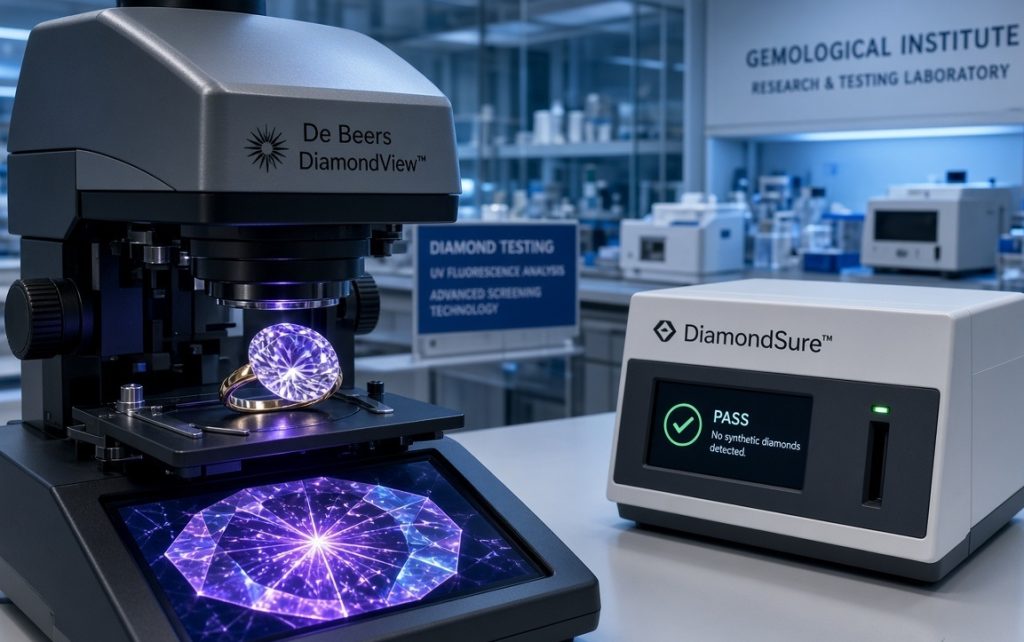
Lab-grown diamonds have added to the pressure, offering consumers a lower-priced alternative — often just 10% of the cost of natural diamonds — and proving difficult to distinguish without professional laboratory testing, such as that provided by DCLA. This shift in consumer preference is eating into the market for natural stones, further squeezing margins for cutters and polishers.
Declining Trade Figures
According to the Gem and Jewellery Export Promotion Council (GJEPC), India imported $10.8 billion worth of rough diamonds in 2024–25, a 24% drop from the previous year. Exports of cut and polished natural diamonds fell nearly 17% year-on-year.
Industry leaders warn that if the new US tariffs remain in place, as many as 200,000 workers could lose their jobs in Gujarat alone.
Ripple Effects Beyond India
The impact will not be confined to India. US jewellers — around 70,000 businesses — will also feel the pressure as higher prices could dampen consumer demand. This could disrupt supply chains, delay deliveries, and push customers towards alternative products.
Finding a Way Forward
Some in the industry see an opportunity to strengthen domestic demand and diversify exports towards Latin America, the Middle East, and other emerging markets. India’s domestic gems and jewellery market is projected to grow from $85 billion to $130 billion within two years, offering a potential buffer.
For now, though, the threat is real and urgent. Without relief on tariffs, support for natural diamond certification, and a coordinated strategy to protect jobs, the world’s biggest cutting and polishing centre risks losing its global dominance — and with it, a key part of the natural diamond supply chain.
As Patel puts it, “Without help, the business will lose its shine forever.”
South Africa is to sign up to the milestone Luanda Accord, which is funding a global campaign to promote natural diamonds.
It joined the governments of Angola, Botswana, Namibia, Sierra Leone and the Democratic Republic of the Congo, in June in pledging to contribute 1 per cent of the value of their rough sales annually.
But the move was only approved South Africa’s cabinet last week. Minister in the Presidency Khumbudzo Ntshavheni and confirmed the decision on 7 August, committing 1 per cent of the annual revenues generated from rough diamond sales to a global marketing fund led by the Natural Diamond Council (NDC).
South Africa, the world’s sixth biggest diamond producing nation by value, saw sales down by 21 per cent last year amid the global slowdown.
The country’s mining minister mining minister Gwede Mantashe was listed as a signatory to the Luanda Accord in an official communique after the agreement.
But a conflicting Reuters report said South Africa did not actually sign at the time and has only done so now.
The Luanda Accord is seen as a potential turning point for the sector, aiming to rebuild consumer trust and interest in natural diamonds over lab growns, by emphasizing their origin, authenticity, and community impact.
It will highlight the positive economic and social contributions of the natural diamond industry to producing nations and their communities.
Governments of the African diamond producing nations have been joined by the Antwerp World Diamond Centre (AWDC), African Diamond Producers Association, India’s Gem and Jewellery Export Promotion Council (GJEPC) and the Dubai Multi Commodities Centre (DMCC).
The average price of a natural diamond engagement ring in the US last year was $6,750.
And the average size of the stone was 1.07 carats, according to a new report by the New York-based Natural Diamond Council.
It provides a detailed analysis of the shift to larger, higher quality diamonds in its downloadable 20-page Natural Diamond Trends: A 2024 Overview.
Round brilliants remain by far the most popular shapes in diamond jewelry, at 81.7 per cent, but that figure is slipping slightly.
Among fancy shapes for all diamond jewelry, princess and cushion showed the biggest increases, albeit from a very low base (2.1 per cent and 1.0 per cent market share respectively).
The most common color for an engagement diamond was H and the most common clarity was SI1, with bridal representing 33 per cent of all natural diamond sales in the US.
The average price of wedding sets increased 31 per cent in 2024, the report said.
“The increase was mainly due to a rise in the average size of diamonds and a notable change in the type of metal used.”
The average price of natural diamond jewelry sold across all product categories grew 2.7% to $2,360 in 2024.
The report, the latest in a series uncovering the trends, origins and impacts of natural diamonds, was jointly produced with Tenoris.
Key players have taken “a very important step in the right direction” to raising $100m for the long-term promotion of natural diamonds, according to Yoram Dvash, president of the World Federation of Diamond Bourses (WFDB).
He also said he was cautiously optimistic for the holiday season as prices had started to stabilize globally, inventories were reducing and De Beers and the World Diamond Council (WDC) had embarked on multimillion-dollar advertising campaigns.
Dvash (pictured) said trade bodies had reacted very positively o his call for a $100m marketing campaign after what he described as a “brainstorming session” at the Dubai Diamond Conference earlier this month.
The Antwerp World Diamond Council (AWDC) and India’s Gem & Jewellery Export Promotion Council (GJEPC), had agreed to start looking into funding campaigns by the Natural Diamond Council, he said, in collaboration with the WFDB, IDMA (International Diamond Manufacturers Association) and CIBJO (World Jewellery Confederation). More trade bodies are expected to follow suit.
Dvash said he’d called for the industry to unite behind a major and sustained marketing campaign over the next five years to create demand for natural diamonds some weeks ago, and had been pleased by their response.
“It seems that we have found the golden formula that would enable the industry to raise $100m for generic advertising of natural diamonds,” he said.
Earlier this month he said there hadn’t been a major generic marketing campaign for natural diamonds for almost 20 years, when De Beers halted its “A Diamond is Forever” promotion.
“An entire generation of consumers has come of age without having been exposed to promotional campaigns with positive messages about natural diamonds,” he said in a letter to all the WFDB’s 29 member bourses.
Do April birthdays have it best? With diamonds as their birthstone, they just might. Our selection of diamond April birthstone jewelry spans the wide range of diamond jewelry available today, from classic diamond high-jewelry from Harry Winston, the King of Diamonds, to demi-fine jewelry that perfectly expresses your unique style.
HARRY WINSTON
The Winston Cluster has been an icon for Harry Winston — and the jewelry world — since it debuted in the 1940s. Mr. Winston decided to place diamonds at different heights and angles, bringing in more light and increasing their sparkle. This high-jewelry necklace features 195 pear- and marquise-cut diamonds.
Harry Winston Winston Cluster necklace in platinum with 136.66 carats diamond, price on request, harrywinston.com
Ananya Scatter earrings in 18K white gold with 4.9 carats diamond, $16,600, ananya.com ANANYA
London-based designer Ananya honors her Indian heritage in her pieces, but updates them with a contemporary design. The Scatter earrings feature 4.9 carats of baguette diamonds set in an organic pattern.
AnanyaScatter earrings in 18K white gold with 4.9 carats diamond, $16,600, ananya.com
ANITA KO
Anita Ko ring in 18K white gold with 3.8 carats diamond, $18,800, anitako.com ANITA KO
Anita Ko is known for her stunning diamond jewelry. She brings her unique design aesthetic to classic pieces, like this eternity band, which she makes modern and chic by using diagonally set diamonds. While eternity bands are traditional wedding bands, this piece is so chic it could easily be an everyday fashion statement.
Anita Ko ring in 18K white gold with 3.8 carats diamond, $18,800, anitako.com
KWIAT
Kwiat Legacy Embrace earrings in platinum with 25.46 carats diamond, price on request, kwiat.com KWIAT
Kwiat’s superb stones are on full display in the Legacy Embrace earrings. Two round brilliant diamonds, each around 1 carat, sit at the top of the earrings. Two diamond-set X motifs connect them to gorgeous pear-shaped diamonds, one weighing 11.06 carats, the other 11.19 carats.
KwiatLegacy Embrace earrings in platinum with 25.46 carats diamond, price on request, kwiat.com
FRED LEIGHTON
Fred Leighton Collet ring in 18K gold with 11.19 carats diamond, $254,000, fredleighton.com FRED LEIGHTON
Fred Leighton takes an unusual design approach in the Collet ring. It features a 10.05-carat marquise-cut diamond set in silver-topped 18K gold, a stark contrast to the white diamond. A smattering of round diamonds tops the yellow gold band.
Fred Leighton Collet ring in 18K gold with 11.19 carats diamond, $254,000, fredleighton.com
GRAZIELA
These chic Ascension Fringe earrings from Graziela have five strands of baguette diamonds that hang from cleverly-set baguette diamonds that recreate the look of a large emerald-cut diamond. Round-cut diamonds encircle the baguettes.
Graziela Ascension Fringe earrings in 18K white gold with 13.11 carats diamond, $91,000, grazielagems.com
JUDITH RIPKA
Judith Ripka Eros ring in sterling silver with .265 carats diamond, $895, judithripka.com JUDITH RIPKA
Judith Ripka’s Eros ring is perfect for wearing everyday. The sculptural rhodium-plated sterling silver ring curves around the finger and two rows of diamonds add sparkle. The Eros collection comes in 18K yellow gold, which is perfect for stacking.
Judith Ripka Eros ring in sterling silver with .265 carats diamond, $895, judithripka.com
CAYE JOAILLIER
Caye Joaillier Dizzy Diamonds bracelet in 18K yellow gold with .82 carats diamond, $2,950, … [+] CAYE JOAILLIER
This playful bracelet from Caye Joaillier is part of its Dizzy Diamonds collection. Three moving diamonds sit atop a diamond-set bar, and the three diamonds slide back and forth along the bar as you move.
Caye Joaillier Dizzy Diamonds bracelet in 18K yellow gold with .82 carats diamond, $2,950, cayejoaillier.com
OTIUMBERG
Otiumberg Diamond Charm Hoop earring in 9K yellow gold with .15 carats diamond, $730, otiumberg.com OTIUMBERG
Otiumerg is a chic demi-fine jewelry brand based in London. It was founded in 2016 by sisters Christie and Rosanna Wollenberg who couldn’t find affordable fine jewelry with cool designs that they wanted to wear. This 9K yellow gold hoop features 10 round brilliant diamonds on the hoops and has a single diamond drop. It’s sold individually, so you can mix and match.
Otiumberg Diamond Charm Hoop earring in 9K yellow gold with .15 carats diamond, $730, otiumberg.com
Source: luxury expert who specializes in style Kristen Shirley
Do April birthdays have it best? With diamonds as their birthstone, they just might. Our selection of diamond April birthstone jewelry spans the wide range of diamond jewelry available today, from classic diamond high-jewelry from Harry Winston, the King of Diamonds, to demi-fine jewelry that perfectly expresses your unique style.
HARRY WINSTON
The Winston Cluster has been an icon for Harry Winston — and the jewelry world — since it debuted in the 1940s. Mr. Winston decided to place diamonds at different heights and angles, bringing in more light and increasing their sparkle. This high-jewelry necklace features 195 pear- and marquise-cut diamonds.
Harry Winston Winston Cluster necklace in platinum with 136.66 carats diamond, price on request, harrywinston.com
Ananya Scatter earrings in 18K white gold with 4.9 carats diamond, $16,600, ananya.com ANANYA
London-based designer Ananya honors her Indian heritage in her pieces, but updates them with a contemporary design. The Scatter earrings feature 4.9 carats of baguette diamonds set in an organic pattern.
AnanyaScatter earrings in 18K white gold with 4.9 carats diamond, $16,600, ananya.com
ANITA KO
Anita Ko ring in 18K white gold with 3.8 carats diamond, $18,800, anitako.com ANITA KO
Anita Ko is known for her stunning diamond jewelry. She brings her unique design aesthetic to classic pieces, like this eternity band, which she makes modern and chic by using diagonally set diamonds. While eternity bands are traditional wedding bands, this piece is so chic it could easily be an everyday fashion statement.
Anita Ko ring in 18K white gold with 3.8 carats diamond, $18,800, anitako.com
KWIAT
Kwiat Legacy Embrace earrings in platinum with 25.46 carats diamond, price on request, kwiat.com KWIAT
Kwiat’s superb stones are on full display in the Legacy Embrace earrings. Two round brilliant diamonds, each around 1 carat, sit at the top of the earrings. Two diamond-set X motifs connect them to gorgeous pear-shaped diamonds, one weighing 11.06 carats, the other 11.19 carats.
KwiatLegacy Embrace earrings in platinum with 25.46 carats diamond, price on request, kwiat.com
FRED LEIGHTON
Fred Leighton Collet ring in 18K gold with 11.19 carats diamond, $254,000, fredleighton.com FRED LEIGHTON
Fred Leighton takes an unusual design approach in the Collet ring. It features a 10.05-carat marquise-cut diamond set in silver-topped 18K gold, a stark contrast to the white diamond. A smattering of round diamonds tops the yellow gold band.
Fred Leighton Collet ring in 18K gold with 11.19 carats diamond, $254,000, fredleighton.com
GRAZIELA
These chic Ascension Fringe earrings from Graziela have five strands of baguette diamonds that hang from cleverly-set baguette diamonds that recreate the look of a large emerald-cut diamond. Round-cut diamonds encircle the baguettes.
Graziela Ascension Fringe earrings in 18K white gold with 13.11 carats diamond, $91,000, grazielagems.com
JUDITH RIPKA
Judith Ripka Eros ring in sterling silver with .265 carats diamond, $895, judithripka.com JUDITH RIPKA
Judith Ripka’s Eros ring is perfect for wearing everyday. The sculptural rhodium-plated sterling silver ring curves around the finger and two rows of diamonds add sparkle. The Eros collection comes in 18K yellow gold, which is perfect for stacking.
Judith Ripka Eros ring in sterling silver with .265 carats diamond, $895, judithripka.com
CAYE JOAILLIER
Caye Joaillier Dizzy Diamonds bracelet in 18K yellow gold with .82 carats diamond, $2,950, … [+] CAYE JOAILLIER
This playful bracelet from Caye Joaillier is part of its Dizzy Diamonds collection. Three moving diamonds sit atop a diamond-set bar, and the three diamonds slide back and forth along the bar as you move.
Caye Joaillier Dizzy Diamonds bracelet in 18K yellow gold with .82 carats diamond, $2,950, cayejoaillier.com
OTIUMBERG
Otiumberg Diamond Charm Hoop earring in 9K yellow gold with .15 carats diamond, $730, otiumberg.com OTIUMBERG
Otiumerg is a chic demi-fine jewelry brand based in London. It was founded in 2016 by sisters Christie and Rosanna Wollenberg who couldn’t find affordable fine jewelry with cool designs that they wanted to wear. This 9K yellow gold hoop features 10 round brilliant diamonds on the hoops and has a single diamond drop. It’s sold individually, so you can mix and match.
Otiumberg Diamond Charm Hoop earring in 9K yellow gold with .15 carats diamond, $730, otiumberg.com
Source: luxury expert who specializes in style Kristen Shirley
Laboratories should reserve the term “grading report” for natural diamonds rather than lab-grown stones, the World Jewellery Confederation (CIBJO) has urged.
Lab-grown diamonds lack the rarity that underpins the concept of grading, CIBJO argued Tuesday. Instead, documents providing details of synthetics should be called “Laboratory-Grown Diamond Product Specifications,” the organization says in a new set of guidelines it released to the trade this week.
The standard grading report implies “a degree of rarity of the product,” a CIBJO spokesperson told Rapaport News. “But on the other hand, the consumer has a right to know what the components of the product are. The important element is that the term ‘grading’ is taken out.”
CIBJO’s board has made its new Laboratory-Grown Diamond Guidance available for review by affiliated companies and national associations, the organization said. The consultation phase is the final stage in a two-year process to create harmonized standards for man-made stones.
The rule book, which is not binding, also calls for laboratories to include extra information such as the name of the manufacturer, the country and method of manufacture (chemical vapor deposition or High Pressure-High Temperature), and information about post-growth treatments. It also recommends that the letters “LG” precede the color and clarity grades on the report to indicate the stones are lab-grown.
The guidelines deal with how to describe lab-grown diamonds and display them at events such as trade shows. They also provide recommendations on how companies should disclose the origin of the stones on invoices and consignment documents, and discuss synthetics detection technology.
“A key principle of the Laboratory-Grown Diamond Guidance is that, to ensure confidence, consumers must receive complete and unambiguous information about what they are buying, so that they can make consciously informed purchasing decisions,” CIBJO explained.
CIBJO’s Blue Book, a separate document on grading standards and terminology, notably kept “natural” in its definition of diamonds even after the US Federal Trade Commission dropped the word in 2018.
Laboratories should reserve the term “grading report” for natural diamonds rather than lab-grown stones, the World Jewellery Confederation (CIBJO) has urged.
Lab-grown diamonds lack the rarity that underpins the concept of grading, CIBJO argued Tuesday. Instead, documents providing details of synthetics should be called “Laboratory-Grown Diamond Product Specifications,” the organization says in a new set of guidelines it released to the trade this week.
The standard grading report implies “a degree of rarity of the product,” a CIBJO spokesperson told Rapaport News. “But on the other hand, the consumer has a right to know what the components of the product are. The important element is that the term ‘grading’ is taken out.”
CIBJO’s board has made its new Laboratory-Grown Diamond Guidance available for review by affiliated companies and national associations, the organization said. The consultation phase is the final stage in a two-year process to create harmonized standards for man-made stones.
The rule book, which is not binding, also calls for laboratories to include extra information such as the name of the manufacturer, the country and method of manufacture (chemical vapor deposition or High Pressure-High Temperature), and information about post-growth treatments. It also recommends that the letters “LG” precede the color and clarity grades on the report to indicate the stones are lab-grown.
The guidelines deal with how to describe lab-grown diamonds and display them at events such as trade shows. They also provide recommendations on how companies should disclose the origin of the stones on invoices and consignment documents, and discuss synthetics detection technology.
“A key principle of the Laboratory-Grown Diamond Guidance is that, to ensure confidence, consumers must receive complete and unambiguous information about what they are buying, so that they can make consciously informed purchasing decisions,” CIBJO explained.
CIBJO’s Blue Book, a separate document on grading standards and terminology, notably kept “natural” in its definition of diamonds even after the US Federal Trade Commission dropped the word in 2018.
The Diamond Producers’ Association (DPA), established only five years ago by a coalition of diamond miners including De Beers and Alrosa, has relaunched as the Natural Diamond Council.
In addition to continuing to advertise natural diamonds as the DPA did previously, the council is also hoping to reach younger consumers by producing catchy editorial content on trends and innovations in diamond jewelry and the heritage of natural diamonds.
The rebranding comes at a difficult time for the diamond sector, with the economic fallout from the coronavirus pandemic depressing demand and prices.
“The current economic climate creates unprecedented challenges for the luxury industry. But, as the climate improves, natural diamonds will connect stronger than ever before,” said Natural Diamond Council CEO, David Kellie in a release. “Consumers will have a greater respect for all things natural and seek brands that have an honest mission to be truly sustainable. They’ll be purchasing luxury goods with a greater meaning, particularly those celebrating connections between friends and loved ones. We need to speak to the younger audience in a different way and we’re delighted to have brought in a number of partners that will contribute to the new world of natural diamonds we’re creating.”
The website will offer coverage under six categories: Epic Diamonds, Hollywood & Pop Culture, Love & Diamonds, Style & Innovation, Diamonds 101 and Inside the Diamond World. The council has also started a new, biannual trend report written by style experts, forecasting diamond jewelry trends, and incorporating styling tips.
In addition, the DPA’s Real is Rare, Real is a Diamond campaign will be replaced with the council’s new branding: “Only Natural Diamonds” (OND).
“Our new digital platforms will inspire and inform consumers globally about the values and heritage of natural diamonds, as well as promoting the significant innovation happening throughout the world of diamond jewelry,” added NDC’s managing director, Kristina Buckley Kayel. “The younger audience is clearly engaged and inspired when we present ourselves with authority in the digital world. It’s our aim to be number one across all digital platforms in our industry and our ambitious plans reflect these goals.”
The Natural Diamond Council will also aim to educate consumers on the sustainability and ethical practices of diamond producers, as well as everything they need to know when buying diamond jewelry.
In a release, the organization said the relaunch reflects the collective commitment of its members, Alrosa, De Beers, Dominion Diamonds, Lucara Diamond, Petra Diamonds, Murowa Diamonds, and Rio Tinto, to the growth of the industry beyond the current economic crisis.
“Our mission is to educate consumers on the industry and positive social contribution diamonds make to the world today,” said Stephen Lussier, Chairman of the NDC. “Our members are committed to these goals and the launch of the NDC marks an exciting step on this path.”
Visit www.naturaldiamonds.com for more information.
The Diamond Producers’ Association (DPA), established only five years ago by a coalition of diamond miners including De Beers and Alrosa, has relaunched as the Natural Diamond Council.
In addition to continuing to advertise natural diamonds as the DPA did previously, the council is also hoping to reach younger consumers by producing catchy editorial content on trends and innovations in diamond jewelry and the heritage of natural diamonds.
The rebranding comes at a difficult time for the diamond sector, with the economic fallout from the coronavirus pandemic depressing demand and prices.
“The current economic climate creates unprecedented challenges for the luxury industry. But, as the climate improves, natural diamonds will connect stronger than ever before,” said Natural Diamond Council CEO, David Kellie in a release. “Consumers will have a greater respect for all things natural and seek brands that have an honest mission to be truly sustainable. They’ll be purchasing luxury goods with a greater meaning, particularly those celebrating connections between friends and loved ones. We need to speak to the younger audience in a different way and we’re delighted to have brought in a number of partners that will contribute to the new world of natural diamonds we’re creating.”
The website will offer coverage under six categories: Epic Diamonds, Hollywood & Pop Culture, Love & Diamonds, Style & Innovation, Diamonds 101 and Inside the Diamond World. The council has also started a new, biannual trend report written by style experts, forecasting diamond jewelry trends, and incorporating styling tips.
In addition, the DPA’s Real is Rare, Real is a Diamond campaign will be replaced with the council’s new branding: “Only Natural Diamonds” (OND).
“Our new digital platforms will inspire and inform consumers globally about the values and heritage of natural diamonds, as well as promoting the significant innovation happening throughout the world of diamond jewelry,” added NDC’s managing director, Kristina Buckley Kayel. “The younger audience is clearly engaged and inspired when we present ourselves with authority in the digital world. It’s our aim to be number one across all digital platforms in our industry and our ambitious plans reflect these goals.”
The Natural Diamond Council will also aim to educate consumers on the sustainability and ethical practices of diamond producers, as well as everything they need to know when buying diamond jewelry.
In a release, the organization said the relaunch reflects the collective commitment of its members, Alrosa, De Beers, Dominion Diamonds, Lucara Diamond, Petra Diamonds, Murowa Diamonds, and Rio Tinto, to the growth of the industry beyond the current economic crisis.
“Our mission is to educate consumers on the industry and positive social contribution diamonds make to the world today,” said Stephen Lussier, Chairman of the NDC. “Our members are committed to these goals and the launch of the NDC marks an exciting step on this path.”
Visit www.naturaldiamonds.com for more information.
The emergence of blockchain technology is helping to turn diamonds into a new investment asset class that in turn, could drive future demand for natural diamonds, the creator of a new diamond backed crypto coin said on Friday.
Singapore based D1 Mint Limited, the creator of the diamond backed D1 Coin, announced on Friday that it has signed a purchase order with diamond cutting and polishing company KGK Diamonds to start its diamond reserve with 1 500 investment-grade diamonds delivered by Russian diamond producer Alrosa, valued at close to $20 million, and which are deposited at a vault in Antwerp, Belgium, the global centre for the diamond trade.
“Today we made a huge step forward in the development of D1, a project started a year ago to create an asset backed token and to make diamonds an investable asset class,” D1 founder Hogi Hyun said. The purchase order is meant to establish a reserve for digital tokens backed by gem quality diamonds certified by the Gemological Institute of America (GIA). Each D1 Coin is pegged to the value of a fraction of an authentic, natural diamond, as determined by the proprietary pricing algorithm, the D1 Matrix.
According to D1 Mint, diamonds are an ideal asset backing for a coin since they are rare, taking a billion years to develop, and have several millennia of history as a recognised store of wealth and value.
The diamonds in the D1 reserve will be sent to GIA in New York to be graded, laser-etched and packed in tamper proof packaging, before being shipped to secure vaults in Singapore and Switzerland. Logistics and warehousing are provided by established specialists such as Brinks and Malca Amit, while insurance is provided by Lloyds of London.
Further, D1 Coins provide users the ability at any point in time to select specific diamonds from the diamond reserve and convert their tokens into diamonds at a fixed price determined by D1 Matrix. D1 Coins provide a direct exposure to the price of diamonds, opening a new asset class to investors globally. In addition, as an asset-backed token, the D1 Coin provides an excellent means of exchange and store of value in the crypto markets.
Alrosa noted that the approach taken by D1 “will succeed in making natural diamonds an investment asset class attractive to various investor groups, drive higher demand for natural diamonds and support further growth of the diamond industry in Russia”, Alrosa board member and D1 advisory committee member Alexei Chekunkov noted. “The convenience of blockchain will help turn diamonds into a respectable investment asset class that in turn will drive future demand for natural diamonds.”
PHYSICAL DEMAND
Independent New York diamond analyst Paul Ziminisky noted in comments to Mining Weekly Online that the potential for new diamond demand is there, but blockchain does not necessarily address the traditional challenge of investing in physical diamonds with its fungibility, or lack thereof.
“I think the success of products like these will rest on the reputation of the funds and the custodians, for example, confidence that the underlying asset is accurately reflected in the coin. This can be mitigated somewhat with auditing.”
According to him, gold has done quite well in securitised form, and he believes that this is in part due its fungibility, and the simplicity that comes with that. “So gold has a natural advantage relative to diamonds as a securitised physical investment vehicle in that sense.”
“In general, I see securitised forms of physical commodities more as trading vehicles than investments. I think the inherent desire to hold physical diamonds as an investment, or as a store of value significantly rests in the desire to physically possess the asset,” Zimnisky commented.
The emergence of blockchain technology is
helping to turn diamonds into a new investment asset class that in
turn, could drive future demand for natural diamonds, the creator of a
new diamond backed crypto coin said on Friday.
Singapore based D1 Mint Limited, the creator of the diamond backed D1
Coin, announced on Friday that it has signed a purchase order with
diamond cutting and polishing company KGK Diamonds to start its diamond
reserve with 1 500 investment-grade diamonds delivered by Russian
diamond producer Alrosa, valued at close to $20 million, and which are
deposited at a vault in Antwerp, Belgium, the global centre for the
diamond trade.
“Today we made a huge step forward in the development of D1, a
project started a year ago to create an asset backed token and to make
diamonds an investable asset class,” D1 founder Hogi Hyun said.
The purchase order is meant to establish a reserve for digital tokens
backed by gem quality diamonds certified by the Gemological Institute
of America (GIA). Each D1 Coin is pegged to the value of a fraction of
an authentic, natural diamond, as determined by the proprietary pricing
algorithm, the D1 Matrix.
According to D1 Mint, diamonds are an ideal asset backing for a coin
since they are rare, taking a billion years to develop, and have several
millennia of history as a recognised store of wealth and value.
The diamonds in the D1 reserve will be sent to GIA in New York to be
graded, laser-etched and packed in tamper proof packaging, before being
shipped to secure vaults in Singapore and Switzerland. Logistics and
warehousing are provided by established specialists such as Brinks and
Malca Amit, while insurance is provided by Lloyds of London.
Further, D1 Coins provide users the ability at any point in time to
select specific diamonds from the diamond reserve and convert their
tokens into diamonds at a fixed price determined by D1 Matrix. D1 Coins
provide a direct exposure to the price of diamonds, opening a new asset
class to investors globally. In addition, as an asset-backed token, the
D1 Coin provides an excellent means of exchange and store of value in
the crypto markets.
Alrosa noted that the approach taken by D1 “will succeed in making
natural diamonds an investment asset class attractive to various
investor groups, drive higher demand for natural diamonds and support
further growth of the diamond industry in Russia”, Alrosa board member
and D1 advisory committee member Alexei Chekunkov noted.
“The convenience of blockchain will help turn diamonds into a
respectable investment asset class that in turn will drive future demand
for natural diamonds.”
PHYSICAL DEMAND
Independent New York diamond analyst Paul Ziminisky noted in comments to Mining Weekly Online
that the potential for new diamond demand is there, but blockchain does
not necessarily address the traditional challenge of investing in
physical diamonds with its fungibility, or lack thereof.
“I think the success of products like these will rest on the
reputation of the funds and the custodians, for example, confidence that
the underlying asset is accurately reflected in the coin. This can be
mitigated somewhat with auditing.”
According to him, gold has done quite well in securitised form, and
he believes that this is in part due its fungibility, and the simplicity
that comes with that. “So gold has a natural advantage relative to
diamonds as a securitised physical investment vehicle in that sense.”
“In general, I see securitised forms of physical commodities more as
trading vehicles than investments. I think the inherent desire to hold
physical diamonds as an investment, or as a store of value significantly
rests in the desire to physically possess the asset,” Zimnisky
commented.