Rising production costs, energy consumption and shrinking margins could change the economics of the lab-grown diamond industry
For several years, the lab-grown diamond industry has been defined by one dominant story: falling prices.
What was once promoted as a lower-cost alternative to natural diamonds has become dramatically cheaper as manufacturers around the world expanded production capacity. In India, which has become one of the world’s major lab-grown diamond manufacturing and polishing centres, the rapid growth in production has created intense competition and severe pressure on margins.
But the economics of the industry may now be reaching an important turning point.
Recent developments in Surat suggest that manufacturers and traders are increasingly concerned that prices and discounts have fallen too far.
At a meeting of the Surat Lab Grown Diamond Association on September 7, industry participants called for greater discipline in pricing and an end to aggressive discounting. Reports from India said polished lab-grown diamond prices had recently increased by approximately 20% to 25%, while traders were reducing discounts from around 7% to approximately 3% to 4%.
This does not necessarily mean that lab-grown diamond prices are about to return to previous levels.
Instead, it may signal something more fundamental: the industry is beginning to confront the cost of actually producing a diamond.
A decade of falling prices
The scale of the price decline has been extraordinary.
According to data reported by the Times of India, India’s average export value for polished lab-grown diamonds fell from approximately US$246 per carat in 2016–17 to around US$60 per carat in 2025–26.
During 2025–26, India exported approximately 18.8 million carats of polished lab-grown diamonds, up substantially in volume, while the total export value fell to approximately US$1.133 billion.
That means the industry was producing and exporting significantly more diamonds while receiving considerably less per carat.
The same report found that the average export value had improved to almost US$69 per carat during April and May 2026, suggesting that the long decline may have started to stabilise.
The latest developments in Surat provide another indication that the market may be attempting to establish a floor.
The problem with selling below cost
The Surat Lab Grown Diamond Association has warned that excessive discounting is damaging manufacturers’ earnings.
Association president Babu Vaghani reportedly said that continued price reductions were reducing manufacturers’ profits and putting pressure on wages.
The concern is straightforward.
A diamond manufacturer has to pay for:
- sophisticated growing equipment
- electricity
- cooling systems
- gases such as hydrogen and methane for CVD production
- diamond seed plates
- maintenance
- skilled technicians
- factory buildings
- financing and equipment depreciation
- cutting and polishing
- grading and certification
- rejected or lower-quality production
- logistics and administration
If the finished diamond is continually sold for less, eventually something has to give.
Manufacturers can reduce margins, reduce wages, reduce investment, reduce production or leave the industry altogether.
Reports from Surat indicate that some polishing units have already considered moving into other industries as prolonged price erosion has reduced earnings and contributed to skilled-worker shortages.
Energy: the hidden cost of a laboratory diamond
One of the most important factors in understanding the future cost of lab-grown diamonds is energy.
Lab-grown diamonds are not simply manufactured like an ordinary consumer product. They are grown under highly controlled conditions using enormous amounts of technology, heat, pressure, vacuum systems, plasma and cooling.
There are two principal technologies used to grow gem-quality laboratory diamonds: HPHT, or High Pressure High Temperature, and CVD, or Chemical Vapour Deposition.
DCLA’s information on synthetic diamonds and laboratory-grown diamond certification explains the technologies used to produce laboratory-grown diamonds and the importance of identifying their origin.
The Gemological Institute of America explains that HPHT involves temperatures of approximately 1,300°C to 1,600°C and pressures exceeding 870,000 pounds per square inch. CVD uses a vacuum chamber, gases and an energy source to create a plasma in which carbon atoms are deposited onto diamond seed plates.
For CVD production in particular, electricity is a critical ongoing input because the reactor, plasma generation, vacuum equipment, pumps and cooling systems must operate for extended periods.
Research into synthetic diamond production has identified electricity as a major environmental and production hotspot for microwave-CVD manufacturing.
The exact electricity consumption varies considerably depending on equipment, efficiency, production scale, cooling systems and operating conditions. Published estimates range from several dozen kilowatt-hours per carat to substantially more in less-efficient systems.
One recent technical analysis estimates modern HPHT production at around 36 kWh per carat under particular operating conditions, while CVD systems can vary substantially, with some commercial systems using around 77 kWh per carat and less-efficient systems exceeding 200 kWh per carat. These figures should be treated as indicative rather than a universal industry standard.
The important point is not one particular number.
It is that electricity is a recurring cost for every diamond produced.
Once a manufacturing plant has been built, the machines still have to run.
Why energy could become a price driver
This is where the economics become particularly interesting.
The initial investment in a laboratory-grown diamond factory is largely a capital cost. The manufacturer buys reactors, presses, vacuum equipment, cooling systems, power infrastructure and other machinery.
Once the factory is operating, however, the manufacturer faces continuing costs.
Electricity is one of them.
Unlike the purchase of a machine, electricity cannot be depreciated away. Every production cycle consumes power.
That means energy prices can have a direct effect on the minimum economic price at which a manufacturer can operate.
If electricity prices increase, production costs rise.
If manufacturers are already operating on very small margins, they may have little ability to absorb those increases.
The effect can be particularly significant for producers using electricity-intensive CVD or HPHT systems for long production cycles.
This creates an important potential turning point for the lab-grown diamond industry.
The lower the selling price becomes, the more important the underlying production cost becomes.
At some point, manufacturers have to decide whether producing another carat is economically worthwhile.
The economics of oversupply
The spectacular fall in lab-grown diamond prices was not caused simply by consumers suddenly deciding that diamonds were worth less.
A major factor has been the expansion of production capacity.
India alone produced more than 3 million lab-grown diamonds in 2023 and accounted for more than 15% of global output, according to India’s NITI Aayog.
Other major production centres, particularly China, also expanded capacity.
The result was a classic supply-and-demand problem.
When production capacity grows faster than consumer demand, manufacturers compete for buyers.
One manufacturer reduces its price.
Another offers a discount.
A trader offers an additional discount.
A broker undercuts another broker.
The process can continue until the market price is significantly below the level manufacturers originally expected.
This is precisely why the recent call from Surat for an end to excessive discounting is significant.
The industry is effectively saying that price competition has gone too far.
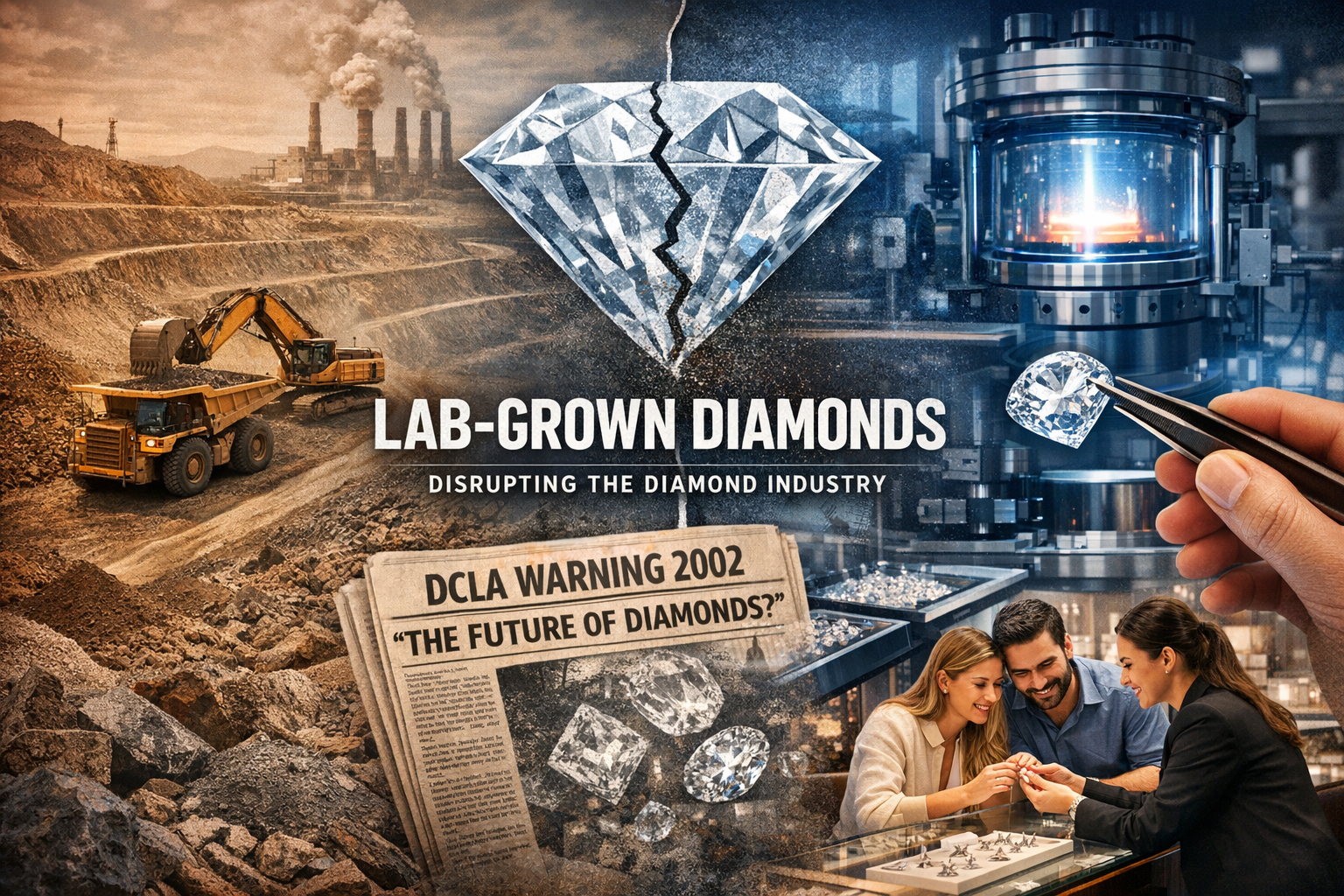
DCLA has previously examined this broader transformation in the diamond industry in its article on lab-grown diamonds as a structural disruption to the traditional diamond industry.
The cost floor
Every manufactured product has an economic cost floor.
That does not mean prices can never fall below the cost of production. Companies can sell inventory at a loss, factories can operate below capacity and distressed businesses can liquidate stock.
But those conditions cannot continue indefinitely.
If manufacturers consistently lose money, production capacity eventually disappears.
Machines are switched off.
Investment stops.
Workers leave.
Companies close or move into other businesses.
Supply then begins to contract.
This is potentially what the lab-grown diamond industry is now trying to avoid.
The Times of India reported that persistent price erosion has already forced some polishing units to consider alternative industries and has placed pressure on wages.
Could this lead to higher lab-grown diamond prices?
Possibly — but it is important not to confuse a price stabilisation with a return to the prices of several years ago.
There are still enormous production capacities around the world, and technological improvements can continue to reduce manufacturing costs.
Competition also remains intense.
However, the recent 20% to 25% reported increase in polished prices in Surat, combined with the reduction in discounts from approximately 7% to 3%–4%, suggests that parts of the industry are already attempting to establish greater pricing discipline.
If manufacturers continue to reduce production, consolidate capacity or refuse to sell below sustainable levels, prices could eventually find a stronger floor.
Energy costs could become an important part of that floor.
Why energy matters more as prices fall
There is an interesting economic paradox here.
When lab-grown diamonds were expensive, energy represented only one component of a much larger selling price.
As the selling price falls dramatically, however, every operating cost becomes proportionally more important.
Imagine a manufacturer producing a diamond at a total cost of $100 per carat.
Selling it for $200 leaves room for overheads, financing and profit.
Selling it for $120 leaves very little.
Selling it for $90 creates a loss.
The actual numbers vary enormously between manufacturers, technologies, electricity prices, yields and diamond specifications. Therefore, there is no single industry-wide production cost that can be applied to every lab-grown diamond.
But the economic principle remains the same.
There is a point at which further price reductions stop being sustainable.
The next phase of the lab-grown diamond market
The laboratory-grown diamond industry may therefore be entering a different phase.
The first phase was technological.
Could diamonds be grown commercially in laboratories?
The second phase was expansion.
How quickly could manufacturers increase production?
The third phase was price competition.
How cheaply could those diamonds be sold?
The next phase may be about economics.
How cheaply can a diamond realistically be produced while still providing a sustainable return to the manufacturer?
That question could become increasingly important.
The industry has already demonstrated that laboratory-grown diamonds can be produced at dramatically lower prices than natural diamonds.
What it has not yet demonstrated is where the long-term sustainable price floor lies.
Energy will be one of the factors determining that answer.
So will equipment depreciation, financing, labour, gases, seeds, yields, polishing, grading and the cost of maintaining sophisticated manufacturing facilities.
What this means for consumers
For consumers, lower lab-grown diamond prices have been an obvious advantage.
They have made larger and higher-specification diamonds accessible to a much wider market.
But consumers should also understand that cheap does not necessarily mean the price cannot fall further — and it does not mean the price cannot eventually rise.
The current market is still evolving.
The recent developments in Surat suggest that manufacturers are increasingly unwilling to continue absorbing falling margins and aggressive discounts.
If production is reduced and pricing discipline improves, the market could begin to stabilise.
If energy and other operating costs rise at the same time, those costs could become increasingly important in determining the minimum sustainable price of a lab-grown diamond.
The DCLA view
For consumers, the most important point remains understanding exactly what they are buying.
A laboratory-grown diamond is a real diamond with essentially the same chemical composition and crystal structure as a natural diamond, but its origin is different.
DCLA’s recent article, Natural or Laboratory-Grown? How Can You Tell What Diamond Is in Your Ring?, explains why laboratory-grown and natural diamonds can be difficult to distinguish visually and why independent laboratory testing is important.
DCLA recommends independent diamond identification and certification where appropriate, particularly when establishing whether a diamond is natural or laboratory-grown.
The DCLA Diamond Grading Report records important characteristics including carat weight, colour, clarity, measurements, treatments and whether the diamond is natural or laboratory-grown.
The laboratory-grown diamond industry has undergone an extraordinary period of technological development and price compression.
The next question is whether it can achieve something arguably more difficult:
long-term economic stability.
If manufacturers can no longer operate profitably at today’s heavily discounted prices, and if energy and other production costs continue to rise, the economics of the industry suggest that prices may eventually have to move higher or production capacity will have to contract.
The recent events in Surat may be an early indication that this process has already begun.