
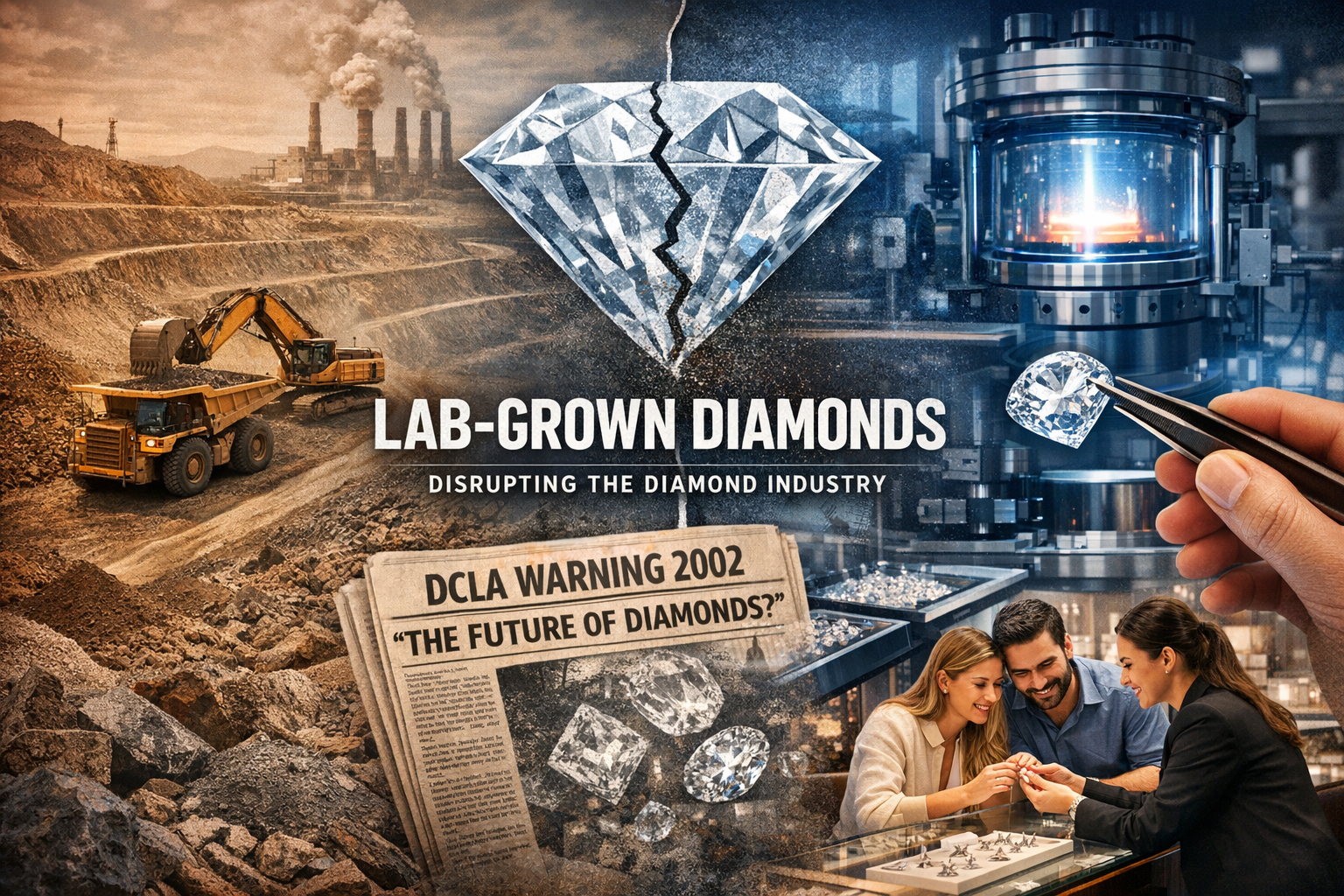
The global diamond industry is undergoing one of the most profound transformations in its modern history. The rapid rise of lab-grown diamonds is not merely a cyclical shift it represents a structural disruption that is reshaping mining economics, retail strategies, and long-held consumer perceptions of value.
What makes this transition particularly striking is that it was not unforeseen. As early as 2002, Diamond Certification Laboratory of Australia (DCLA) issued clear warnings to the Australian diamond industry about the impending impact of synthetic diamonds. Yet, industry associations largely failed to act, leaving miners, wholesalers, and retailers exposed to a technological shift that is now impossible to ignore.
A Warning Ignored: DCLA’s Early Insight
More than two decades ago, DCLA identified that advances in diamond-growing technology particularly Chemical Vapour Deposition (CVD) and High-Pressure High-Temperature (HPHT) would eventually produce gem-quality diamonds indistinguishable from natural stones without specialised equipment.
At the time, the broader industry dismissed these developments as niche or irrelevant to the emotional and luxury positioning of natural diamonds. Industry bodies continued to promote rarity, tradition, and romance, rather than preparing for a future where functional equivalence meets dramatic price advantage.
The failure was not technological it was strategic.
No meaningful contingency planning was undertaken. There was no large-scale consumer education framework, no segmentation strategy, and no defensive positioning to preserve the long-term value of natural diamonds. The result is the dislocation we are witnessing today.
Technological Parity and Economic Reality
Lab-grown diamonds are, from a scientific standpoint, diamonds in every sense. They possess identical:
- Hardness (10 on the Mohs scale)
- Refractive index
- Thermal conductivity
- Crystal structure
The only difference lies in origin.
Modern production methods have compressed what takes nature billions of years into a matter of weeks. CVD grows diamonds atom by atom in controlled environments, while HPHT replicates the extreme pressure and heat conditions found deep within the Earth.
This technological leap has created a fundamental economic imbalance:
- 1-carat lab-grown diamond: $800–$1,500
- 1-carat natural diamond: $4,000–$8,000
An 80%+ price differential for a visually identical product is not a temporary inefficiency—it is a permanent market force.
Impact on Traditional Mining
The implications for mining companies are severe and ongoing.
Major producers, including De Beers (owned by Anglo American), have experienced dramatic valuation declines and sustained financial pressure. Falling polished diamond prices—down more than 40% from recent peaks—are compressing margins across the sector.
Unlike synthetic producers, miners cannot rapidly adjust supply or significantly reduce extraction costs. Their operations are capital intensive, geographically fixed, and subject to long development cycles.
This has led to:
- Mine closures and production cuts
- Asset write-downs
- Consolidation across the industry
- Reduced exploration investment
The traditional model—built on scarcity and controlled supply—is being undermined by a product that can be manufactured at scale.
Retailers Caught in the Middle
Diamond retailers have arguably been hit the hardest.
For decades, retailers relied on consistent pricing structures, stable supply chains, and the emotional narrative of natural diamonds. Today, they face a vastly more complex landscape:
- Consumers are more informed and price-sensitive
- Lab-grown diamonds offer higher margins but lower ticket values
- Natural diamonds face resale and perception challenges
- Inventory risk has increased significantly
Retailers must now walk a fine line—offering both products while clearly communicating the differences. Failure to do so risks eroding consumer trust.
Many have pivoted toward lab-grown diamonds due to demand, but this shift often comes at the expense of the very product category that built their business.
Changing Consumer Psychology
Perhaps the most significant shift is not technological—but psychological.
Younger consumers increasingly prioritise:
- Value for money
- Ethical sourcing
- Environmental considerations
- Transparency
The traditional narrative—“a diamond is forever”—no longer carries the same weight it once did.
Instead, buyers are asking practical questions:
- Why pay significantly more for a natural stone?
- What is the resale value?
- Is the origin worth the premium?
This change in mindset has accelerated lab-grown adoption, particularly in engagement rings, where they now account for nearly half of purchases in key markets.
Environmental Considerations
Lab-grown diamonds have also gained traction through environmental positioning.
While the full lifecycle impact varies depending on energy sources, synthetic diamonds generally offer:
- Lower land disruption
- Reduced water usage
- Less waste generation
Natural diamond mining, by contrast, involves significant earth movement, long-term environmental management, and complex logistics.
However, it is important to note that not all lab-grown diamonds are environmentally equal—production powered by fossil fuels can offset many of these advantages.
Industry Response: Too Little, Too Late?
Traditional players have responded with a mix of strategies:
- Emphasising rarity and natural origin
- Investing in traceability and certification
- Targeting high-value, large-stone segments
- Strengthening luxury branding
Yet these responses are largely reactive.
Had the industry heeded DCLA’s early warnings in 2002, it could have:
- Established clear market segmentation early
- Educated consumers proactively
- Protected natural diamond positioning
- Developed stronger resale and investment frameworks
Instead, the industry allowed the narrative to be rewritten by price and accessibility.
The Road Ahead: Coexistence or Displacement?
The most likely outcome is not total replacement, but market bifurcation:
- Natural diamonds: Premium, rare, investment-oriented
- Lab-grown diamonds: Accessible, mass-market, value-driven
However, this coexistence depends on the natural diamond industry’s ability to redefine its value proposition beyond aesthetics.
Without that, the pressure from lab-grown alternatives will only intensify.
The rise of lab-grown diamonds is a textbook case of technological disruption—where innovation delivers a product of equal function at a fraction of the cost.
The tragedy for the traditional diamond industry is not that it was disrupted, but that it was warned.
The Diamond Certification Laboratory of Australia saw the shift coming over 20 years ago. The failure of industry associations to act on that warning has left miners and retailers scrambling to adapt in real time.
For investors, retailers, and consumers alike, the lesson is clear:
In markets driven by both emotion and economics, technology will always find a way to challenge tradition.
Disclaimer: This article is for informational purposes only and does not constitute financial or investment advice. Market conditions and industry dynamics may change, and readers should conduct independent research before making any decisions.



No comments:
Post a Comment