Showing posts with label Swarovski .laboratory-grown diamonds. Show all posts

Monday, 17 August 2026

The changing romance of diamonds and jewellery

 Laboratory-grown diamonds have accelerated this change. As production costs and retail prices have fallen, diamond-set jewellery has become accessible to a broader customer base.

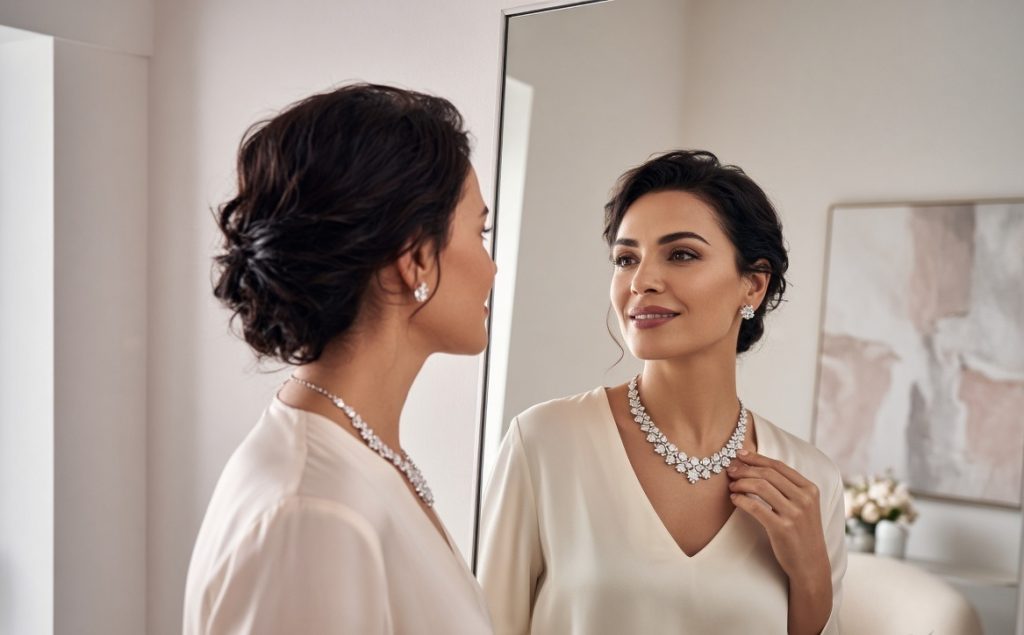
Swarovski’s chief executive has told the Financial Times that falling prices for laboratory-grown diamonds are enabling more women to buy diamond jewellery for themselves, rather than waiting for it to be given as a romantic gift.

The comments highlight a wider shift in the way consumers relate to diamonds and fine jewellery. Traditionally associated with engagements, anniversaries and other relationship milestones, diamond jewellery is increasingly being positioned as a form of personal expression, self-reward and financial independence. The romance of the diamond is not disappearing; it is becoming more personal and less dependent on a partner or a formal occasion.

Laboratory-grown diamonds have accelerated this change. As production costs and retail prices have fallen, diamond-set jewellery has become accessible to a broader customer base. Consumers who may previously have considered diamond jewellery unattainable can now enter the category at a lower price point, while those purchasing for themselves can choose pieces based on personal style rather than the expectations attached to a traditional gift.

For Swarovski, which operates across crystal, fashion jewellery and fine jewellery, laboratory-grown diamonds provide an opportunity to move further into the premium sector without the price barriers associated with natural stones. The company can present diamonds as contemporary, wearable and attainable appealing to customers who may be buying a meaningful piece to mark a personal achievement, career milestone or simply a moment of self-indulgence.

This shift towards self-purchase is one of the most closely watched developments in jewellery and watches. Brands ranging from De Beers to newer laboratory-grown specialists are adapting their communications to focus less exclusively on romance between couples and more on individuality, empowerment and personal reward. The message is increasingly that a diamond does not need to be given by someone else to be emotionally significant.

The trend also creates challenges for the natural diamond sector. Producers are already facing pressure from weaker rough-diamond prices, changing consumer expectations and growing scrutiny around provenance and sustainability. If consumers buying for themselves increasingly choose laboratory-grown diamonds because of their affordability and compatibility with modern messaging, natural diamond companies will need to work harder to communicate the value of rarity, origin, longevity and heritage.

The key question for the industry is whether self-purchase becomes a permanent pillar of jewellery marketing rather than a temporary response to changing consumer behaviour. As the boundaries between romantic gifting and personal luxury continue to blur, the meaning of the diamond itself is evolving from a symbol primarily of commitment between two people to one that can also represent ambition, independence and self-expression.

For the DCLA, this changing relationship with diamonds underlines the importance of communicating the distinct qualities of natural diamonds while recognising the broader cultural shift taking place across the jewellery market. The future of the category may depend on its ability to preserve the emotional power of the diamond while expanding the occasions, customers and stories connected to it.

Friday, 8 May 2026

Lab-Grown Diamonds Face Growing Scrutiny Over Massive Energy Use and Carbon Footprint


According to Pandora, the new carbon footprint reporting is being introduced in response to increasing consumer expectations to sustainability

While jewellery retailer Pandora has introduced carbon footprint labelling for its laboratory-grown diamonds in response to growing consumer demand for sustainability and transparency, the announcement also highlights an important reality often overlooked in the marketing of synthetic diamonds laboratory-grown diamonds are highly energy-intensive products.

Creating laboratory-grown diamonds requires enormous amounts of electricity to replicate the extreme heat and pressure conditions found deep within the earth. Whether produced through High Pressure High Temperature (HPHT) or Chemical Vapour Deposition (CVD) technology, these processes rely on industrial machinery operating continuously for extended periods, consuming significant energy during crystal growth, cutting and polishing.

Pandora stated that its laboratory-grown diamonds are produced using “100% renewable energy” and claimed their carbon footprint is approximately 90% lower than mined diamonds. However, this depends heavily on the availability, reliability and verification of renewable energy sources, as well as regional electricity grids. In many parts of the world where laboratory-grown diamonds are manufactured, energy generation still relies substantially on fossil fuels, raising ongoing questions about the true environmental impact of mass synthetic diamond production.

The company’s new carbon footprint reporting covers emissions from raw material production through to polishing and has reportedly been verified by external life-cycle assessment experts and reviewed by EY. Pandora says the initiative aims to give consumers greater transparency alongside the traditional 4Cs Cut, Colour, Clarity and Carat by adding what it calls a “5th C” focused on climate impact.

At the same time, the broader diamond industry continues to debate the long-term sustainability claims surrounding laboratory-grown diamonds. Natural diamonds are created by nature over billions of years, while synthetic diamonds require constant industrial energy input to manufacture in controlled factory environments.

As consumer awareness grows, transparency around energy consumption, carbon reporting and manufacturing practices will likely become an increasingly important part of the conversation surrounding both natural and laboratory-grown diamonds.

Source: DCLA

Monday, 30 March 2026

Swarovski's Pop Luxury Plan Pays Off Again

 Swarovski

Swarovski delivered 6% year on year organic growth in 2025 as its turnaround and repositioning plan continued to pay dividends.

The family controlled Austrian company reported EUR1.97 billion ($2.26 billion) in revenue for the year, generated across its 2,300 retail boutiques worldwide.

Swarovski, best known for selling precision cut crystal jewelry and accessories, embarked on its “LUXignite” strategy in 2022, moving toward a “pop luxury” jewelry led business.

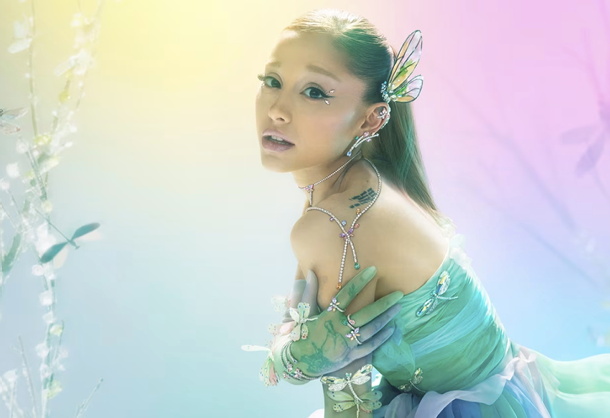
Ariana Grande, the Grammy-winning American singer, songwriter, and actress, became Swarovski’s brand ambassador in 2023, and has played a key role in blending high fashion with mainstream cultural appeal.

As the company issued an update on its 2025 performance, CEO Alexis Nasard said: “Our consistent progress continued in 2025 despite a challenging environment, as we delivered broad based top line growth, strengthened profitability, and improved cash generation, while reaching new heights of brand desirability and anchoring the Swarovski brand as a cultural icon in the pop luxury space. The execution of the LUXignite strategy is delivering as intended.”

Swarovski saw year on year growth in all regions and sales channels, notably in North America (+10%) and among the company’s own directly operated stores.
EBITDA rose 12% compared with the prior year, supported by strong cash generation.

As a privately held company, Swarovski is not obliged to publish detailed financial accounts.

In November, the company announced plans to cut around 400 jobs at its headquarters in Austria and to reduce pay and working hours for the remaining 2,100 staff.

Source:DCLA

Friday, 21 November 2025

Swarovski Cuts 400 Jobs at Austria HQ

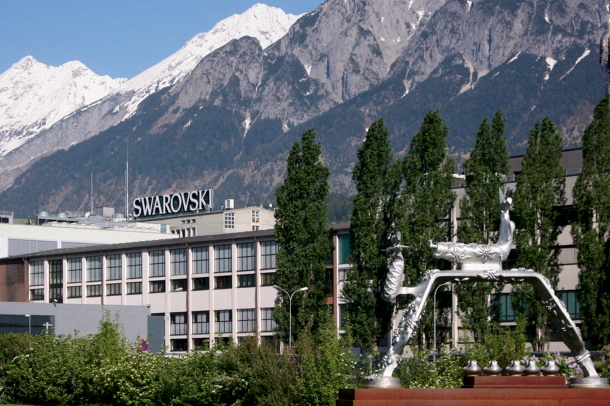
WATTENS, AUSTRIA - 07 May 2009: Swarovski Corporation headquarter. Company is traditional producer cut crystal and was founded by in 1895.

Swarovski is to cut around 400 jobs at its headquarters in Austria and to reduce pay and working hours there for the remaining 2,100 staff.

The family-run company, founded in 1895, blamed weaker sales to other companies rather than direct sales to individual consumers.

Layoffs will start in January 2026, the company said. It will also reduce staff numbers through voluntary departures, and retirements.

In addition, Swarovski, best known for its crystal products, will reduce pay and hours for HQ staff by 10 per cent and eliminate the night shift.

Swarovski has axed over 5,000 jobs since 2007, reflecting ongoing efforts to slim down the workforce amid market pressures.

The company, which has 2,300 outlets globally, returned to profit in 2024 after five years, and reported full-year revenue of EUR 1.9bn (USD 2.0bn).

Pic shows the Swarovski HQ, in Wattens, Austria.

Source: DCLA

Wednesday, 29 January 2020

Swarovski Debuts New Lab-Grown Diamond Colors


Crystal brand Swarovski introduced 16 new synthetic-diamond colors at Paris Haute Couture Fashion Week.
The new hues fall into four creative categories in which Swarovski claims to play a role, it said last week. Each of the four areas — fashion, art, music and architecture — includes four colors of cushion-cut lab-grown diamonds.
Every category in the collection is led by a “hero” color. These include Androgyny Flamingo for fashion, Cubist Sky for art, Heavy Metal Cherry for music, and Gothic Cognac for architecture. Some of the other colors in the collection are Punk Lipstick, Surrealist Butter, Draped Fire and Electro Arctic.
The stones showcased in Paris range from 1.25 to 2.50 carats, while the 16 colors will be available at stores in 0.25- to 1.50-carat sizes.
“I’d like to think that these stones have endless potential, and are able to bring any idea to life,” said Markus Langes-Swarovski, a member of the Austrian jeweler’s executive board. “The colors, cuts and sizes are created to inspire jewelry that has never been made or even dreamed of. It’s a toolbox of unlimited creativity.”
Swarovski first launched laboratory-grown diamonds in 2018.
Source: DCLA

Swarovski Debuts New Lab-Grown Diamond Colors


Crystal brand Swarovski introduced 16 new synthetic-diamond colors at Paris Haute Couture Fashion Week.
The new hues fall into four creative categories in which Swarovski claims to play a role, it said last week. Each of the four areas — fashion, art, music and architecture — includes four colors of cushion-cut lab-grown diamonds.
Every category in the collection is led by a “hero” color. These include Androgyny Flamingo for fashion, Cubist Sky for art, Heavy Metal Cherry for music, and Gothic Cognac for architecture. Some of the other colors in the collection are Punk Lipstick, Surrealist Butter, Draped Fire and Electro Arctic.
The stones showcased in Paris range from 1.25 to 2.50 carats, while the 16 colors will be available at stores in 0.25- to 1.50-carat sizes.
“I’d like to think that these stones have endless potential, and are able to bring any idea to life,” said Markus Langes-Swarovski, a member of the Austrian jeweler’s executive board. “The colors, cuts and sizes are created to inspire jewelry that has never been made or even dreamed of. It’s a toolbox of unlimited creativity.”
Swarovski first launched laboratory-grown diamonds in 2018.
Source: DCLA

Petra Diamonds Weighs Sale as Diamond-Market Pressures Mount

  Strategic review highlights the financial pressure facing one of Africa’s best-known natural diamond producers Petra Diamonds has launched...