Showing posts with label diamondjewellery. Show all posts

Monday, 13 July 2026

The Three Essential Jewellery Pieces Every Woman Should Own

 A Timeless Jewellery Wardrobe Beyond the Engagement Ring and Wedding Band

A Timeless Jewellery Wardrobe Beyond the Engagement Ring and Wedding Band


An engagement ring and wedding band are among the most treasured pieces of jewellery a woman will ever own. They represent love, commitment and life’s most significant milestones. However, beyond these iconic symbols, there are three jewellery pieces that form the foundation of a truly elegant and versatile collection.

These timeless pieces transcend fashion trends, complement virtually every wardrobe, and can be worn for decades. Whether crafted in platinum or gold and adorned with diamonds or coloured gemstones, they become heirlooms that tell a personal story.

The Three Essential Jewellery Pieces Every Woman Should Own

A Timeless Jewellery Wardrobe Beyond the Engagement Ring and Wedding Band

An engagement ring and wedding band are among the most treasured pieces of jewellery a woman will ever own. They represent love, commitment and life’s most significant milestones. However, beyond these iconic symbols, there are three jewellery pieces that form the foundation of a truly elegant and versatile collection.

These timeless pieces transcend fashion trends, complement virtually every wardrobe, and can be worn for decades. Whether crafted in platinum or gold and adorned with diamonds or coloured gemstones, they become heirlooms that tell a personal story.

1. Diamond Stud Earrings – The Ultimate Everyday Luxury

The Three Essential Jewellery Pieces Every Woman Should Own

7

If there is one piece of jewellery every woman should own, it is a pair of beautifully proportioned diamond stud earrings.

Simple yet sophisticated, diamond studs have remained the benchmark of elegance for generations. Their understated brilliance suits every age, every occasion and every style.

Why they’re essential

Unlike fashion jewellery, quality diamond studs never become outdated. They effortlessly transition from business meetings to formal dinners, weddings and casual weekends.

Women who prefer colour can choose sapphire, ruby or emerald studs, which offer a striking alternative while maintaining the same timeless appeal.

Best metal choices

  • Platinum provides exceptional durability with a naturally white finish that enhances a diamond’s brilliance.
  • 18ct White Gold offers a contemporary appearance with excellent value.
  • 18ct Yellow Gold creates a beautiful contrast against white diamonds and pairs especially well with warmer skin tones.
  • 18ct Rose Gold offers a softer, romantic aesthetic that complements pink diamonds and many coloured gemstones.

When to wear them

Diamond or gemstone studs are among the few pieces of jewellery appropriate for almost every occasion—from the office and business travel to evening events and black-tie functions.


2. A Diamond Tennis Bracelet – Effortless Sophistication

The Three Essential Jewellery Pieces Every Woman Should Own

6

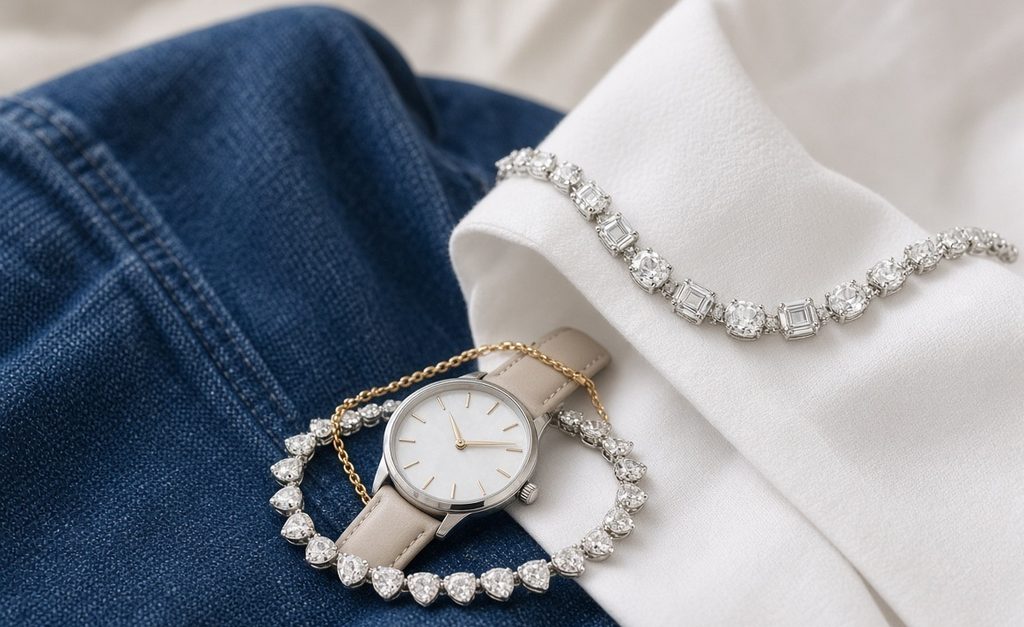
The diamond tennis bracelet has become one of the world’s most recognised luxury jewellery pieces.

Originally popularised during professional tennis in the 1980s, today’s tennis bracelet has evolved into an everyday symbol of understated luxury.

Its continuous row of perfectly matched diamonds creates elegant sparkle without overwhelming an outfit.

Why it’s important

Unlike statement jewellery reserved for special occasions, a tennis bracelet is remarkably versatile.

It can be worn alone for a refined appearance or layered with a watch or delicate bangles for a modern look.

For women wanting something distinctive, alternating diamonds with sapphires, rubies or emeralds creates a colourful interpretation of this classic design.

Best metal choices

  • Platinum for maximum longevity and security.
  • White gold for contemporary styling.
  • Yellow gold for timeless warmth and vintage appeal.

When to wear it

A tennis bracelet transitions effortlessly from professional attire to cocktail events and formal celebrations. Many women choose to wear theirs daily because of its comfort and enduring style.


3. A Signature Pendant or Necklace – Jewellery with Meaning

The Three Essential Jewellery Pieces Every Woman Should Own

6

Every jewellery collection deserves a centrepiece that carries personal significance.

A finely crafted pendant worn on a quality chain becomes one of the most personal pieces a woman can own.

Whether featuring a brilliant-cut diamond, an elegant coloured gemstone or a family heirloom stone, the pendant often represents an important milestone, anniversary or personal achievement.

Why it’s essential

Unlike rings or bracelets, a pendant naturally draws attention to the face while adding elegance without dominating an outfit.

It also layers beautifully with shorter or longer necklaces, allowing endless styling possibilities.

Diamond or coloured gemstone?

Diamonds remain the classic choice, but coloured gemstones allow personality to shine.

Popular options include:

  • Sapphires – symbols of wisdom, loyalty and elegance.
  • Rubies – representing love, confidence and passion.
  • Emeralds – admired for their rich green colour and timeless sophistication.
  • Aquamarines, spinels and tourmalines – increasingly popular among collectors seeking individuality.

When to wear it

A signature pendant can become an everyday favourite while also elevating formal attire. It is often the jewellery piece most closely associated with its wearer.


Building a Jewellery Collection That Lasts a Lifetime

Luxury jewellery should never be viewed simply as an accessory. Well-crafted pieces become part of a family’s history, often passed from one generation to the next.

When investing in fine jewellery, quality should always take precedence over size alone.

Consider:

  • Natural diamonds with independent grading certificates.
  • High-quality coloured gemstones with strong colour saturation and transparency.
  • Platinum or 18-carat gold for durability and lasting value.
  • Expert craftsmanship that ensures longevity and ease of future maintenance.

The DCLA Perspective

At the Diamond Certification Laboratory of Australia (DCLA), we believe exceptional jewellery begins with exceptional gemstones.

Whether selecting natural diamonds or rare coloured gemstones, independent certification provides confidence in quality, authenticity and value. Understanding the characteristics of diamonds and coloured gemstones enables buyers to make informed decisions that will endure for generations.

The most treasured jewellery is rarely the most extravagant. Instead, it is the jewellery worn often, cared for carefully and filled with personal meaning. A pair of elegant diamond earrings, a classic tennis bracelet and a signature pendant together form the foundation of a jewellery collection that will remain beautiful, relevant and cherished for a lifetime.

Source: DCLA

Sunday, 12 July 2026

Jewellery Trends Defining 2026: Colour, Layers and Individual Expression

 Coloured Gemstones Take Centre Stage

For several years, minimalist jewellery dominated fashion, with fine chains and delicate diamond pendants becoming everyday staples. In 2026, however, the industry has taken a noticeable turn. Jewellery is becoming more expressive, more colourful and, above all, more personal.

Consumers are no longer choosing a single statement piece. Instead, they are curating collections that reflect their own style through layered necklaces, stacked rings, colourful gemstones and a mix of precious metals. The result is a fresh approach to fine jewellery that celebrates individuality rather than conformity.

Coloured Gemstones Take Centre Stage

While diamonds remain the cornerstone of fine jewellery, coloured gemstones are experiencing a remarkable resurgence. Designers are increasingly incorporating vibrant sapphires, emeralds, rubies, spinels, tourmalines, aquamarines, morganites and even lesser-known gems into both everyday and high jewellery collections. Recent high jewellery collections from the world’s leading luxury houses have placed exceptional coloured gemstones at the forefront, reflecting growing consumer demand for rarity, individuality and vibrant colour.

Consumers are seeking jewellery that tells a story, and colour provides an emotional connection that white diamonds alone cannot always achieve.

Each gemstone carries its own symbolism:

  • Blue sapphires represent wisdom and loyalty.
  • Emeralds symbolise renewal and prosperity.
  • Rubies continue to represent passion and strength.
  • Tourmalines offer an extraordinary palette of colours that appeals to younger buyers.
  • Morganite and aquamarine provide softer pastel tones that complement modern fashion.

Increasingly, clients are choosing gemstones based not only on beauty but also on personal meaning, birthstones or unique colour combinations.

Layering Has Become an Art Form

One of the strongest trends throughout 2026 is jewellery layering.

Rather than wearing a single necklace or bracelet, consumers are combining multiple pieces of varying lengths, textures and gemstone colours to create a personalised look. The trend extends across virtually every jewellery category:

  • Multiple necklaces worn together.
  • Diamond tennis necklaces paired with coloured gemstone pendants.
  • Stacked bangles and bracelets.
  • Several rings worn across both hands.
  • Earrings featuring multiple piercings with coordinated designs.

Layering allows jewellery collections to evolve over time. Instead of purchasing one large statement piece, clients can add individual items over many years, creating combinations that are unique to them. The growing popularity of personalised layering has become one of the defining luxury jewellery trends of the year.

Mixing Metals Is No Longer a Fashion Mistake

For decades, jewellery etiquette suggested that yellow gold should never be worn with white gold or silver.

Today, that rule has largely disappeared.

Designers are actively encouraging combinations of yellow gold, white gold, rose gold and platinum within the same outfit. Mixed-metal jewellery creates greater versatility and allows existing collections to work together rather than limiting clients to one metal colour. Fashion editors and luxury designers now regard mixed-metal styling as one of the year’s defining jewellery looks.

Larger Gemstones Are Making a Comeback

After years of understated designs, larger centre stones are once again attracting attention.

This does not necessarily mean extravagant jewellery. Instead, jewellers are using bold coloured gemstones as centrepieces, surrounded by refined diamond settings that allow colour to become the hero.

Oval, emerald-cut and cushion-cut gemstones remain particularly popular due to their ability to maximise colour while maintaining elegant proportions.

Personalisation Continues to Drive Buying Decisions

Perhaps the biggest change is the consumer’s desire for jewellery that feels unique.

Rather than following trends alone, buyers increasingly want pieces that represent milestones, family, travel or personal achievements.

Custom-designed engagement rings featuring coloured centre stones continue to grow in popularity, while remodelled heirloom jewellery allows families to preserve sentimental value in contemporary designs.

Bespoke manufacturing has become one of the fastest-growing areas of the jewellery industry as clients seek one-of-a-kind creations that cannot be replicated by mass production.

Natural Diamonds Continue to Complement Colour

Although coloured gemstones are enjoying unprecedented popularity, natural diamonds remain the foundation of fine jewellery.

Rather than replacing diamonds, coloured stones are enhancing them.

Diamond halos surrounding vibrant sapphires, emerald side stones paired with oval diamonds, and alternating diamond-and-gemstone tennis bracelets are all becoming increasingly common.

The contrast between colourless diamonds and richly saturated gemstones creates visual depth while maintaining the timeless elegance that natural diamonds have always provided.

Quality Matters More Than Ever

As colourful jewellery becomes increasingly desirable, buyers should remember that not all gemstones are equal.

Natural gemstones vary enormously in colour, clarity, cut and origin, while laboratory-grown alternatives are becoming more widely available across several gemstone categories.

Professional grading and independent laboratory assessment remain essential for consumers seeking confidence in the authenticity and quality of significant gemstone purchases.

Whether purchasing a natural diamond, a vivid sapphire or an exceptional emerald, independent certification provides assurance regarding identity, treatments and quality characteristics.

Looking Ahead

The jewellery industry is entering a vibrant new era where individuality is replacing uniformity. Layered jewellery, colourful gemstones, mixed metals and bespoke design are redefining luxury for a new generation of buyers.

Rather than following rigid fashion rules, today’s consumers are building collections that evolve over time combining diamonds with coloured gemstones, vintage pieces with contemporary designs, and treasured heirlooms with modern craftsmanship.

For jewellers, designers and laboratories alike, the trend is clear: jewellery is becoming increasingly personal, expressive and colourful, with quality, authenticity and expert craftsmanship remaining at the heart of every exceptional piece.

Source: DCLA

Wednesday, 8 July 2026

The Rise of Sculptural Diamond Rings, Why Curves Are Replacing Straight Lines

 The Rise of Sculptural Diamond Rings: Why Curves Are Replacing Straight Lines

For decades, engagement rings and diamond jewellery followed a familiar formula: a straight band, a centre diamond, and a timeless setting. While these classic designs remain popular, a new generation of jewellery lovers is embracing something far more expressive.

Across the luxury jewellery world, sculptural rings with flowing curves, sweeping twists and organic shapes are becoming one of the strongest design movements of recent years. Rather than relying on rigid symmetry, these contemporary creations celebrate movement, individuality and artistic craftsmanship.

For decades, engagement rings and diamond jewellery followed a familiar formula: a straight band, a centre diamond, and a timeless setting.

Jewellery Inspired by Nature and Architecture

Today’s designers are finding inspiration everywhere from rolling ocean waves and winding rivers to modern architecture and abstract sculpture.

The result is jewellery that feels alive.

Instead of perfectly straight bands, precious metals sweep around the finger in elegant curves, creating rings that appear to flow naturally. Some designs twist gently around a single diamond, while others form dramatic sculptural silhouettes that make the jewellery itself as important as the gemstone it holds.

These pieces are designed to be viewed from every angle, revealing new lines, reflections and proportions with every movement of the hand.

Natural Diamonds Become the Centre of the Artwork

One reason these sculptural designs have become so popular is the way they showcase natural diamonds.

Curved settings create visual movement that naturally draws the eye toward the diamond. Open spaces within the design allow more light to enter the stone, enhancing brilliance and creating the illusion that the diamond is floating above the band.

This architectural approach transforms the diamond from simply being set into a ring to becoming part of a carefully balanced work of art.

Whether featuring a classic round brilliant, an elegant oval, a pear shape or an emerald cut, sculptural settings allow each diamond to appear more dynamic and distinctive.

Stackable Rings Continue to Grow in Popularity

Another driving force behind this trend is versatility.

Rather than purchasing a single ring that never changes, many buyers are building personal collections of curved bands that can be stacked together in different combinations.

Anniversary bands, eternity rings and special occasion pieces can all be added over time, creating a jewellery collection that evolves alongside life’s milestones.

Each additional ring becomes another chapter in the owner’s personal story, making the collection increasingly meaningful with every passing year.

A Move Towards Individual Expression

Consumers today are increasingly looking for jewellery that reflects their personality rather than following tradition.

While the classic solitaire remains one of the world’s most recognisable engagement rings, many couples now want something that feels unique without sacrificing elegance.

Soft curves and sculptural forms offer exactly that balance. They remain sophisticated and timeless while introducing an artistic edge that sets them apart from conventional designs.

This growing appreciation for individuality has encouraged independent designers and established luxury houses alike to experiment with increasingly innovative forms.

Pear Shapes and Fancy Diamonds Shine

Although white diamonds continue to dominate engagement jewellery, designers are increasingly incorporating fancy-coloured natural diamonds, champagne diamonds and other distinctive gemstones into sculptural settings.

Pear-shaped diamonds are particularly well suited to flowing designs. Their elegant silhouette naturally complements curved bands, creating a sense of motion while directing attention towards the stone’s brilliance.

Oval, marquise and elongated cushion cuts also work exceptionally well within these contemporary compositions.

Craftsmanship Matters More Than Ever

Creating a sculptural ring is considerably more challenging than manufacturing a traditional straight band.

Every curve must be carefully engineered to ensure comfort, structural integrity and precise diamond placement. The flowing lines must appear effortless while maintaining perfect proportions and durability for everyday wear.

This level of precision requires highly skilled jewellers capable of combining artistic vision with exceptional technical expertise.

The finest examples demonstrate that outstanding jewellery is not simply about the size of the diamond it is about the harmony between design, craftsmanship and the natural beauty of the stone.

The Future of Fine Jewellery Design

Sculptural diamond rings represent more than a passing fashion trend. They reflect a broader shift towards jewellery that is personal, artistic and designed to be treasured for generations.

As consumers continue seeking originality alongside timeless elegance, flowing curves, organic forms and innovative settings are likely to remain an important direction in contemporary fine jewellery.

For collectors and buyers alike, these designs prove that natural diamonds continue to inspire creativity, allowing master jewellers to transform precious stones into wearable works of art that are every bit as individual as the people who wear them.

Source: DCLA

Monday, 6 July 2026

Men's Jewellery Trends Are Breaking Gender Barriers

 For generations, the jewellery industry has primarily marketed fine jewellery to women, while men were viewed as purchasers rather than wearers. Outside wedding bands, signet rings and luxury watches, men's jewellery occupied only a small corner of the market. That perception is changing rapidly.

Why More Men Are Buying Fine Jewellery Than Ever Before

For generations, the jewellery industry has primarily marketed fine jewellery to women, while men were viewed as purchasers rather than wearers. Outside wedding bands, signet rings and luxury watches, men’s jewellery occupied only a small corner of the market. That perception is changing rapidly.

Today, one of the most significant shifts in the global jewellery industry is the rise of the male jewellery consumer. Men are not only buying more jewellery, they are purchasing it for themselves, embracing precious metals, diamonds and coloured gemstones as an extension of their personal style. The traditional boundaries between men’s and women’s jewellery are becoming increasingly blurred, creating exciting opportunities for jewellers, designers and gem laboratories alike.

A New Generation of Male Jewellery Buyers

Luxury retailers and designers report that male clients have increased significantly over recent years. More importantly, today’s buyers are becoming increasingly adventurous.

Rather than limiting themselves to simple chains or traditional signet rings, men are exploring diamond bracelets, gemstone rings, layered necklaces, earrings, brooches and personalised jewellery. Many purchases are driven by self expression rather than special occasions or gifting.

This evolution represents a cultural shift rather than a passing fashion trend.

Celebrity Influence Has Changed Everything

The modern acceptance of men’s jewellery has been accelerated by celebrities, athletes and musicians who confidently wear fine jewellery on the world’s biggest stages.

Red carpet appearances now regularly feature diamond brooches, layered necklaces, gemstone rings and statement bracelets worn by leading actors and musicians. Sporting stars have also embraced tennis necklaces, diamond earrings and luxury jewellery as part of their personal identity.

These public figures have helped redefine masculinity, showing that fine jewellery is no longer restricted by traditional gender expectations.

Breaking Traditional Gender Barriers

Perhaps the biggest transformation is the growing popularity of gender neutral jewellery.

Many luxury brands have discovered that collections originally designed for men are equally popular with women, leading several manufacturers to reposition their ranges as unisex collections. Clean lines, minimal styling and high quality craftsmanship appeal across all demographics.

Consumers today are less concerned with whether a piece is labelled “men’s” or “women’s.” Instead, they choose jewellery that reflects their own personality, lifestyle and values.

Personal Expression Is Driving Demand

Unlike previous generations, many younger buyers view jewellery as a form of storytelling.

Engraved signet rings, symbolic pendants, coloured gemstones and layered jewellery allow individuals to communicate their identity, achievements and beliefs without saying a word.

Jewellery has become deeply personal, transforming from a status symbol into an expression of individuality. Designers report growing demand for bespoke pieces that carry emotional significance rather than simply displaying wealth.

Diamonds Remain at the Centre

While contemporary designs may be evolving, diamonds continue to play a central role in men’s fine jewellery.

Diamond set rings, tennis bracelets, pendants and earrings are becoming everyday accessories rather than pieces reserved for formal occasions.

Natural diamonds remain particularly attractive due to their rarity, durability and enduring value. As consumers become more educated, many appreciate the geological history and authenticity that natural diamonds represent.

For laboratories such as the Diamond Certification Laboratory of Australia (DCLA), this growing market reinforces the importance of independent grading and certification, ensuring buyers have confidence in the quality and authenticity of every natural diamond they purchase.

The Market Continues to Expand

Industry research supports what jewellers are already witnessing in their showrooms.

The global men’s jewellery market was valued at approximately US$48.5 billion in 2024 and is forecast to grow at almost 10 percent annually over the next decade. Separately, broader jewellery market analysis identifies men’s jewellery as the fastest growing consumer segment through 2033, driven by changing cultural attitudes and increasing acceptance of jewellery as everyday fashion.

This growth is being fuelled by Millennials and Generation Z, who have largely abandoned traditional ideas about who should wear jewellery.

What This Means for the Jewellery Industry

The rise of men’s jewellery represents more than a fashion trend. It signals a structural change in consumer behaviour.

Jewellers who once focused almost exclusively on female customers are now expanding their men’s collections with sophisticated designs featuring diamonds, coloured gemstones and precious metals. Designers are embracing versatility, while retailers are recognising that today’s male customer values craftsmanship, authenticity and personal expression just as highly as any other buyer.

For the diamond industry, this creates exciting opportunities. As more men invest in fine jewellery featuring natural diamonds, the importance of trusted grading and certification becomes even more significant.

The modern jewellery market is becoming increasingly inclusive. Men are purchasing jewellery not because tradition dictates it, but because it reflects who they are.

As gender barriers continue to dissolve and personal style becomes the defining influence, fine jewellery is evolving into a universal form of self expression. Natural diamonds remain at the heart of this transformation, combining timeless beauty with lasting value.

For organisations such as the DCLA, this changing landscape highlights the continuing importance of independent diamond grading, providing confidence and transparency for a new generation of jewellery buyers who value authenticity above all else.

Source: DCLA

Tuesday, 6 May 2025

US Watch and Jewelry Sales Steady Again in March

Diamond Bracelet

Watch and jewelry sales in the US remained steady in March, with a slight overall increase of 0.4 per cent, according to the latest US Department of Commerce figures.

Jewelry sales rose slightly, while watch sales dipped, as consumers opted for higher-priced items, but bought fewer of them.

In February overall sales increased by just 0.2 per cent and in January they fell by 1.0 per cent

The US government’s BEA (Bureau of Economic Analysis) reported a 0.7 per cent increase in consumer spending in March, the biggest increase for two years, but said it was largely driven by a rush to buy cars before US reciprocal tariffs forced prices up.

Watch and jewelry sales have been characterized by very modest increases in recent months, following on from a year of sustained growth – 10 per cent or more in some months – as shown below.

Reciprocal US tariffs – announced in April, then paused until July – will almost certainly hit sales, as producers forced to either absorb the costs or pass them on to consumers.

Source: DCLA

Thursday, 27 March 2025

Revenue Down, Stores Closed at Chow Sang Sang

Chow Sang Sang

Chow Sang Sang suffered a net loss of 74 of its 1,032 stores last year, amid weak demand, record-high gold prices and an economic slowdown in China, as well as Hong Kong and Macau.

China’s third biggest jewelry retailer (by revenue) saw sales for the year to 31 December 2024 fall by 15 per cent to HKD 21.18bn ($2.72bn).

Same-store sales were down 38 per cent on the mainland and 24 per cent in Hong Kong and Macau, primarily due to a drop in diamond demand. Profit slid 20 per cent to HKD 805.6m ($103.6m).

Chow Sang Sang did not rule out further store closures. “Under the present economic climate, it would be prudent to continue our physical store network consolidation,” it said its Annual Results.

“In 2024, uncertain economic conditions coupled with record-high gold price exerted significant pressure on jewellery demand in both Mainland China, and the Hong Kong and Macau markets, resulting in a 15 per cent year-on-year decline in turnover.

“Continuing our efforts to consolidate the store networks, we opened 48 and closed 122 stores, mostly in Mainland China.”

Source: DCLA

Sunday, 21 January 2024

Michael Hill closes six stores, axes senior managers amid tough retail environment


Michael Hill closes six stores, axes senior managers amid tough retail environment

Well-known jewellery chain Michael Hill has revealed it closed six stores in the past six months and scrapped senior management roles due to tough retail conditions.

In a trading update released by the stock market listed company, it described the six months to December 31, 2023 as a “challenging period for the business” as its profitability took a hit and is estimated to be down 45 to 39 per cent on the same period of 2022.

Of the six “underperforming” stores it closed, one was in regional WA, one in Queensland, one in Victoria, two in NSW and one in Canada.

In the statement, the company blamed economic conditions for “impacting consumer sentiment”, adding that its profit margin was affected by the inflated cost of gold and diamonds, and “aggressive competitor behaviour”, which led to a decision to “reduce operating costs, including the exit of a number of senior management roles”.

It did not reveal how many staff or which roles were affected.

Michael Hill also owns the more affordable Bevilles chain.

Michael Hill also owns the more affordable Bevilles chain.

The company achieved sales of $362.8 million during the six months to December 31, 2023, which was up 4.1 per cent on the same period of 2022.

But it revealed its gross profit for the period was expected to be between $30-33 million, which represents a fall of 45 to 39 per cent from the gross profit of $54.5 million it posted in the second half of 2022.

Earlier in 2023 the company bought the more affordable Bevilles jewellery chain, and it opened four new Bevilles stores in Australia during the past six months.

Michael Hill CEO and managing director Daniel Bracken said profit margins were hit in the second half of 2023. Picture: Richard Walker.

Michael Hill CEO and managing director Daniel Bracken said profit margins were hit in the second half of 2023. Picture: Richard Walker.

Source: news.com.au

Choosing the Right Precious Metal for Fine Diamond Jewellery

  Why Gold Purity, Colour and Craftsmanship Matter When purchasing a fine diamond, most buyers focus on the stone itself its cut, colour, cl...