Monday, 27 July 2026

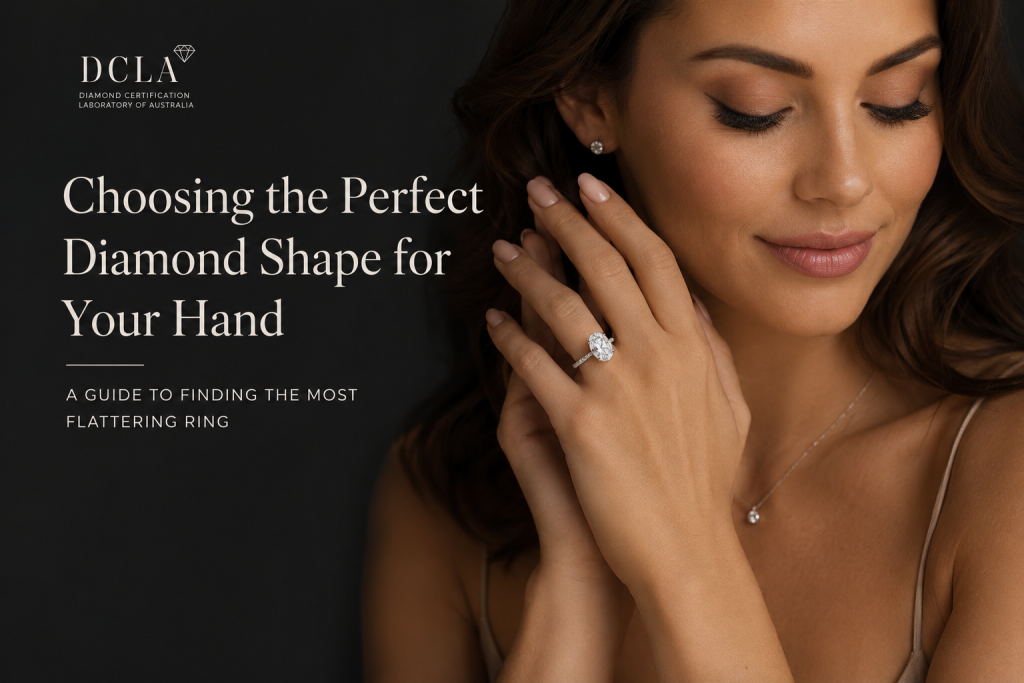
Choosing the Perfect Diamond Shape for Your Hand: A Guide to Finding the Most Flattering Ring

 Selecting a diamond is about far more than choosing the largest stone or the most popular shape.

Selecting a diamond is about far more than choosing the largest stone or the most popular shape. While the quality of a diamond is essential, the proportions of your hand and fingers play a significant role in how a ring will look once it is worn.

At the Diamond Certification Laboratory of Australia (DCLA), we believe the most beautiful engagement ring or dress ring is one that complements the wearer. The right combination of diamond shape, size, setting and band width can enhance the appearance of the hand, making fingers appear longer, slimmer or more balanced.

Here is a guide to selecting the most flattering diamond shape for different hand types.


Long, Slim Fingers

Those with long, elegant fingers have the greatest flexibility when choosing a diamond shape. Almost every cut looks proportionate and attractive.

Best diamond shapes:

  • Round Brilliant
  • Cushion
  • Princess
  • Asscher
  • Emerald
  • Radiant

Long fingers can comfortably wear larger diamonds without appearing overwhelming. Wider bands and bold settings also suit this hand type.

Recommended sizes

  • 1.50 to 5.00 carats and above
  • Fancy shapes with wider proportions work particularly well.

Short Fingers

The objective for shorter fingers is to create the illusion of length.

Best diamond shapes

  • Oval
  • Pear
  • Marquise
  • Emerald Cut
  • Elongated Radiant

These elongated shapes naturally draw the eye vertically, making fingers appear longer and more slender.

A slightly narrower band further enhances this effect.

Avoid

  • Very wide cushion cuts
  • Large square princess cuts
  • Extremely wide bands

Wider or Fuller Fingers

Many people believe they need a very large diamond to suit broader fingers. While size is important, shape and proportion are even more critical.

Best diamond shapes

  • Oval
  • Cushion
  • Radiant
  • Emerald
  • Elongated Cushion

These shapes provide excellent finger coverage while maintaining elegant proportions.

Diamonds between 2 and 4 carats often create excellent balance depending on the finger size.

Thicker bands generally complement broader fingers better than very fine bands.


Very Thin Fingers

Fine fingers can easily become overwhelmed by an oversized diamond.

Best diamond shapes

  • Round Brilliant
  • Oval
  • Cushion
  • Heart
  • Pear

Delicate settings with diamonds between 0.50 and 2.00 carats often create the most balanced appearance.

Fine claws and narrow bands maintain elegance without overpowering the hand.


Diamond Shape and Visual Illusion

Each diamond shape creates a different visual effect.

Oval

Perhaps the most universally flattering shape.

Oval diamonds:

  • make fingers appear longer
  • maximise face-up size
  • often appear larger than round diamonds of equal weight

Pear

The pear shape creates a slimming effect.

When worn with the point facing outward, it naturally elongates the finger while providing exceptional brilliance.


Marquise

One of the oldest royal diamond cuts remains one of the best for creating length.

Its pointed ends maximise spread and make the finger appear noticeably longer.


Emerald Cut

Elegant and understated.

The long step-cut facets create a sophisticated appearance and visually lengthen both the diamond and the finger.

This cut particularly suits those who appreciate timeless style.


Round Brilliant

The world’s most popular diamond remains the safest choice.

Its perfect symmetry suits almost every hand shape, although on shorter fingers it may not create as much visual length as an oval or pear.


Cushion Cut

Soft corners and larger facets give cushion diamonds a romantic appearance.

They suit medium to long fingers particularly well and provide excellent brilliance.


Princess Cut

The sharp square outline creates a modern appearance.

Best suited to longer fingers where the square proportions remain balanced.


Choosing the Right Carat Size

Carat weight should always be proportional to the hand.

Petite Hands

Ideal sizes:

  • 0.50–1.50 carats

These maintain elegance without appearing oversized.


Average Hands

Ideal sizes:

  • 1.00–3.00 carats

Most diamond shapes remain well proportioned.


Larger Hands

Ideal sizes:

  • 2.00 carats and above

Larger hands often benefit from diamonds offering greater finger coverage, particularly elongated fancy shapes.


Ring Width Matters

Many buyers focus entirely on the diamond and overlook the importance of the band.

A thin band:

  • makes the diamond appear larger
  • elongates the finger
  • creates a delicate appearance

A wider band:

  • balances larger diamonds
  • suits broader hands
  • provides a bold contemporary look

The relationship between the band and the diamond is often just as important as the diamond itself.


Men’s Diamond Rings

Men’s jewellery has evolved considerably over recent years, with diamond rings becoming increasingly sophisticated.

Larger Hands

Popular choices include:

  • Emerald Cut
  • Asscher
  • Radiant
  • Cushion

These geometric shapes complement broader masculine proportions.

Diamonds from 1 to 3 carats generally create excellent balance.


Slimmer Hands

Men with narrower fingers often suit:

  • Round Brilliant
  • Oval
  • Emerald Cut

More refined settings avoid appearing oversized while maintaining a strong masculine presence.


Beyond the Diamond Shape

While finger shape provides an excellent starting point, several other factors influence how a ring appears:

  • Finger length
  • Finger width
  • Knuckle size
  • Palm size
  • Skin tone
  • Lifestyle
  • Personal style
  • Ring setting
  • Band width
  • Metal colour

White gold and platinum provide a crisp contemporary appearance, while yellow and rose gold can create warmth and contrast depending on skin tone.


There Is No Universal “Perfect” Diamond

The most beautiful diamond is ultimately the one that feels right for the wearer. Trends come and go, but proportion, balance and craftsmanship remain timeless.

A well-selected diamond should complement the natural shape of the hand rather than compete with it. Whether it is a classic round brilliant, an elegant emerald cut or a striking oval, the right combination of shape, size and setting creates a piece of jewellery that looks effortlessly elegant for decades to come.

At DCLA, every diamond tells its own story. Choosing the right shape is not simply about fashion it’s about finding the perfect balance between beauty, proportion and individuality.


Disclaimer: This article is intended as a general guide. Individual preferences, ring design, finger proportions and setting style all influence how a diamond appears when worn. Viewing and comparing different diamond shapes in person is recommended before making a final selection.

Friday, 24 July 2026

The Future of Natural Diamonds: As Global Mines Reach End of Life, Will the Second-Hand Market Become the New Source of Supply?

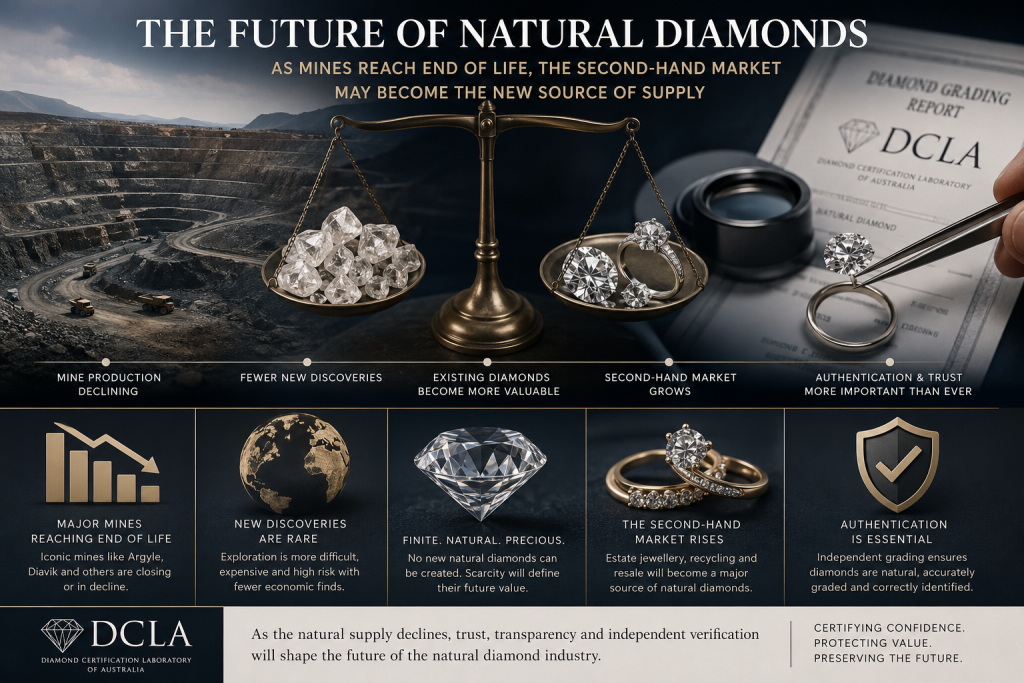
 For more than 150 years, the world's natural diamond industry has relied on a steady pipeline of newly mined diamonds entering the market. However, that era is rapidly changing. Many of the world's most productive diamond mines are approaching the end of their economic lives, exploration success has slowed dramatically, and few major new discoveries are expected to replace the enormous production that is disappearing.

For more than 150 years, the world’s natural diamond industry has relied on a steady pipeline of newly mined diamonds entering the market. However, that era is rapidly changing. Many of the world’s most productive diamond mines are approaching the end of their economic lives, exploration success has slowed dramatically, and few major new discoveries are expected to replace the enormous production that is disappearing.

This raises an important question for the jewellery industry, collectors, and consumers alike:

Where will tomorrow’s natural diamonds come from?

The World’s Largest Diamond Mines Are Running Out

Many of the world’s iconic diamond mines are now in decline or nearing closure.

Examples include:

  • Argyle Mine (Australia) – Closed in 2020 after producing more than 865 million carats over its 37-year life. Argyle supplied around 90% of the world’s rare pink diamonds and was once one of the highest-volume producers globally. Its closure permanently removed a significant source of natural diamonds from the market.
  • Diavik Mine (Canada) – Scheduled to cease production around 2026–2027 after two decades of operation.
  • Ekati Mine (Canada) – Although still operating, reserves continue to decline and production has fallen significantly from its peak.
  • Venetia Open Pit (South Africa) – Transitioning to underground mining to extend its life, but at considerably lower production levels and substantially higher operating costs.
  • Jwaneng (Botswana) – Often described as the richest diamond mine in the world, it continues to produce exceptional diamonds, although maintaining production requires increasingly expensive underground expansion projects.
  • Orapa (Botswana) – One of the world’s largest diamond mines by area, but also a mature operation facing the realities of ageing reserves.

Few major discoveries have emerged over the past twenty years that are capable of replacing the millions of carats these operations once produced.

New Discoveries Are Becoming Increasingly Rare

Diamond exploration is an expensive, high-risk undertaking.

Unlike previous decades, when rich kimberlite pipes were discovered in Australia, Canada, Russia and southern Africa, today’s exploration companies face:

  • Much deeper geological targets
  • Increasing environmental approvals
  • Higher capital costs
  • Greater political uncertainty
  • Reduced investor appetite

Even when a new deposit is found, bringing it into commercial production can take well over a decade and require investments measured in billions of dollars.

The result is a steadily shrinking pipeline of new natural diamonds.

Fewer Diamonds Does Not Mean Lower Demand

Although consumer preferences continue to evolve, natural diamonds remain highly sought after for fine jewellery, investment-grade stones and rare collector pieces.

Unlike laboratory-grown diamonds, every natural diamond is a finite geological resource formed between one and three billion years ago. Once mined, no new natural diamonds can be manufactured.

As mining output declines, the existing inventory of polished natural diamonds becomes increasingly important.

The Rise of the Secondary Market

Historically, relatively few diamonds returned to the market.

Natural diamonds were commonly passed through generations as family heirlooms or remained in jewellery collections for decades.

However, several factors are beginning to change this:

  • An ageing population transferring wealth
  • Estate jewellery entering the market
  • Increased recycling by professional jewellers
  • Specialist diamond buying companies
  • Greater consumer awareness of resale value
  • Online marketplaces making resale easier

Over time, previously owned natural diamonds may become one of the largest sources of supply for the jewellery trade.

Much like antique watches, rare coins and fine art, existing natural diamonds may circulate repeatedly between owners while no meaningful replacement supply enters the market.

Recycling Diamonds Is Not New

The diamond trade has quietly recycled diamonds for centuries.

Antique European jewellery has often been dismantled and remounted multiple times as fashions changed.

Victorian diamonds became Edwardian jewellery.

Edwardian diamonds became Art Deco pieces.

Art Deco diamonds have been reset into modern engagement rings.

The diamond itself may have changed settings numerous times while remaining the same natural gemstone throughout its life.

This process is likely to accelerate as newly mined diamonds become increasingly scarce.

Authentication Will Become More Important Than Ever

As more diamonds enter the secondary market, authentication will become increasingly critical.

Consumers will want certainty that the diamond they are purchasing is:

  • Natural rather than laboratory-grown
  • Correctly identified
  • Accurately graded
  • Free from undisclosed treatments
  • Properly documented

This places greater importance on independent laboratory grading.

Professional laboratories such as DCLA play an essential role in verifying the identity and quality of diamonds entering both the primary and secondary markets. Independent examination provides confidence for buyers, sellers, insurers and future owners alike.

The Growing Challenge of Laboratory-Grown Substitution

One emerging concern is the increasing number of natural diamond certificates being fraudulently paired with laboratory-grown diamonds or simulants.

As DCLA has previously reported, certificates can be separated from the original stone, creating opportunities for deliberate substitution. As secondary market activity increases, verifying that the diamond matches its accompanying grading report will become essential.

Independent examination helps protect both consumers and the integrity of the natural diamond market.

A Market That Could Resemble Fine Art

Natural diamonds possess one characteristic that laboratory-grown diamonds can never replicate—true geological scarcity.

As mine production continues to decline, natural diamonds may increasingly resemble other finite luxury assets such as fine art, vintage automobiles and rare watches.

Their value will not simply depend on beauty or craftsmanship, but also on rarity, provenance and authenticated identity.

The second-hand market is therefore likely to evolve from an occasional source of supply into a fundamental pillar of the global natural diamond industry.

Looking Ahead

The natural diamond industry is entering a period of structural change.

Mine production is expected to continue declining over the coming decades, while new discoveries remain scarce and increasingly difficult to develop. Existing polished diamonds already in private ownership represent an enormous reservoir of future supply.

As these stones gradually re-enter the marketplace through resale, estate collections and jewellery recycling, confidence in independent authentication will become more important than ever.

For laboratories such as DCLA, this evolving landscape reinforces a central responsibility: ensuring every diamond can be accurately identified, independently graded and matched to its rightful documentation. In a future where existing natural diamonds become an increasingly valuable and finite resource, trust will be as important as the diamonds themselves.

Disclaimer: This article is intended for general industry information and commentary. Market conditions, mine production and future supply forecasts are subject to change. DCLA encourages consumers and members of the jewellery trade to obtain independent laboratory verification when buying, selling or re-entering natural diamonds into the marketplace.

Thursday, 23 July 2026

From Imagination to Heirloom: How the DCLA Brings Your Jewellery Vision to Life

 Every remarkable piece of jewellery begins with an idea.

Every remarkable piece of jewellery begins with an idea.

It may be inspired by a treasured memory, a family diamond, a milestone anniversary, an engagement, or simply a design you have always dreamed of owning. While many jewellers offer standard collections, the DCLA Diamond Exchange takes a different approach transforming your ideas into exceptional jewellery that will be treasured for generations.

Where Every Design Begins

The journey starts with a conversation.

The DCLA’s experienced in-house jewellery designers work closely with each client to understand not only what they want their piece to look like, but also the story behind it. Every detail is considered from the choice of gemstones and precious metals to the proportions, balance and practicality of the design.

Whether you have a hand-drawn sketch, a collection of photographs, or simply an idea in your mind, our designers can translate your vision into a professionally developed concept.

Bringing Your Vision to Paper

Before a single piece of precious metal is cast, your ideas are transformed into detailed design drawings.

This stage allows every aspect of the jewellery to be refined and perfected. Stone placement, setting styles, proportions and fine details are carefully evaluated to ensure the finished piece is both beautiful and structurally sound.

Clients have the opportunity to review the design, make changes and collaborate with our designers until every detail is exactly as they imagined.

It is a process that combines artistic creativity with technical expertise.

Crafted Using the Finest Materials

Beautiful jewellery begins with exceptional materials.

The DCLA Diamond Exchange sources premium natural diamonds, laboratory-grown diamonds and coloured gemstones from trusted suppliers around the world. Every diamond can be independently verified and certified, giving clients complete confidence in the quality of their purchase.

Only high-quality precious metals are used, including platinum, 18-carat gold and other premium alloys selected for their beauty, durability and longevity.

The result is jewellery that is designed not only to impress today, but to last for generations.

Precision Manufacturing Meets Traditional Craftsmanship

Creating exceptional jewellery requires more than beautiful design it demands outstanding craftsmanship.

The DCLA Diamond Exchange combines modern production technology with traditional hand-finishing techniques to achieve extraordinary results.

Each piece is carefully manufactured using precision engineering before being expertly assembled, set, polished and inspected by experienced craftsmen. Every stage of production is carried out with meticulous attention to detail to ensure the highest standards of quality.

Nothing leaves the workshop until it meets the exacting standards expected of the DCLA name.

Creating Tomorrow’s Family Heirlooms

Creating Tomorrow's Family Heirlooms


Fine jewellery is more than an accessory it is a legacy.

The engagement ring that begins a marriage may one day be passed to a daughter or granddaughter. A custom pendant may become a cherished family keepsake. A pair of earrings may celebrate a significant achievement and carry its story through future generations.

These are not simply purchases; they are future heirlooms.

By combining inspired design, exceptional materials and uncompromising craftsmanship, the DCLA Diamond Exchange creates jewellery that is intended to be worn, loved and handed down for decades to come.

Experience the Difference

At the DCLA Diamond Exchange, every creation is unique because every client is unique.

From your very first idea through to the finished masterpiece, our in-house designers and master craftsmen guide you through every stage of the journey, ensuring your vision becomes reality.

Whether you are redesigning inherited jewellery, creating the perfect engagement ring, or commissioning a one-of-a-kind masterpiece, the DCLA Diamond Exchange has the expertise, technology and passion to transform your imagination into jewellery that will become part of your family’s history.

Source: DCLA

Wednesday, 22 July 2026

Consumer Alert: Certificate Swapping Fraud – A Growing Threat to the Diamond Industry

 The Diamond Certification Laboratory of Australia (DCLA) Issues Warning to Consumers and the Jewellery Trade

The Diamond Certification Laboratory of Australia (DCLA) Issues Warning to Consumers and the Jewellery Trade

The Diamond Certification Laboratory of Australia (DCLA) is warning both the jewellery trade and the public about an increasingly concerning practice involving the misuse of legitimate diamond grading certificates.

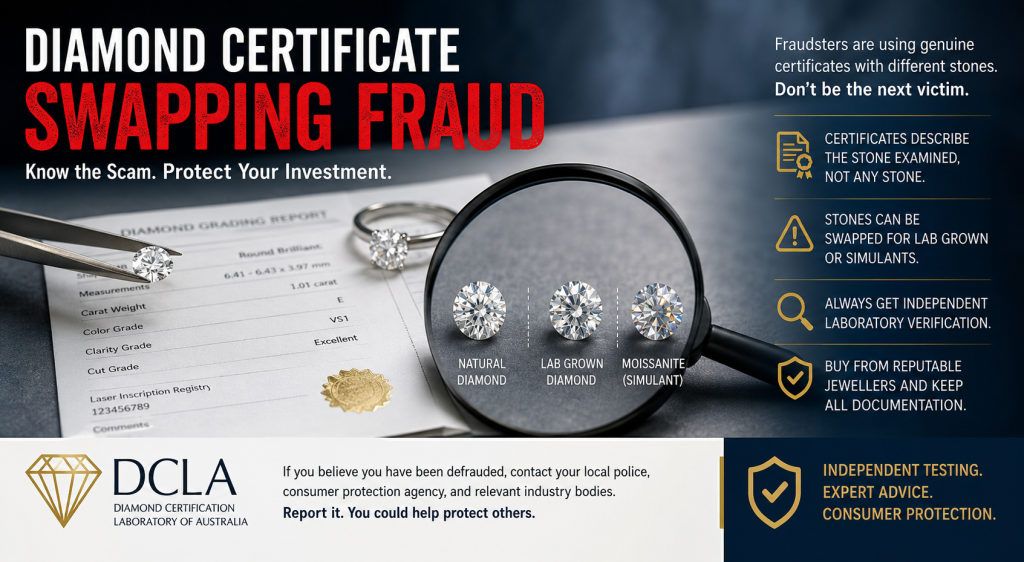
Over recent years, laboratories around the world have identified instances where an authentic grading certificate is presented with a different stone than the one originally examined. In many cases, the original natural diamond has allegedly been replaced with a laboratory-grown diamond or a diamond simulant such as moissanite or cubic zirconia, while the genuine certificate is retained to give the replacement stone an appearance of legitimacy.

These practices have the potential to deceive buyers, undermine confidence in the jewellery industry, and expose innocent consumers to significant financial loss.

A Recent Case Submitted to the DCLA

The DCLA recently examined a stone submitted by a member of the public who believed they owned a natural diamond.

The owner advised the laboratory that the stone had previously been represented as a natural diamond and further claimed that it had been assessed by an Australian gemologist in their local area.

Following comprehensive gemmological testing using multiple independent testing methods, the DCLA determined that the submitted stone was not a natural diamond.

Cases such as this reinforce the importance of independent laboratory verification before purchasing, selling, or insuring any significant diamond.

The DCLA makes no comment regarding how the substitution may have occurred or whether any individual or business was responsible. Determining whether a criminal offence has taken place is a matter for the relevant authorities.

How Certificate Swapping Can Occur

A legitimate laboratory certificate describes only the specific diamond that was examined at the time of grading.

If that diamond is later removed from its jewellery setting and replaced with another stone, the certificate no longer relates to the stone being presented.

Unscrupulous individuals may attempt to exploit this by presenting an authentic certificate alongside a completely different stone, creating the false impression that the replacement stone has been independently graded.

This practice can occur with:

  • Laboratory-grown diamonds substituted for natural diamonds.
  • Moissanite substituted for natural diamonds.
  • Cubic zirconia or other simulants presented as genuine diamonds.
  • Lower-quality natural diamonds substituted for higher-grade stones.

In every case, the certificate itself may be genuine, but it no longer corresponds to the stone being offered.

Why Professional Laboratory Verification Matters

Modern gemmological testing involves far more than simply using a handheld diamond tester.

The DCLA utilises advanced gemmological instrumentation together with traditional microscopic examination to identify natural diamonds, laboratory-grown diamonds and diamond simulants.

Every significant diamond should be verified by an independent laboratory whenever there is doubt regarding its identity or whenever ownership changes.

Consumers should be particularly cautious when:

  • Purchasing second-hand diamonds.
  • Buying diamonds through online marketplaces.
  • Purchasing from private sellers.
  • Acquiring diamonds accompanied by older certificates where the stone has been removed from its original setting.
  • Buying unusually inexpensive diamonds that appear “too good to be true.”

Protect Yourself

Consumers can significantly reduce their risk by following a few simple precautions:

  • Always compare the stone to the laboratory certificate.
  • Where possible, verify any laser inscription against the grading report.
  • Request an independent examination before completing a purchase.
  • Retain invoices and supporting documentation.
  • Purchase from reputable jewellers who provide clear provenance and after-sales support.

If You Believe You Have Been Defrauded

If you discover that a diamond has been substituted or that a certificate does not correspond to the stone supplied, you should:

  • Preserve all documentation and correspondence.
  • Obtain an independent laboratory report.
  • Contact your state’s consumer protection agency.
  • Report suspected criminal activity to your local police.
  • Notify relevant jewellery industry organisations where appropriate.

Reporting suspected fraud not only assists your own case but also helps protect future consumers from becoming victims of similar scams.

Maintaining Confidence in the Industry

The overwhelming majority of jewellers, diamond dealers and gemologists operate with honesty, professionalism and integrity. However, even isolated cases of certificate misuse can damage public confidence in the industry.

Independent laboratory verification remains one of the most effective safeguards against misrepresentation.

The DCLA encourages consumers to seek independent expert advice whenever uncertainty exists regarding a diamond’s identity. Verification before purchase—or before resale—can prevent costly mistakes and help maintain confidence throughout Australia’s diamond industry.

Diamond Certification Laboratory of Australia (DCLA)

Protecting consumer confidence through independent scientific diamond identification and grading.

Tuesday, 21 July 2026

Nature vs Technology: Why Large Natural Diamonds Are Exceptionally Rare While Large Laboratory-Grown Diamonds Are Increasingly Common

 Large Diamonds Are Exceptionally Rare

For billions of years, nature has been producing diamonds deep beneath the Earth’s surface under immense pressure and temperatures exceeding 1,000°C. Every natural diamond is the result of a geological journey unlike any other gemstone, carrying with it a unique record of the Earth’s history.

Today, laboratory-grown diamonds are manufactured in controlled environments over a period of weeks rather than billions of years. While they possess the same crystal structure as diamond, the economics of their production are almost the complete inverse of nature.

Nature’s Ratio: Large Diamonds Are Exceptionally Rare

Natural diamond deposits follow a remarkably predictable size distribution.

The overwhelming majority of diamonds recovered from mines around the world are small crystals. As crystal size increases, rarity increases exponentially. Large gem-quality rough diamonds are exceptionally uncommon because their growth requires an uninterrupted geological environment over immense periods of time. Even minor changes in pressure, temperature, or surrounding chemistry can halt growth or fracture a developing crystal.

This means that:

  • Small diamonds make up the vast majority of natural production.
  • Medium-sized diamonds are considerably less common.
  • Large diamonds are exceptionally rare.
  • Very large, high-quality diamonds are among the rarest natural materials on Earth.

This natural scarcity is why diamonds above several carats increase dramatically in value. Their rarity is not created by marketing—it is governed by geology.

Laboratory Production: The Reverse Distribution

Laboratory-grown diamonds operate under a completely different economic model.

Manufacturers begin with a tiny diamond seed and grow additional carbon onto it using either High Pressure High Temperature (HPHT) or Chemical Vapour Deposition (CVD) technology.

Unlike mining, where large diamonds are rarely discovered, laboratory production often aims to grow the largest crystal economically possible.

The production costs of a laboratory-grown diamond are concentrated in operating the equipment rather than discovering the crystal. Once a growth cycle has begun, extending growth to produce a larger crystal is frequently more profitable than manufacturing numerous small stones.

As a result:

  • Larger laboratory-grown rough is increasingly common.
  • Multiple large diamonds can be produced from a single manufacturing facility every month.
  • Production volumes are limited primarily by equipment capacity and electricity costs rather than geological rarity.

In many modern factories, larger diamonds are actually preferred because they provide greater manufacturing flexibility and can be cut into multiple finished stones.

The distribution therefore becomes almost the reverse of nature.

Why Large Natural Diamonds Are Exceptionally Rare


Billions of Years vs Several Weeks

Natural diamonds typically formed between one and three billion years ago within the Earth’s mantle at depths approaching 150 to 250 kilometres.

Their growth occurred slowly under constantly changing geological conditions before volcanic eruptions transported them to the Earth’s surface through kimberlite and lamproite pipes.

Laboratory-grown diamonds, by comparison, are produced in controlled chambers over several weeks.

Every variable—including temperature, pressure, gas composition and growth rate—is carefully managed by technicians rather than nature.

A Record of Earth’s History

One of the most fascinating differences lies within the crystal itself.

Natural diamonds contain microscopic traces of the environment in which they formed. These include tiny amounts of nitrogen, boron, hydrogen and numerous other trace elements that became incorporated into the crystal lattice over geological time.

Many natural diamonds also contain microscopic mineral inclusions originating from deep within the Earth’s mantle. These tiny crystals provide scientists with valuable information about regions of the Earth that can never be directly sampled.

In effect, every natural diamond is a geological time capsule.

Laboratory-grown diamonds, however, are produced from highly purified carbon sources under carefully controlled conditions. Their objective is consistency rather than geological complexity.

Consequently, laboratory-grown diamonds are composed almost entirely of carbon, with very low levels of naturally occurring trace elements. Depending on the manufacturing process, they may instead exhibit characteristics associated with their production, including metallic catalyst residues in some HPHT-grown diamonds or growth-related structural features in CVD-grown diamonds.

Rather than recording billions of years of Earth’s geological history, laboratory-grown diamonds primarily reflect the manufacturing process used to create them.

Why These Differences Matter

Although natural and laboratory-grown diamonds share the same fundamental crystal structure and hardness, their origin is entirely different.

Natural diamonds represent an irreplaceable finite resource created by geological processes that cannot be replicated by nature within any human timescale. Their rarity is determined by billions of years of Earth history and the extremely low probability of large crystal formation.

Laboratory-grown diamonds represent an impressive technological achievement. They are manufactured products whose supply is governed by industrial capacity, advances in production technology and manufacturing costs.

Understanding these differences is essential when assessing rarity, long-term availability and market value. As laboratory production continues to expand, large laboratory-grown diamonds are expected to become increasingly accessible, while large natural diamonds will remain among the rarest and most sought-after treasures ever created by nature.

The DCLA Perspective

At the Diamond Certification Laboratory of Australia (DCLA), every diamond is identified and graded according to internationally recognised gemmological standards. Whether natural or laboratory-grown, accurate identification allows consumers, jewellers and collectors to make informed decisions based on origin, rarity and value.

While both categories have their place within today’s jewellery market, they should never be considered equivalent in terms of geological origin. One is a remarkable product of Earth’s natural history, while the other is a remarkable achievement of modern science.

Understanding that distinction remains fundamental to informed purchasing and responsible disclosure throughout the diamond industry.

Source: DCLA

Fancy Colour Diamonds, From Hollywood Statement to the Ultimate Collectable

  For generations, the traditional diamond engagement ring has been dominated by the classic colourless stone. But the world of exceptional ...