
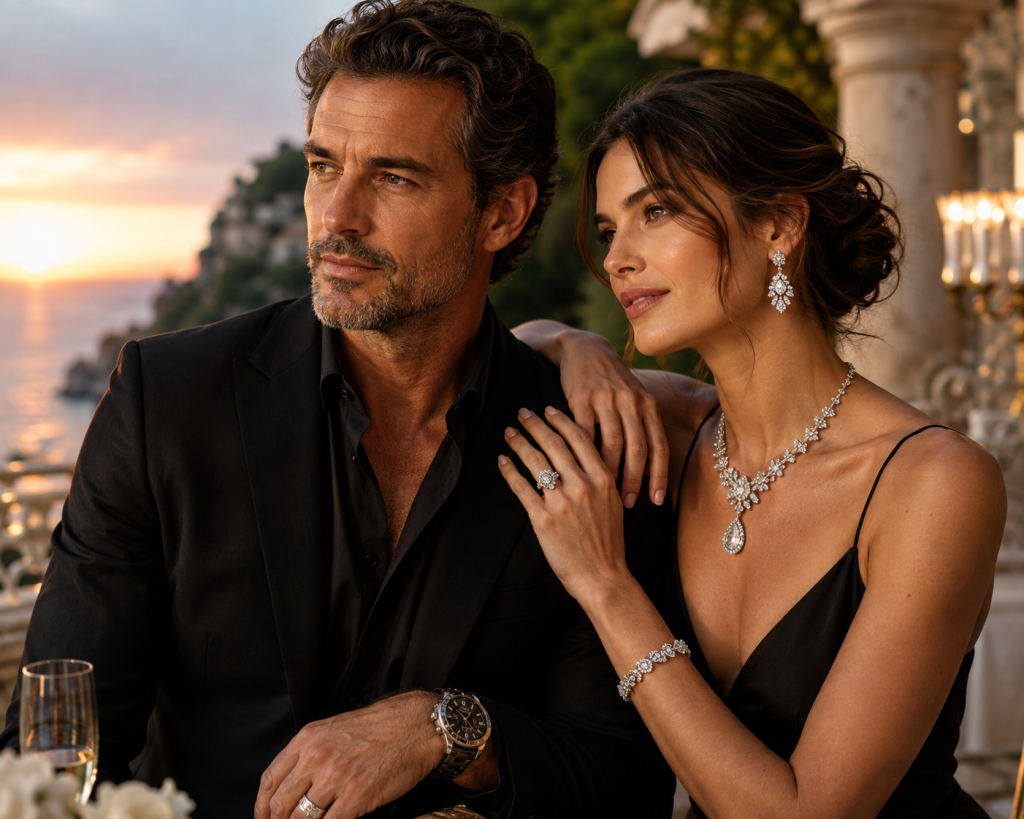
When buying or commissioning fine jewellery, much of the attention naturally goes to the diamond or gemstone, the design and the craftsmanship. Yet one of the most important decisions is often overlooked: which precious metal should the jewellery be made from?
The choice of metal affects far more than colour and price. It influences durability, hardness, scratch resistance, maintenance, weight, wear characteristics, setting security and how the piece will look after years of use.
There is no single precious metal that is best for every piece of jewellery. The correct choice depends on what the jewellery is, how it will be worn and what demands will be placed upon it.
At the Diamond Certification Laboratory of Australia (DCLA), we believe consumers should understand these differences before making an important jewellery purchase.
Gold Is an Alloy, Not Just Gold
Pure gold is exceptionally soft. For this reason, virtually all gold jewellery is alloyed with other metals to increase its hardness, strength and workability.
Gold purity is measured in carats:
| Gold | Pure Gold Content | General Characteristics |
|---|---|---|
| 9ct | 37.5% | Harder, economical, less rich in colour |
| 14ct | 58.3–58.5% | Excellent balance of durability and gold content |
| 18ct | 75.0% | Rich colour, high gold content, softer |
| 22ct | 91.7% | Very rich colour, considerably softer |
| 24ct | 99.9%+ | Extremely pure but generally too soft for most jewellery |
The World Gold Council notes that alloying gold with other metals increases its durability and can also alter its colour.
This is an important point: a higher carat does not automatically mean a stronger piece of jewellery.
In fact, increasing the gold content generally makes the alloy softer, although the exact hardness depends on the particular alloy and manufacturing process.
9ct Gold — Practical and Affordable
9ct gold contains 37.5% pure gold, with the balance made up of alloy metals.
Its relatively high alloy content can make it harder than higher-carat gold alloys, and it is widely used for jewellery where price and everyday wear are important considerations.
Advantages
- Lower material cost
- Good resistance to everyday scratching
- Available in yellow, white and rose gold
- Suitable for many bracelets, earrings, pendants and everyday jewellery
- Practical for consumers looking for a lower entry price
Disadvantages
- Contains considerably less gold than 18ct or 22ct
- Colour can be less rich and saturated
- Alloy composition can be important for people with metal sensitivities
- Some 9ct alloys can be relatively brittle rather than simply being “stronger”
This last point is important. Hardness and toughness are not the same thing.
A very hard alloy can resist scratching but may be less forgiving when subjected to bending or impact. Jewellery designers therefore need to consider the specific alloy, not simply the carat stamp.
14ct Gold — The Practical Sweet Spot
14ct gold contains approximately 58.3–58.5% pure gold.
For jewellery that is going to receive significant daily wear, 14ct can provide an excellent balance between gold content, durability, appearance and cost.
It is generally harder than 18ct gold, making it particularly attractive for jewellery that experiences continual movement, friction and contact with other objects.
Advantages
- Good hardness and wear resistance
- More gold content than 9ct
- Generally more durable than 18ct
- Excellent for everyday jewellery
- Particularly useful for bracelets, rings and other pieces exposed to continual wear
- Lower cost than 18ct for the same volume of metal
Disadvantages
- Less rich gold colour than 18ct yellow gold
- Contains more alloy metals
- Exact performance depends on the alloy formulation and manufacturing technique
For many jewellery applications, 14ct represents an excellent engineering compromise.
18ct Gold — Luxury, Richness and High Gold Content
18ct gold contains 75% pure gold and 25% alloy metals.
It is a traditional choice for fine jewellery because of its rich colour, high gold content and luxurious appearance.
18ct yellow gold has a noticeably deeper and warmer colour than lower-carat gold, while 18ct rose gold has a softer, more refined pink tone depending on its alloy composition.
Advantages
- 75% pure gold
- Rich, luxurious colour
- High intrinsic precious-metal content
- Excellent for fine and high-value jewellery
- Traditionally associated with premium jewellery
- Often preferred for heirloom pieces and important jewellery
Disadvantages
- Softer than many 14ct alloys
- More susceptible to scratches and dents
- Can show signs of everyday wear more quickly
- May require more care where continual friction occurs
This does not mean that 18ct gold is unsuitable for everyday jewellery. Far from it.
Rather, the designer needs to understand the application.
An 18ct gold engagement ring can be an excellent choice. But an 18ct gold bracelet consisting of hundreds of small articulated components may experience very different stresses from a simple ring.
22ct Gold — Beautiful but Soft
22ct gold contains approximately 91.7% pure gold.
It has a distinctive, highly saturated yellow colour that is particularly prized in some jewellery markets.
The problem is that the higher gold content also means there is less alloy available to increase hardness and strength.
Advantages
- Very high gold content
- Exceptional rich yellow colour
- High intrinsic precious-metal value
- Highly desirable for traditional and cultural jewellery
Disadvantages
- Relatively soft
- More easily scratched and deformed
- Less suitable for delicate settings exposed to constant mechanical stress
- Requires greater consideration when used for everyday jewellery
22ct can be beautiful, but it is not necessarily the best choice simply because it contains more gold.
More gold does not automatically mean better jewellery.
Platinum — A Completely Different Metal

Platinum should not be thought of simply as “higher-carat white gold”.
It is a completely different precious metal.
Jewellery platinum is commonly used at around 95% purity, often referred to as Pt950. It is naturally white and does not require rhodium plating to create its characteristic appearance.
One of platinum’s major advantages is its density and wear characteristics. Platinum tends to deform and develop a patina rather than behaving like a softer gold alloy that is progressively worn away.
Advantages
- Naturally white
- No rhodium plating required
- Very high purity
- Dense and substantial
- Excellent for important gemstone settings
- Does not require the same replating maintenance as white gold
- Often a good choice for people concerned about certain alloy sensitivities
Disadvantages
- More expensive
- Heavier than gold
- More difficult and demanding to manufacture and repair
- Develops a visible patina with wear
- Can scratch, although the metal behaves differently from gold
The development of a platinum patina is not necessarily a defect. Many owners actually appreciate it because it records the history of the jewellery.
18ct White Gold vs Platinum
This is one of the most common decisions when purchasing diamond jewellery.
At first glance, the two metals can look almost identical.
They are not.
18ct White Gold
18ct white gold contains 75% gold combined with whitening alloy metals. It is normally finished with rhodium plating to produce a bright, highly reflective white surface. The World Gold Council explains that rhodium plating is commonly used on white gold to create a brighter and harder surface.
The disadvantage is that rhodium is a surface coating.
Over time, friction can wear the rhodium away, particularly on rings and areas that receive constant contact. The underlying white-gold alloy can then become visible, and the jewellery may require professional cleaning and re-rhodium plating.
Platinum
Platinum is naturally white.
There is no rhodium layer that needs to be periodically replaced.
It will still scratch and develop a patina, but the colour of the metal itself remains white.
For consumers wanting the brightest possible white finish, 18ct white gold can be extremely attractive. For those wanting a naturally white metal without rhodium maintenance, platinum has a significant advantage.
The Tennis Bracelet: A Perfect Example of Why Metal Selection Matters
The tennis bracelet is an excellent example of why the metal should be selected according to the engineering requirements of the jewellery, rather than simply its perceived prestige.
A tennis bracelet is not a static piece of jewellery.
It contains numerous articulated links, settings, joints and moving components. Every time the bracelet moves around the wrist, components can rub against one another.
The bracelet can also encounter:
- clothing
- desks and tables
- watches
- handbags
- other jewellery
- skin
- accidental impacts
- repeated flexing
Over many years, these small movements can add up to significant wear.
Why 14ct Can Be an Excellent Choice
A well-designed 14ct gold tennis bracelet can offer a very good combination of hardness, strength and durability.
Compared with many 18ct gold alloys, 14ct is harder and can be better suited to jewellery that experiences continuous mechanical wear.
This is why a 14ct tennis bracelet can, in practical terms, be a better engineering choice than an 18ct version when maximum resistance to everyday wear is the priority.
However, it would be incorrect to say that every 14ct bracelet will automatically outlast every 18ct bracelet.
The alloy formulation, construction, thickness, setting design, quality of manufacture and maintenance are all critical.
Design and engineering matter just as much as carat.
Hardness Is Not the Same as Durability
This distinction is particularly important for consumers.
Hardness generally refers to a material’s resistance to scratching or indentation.
Durability is broader.
A piece of jewellery must also withstand:
- bending
- impact
- repeated movement
- fatigue
- deformation
- wear at joints
- wear around stone settings
A harder material is not automatically tougher in every application.
For this reason, professional jewellery manufacturers select alloys according to the intended use of the finished piece.
The Importance of Jewellery Design
The metal is only one part of the equation.
A poorly engineered piece made from platinum can perform worse than a well-engineered piece made from 14ct gold.
For example, a tennis bracelet should be assessed for:
Link thickness
Thin links can wear more quickly regardless of metal.
Setting construction
The way diamonds are secured is critical.
Hinge and joint design
Movement places continual stress on these areas.
Clasp security
A strong bracelet is of little value if the clasp is poorly designed.
Metal thickness around stones
Very fine metal can wear through over time.
Manufacturing quality
Precision and finishing can make a substantial difference to longevity.
This is why consumers should not judge jewellery solely by the carat stamp.
Other Precious Metals
Silver
Sterling silver is approximately 92.5% silver and is widely used because it is attractive and relatively affordable.
Its disadvantages are that it is softer than many gold alloys and can tarnish through interaction with the environment.
Silver is excellent for many earrings, pendants, fashion pieces and larger designs, but it generally requires more maintenance than gold or platinum.
Palladium
Palladium is a member of the platinum group of metals and has been used in jewellery, including as an alloy in white gold.
It is naturally white and relatively lightweight compared with platinum.
Its use in jewellery varies by market and application, but it remains an interesting alternative for designers looking for a naturally white precious metal.
Maintenance: What Owners Should Expect
Different metals require different maintenance.
9ct and 14ct Yellow or Rose Gold
Generally straightforward to maintain. Regular cleaning and professional inspection are recommended, particularly for jewellery containing gemstones.
18ct Yellow or Rose Gold
Also relatively straightforward to maintain, although the softer alloy can show scratches and surface marks more readily.
White Gold
Requires additional attention because the rhodium plating can wear away. Periodic professional inspection, cleaning and replating may be required depending on how frequently the piece is worn.
Platinum
Does not require rhodium plating. It will develop a patina and can be polished when the owner wants to restore a brighter finish.
There Is No “Best” Precious Metal
The most important lesson for jewellery buyers is that the highest gold content is not necessarily the best choice for every piece of jewellery.
A 22ct gold bracelet may contain far more gold than a 14ct bracelet, but the 14ct piece may be better suited to constant mechanical wear.
An 18ct gold engagement ring may be exactly the right choice for someone who values its rich colour and high gold content.
A platinum ring may be preferred by someone who wants a naturally white metal and a substantial, high-purity material.
A 14ct tennis bracelet may be the more practical choice for someone who wants a bracelet that will tolerate considerable everyday wear.
The correct question is therefore not:
“Which metal is the best?”
It is:
“Which metal is best for this piece of jewellery and the way it will be worn?”
DCLA’s View: Design the Jewellery Around Its Purpose
At DCLA, we believe that understanding precious metals is an essential part of understanding jewellery.
The choice between 9ct, 14ct, 18ct, 22ct gold and platinum should be based on a combination of:
- Purity
- Colour
- Hardness
- Toughness
- Wear resistance
- Design
- Stone security
- Frequency of wear
- Maintenance requirements
- Budget
- Personal preference
A beautiful piece of jewellery should not only look exceptional when it leaves the jeweller’s workshop. It should be appropriate for the way it will actually be worn.
The best jewellery is where the gemstone, metal, design and craftsmanship are considered as one complete system.
Because when it comes to fine jewellery, more precious does not always mean more durable and the right metal is the one that performs best for its purpose.
This article is intended for general educational purposes. The actual performance of a jewellery alloy depends on its precise composition, manufacturing process, design, dimensions, finishing and method of wear. Consumers should consult a qualified jeweller or jewellery professional when selecting a metal for a particular application.



No comments:
Post a Comment