An engagement ring is one of the most sentimental pieces of jewellery a person can own. It represents a promise, a relationship and a moment in time. But what happens when life changes?
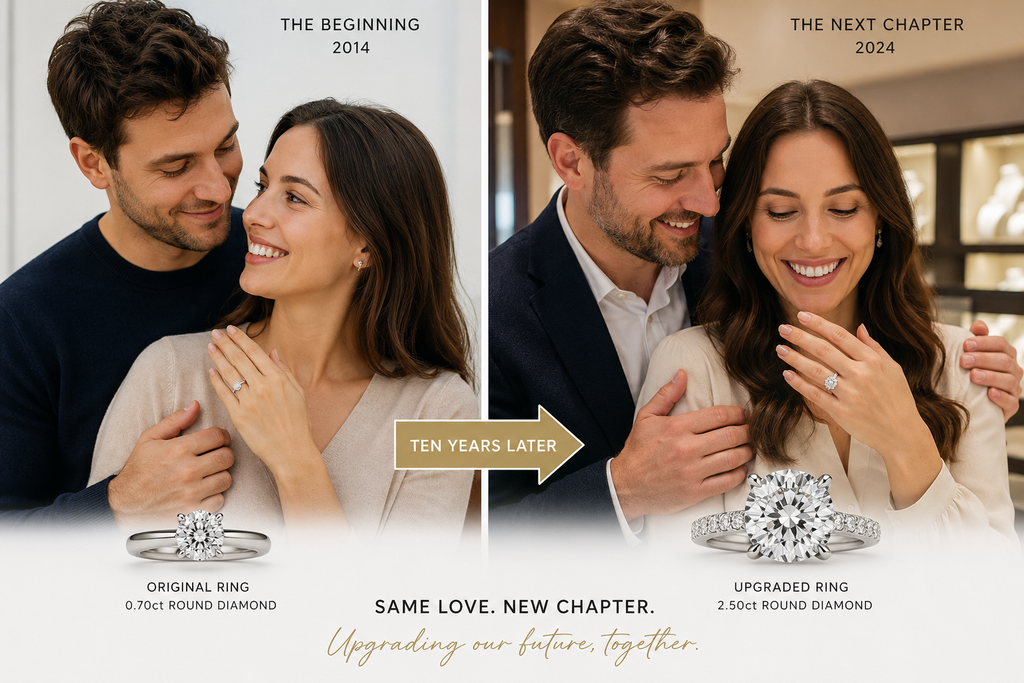
Perhaps the couple’s financial position has improved significantly. Perhaps the original diamond was chosen when money was tighter, and she has always secretly dreamed of a larger stone or a completely different diamond shape. Or perhaps jewellery styles have changed and the original setting no longer reflects her personal taste.
This raises an interesting question: Should you upgrade an engagement diamond, or is the original stone too sentimental to replace?
At the Diamond Certification Laboratory of Australia (DCLA), we believe there is no single right answer. The decision comes down to the meaning attached to the original diamond, its quality and value, and what the owner wants from the jewellery today.
The Diamond May Be Sentimental — But the Memory Is Not Only in the Stone
There is a common belief that the original engagement diamond should never be changed because it represents the beginning of the marriage.
That is certainly a valid view.
For some couples, the original diamond is an important family heirloom in the making. It is the stone that was present when the proposal happened, and no larger or more valuable diamond could replace that emotional significance.
But jewellery can also evolve.
A diamond is a precious asset, but it is also a piece of jewellery designed to be worn and enjoyed. If circumstances change, there is nothing inherently wrong with changing the stone, redesigning the ring or even selling the original diamond.
The sentimental value does not necessarily disappear simply because the jewellery changes.
What If She Has Always Wanted a Different Shape?
Diamond shapes are highly personal.
Perhaps the original engagement ring contains a round brilliant diamond, but she has always preferred an oval, emerald cut, pear, cushion or radiant cut.
If the couple can now comfortably afford the diamond she always wanted, upgrading can be an opportunity to create the ring that reflects her personality today.
A larger diamond is not necessarily a better diamond. Shape, proportions, cut quality, colour, clarity and the overall design of the ring all influence its appearance.
This is where professional diamond advice becomes particularly important.
A significant increase in size may look impressive, but changing shape can sometimes produce an even more dramatic transformation without simply buying the biggest stone available.
Should You Trade In the Original Diamond?
There are several options.
1. Trade the Original Diamond Toward the New One
This is probably the simplest solution.
The original diamond can be professionally assessed and valued, with its value contributing toward the purchase of the replacement diamond.
However, owners should understand that the original retail purchase price is not necessarily what the diamond is worth when it is traded.
The diamond’s current quality, certification, market demand, proportions, colour, clarity and overall desirability will influence its value.
This is why an independent assessment and proper diamond grading can be extremely useful before making a decision.
2. Keep the Original Diamond
For some couples, this is the best of both worlds.
The original diamond can be removed from the engagement ring and preserved, while a new diamond becomes the centrepiece of the redesigned engagement ring.
The original stone can then remain with the family as an heirloom.
One day it might become a pendant, a dress ring or even another family member’s engagement ring.
The important point is that the original diamond does not have to disappear simply because the engagement ring has been upgraded.
3. Remodel the Original Diamond
Sometimes the diamond is not the problem the setting is.
An old-fashioned setting can make a beautiful diamond look dated.
A new setting can completely transform the appearance of the original diamond.
This can be particularly attractive when the diamond itself has strong sentimental value.
Instead of replacing the stone, the couple can create an entirely new piece of jewellery around it.
4. Create Another Piece of Jewellery
There is also the possibility of taking the original diamond out of the engagement ring and creating something completely different.
A diamond that has spent decades in an engagement ring could become a pendant, earrings or another ring.
This can be a wonderful way of preserving the original diamond while allowing the owner to enjoy a new design.
Is the Original Diamond an Heirloom?

If the diamond was passed down from a parent or grandparent, its emotional value may far exceed its monetary value.
In that situation, selling or replacing it may not make sense.
But if the diamond was purchased specifically for the original engagement and has no previous family history, the decision may be different.
A diamond can become an heirloom because of the story attached to it not simply because of its age.
Keeping the original stone means preserving that story.
But creating a new piece of jewellery from it can also preserve the story.
Jewellery Trends Will Change — But Quality Should Remain
Fashion inevitably changes.
The popularity of particular diamond shapes, settings, metal colours and jewellery styles can move in cycles.
What looks contemporary today may look dated in twenty years.
That does not mean an engagement ring should be changed every time fashion changes. Good jewellery should have longevity.
However, there is nothing wrong with updating a piece when the owner genuinely wants something different.
The key is not to confuse a temporary fashion trend with a genuine change in personal preference.
The Emotional Decision
Ultimately, upgrading an engagement diamond is not simply a financial decision.
It is worth asking:
Does the original diamond still make you happy?
Would you regret selling it?
Have you always wanted a different shape or larger diamond?
Would keeping the original diamond as an heirloom be meaningful to your family?
Could the original diamond be remodelled into another piece that you would actually wear?
If the answer is that the original diamond has enormous sentimental value, keep it.
If the answer is that it is simply an old piece of jewellery that no longer suits your taste, upgrading may make perfect sense.
And sometimes the best answer is both: buy the diamond you always wanted and preserve the original diamond for the next generation.
There Is No Rule That Says Jewellery Cannot Evolve
An engagement ring marks the beginning of a marriage. It does not have to remain frozen in time for the next fifty years.
People change. Relationships grow. Financial circumstances change. Tastes develop. Jewellery can change too.
The original engagement diamond may remain the most important diamond you ever owned even if it eventually becomes a pendant or is carefully stored as a family heirloom.
Alternatively, it may simply be a piece of jewellery that has served its purpose and can be traded toward something that better reflects your life today.
The right decision is the one that balances sentimental value, financial value and personal enjoyment.
At DCLA, we believe the most important step is to understand exactly what you have before deciding what to do with it. Professional diamond grading and identification can help establish the characteristics of the original stone, allowing you to make an informed decision about keeping, remodelling, trading or upgrading it.
After all, an engagement diamond is valuable but the story surrounding it can be priceless.