Wednesday, 16 September 2026

The Extraordinary Rarity of Pink Diamonds: Christie’s Sets a $12 Million Estimate

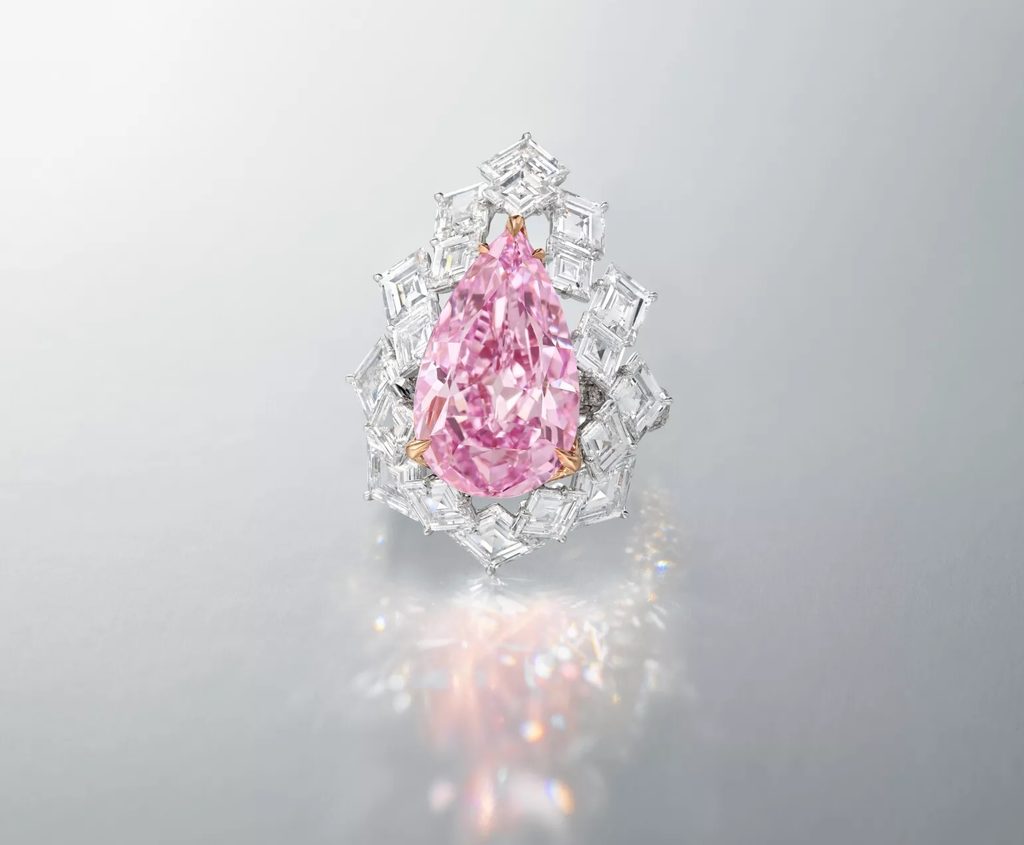
 8.41-carat pear modified brilliant-cut Fancy Vivid Purple-Pink diamond

Few gemstones command the combination of fascination, rarity and value associated with a natural pink diamond.

Unlike many coloured gemstones, the extraordinary pink colour of a natural diamond is not simply the result of a trace element creating a familiar colour. The science behind natural pink diamonds is considerably more complex. Their colour is generally associated with structural distortion within the diamond’s crystal lattice, created deep within the Earth over immense periods of geological time.

It is this extraordinary combination of natural rarity, geological history and optical beauty that has placed the finest pink diamonds among the world’s most coveted gemstones.

Now, Christie’s is preparing to offer another remarkable example.

At its Hong Kong Magnificent Jewels Autumn Auction on November 24, Christie’s will present an 8.41-carat pear modified brilliant-cut Fancy Vivid Purple-Pink diamond, with an estimate reaching HKD 95 million, approximately US$12 million.

The stone is also classified as Type IIa, adding another notable dimension to its gemmological profile.

When colour becomes the rarity

In the world of diamonds, carat weight is only one part of the story.

For exceptional coloured diamonds, hue, tone, saturation and distribution of colour can be every bit as important as size. A diamond may be large, yet its colour characteristics can determine whether it becomes merely unusual or genuinely extraordinary.

The Christie’s diamond combines several characteristics rarely encountered together: significant size, a strong purple-pink colour, Fancy Vivid intensity and Type IIa classification.

The result is a gemstone occupying an exceptionally rare position within the natural diamond market.

The distinction between a pink diamond and an exceptional pink diamond can be subtle to the untrained eye. Under professional examination, however, the precise characteristics of colour become a sophisticated subject of gemmological analysis.

The science behind natural pink

The colour of most natural diamonds is associated with impurities within the crystal structure. Nitrogen, for example, plays a major role in many yellow diamonds.

Pink diamonds are different.

Their colour is generally linked to deformation of the diamond’s atomic lattice, rather than simply the presence of a colouring impurity. Scientists believe that immense geological forces can distort the crystal structure during the diamond’s formation and subsequent journey toward the Earth’s surface.

This distortion affects the way light interacts with the diamond, producing the extraordinary pink appearance for which these stones are renowned.

The exact relationship between crystal deformation and the resulting colour remains an area of sophisticated scientific study, making pink diamonds particularly fascinating from both a gemmological and geological perspective.

Type IIa: exceptional chemical purity

The Christie’s diamond is classified as Type IIa, a designation that describes the diamond’s chemical composition.

Type IIa diamonds contain extremely low levels of detectable nitrogen and are regarded as among the chemically purest diamonds.

This classification should not, however, be confused with a quality grade.

Type IIa is a scientific classification, not a statement that a diamond is automatically more valuable. A diamond’s desirability and market value depend on the complete combination of its characteristics.

In this case, Type IIa adds another intriguing scientific feature to an already exceptional natural coloured diamond.

Why the strongest pinks are so difficult to find

The rarity of exceptional natural pink diamonds has been reinforced by the limited availability of significant sources of these stones.

For decades, Australia’s Argyle mine in Western Australia was internationally recognised as the world’s most important source of natural pink diamonds. The mine produced an extraordinary range of pink, red and purplish diamonds, but ceased production in 2020.

Its closure fundamentally changed the landscape for the supply of important natural pink diamonds.

While pink diamonds can occur in other deposits around the world, stones possessing the combination of strong colour, exceptional saturation, significant size and desirable clarity remain exceptionally uncommon.

This scarcity has helped establish the finest natural pink diamonds as important collector gemstones rather than simply luxury jewellery.

The auction market for exceptional colour

Major jewellery auctions provide a fascinating window into the upper end of the natural coloured diamond market.

When a rare stone comes to auction, collectors are not simply buying carat weight. They are competing for a combination of characteristics that may never be replicated.

The provenance of a jewel, its laboratory documentation, its natural colour, treatment status, cutting quality and historical significance can all contribute to its desirability.

For a gemstone of this calibre, laboratory examination is therefore fundamental.

A second extraordinary jewel

Christie’s Hong Kong sale will feature another remarkable gemstone in the form of a 10.10-carat Burmese ruby, set within a Cartier brooch incorporating triangular and square diamonds.

The jewel carries a high estimate of approximately HKD 60 million, or US$7.7 million.

The ruby is particularly significant for its Burmese origin and substantial size, while the Cartier design connects the jewel with the maison’s pioneering use of platinum during the early 20th century.

Exceptional Burmese rubies are among the world’s most celebrated coloured gemstones, particularly when they display desirable colour, transparency and other characteristics associated with fine-quality material.

The importance of knowing what lies beneath the beauty

At the highest levels of the jewellery market, beauty and science increasingly go hand in hand.

A spectacular diamond may capture the eye, but professional gemmology seeks to establish what the stone actually is, how its characteristics were formed and whether those characteristics are natural or treatment-related.

For coloured diamonds, this distinction can be particularly important.

Independent laboratory examination can investigate characteristics such as natural versus laboratory-grown origin, colour treatment, diamond type and other identifying features. For important stones, such documentation provides an objective scientific foundation for the jewel’s description.

At DCLA, the Diamond Certification Laboratory of Australia, gemmological examination is centred on independent scientific assessment and reporting in accordance with recognised international standards.

A jewel measured in rarity, not simply carats

The Christie’s 8.41-carat Fancy Vivid Purple-Pink diamond illustrates why exceptional gemstones occupy a category of their own.

Its significance lies not simply in its weight.

It is the combination of natural colour, vivid intensity, purple-pink hue, substantial size, Type IIa classification and exceptional geological rarity that makes the stone so compelling.

As it takes its place under the hammer in Hong Kong, collectors will once again be reminded of one of the enduring truths of the diamond world:

The rarest diamonds are not necessarily the largest. They are the diamonds in which nature has created something extraordinarily difficult to reproduce.

And in the case of a truly exceptional natural pink diamond, that rarity began billions of years before it ever became a jewel.


Diamond Detection Keeps Advancing, And DCLA Has used the Technology for Decades

 DCLA has been at the forefront of diamond detection and disclosure for more than two decades,

The technology used to identify laboratory-grown diamonds continues to advance, with De Beers Group announcing its next-generation SynthDetect™ 2 desktop diamond screening instrument.

For DCLA, however, the challenge of distinguishing natural diamonds from laboratory-grown diamonds is not new.

DCLA has been at the forefront of diamond detection and disclosure for more than two decades, recognising well before laboratory-grown diamonds became a mainstream commercial product that advances in diamond-growing technology would create a major challenge for the jewellery industry.

The next generation of diamond screening

De Beers says its new SynthDetect™ 2 builds on its earlier SynthDetect and SynthDetect XL instruments, introduced in 2017 and 2018.

According to De Beers, the new system is designed to make screening faster, more automated and easier to integrate into the day-to-day operations of diamond manufacturers, laboratories and retailers.

One of the most significant changes is speed. De Beers says a full tray scan that previously took approximately 30 minutes can now be completed in less than five minutes.

The instrument is designed to screen loose diamonds as well as a wide range of jewellery, including rings, earrings, necklaces, pendants, bracelets and bangles. De Beers states that SynthDetect 2 can screen diamonds from 0.001 to 10 carats in the D–J colour range.

The company says automated results, reporting and software updates are intended to further reduce operator input and improve screening efficiency.

De Beers currently lists SynthDetect 2 as being available from Q1 2027.

De Beers SynthDetect™ 2

DCLA recognised the challenge long before it became mainstream

While new screening technology continues to improve, the underlying problem has been known for many years.

DCLA identified the potential impact of synthetic diamond technology on the Australian diamond industry as early as 2002, when the laboratory warned about advances in technologies such as CVD and HPHT and their potential to produce gem-quality laboratory-grown diamonds that could not be reliably distinguished from natural diamonds by ordinary visual examination.

That early recognition is particularly relevant today.

Laboratory-grown diamonds are real diamonds. They have essentially the same chemical composition and crystal structure as natural diamonds and can look virtually identical to the unaided eye.

The distinction is therefore not something that can reliably be established simply by looking at a stone.

DCLA has previously explained that sophisticated gemmological equipment is required to identify the characteristics associated with different diamond growth processes.

DCLA: Lab-Grown Diamonds — A Structural Disruption to the Traditional Diamond Industry

DCLA: What Is a Lab-Grown Diamond?

Detection has always been part of DCLA’s laboratory process

DCLA’s approach has never been based simply on whether a stone “tests as a diamond”.

That distinction is important.

A basic diamond tester can establish that a stone behaves like diamond. It does not necessarily establish whether that diamond was formed naturally or grown in a laboratory.

DCLA’s laboratory uses advanced analytical technology, combined with experienced gemmological examination, to investigate diamond origin, treatments and other characteristics.

DCLA’s published laboratory process states that diamonds are screened for known treatments and tested to establish whether they are natural or man-made, with grading conducted according to International Diamond Council standards.

The laboratory also uses technologies including DiamondView™ fluorescence imaging, which can reveal growth structures and fluorescence patterns that are not visible under normal lighting.

DCLA Technology & Grading Process

DCLA Our Laboratory and Advanced Diamond Testing Technology

Why the technology race matters

The development of instruments such as SynthDetect 2 demonstrates how quickly diamond-screening technology is evolving alongside diamond-growing technology.

As laboratory-grown diamond production has become more sophisticated, identification technology has had to become more sophisticated as well.

This is not simply a question of identifying whether a stone is “real”.

A laboratory-grown diamond is diamond. The critical question is whether its origin has been correctly identified and disclosed.

That distinction becomes particularly important when diamonds are bought, sold, traded, insured, certified or resold.

DCLA has encountered cases where advanced testing has uncovered synthetic diamonds presented in circumstances where their identity or origin was in question.

In one case documented by DCLA, an HPHT-grown synthetic diamond had been fraudulently inscribed with a report number intended to correspond to a natural diamond. Advanced testing identified differences in the stone’s characteristics and growth origin.

DCLA: Synthetic Diamond Fraudulently Inscribed to Match Natural Diamond Report

More recently, DCLA has also highlighted the risk of certificate swapping, where a genuine certificate may be presented with a different diamond from the one originally examined.

DCLA: Consumer Alert — Certificate Swapping Fraud

Screening is not the same as certification

Modern screening instruments are becoming faster and more accessible to the trade, and that is an important development.

However, screening and independent laboratory certification perform different functions.

A screening instrument can help a business rapidly identify stones requiring further examination.

A professional laboratory can go further by independently examining and documenting the characteristics of the individual diamond.

At DCLA, every diamond submitted for certification is examined by accredited gemmologists in the Sydney laboratory, with advanced instrumentation used alongside traditional gemmological examination.

DCLA — Independent Diamond Certification Laboratory

DCLA’s philosophy has remained consistent

The equipment may change.

The technology may become faster.

The screening process may become increasingly automated.

But the fundamental principle remains the same:

Know what the diamond is.

DCLA has consistently advocated transparency, independent testing and accurate disclosure as laboratory-grown diamond technology has evolved.

From recognising the potential impact of synthetic diamonds more than two decades ago, to using advanced detection technology today, DCLA’s role has been to help the Australian jewellery industry and consumers understand what technology can — and cannot — tell them.

As diamond-growing technology continues to advance, diamond detection technology will continue to evolve with it.

For consumers and the trade, that makes independent verification more important than ever.

A diamond may look natural. A basic tester may say “diamond”. But when origin matters, sophisticated testing and independent documentation provide the evidence.

Tuesday, 15 September 2026

Rare Orangey Pink Diamond to Take Centre Stage at Christie’s Geneva Auction

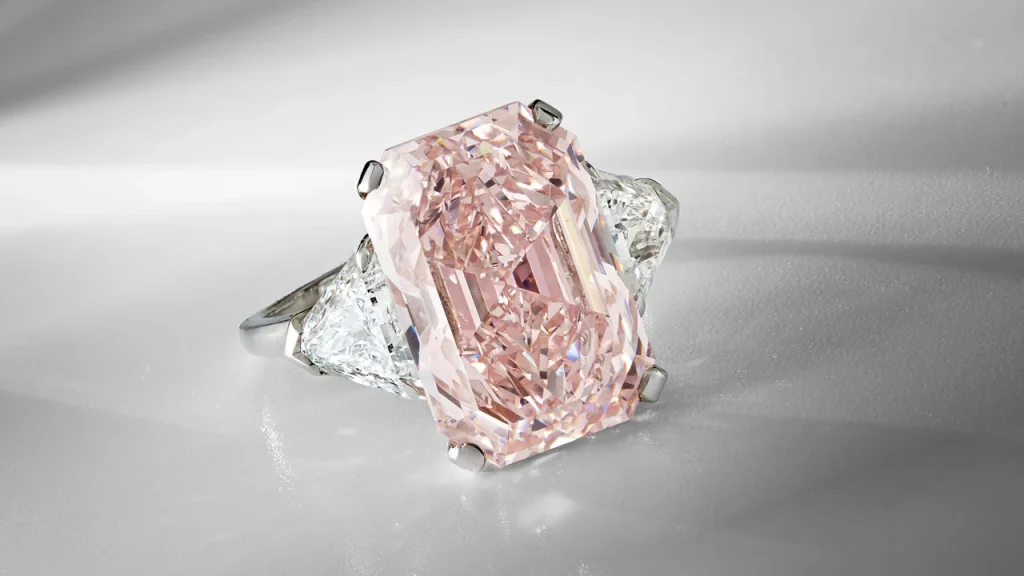
 14.63 carat fancy orangey pink natural diamond

A remarkable 14.63 carat fancy orangey pink natural diamond is set to be one of the highlights of Christie’s upcoming Geneva jewellery auction, with the David Morris ring carrying an upper estimate of approximately US$2.6 million.

The exceptional stone will be offered as part of Christie’s Exceptional Jewels & Objects of Elegance: A Connoisseur’s Collection, taking place in Geneva on November 10, with an accompanying online auction running from November 5 to 17.

The private collection comprises almost 300 lots and includes important jewellery from internationally recognised maisons including Van Cleef & Arpels, Bulgari and Graff, alongside Art Deco vanity cases and finely crafted gold objects.

Why are natural pink diamonds pink?

Pink diamonds are among the most intriguing of all natural diamonds because, unlike many other coloured diamonds, their colour is not easily explained by the presence of a specific trace element.

The colour of a natural pink diamond is generally associated with changes in the diamond’s crystal structure that occurred deep within the Earth during its formation. Diamonds are made from carbon atoms arranged in an exceptionally precise crystal lattice. In some diamonds, geological forces cause distortions within that lattice.

These microscopic structural distortions affect the way light passes through the diamond, producing the remarkable pink colour that makes these stones so desirable.

When the colour moves towards orangey pink, the diamond displays a combination of pink and orange body colour. The precise appearance can vary considerably from one diamond to another, ranging from delicate pastel tones to highly saturated and vivid colours.

This is one reason every exceptional natural coloured diamond is effectively unique.

For more information about diamond structure, properties and the differences between natural and laboratory-grown diamonds, see DCLA’s guide to What Is a Diamond? Natural vs Laboratory-Grown – Structure, Science and Pricing.

Why are pink diamonds so rare?

Natural diamonds occur in many parts of the world, but diamonds with a strong and attractive natural pink colour are extraordinarily uncommon.

Diamonds are formed under immense pressure and temperature deep within the Earth’s mantle and can take billions of years to reach the surface through geological processes. Only a very small proportion develop the particular crystal characteristics responsible for a natural pink colour.

Importantly, pink diamonds are not confined to one location. Natural pink diamonds have been discovered in diamond-producing regions around the world. However, the supply of fine-quality pink diamonds is exceptionally limited.

The rarity becomes even greater when factors such as carat weight, colour intensity, clarity, cut and overall beauty are taken into account.

A large pink diamond with strong colour and good clarity is therefore extraordinarily difficult to find.

DCLA has explored the extraordinary rarity of large natural diamonds in its article Nature vs Technology: Why Large Natural Diamonds Are Exceptionally Rare, explaining why increasing diamond size results in dramatically greater natural scarcity.

Size changes everything

With coloured diamonds, rarity increases dramatically as size increases.

A small natural pink diamond may already be a scarce gemstone, but a large stone with an attractive, saturated colour can be in an entirely different category.

The 14.63 carat diamond being offered in Geneva is therefore significant not simply because it is pink, but because of its combination of natural colour, substantial size and orangey pink appearance.

At more than 14 carats, the stone belongs to a category where the number of comparable natural diamonds available to the market is extremely small.

This scarcity is one of the fundamental reasons exceptional pink diamonds can command prices far beyond those of similarly sized colourless diamonds.

Natural colour is the key

The distinction between a natural coloured diamond and a treated or laboratory-grown diamond is particularly important when discussing rare pink diamonds.

A natural pink diamond has acquired its colour through the geological processes that formed the stone over an immense period of time. The colour is part of the diamond’s natural characteristics.

Modern technology can produce laboratory-grown diamonds and can also alter the colour of diamonds through various treatments. These stones can be beautiful in their own right, but they are fundamentally different from a rare natural coloured diamond.

For an important natural coloured diamond, independent examination and documentation are therefore critical.

DCLA explains the importance of determining diamond origin in its article Natural or Laboratory-Grown? How Can You Tell What Diamond Is in Your Ring?, which explains why visual examination or a basic diamond tester cannot reliably establish whether a diamond is natural or laboratory-grown.

The challenge of grading coloured diamonds

Coloured diamonds are assessed differently from traditional colourless diamonds.

The colour itself is a major component of the stone’s rarity and desirability, with factors including hue, tone and saturation playing an important role.

Two diamonds of exactly the same carat weight can therefore have dramatically different values because their colours differ in strength, distribution and attractiveness.

For a buyer or collector, establishing whether the colour is natural, determining the characteristics of the diamond and confirming any treatments is essential.

At the Diamond Certification Laboratory of Australia (DCLA), diamonds undergo detailed examination using advanced laboratory technology. DCLA states that every diamond is screened for known treatments, tested to establish whether it is natural or man-made, and graded according to International Diamond Council (IDC) rules.

Learn more about the DCLA Diamond Grading and Certification Process.

Why independent certification matters

With an exceptionally rare coloured diamond, establishing exactly what the stone is becomes particularly important.

A DCLA diamond grading report provides a technical breakdown including carat weight, colour, clarity, measurements, stone type, treatments or enhancements, cut, symmetry, polish, transparency and fluorescence.

For rare natural coloured diamonds, documentation can therefore become an important part of the stone’s history and provenance.

DCLA’s Diamond Grading Report service provides independent documentation of the diamond’s characteristics.

Why exceptional pink diamonds command exceptional prices

The market for the finest natural pink diamonds is ultimately driven by a simple combination:

Nature created very few of them, and the world’s supply cannot simply be increased.

A large, naturally coloured pink diamond with attractive colour, good clarity and excellent cutting represents the convergence of several rare characteristics.

This scarcity is particularly important in today’s diamond market. While laboratory-grown diamonds can be produced using controlled manufacturing processes, the supply of large, exceptional natural diamonds remains limited by geology.

DCLA’s research into the changing natural diamond market notes that large, rare and unusually coloured natural diamonds continue to command strong premiums because of their exceptional rarity and provenance.

The Christie’s Geneva offering demonstrates the continuing fascination with these extraordinary natural treasures. While the US$2.6 million upper estimate is substantial, the importance of the stone extends beyond its auction price.

It is a reminder that in the world of natural diamonds, rarity is not simply about size. It is about how many times nature was able to create the right combination of colour, structure, clarity, size and beauty.

And when that combination occurs naturally, there may be very few comparable diamonds anywhere in the world.

DCLA — Independent Diamond Expertise

For consumers, collectors, jewellers and insurers, independent examination can provide confidence that a diamond is accurately identified and documented.

Diamond Certification Laboratory of Australia (DCLA) is Australia’s internationally accredited diamond certification laboratory, providing independent grading and testing of natural and laboratory-grown diamonds in its Sydney laboratory.

DCLA — Where nature’s rarest diamonds meet independent science.

Monday, 14 September 2026

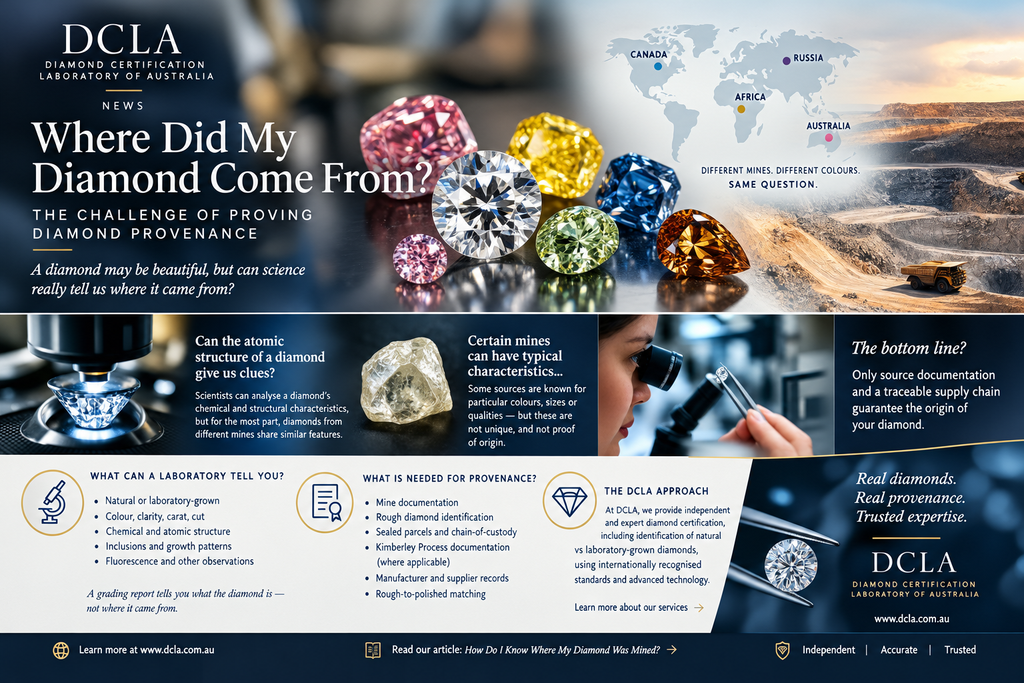
Where Did My Diamond Come From?

 How can you prove the provenance of a polished diamond?

How can you prove the provenance of a polished diamond?

When buying a natural diamond, one question is becoming increasingly important:

Where did it come from?

A diamond may have been mined in Botswana, South Africa, Canada, Australia, Angola, Namibia, Lesotho, Russia or one of the many other diamond-producing regions around the world. But once that rough diamond has been cut and polished, can a laboratory actually look at the finished stone and determine which mine it came from?

For the vast majority of polished diamonds, the answer is no.

This is an important distinction between identifying what a diamond is and identifying where it came from.

A gemmological laboratory can examine a polished diamond and determine many things about it, including its natural or laboratory-grown origin, colour, clarity, carat weight and other characteristics. But determining the geographic origin of a natural diamond is a very different scientific problem.

DCLA has previously addressed the difficulty of determining where a diamond was mined and the importance of documentation and traceability. DCLA: How Do I Know Where My Diamond Was Mined?

Can the atomic structure of a diamond reveal its mine?

This is where the science becomes particularly interesting.

A diamond is made primarily from carbon atoms arranged in a highly organised crystal structure. Small amounts of nitrogen, boron and other trace elements can also occur within the crystal.

Scientists can examine characteristics such as:

  • Crystal structure
  • Nitrogen characteristics
  • Trace elements
  • Isotopic composition
  • Inclusions
  • Growth patterns
  • Spectroscopic characteristics
  • Fluorescence and luminescence

These characteristics can sometimes provide clues.

The problem is that diamonds from different mines can share remarkably similar geological and chemical characteristics.

Research published by the Gemological Institute of America has found that diamond characteristics overlap extensively between deposits around the world. There is currently no scientifically robust method that can independently determine the geographic origin of a random individual polished diamond simply by analysing the stone.

In other words, the atomic structure can tell scientists a great deal about a diamond but for most polished diamonds, it cannot provide a unique geographic fingerprint saying, for example, “this diamond came from Mine X.”

Diamonds from particular mines can have characteristics but that is not proof

This does not mean that diamonds from particular mines are completely indistinguishable.

Certain mines and deposits can become associated with particular characteristics.

For example, some sources have become famous for producing particular sizes, qualities or colours of diamonds. The Argyle mine in Australia became particularly associated with pink and other rare coloured diamonds, while the Cullinan mine in South Africa became famous for producing exceptionally large, high-quality diamonds.

However, these associations are not the same thing as scientific proof of origin.

A diamond may display characteristics that are more common in diamonds from a particular locality without those characteristics being exclusive to that locality.

As GIA research explains, experienced professionals may sometimes make an educated assessment of the likely origin of certain rough diamonds or parcels. But for the majority of polished diamonds, there are no distinctive characteristics that independently reveal their geographic origin.

This distinction is particularly important when a diamond is being marketed with a premium based on its supposed geographical origin.

“This diamond looks like it could have come from that mine” is not the same as “this diamond has been proven to have come from that mine.”

What happens when the diamond is polished?

The journey from rough to polished is critical.

A rough diamond can contain information that is lost or altered when it is cut and polished. Surface characteristics disappear, inclusions may be removed or avoided during cutting, and the original crystal shape is transformed into a finished gemstone.

This makes retrospective identification extremely difficult.

GIA’s research describes the problem clearly: the characteristics of diamonds from different geological environments overlap, while gem-quality diamonds contain extremely low concentrations of many trace elements. The research concludes that, at present, reliable diamond provenance depends on retaining origin information from the time of mining rather than attempting to determine the origin analytically after the fact.

So how can the origin of a polished diamond actually be proven?

The answer is traceability.

Instead of trying to work backwards from the finished diamond, the origin needs to be established at the beginning of the diamond’s journey.

One of the strongest scientific approaches is to analyse the rough diamond when its origin is documented, record its characteristics, and then match the resulting polished diamond back to that original rough.

This is the principle behind the GIA Diamond Origin Report.

GIA requires the rough diamond to be received in a documented, sealed and tamper-resistant parcel directly from the mining company. The rough is analysed and assigned an identification number. After cutting and polishing, the finished diamond can then be submitted and scientifically matched against the original rough.

The matching process can use a combination of physical measurements, spectroscopy, imaging and other characteristics recorded from the rough.

This is fundamentally different from taking an unknown polished diamond and attempting to guess its mine of origin.

What about the Kimberley Process?

The Kimberley Process is also an important part of the broader diamond supply chain.

It was established to prevent the international trade in conflict diamonds and provides a system of controls surrounding the international trade in rough diamonds.

DCLA’s own terms and conditions require diamonds listed through its website to have been imported under the Kimberley Process.

However, it is important to understand what this means.

A Kimberley Process certificate and supply-chain documentation can provide important evidence concerning the legal movement and declared origin of rough diamonds, but it is not the same as a gemmological laboratory looking at an unknown polished diamond and scientifically determining its mine.

What does a normal diamond certificate prove?

A diamond grading report is extremely useful, but consumers should understand what it does and does not establish.

A conventional grading report can document characteristics such as the diamond’s:

Carat weight
Colour
Clarity
Cut
Measurements
Proportions
Fluorescence and other laboratory observations

It may also identify whether a diamond is natural or laboratory-grown, depending on the laboratory and examination performed.

But a standard grading report does not automatically establish the mine where a natural diamond was extracted.

DCLA has also warned consumers about another important issue: a legitimate grading certificate can sometimes be presented with a different stone. The laboratory’s recent consumer alert highlights why matching the physical diamond to its report and verifying inscriptions and characteristics is so important.

You can read more about DCLA’s approach to diamond identification and certification through the DCLA Diamond Certification Laboratory.

What about coloured diamonds?

The situation becomes particularly interesting with natural coloured diamonds.

Certain geographic sources have become strongly associated with particular colours and colour ranges.

Australia’s Argyle mine, for example, became internationally famous for its pink diamonds. Other deposits have produced distinctive populations of yellow, blue, brown and other coloured diamonds.

Colour, hue and saturation can therefore sometimes provide useful clues about a possible source.

But again, a clue is not proof.

A particular colour may be much more frequently encountered from one locality than another, while similar colours can occur elsewhere.

The same principle applies to other characteristics such as inclusions, growth features and trace chemistry.

A laboratory may be able to say that a stone displays characteristics that are consistent with diamonds seen from a particular source. That does not necessarily mean the laboratory can prove that the individual diamond came from that mine.

The difference between identification and provenance

This is perhaps the most important distinction for consumers.

Identification asks:

What is this diamond?

Provenance asks:

Where did this particular diamond come from and can its journey be documented?

A laboratory can provide powerful scientific evidence about the first question.

The second question requires something more: a chain of evidence connecting the individual diamond to its source.

That evidence can include:

  • Mine documentation
  • Rough diamond identification
  • Sealed parcels
  • Export documentation
  • Kimberley Process documentation where applicable
  • Manufacturer records
  • Rough-to-polished matching
  • Laser inscriptions
  • Grading reports
  • Purchase invoices
  • Supplier records
  • Chain-of-custody documentation
  • Verified digital traceability systems

Documentation is the key to provenance

The simplest way to think about diamond provenance is this:

You cannot reliably create provenance after the diamond has lost its documented history.

If a diamond is mined, mixed with thousands of other diamonds, sold through several companies, cut and polished, and eventually appears years later without its original documentation, scientific examination may be unable to reconstruct its exact mine of origin.

By contrast, if the diamond’s identity is established at the mine and maintained throughout the manufacturing process, its journey can potentially be verified.

This is why modern diamond traceability systems are becoming increasingly important.

GIA itself has stated that there is currently no scientific method capable of determining country of origin simply by examining a random natural diamond. Its origin services instead rely on verified origin information and scientific matching between the rough and polished diamond.

The DCLA view

At DCLA, we believe consumers should be given a clear distinction between what can be scientifically established and what may simply be an educated opinion.

Diamonds from certain mines can share characteristics. Certain colours, qualities, inclusions and growth features may occur more frequently in particular deposits.

But the majority of gem-quality white diamonds, once polished, do not carry a unique scientific fingerprint that allows their mine of origin to be established with certainty.

And while some coloured diamonds may display characteristics strongly associated with particular sources, those characteristics are not automatically proof of origin.

The bottom line is simple:

If you want to know where your diamond came from, look at the chain of evidence not just the appearance of the stone.

A diamond grading report can tell you what the diamond is.

Scientific examination can identify many of its characteristics.

But provenance comes from being able to connect that individual diamond to its documented source.

For a diamond whose geographic origin is important to the buyer, the strongest evidence is documentation and traceability maintained from the rough diamond through cutting, polishing and sale.

In the world of diamond provenance, a good story is not the same as proof.

The most valuable provenance is the provenance that can be documented, verified and traced back to the source.

For further information on diamond identification, certification and laboratory-grown diamond detection, visit DCLA – Diamond Certification Laboratory of Australia and explore DCLA’s educational resources, including DCLA’s article on diamond mine origin and DCLA’s information on natural and laboratory-grown diamonds.

Independent research

For further scientific reading, GIA’s research on the geographic origin of diamonds explains the limitations of current analytical methods and why documented origin information remains essential. GIA: Methods and Challenges of Establishing the Geographic Origin of Diamonds

GIA also explains its rough-to-polished scientific matching process through its Diamond Origin Report service.

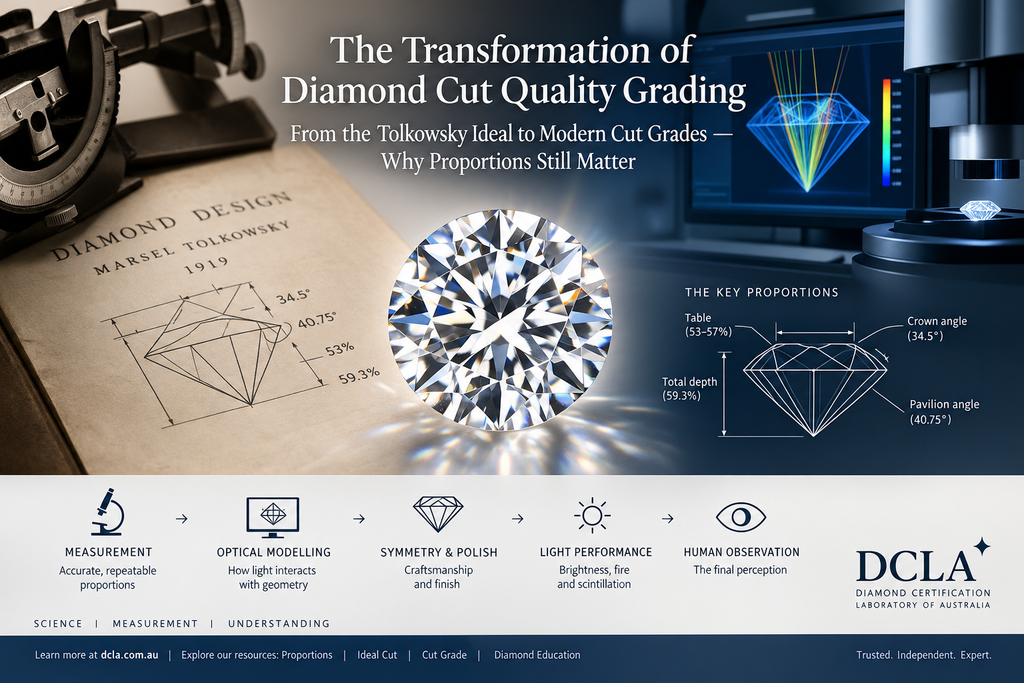
The Transformation of Diamond Cut Quality Grading

  From the Tolkowsky Ideal to Modern Cut Grades, Why Proportions Still Matter For more than a century, diamond cutters, gemologists and scie...