Showing posts with label CVD diamond. Show all posts

Tuesday, 18 August 2026

GIA Alert: CVD Rough Made to Mimic Natural Diamond

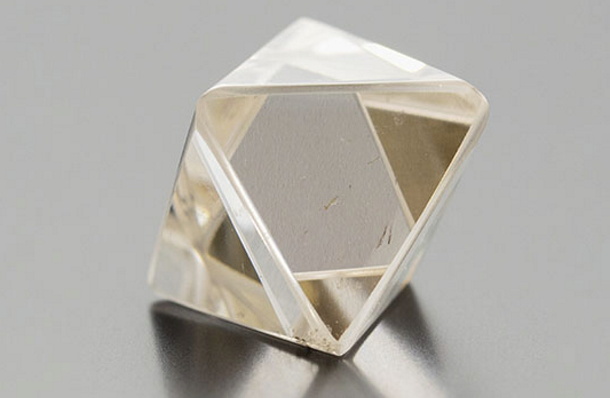
 The Gemological Institute of America (GIA) has issued an important warning after examining a 6.87-carat, near-colourless CVD laboratory-grown diamond that had been deliberately fashioned to resemble a natural rough diamond crystal.

A 6.87 ct CVD-grown synthetic diamond Photo by Danny Bowler.

The Gemological Institute of America (GIA) has issued an important warning after examining a 6.87-carat, near-colourless CVD laboratory-grown diamond that had been deliberately fashioned to resemble a natural rough diamond crystal.

The unusual stone was submitted to GIA as a rough diamond and initially displayed a shape remarkably similar to the familiar octahedral form associated with natural diamond crystals. However, advanced laboratory testing revealed that its origin was very different.

The finding is detailed in the latest issue of Gems & Gemology and highlights an emerging challenge for the diamond industry: laboratory-grown diamonds can be deliberately fashioned to imitate the appearance of natural rough diamonds before they ever reach the cutting stage.

A CVD Diamond Designed to Look Natural

CVD, or Chemical Vapour Deposition, is one of the two principal technologies used to produce laboratory-grown diamonds. Unlike natural diamonds, which form deep within the Earth’s mantle over geological timescales, CVD diamonds are grown in controlled laboratory environments from a carbon-rich gas.

The GIA researchers believe this particular stone represents the first known example, to their knowledge, of a CVD laboratory-grown diamond being deliberately shaped into the approximate form of a natural rough diamond crystal.

The significance is not simply that the material was laboratory-grown. It is the deliberate attempt to make the synthetic material visually resemble natural rough.

According to the researchers, there appears to be little practical reason to produce a CVD diamond in this form other than an attempt at deception.

Advanced Testing Revealed Its True Origin

While its external appearance suggested a natural crystal, sophisticated laboratory analysis told a different story.

GIA used Raman spectroscopy, a powerful analytical technique capable of identifying the molecular and structural characteristics of diamond material.

The testing confirmed that the stone was CVD-grown diamond, rather than a natural diamond crystal.

This demonstrates why visual examination alone cannot always establish the origin of a rough diamond.

Natural diamond crystals can exhibit characteristic crystal forms, surface features and growth patterns. However, a laboratory-grown diamond can potentially be cut, shaped or modified to imitate some of those characteristics.

It Wasn’t Actually a True Octahedron

Closer examination also revealed that the stone was not a genuine natural octahedral crystal.

Only one pair of opposite faces was parallel, while the surfaces did not correspond to the crystallographic planes normally associated with natural diamond crystals.

In other words, the stone had been fashioned to create the impression of a natural crystal rather than actually possessing the crystallographic geometry of one.

For an experienced diamond professional, such inconsistencies may provide important clues. But the case demonstrates how sophisticated the presentation of laboratory-grown material can become.

Why Producing This Stone Would Be Difficult

Interestingly, manufacturing a CVD diamond in this form is not a simple or efficient process.

CVD diamonds are generally grown as larger blocks or plates of material. Producing a rough-looking crystal from that material requires additional cutting and shaping.

The GIA researchers noted that attempting to create a finished diamond from a CVD block while maintaining the required crystal structure would be difficult and wasteful.

A significant amount of material would be lost in the process, and the eventual polished diamond would be considerably smaller than one cut directly from the original as-grown CVD block.

That makes the decision to create a crystal-shaped CVD diamond particularly significant.

From a commercial perspective, it would make little sense to sacrifice valuable CVD material simply to create a rough crystal appearance unless there were another objective.

A Warning for the Rough Diamond Trade

The discovery is particularly relevant to the rough diamond market, where the first assessment of a stone can be based heavily on its external appearance, crystal morphology and surface characteristics.

For generations, experienced diamond buyers have learned to recognise natural crystal forms and the features associated with different types of rough.

But laboratory-grown technology is evolving rapidly.

The GIA case demonstrates that the industry cannot assume that a convincing natural-looking crystal is necessarily natural.

Appearance is not proof of origin.

This is an important distinction for dealers, manufacturers, wholesalers, retailers and consumers alike.

Could This Lead to New Rough-Diamond Screening Technology?

Perhaps the most significant aspect of the GIA report is that the researchers believe the industry could respond if stones of this type become more common.

They suggest that an immediate screening solution for rough diamonds could potentially be developed by adapting existing instruments currently used to screen polished diamonds.

This could become increasingly important as laboratory-grown diamond production expands and techniques for disguising laboratory-grown material become more sophisticated.

The diamond industry already relies on a combination of spectroscopy, fluorescence, photoluminescence and other advanced analytical technologies to separate natural diamonds from laboratory-grown diamonds.

The challenge now is ensuring that these technologies remain effective before a diamond reaches the polishing stage.

What This Means for the Diamond Industry

The GIA discovery is a reminder that the distinction between natural and laboratory-grown diamonds is not simply a matter of appearance.

A laboratory-grown diamond can possess the same basic chemical composition and crystal structure as a natural diamond. The crucial difference is origin.

As laboratory-grown diamond manufacturing becomes more sophisticated, the industry must continue to develop reliable methods for establishing that origin.

For professional diamond buyers, this reinforces the importance of purchasing rough and polished diamonds through reputable channels and using appropriate laboratory testing when the provenance or origin of a stone is in question.

For consumers, it reinforces another important principle:

If the origin matters, test the stone.

A diamond may look natural.

It may have been deliberately shaped to look natural.

It may even convince an experienced eye at first examination.

But sophisticated laboratory analysis can reveal what the eye cannot.

The Bigger Picture

The GIA case should not be interpreted as evidence that every unusual rough diamond is suspicious, nor does it suggest that CVD technology itself is a problem.

Laboratory-grown diamonds are a legitimate category of diamond material and can be accurately identified when appropriate testing is undertaken.

The concern arises when laboratory-grown material is intentionally presented in a manner designed to create the impression that it is natural.

That is where the industry’s established systems of disclosure, screening, verification and independent grading become critical.

As technology advances on both sides of the industry, the race between diamond-growing technology and diamond-identification technology is likely to continue.

The 6.87-carat CVD crystal examined by GIA may be an unusual case today. But it provides a valuable warning about what could become a more significant challenge tomorrow.

For the modern diamond industry, the lesson is clear: a natural-looking rough crystal is not necessarily a natural diamond. Advanced scientific testing remains the ultimate safeguard.

Wednesday, 17 September 2025

Lab Growns – without the High Pressure or Temperature

Lab Growns - without the High Pressure or Temperature

Researchers at the University of Tokyo say they’ve found a way to make tiny diamonds without the need for high temperature or high pressure conditions – unlike current lab grown technology.

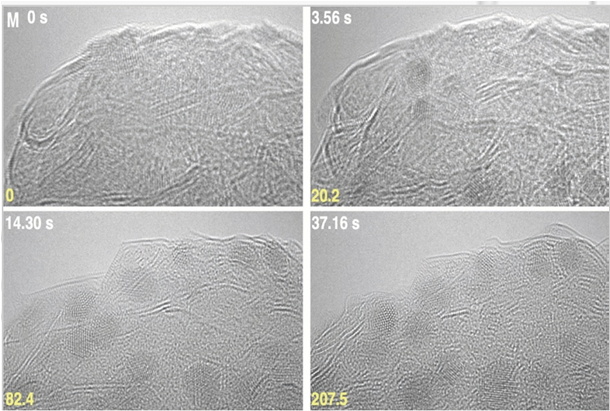
They use electron beams to break and remake bonds in adamantane (C10H16), a carbon molecule in which atoms are arranged in a pattern very similar to the atomic structure of diamond.

The process takes tens of seconds under transmission electron microscopy conditions in a vacuum (low-pressure chamber)

A team led by Professor Eiichi Nakamura, of the Department of Chemistry, has published its findings in the journal Science, in an article entitled Rapid, low-temperature nanodiamond formation by electron-beam activation of adamantane C-H bonds.

It explains how the controlled electron irradiation of adamantane produces defect-free nanodiamonds.

The breakthrough process is aimed at creating tiny diamonds for high-tech industries, scientific research, and medical fields, rather than larger gem-quality stones.

It works through gradual assembly of diamond lattice from adamantane molecules under prolonged electron irradiation, which naturally limits the size to nanodiamonds currently.

Larger diamond growth would require controlling fusion of these nanocrystals and sustained lattice perfection over much longer times and at a larger scale.

Gem quality lab growns are created either using High Pressure High Temperature (HPHT) or Chemical Vapor Deposition (CVD), which uses high temperatures and low pressure.

Source: DCLA

Tuesday, 11 February 2020

De Beers Scores Partial CVD Patent Victory


 A court has awarded a limited victory to De Beers’ synthetic-diamond production unit in a patent dispute with Singapore-based grower IIa Technologies.
IIa infringed an Element Six patent related to diamond material that’s usable for lab-grown diamond jewelry and industrial applications, according to a High Court of Singapore judgment Friday. However, another Element Six patent for post-growth color treatment is invalid, judge Valerie Thean also ruled.
“We will continue to be vigilant for any other potential infringement of our [intellectual-property] rights around the globe,” Element Six CEO Walter Hühn said in a statement Friday. “We will defend our rights vigorously — just as any company would — because protecting our ability to get a full return on our investment in [research and development] is vital to our future.”
UK-based Element Six produces synthetic diamonds for De Beers’ lab-grown jewelry brand, Lightbox, and supplies diamond material for industrial and technological uses. The patent it successfully defended, SG 872, was relevant to optical applications such as infrared spectroscopy and high-power laser optics, as well as to the creation of stones for jewelry, De Beers explained.
IIa, which grows CVD goods for distributor and sister company Pure Grown Diamonds (PGD), must stop making, using, importing or maintaining possession of products that infringe patent SG 872, Thean ordered. She also called for the cancellation of Element Six’s patent SG 508, which relates to the annealing of chemical vapor deposition (CVD) diamonds.
“IIa Technologies has developed its proprietary process in the last 15 years, and is proud of the work we have done to bring lab-grown diamonds to the world,” Vishal Mehta, IIa’s CEO, said in a separate statement. “The current judgment will be considered in its entirety, and then the company will take necessary steps to protect its interests.”
The lawsuit, which Element Six filed in 2016, comes amid heightened patent-related legal activity in the synthetic-diamond sector. Last month, WD Lab Grown Diamonds sued six companies — including IIa and PGD — accusing them of infringing its patents for synthesis and treatment.
Source: DCLA

De Beers Scores Partial CVD Patent Victory


 A court has awarded a limited victory to De Beers’ synthetic-diamond production unit in a patent dispute with Singapore-based grower IIa Technologies.
IIa infringed an Element Six patent related to diamond material that’s usable for lab-grown diamond jewelry and industrial applications, according to a High Court of Singapore judgment Friday. However, another Element Six patent for post-growth color treatment is invalid, judge Valerie Thean also ruled.
“We will continue to be vigilant for any other potential infringement of our [intellectual-property] rights around the globe,” Element Six CEO Walter Hühn said in a statement Friday. “We will defend our rights vigorously — just as any company would — because protecting our ability to get a full return on our investment in [research and development] is vital to our future.”
UK-based Element Six produces synthetic diamonds for De Beers’ lab-grown jewelry brand, Lightbox, and supplies diamond material for industrial and technological uses. The patent it successfully defended, SG 872, was relevant to optical applications such as infrared spectroscopy and high-power laser optics, as well as to the creation of stones for jewelry, De Beers explained.
IIa, which grows CVD goods for distributor and sister company Pure Grown Diamonds (PGD), must stop making, using, importing or maintaining possession of products that infringe patent SG 872, Thean ordered. She also called for the cancellation of Element Six’s patent SG 508, which relates to the annealing of chemical vapor deposition (CVD) diamonds.
“IIa Technologies has developed its proprietary process in the last 15 years, and is proud of the work we have done to bring lab-grown diamonds to the world,” Vishal Mehta, IIa’s CEO, said in a separate statement. “The current judgment will be considered in its entirety, and then the company will take necessary steps to protect its interests.”
The lawsuit, which Element Six filed in 2016, comes amid heightened patent-related legal activity in the synthetic-diamond sector. Last month, WD Lab Grown Diamonds sued six companies — including IIa and PGD — accusing them of infringing its patents for synthesis and treatment.
Source: DCLA

Fancy Colour Diamonds, From Hollywood Statement to the Ultimate Collectable

  For generations, the traditional diamond engagement ring has been dominated by the classic colourless stone. But the world of exceptional ...