Showing posts with label Namibia. Show all posts

Monday, 14 September 2026

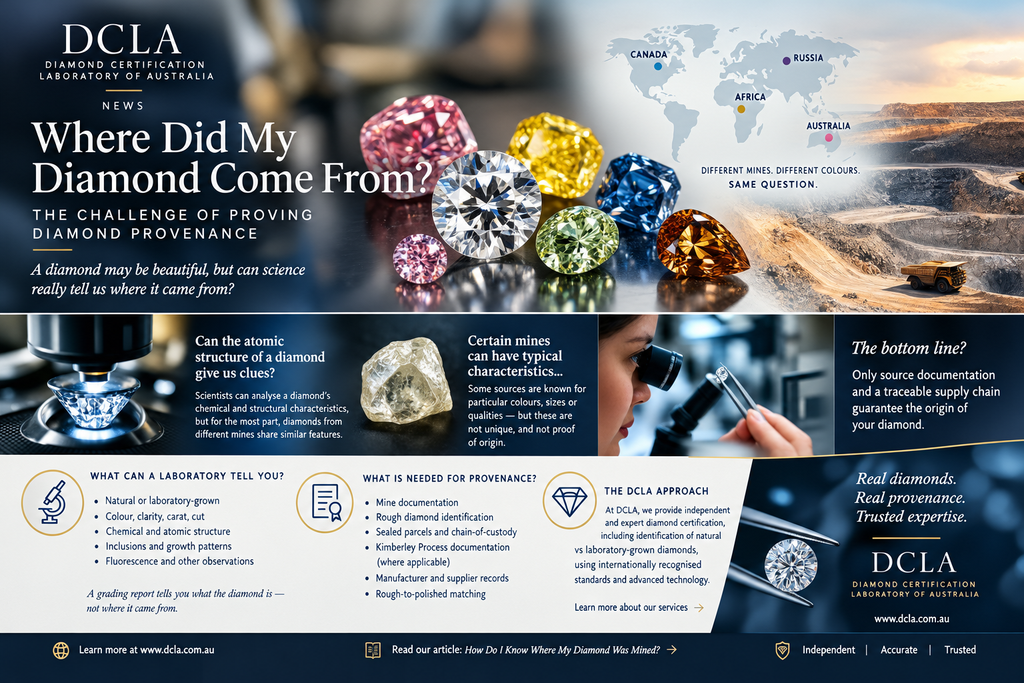
Where Did My Diamond Come From?

 How can you prove the provenance of a polished diamond?

How can you prove the provenance of a polished diamond?

When buying a natural diamond, one question is becoming increasingly important:

Where did it come from?

A diamond may have been mined in Botswana, South Africa, Canada, Australia, Angola, Namibia, Lesotho, Russia or one of the many other diamond-producing regions around the world. But once that rough diamond has been cut and polished, can a laboratory actually look at the finished stone and determine which mine it came from?

For the vast majority of polished diamonds, the answer is no.

This is an important distinction between identifying what a diamond is and identifying where it came from.

A gemmological laboratory can examine a polished diamond and determine many things about it, including its natural or laboratory-grown origin, colour, clarity, carat weight and other characteristics. But determining the geographic origin of a natural diamond is a very different scientific problem.

DCLA has previously addressed the difficulty of determining where a diamond was mined and the importance of documentation and traceability. DCLA: How Do I Know Where My Diamond Was Mined?

Can the atomic structure of a diamond reveal its mine?

This is where the science becomes particularly interesting.

A diamond is made primarily from carbon atoms arranged in a highly organised crystal structure. Small amounts of nitrogen, boron and other trace elements can also occur within the crystal.

Scientists can examine characteristics such as:

  • Crystal structure
  • Nitrogen characteristics
  • Trace elements
  • Isotopic composition
  • Inclusions
  • Growth patterns
  • Spectroscopic characteristics
  • Fluorescence and luminescence

These characteristics can sometimes provide clues.

The problem is that diamonds from different mines can share remarkably similar geological and chemical characteristics.

Research published by the Gemological Institute of America has found that diamond characteristics overlap extensively between deposits around the world. There is currently no scientifically robust method that can independently determine the geographic origin of a random individual polished diamond simply by analysing the stone.

In other words, the atomic structure can tell scientists a great deal about a diamond but for most polished diamonds, it cannot provide a unique geographic fingerprint saying, for example, “this diamond came from Mine X.”

Diamonds from particular mines can have characteristics but that is not proof

This does not mean that diamonds from particular mines are completely indistinguishable.

Certain mines and deposits can become associated with particular characteristics.

For example, some sources have become famous for producing particular sizes, qualities or colours of diamonds. The Argyle mine in Australia became particularly associated with pink and other rare coloured diamonds, while the Cullinan mine in South Africa became famous for producing exceptionally large, high-quality diamonds.

However, these associations are not the same thing as scientific proof of origin.

A diamond may display characteristics that are more common in diamonds from a particular locality without those characteristics being exclusive to that locality.

As GIA research explains, experienced professionals may sometimes make an educated assessment of the likely origin of certain rough diamonds or parcels. But for the majority of polished diamonds, there are no distinctive characteristics that independently reveal their geographic origin.

This distinction is particularly important when a diamond is being marketed with a premium based on its supposed geographical origin.

“This diamond looks like it could have come from that mine” is not the same as “this diamond has been proven to have come from that mine.”

What happens when the diamond is polished?

The journey from rough to polished is critical.

A rough diamond can contain information that is lost or altered when it is cut and polished. Surface characteristics disappear, inclusions may be removed or avoided during cutting, and the original crystal shape is transformed into a finished gemstone.

This makes retrospective identification extremely difficult.

GIA’s research describes the problem clearly: the characteristics of diamonds from different geological environments overlap, while gem-quality diamonds contain extremely low concentrations of many trace elements. The research concludes that, at present, reliable diamond provenance depends on retaining origin information from the time of mining rather than attempting to determine the origin analytically after the fact.

So how can the origin of a polished diamond actually be proven?

The answer is traceability.

Instead of trying to work backwards from the finished diamond, the origin needs to be established at the beginning of the diamond’s journey.

One of the strongest scientific approaches is to analyse the rough diamond when its origin is documented, record its characteristics, and then match the resulting polished diamond back to that original rough.

This is the principle behind the GIA Diamond Origin Report.

GIA requires the rough diamond to be received in a documented, sealed and tamper-resistant parcel directly from the mining company. The rough is analysed and assigned an identification number. After cutting and polishing, the finished diamond can then be submitted and scientifically matched against the original rough.

The matching process can use a combination of physical measurements, spectroscopy, imaging and other characteristics recorded from the rough.

This is fundamentally different from taking an unknown polished diamond and attempting to guess its mine of origin.

What about the Kimberley Process?

The Kimberley Process is also an important part of the broader diamond supply chain.

It was established to prevent the international trade in conflict diamonds and provides a system of controls surrounding the international trade in rough diamonds.

DCLA’s own terms and conditions require diamonds listed through its website to have been imported under the Kimberley Process.

However, it is important to understand what this means.

A Kimberley Process certificate and supply-chain documentation can provide important evidence concerning the legal movement and declared origin of rough diamonds, but it is not the same as a gemmological laboratory looking at an unknown polished diamond and scientifically determining its mine.

What does a normal diamond certificate prove?

A diamond grading report is extremely useful, but consumers should understand what it does and does not establish.

A conventional grading report can document characteristics such as the diamond’s:

Carat weight
Colour
Clarity
Cut
Measurements
Proportions
Fluorescence and other laboratory observations

It may also identify whether a diamond is natural or laboratory-grown, depending on the laboratory and examination performed.

But a standard grading report does not automatically establish the mine where a natural diamond was extracted.

DCLA has also warned consumers about another important issue: a legitimate grading certificate can sometimes be presented with a different stone. The laboratory’s recent consumer alert highlights why matching the physical diamond to its report and verifying inscriptions and characteristics is so important.

You can read more about DCLA’s approach to diamond identification and certification through the DCLA Diamond Certification Laboratory.

What about coloured diamonds?

The situation becomes particularly interesting with natural coloured diamonds.

Certain geographic sources have become strongly associated with particular colours and colour ranges.

Australia’s Argyle mine, for example, became internationally famous for its pink diamonds. Other deposits have produced distinctive populations of yellow, blue, brown and other coloured diamonds.

Colour, hue and saturation can therefore sometimes provide useful clues about a possible source.

But again, a clue is not proof.

A particular colour may be much more frequently encountered from one locality than another, while similar colours can occur elsewhere.

The same principle applies to other characteristics such as inclusions, growth features and trace chemistry.

A laboratory may be able to say that a stone displays characteristics that are consistent with diamonds seen from a particular source. That does not necessarily mean the laboratory can prove that the individual diamond came from that mine.

The difference between identification and provenance

This is perhaps the most important distinction for consumers.

Identification asks:

What is this diamond?

Provenance asks:

Where did this particular diamond come from and can its journey be documented?

A laboratory can provide powerful scientific evidence about the first question.

The second question requires something more: a chain of evidence connecting the individual diamond to its source.

That evidence can include:

  • Mine documentation
  • Rough diamond identification
  • Sealed parcels
  • Export documentation
  • Kimberley Process documentation where applicable
  • Manufacturer records
  • Rough-to-polished matching
  • Laser inscriptions
  • Grading reports
  • Purchase invoices
  • Supplier records
  • Chain-of-custody documentation
  • Verified digital traceability systems

Documentation is the key to provenance

The simplest way to think about diamond provenance is this:

You cannot reliably create provenance after the diamond has lost its documented history.

If a diamond is mined, mixed with thousands of other diamonds, sold through several companies, cut and polished, and eventually appears years later without its original documentation, scientific examination may be unable to reconstruct its exact mine of origin.

By contrast, if the diamond’s identity is established at the mine and maintained throughout the manufacturing process, its journey can potentially be verified.

This is why modern diamond traceability systems are becoming increasingly important.

GIA itself has stated that there is currently no scientific method capable of determining country of origin simply by examining a random natural diamond. Its origin services instead rely on verified origin information and scientific matching between the rough and polished diamond.

The DCLA view

At DCLA, we believe consumers should be given a clear distinction between what can be scientifically established and what may simply be an educated opinion.

Diamonds from certain mines can share characteristics. Certain colours, qualities, inclusions and growth features may occur more frequently in particular deposits.

But the majority of gem-quality white diamonds, once polished, do not carry a unique scientific fingerprint that allows their mine of origin to be established with certainty.

And while some coloured diamonds may display characteristics strongly associated with particular sources, those characteristics are not automatically proof of origin.

The bottom line is simple:

If you want to know where your diamond came from, look at the chain of evidence not just the appearance of the stone.

A diamond grading report can tell you what the diamond is.

Scientific examination can identify many of its characteristics.

But provenance comes from being able to connect that individual diamond to its documented source.

For a diamond whose geographic origin is important to the buyer, the strongest evidence is documentation and traceability maintained from the rough diamond through cutting, polishing and sale.

In the world of diamond provenance, a good story is not the same as proof.

The most valuable provenance is the provenance that can be documented, verified and traced back to the source.

For further information on diamond identification, certification and laboratory-grown diamond detection, visit DCLA – Diamond Certification Laboratory of Australia and explore DCLA’s educational resources, including DCLA’s article on diamond mine origin and DCLA’s information on natural and laboratory-grown diamonds.

Independent research

For further scientific reading, GIA’s research on the geographic origin of diamonds explains the limitations of current analytical methods and why documented origin information remains essential. GIA: Methods and Challenges of Establishing the Geographic Origin of Diamonds

GIA also explains its rough-to-polished scientific matching process through its Diamond Origin Report service.

Tuesday, 6 January 2026

Namibia’s Diamond Output Hit by Price Drops and Lab Growns

Namibia's rough diamond production

Namibia’s rough diamond production fell by 3.5 per cent year-on-year during Q3 2025, as prices fell, demand for lab growns increased and inventories grew.

The Bank of Namibia said in its quarterly bulletin that the country’s output was 442,000 carats, down by 15.3 per cent on the previous quarter, valued at N$ 2.41bn (USD 147.3m).

“The decrease stemmed from planned actions to lower production at Debmarine Namibia on the back of a combination of downside pressures, including the falling price due to rising demand for lab-grown diamonds and high inventory levels.”

It said rough diamond revenue for Q3 fell by 19 per cent year-on-year and 17.4 per cent compared with the previous quarter.

The bank noted “persistently soft consumer demand in key markets such as China and the United States” as well as oversupply of diamonds by some major producers.

Namibia’s diamond sector is a cornerstone of its economy, historically accounting for 7 to 10 per cent of its GDP and 30 per cent of export earnings. Around three quarters of diamonds are recovered from the seabed by Debmarine’s fleet of ships.

Source: DCLA

Tuesday, 23 December 2025

Namibia: Gold and Uranium Earnings Overtake Diamonds

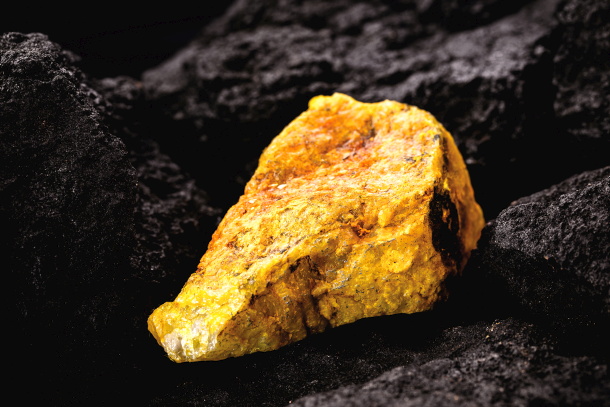
uranium ore in mine, mineral radiation concept, radioactive energy

Namibia has, for the first time, earned more tax revenue from gold and uranium than from diamonds.

Natural diamonds, primarily from marine operations, have long accounted for almost a third of Namibia’s export earnings.

But it has faced a severe contraction since mid-2022. At the same time, gold prices have been surging to record highs, and demand for uranium is rising for nuclear energy production.

Diamond mining is projected to decline by 4.5 per cent in 2025 and 5.7 per cent in 2026, the Bank of Namibia said in its August 2025 Economic Outlook.

“Non-diamond mineral revenues have surpassed diamond revenues for the first time, reinforcing a structural shift towards a more diversified and resilient mining revenue base,” the Chamber of Mines of Namibia said in its report for October, published last week.

It said tax revenue from diamonds in the six months to September was down 79 per cent, year on year. It did not provide like-for-like figures for gold or uranium.

But it said tax revenue from other minerals, mainly uranium and gold, had almost doubled the original budget estimate in the last financial year.

Source: DCLA

Wednesday, 13 August 2025

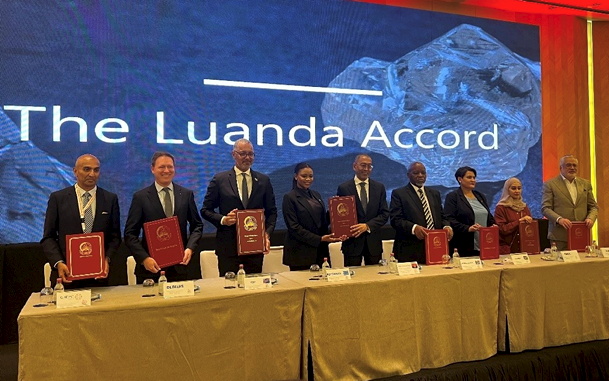
South Africa Joins Luanda Accord to Promote Natural Diamonds

South Africa Joins Luanda Accord

South Africa is to sign up to the milestone Luanda Accord, which is funding a global campaign to promote natural diamonds.

It joined the governments of Angola, Botswana, Namibia, Sierra Leone and the Democratic Republic of the Congo, in June in pledging to contribute 1 per cent of the value of their rough sales annually.

But the move was only approved South Africa’s cabinet last week. Minister in the Presidency Khumbudzo Ntshavheni and confirmed the decision on 7 August, committing 1 per cent of the annual revenues generated from rough diamond sales to a global marketing fund led by the Natural Diamond Council (NDC).

South Africa, the world’s sixth biggest diamond producing nation by value, saw sales down by 21 per cent last year amid the global slowdown.

The country’s mining minister mining minister Gwede Mantashe was listed as a signatory to the Luanda Accord in an official communique after the agreement.

But a conflicting Reuters report said South Africa did not actually sign at the time and has only done so now.

The Luanda Accord is seen as a potential turning point for the sector, aiming to rebuild consumer trust and interest in natural diamonds over lab growns, by emphasizing their origin, authenticity, and community impact.

It will highlight the positive economic and social contributions of the natural diamond industry to producing nations and their communities.

Governments of the African diamond producing nations have been joined by the Antwerp World Diamond Centre (AWDC), African Diamond Producers Association, India’s Gem and Jewellery Export Promotion Council (GJEPC) and the Dubai Multi Commodities Centre (DMCC).

Source: DCLA

Thursday, 10 July 2025

$17m Diamond Heist, Namdia Criticized over New Security

Namdia Criticized over New Security

A Namibian member of parliament has criticized security arrangements made at Namib Desert Diamonds (Namdia), following a $17m armed raid in January.

Job Amupanda claims the state-owned diamond marketing company subsequently appointed an unqualified security consultant, and hired his son to install a new security system.

Namdia said in a statement that it had “taken note of recent social media posts containing unsubstantiated allegations,” but did not categorically deny all claims.

Amupanda, an opposition MP known for actively challenging state-owned enterprises, is also asking why Namdia’s was using Neldan, an Angola-based security company, at the time of the raid.

And he has voiced doubts over the adequacy of Namdia’s security upgrades after the heist.

In a post on X (formerly Twitter) that has been viewed 25,000 times, he said Namdia “brought in a guy as a security consultant, who doesn’t have any qualifications and without following procurement procedures.

“He also doesn’t have a job description. He had his son install a security system.”

Aside from Amupanda’s criticisms, the police warned Namdia of a possible imminent heist before it happened, and advised the company to be vigilant and upgrade security.

Francis “Gosh” Eiseb, aged 57, a senior security supervisor at Namdia, was killed during the heist.

Six suspects, three from the same family – George, Charmaine and Bino Cloete – have since been arrested in connection with the raid.

A relative of the Cloetes – a security guard believed to have taken the diamonds at the scene – remains at large.

Namdia’s CEO, chief operations officer, and security manager remain suspended pending the outcome of an investigation.

In a media statement Namdia said it had implemented critical security upgrades, but said it couldn’t provide details.

It accepted, as Amupanda claimed, that it bypassed procurement procedures, but said it was allowed to do in critical situations.

Namdia also said it had appointed a new security consultant, but gave no details of his qualifications or suitability.

“Prior to this appointment, security services had been provided by Neldan, a Namibian-registered company with operations in several countries, including Angola,” it said. “That contract, however, had come to its natural conclusion.”

Source: DCLA

Wednesday, 30 April 2025

Bank of Namibia’s Warning on US Diamond Tariffs

Benguela Gem, one of Debmarine's diamond vessels

Namibia’s diamond industry may be pushed into deeper crisis if United States (US) president Donald Trump pushes ahead with implementing an export tariff of 21% on Namibia.

The governor of the Bank of Namibia has warned that US tariffs on diamonds – which account for 29 per cent of the country’s exports – could push the country into a deeper crisis. 

It is already suffering the worst drought in over a century, compounded by the slump in diamond demand and other economic hardships, spiralling unemployment and a malaria outbreak.

“The diamond is already going through a difficult time because of low demand, and competition from lab-grown diamonds, and now you have all these tariffs,” said governor Johannes !Gawaxab*.

Namibia currently enjoys duty-free exports to the US on diamonds and most other products, but President Donald Trump announced a 21 per cent export tariff for the country in his 2 April “Liberation Day” speech.

He subsequently said there would be a 90-day pause before reciprocal tariffs on a whole list of countries were implemented.

Namibia is world’s eighth biggest diamond producer by carat, and the sixth by value, primarily from marine diamonds. Last year 12.4 per cent of its polished diamonds were sold to the US.

*The exclamation mark represents a click sound in Khoekhoegowab, an official language of Namibia.

Source: IDEX

Friday, 24 January 2025

US$15 million in diamonds stolen in Namdia heist

Namdia diamond heist

A brazen diamond robbery at Namibia Desert Diamonds (Namdia) early on Saturday evening and involving what is suspected to be the company’s largest-ever consignment of precious stones received, has resulted in two fatalities and two arrests.

Although the figure could not be independently verified, a person with intricate knowledge of the matter said the diamonds are worth more than US$15 million (about N$280 million).

This consignment was reportedly delivered to Namdia’s premises by the Namibia Diamond Trading Company (NDTC).  NDTC is a 50:50 joint venture between the government and De Beers Namibia Holdings. It was formally conceived in January 2007 following an agreement to sort, value and market Namibian diamonds.

Responding to questions yesterday, NDTC CEO Brent Eiseb could not provide any details for security reasons. 

“For safety and security reasons, NDTC does not provide details of rough diamond deliveries/movements. Kindly refer all incident-related queries to Namdia,” Eiseb said.

The Namibian Police have said the exact amount of diamonds stolen in the robbery is unknown, pending an inventory by Namdia.

“The suspects fled with an unspecified amount of Namdia’s diamonds, whose value
is still to be ascertained. There were four suspects involved in the robbery. Two suspects are currently on the run. One suspect is in police custody. One suspect died from a self-inflicted gunshot wound during the incident,” Alisa Amupolo said in another statement issued late yesterday. According to sources familiar with Namdia’s modus operandi, the company was warned to tighten up its security. 

This, however, never happened.  “There were several warnings last year that the security left a lot to be desired. The staff has been worried about this.  The board chairman [Justus Hausiku] warned Alisa Amupolo [CEO] several times to focus on security,” said the source, who preferred to speak on condition of anonymity. 

Despite the advice to improve its security, Namdia’s offices were guarded by a single security guard only identified as Herman, who was seconded from a local security company. 

During the heist, Herman was handcuffed, but somehow managed to notify people at neighbouring premises to call the police, claiming “we’re being robbed”.

Execution

The police confirmed the execution-style killing of a Namdia protection officer during the robbery, as well as one of six perpetrators who succumbed to injuries sustained during the theft. “It is with deep sadness that we confirm an attempted armed robbery at our premises earlier today [Saturday], which tragically resulted in the loss of one of our valued staff members. We are cooperating fully with law-enforcement, and a thorough investigation is currently underway. As this is an ongoing investigation, we are working closely with the relevant authorities to establish the facts surrounding the incident. Namdia remains fully committed to ensuring the safety and security of both its staff and diamonds,” Amupolo said.

Crime report

The weekend police crime report issued yesterday stated that the robbery and murder occurred between 17h00 and 18h00 at the Namdia head office in Klein Windhoek. The police say armed suspects broke into the Namdia premises through yet-to-be determined means. 

The police further said the robbers held staff hostage by tying them up before stealing an undisclosed amount of diamonds.

“In one of the storerooms, the supervisor, who is a protection officer, was found dead with his hands and legs tied up and his face covered with a shopping bag, and a gunshot wound inflicted to the head. He was identified as Francis Eiseb, a 57-year-old Namibian male. His next of kin have been informed of his death,” the police crime report states.

Police said one of the robbery suspects was found with what appeared to be two gunshot wounds.  Late yesterday, police identified Max Endjala as the deceased suspect who was allegedly involved in the Namdia heist. His next of kin have also been informed of his death. He was an auditor at a local firm, according to reports. 

Law-enforcement officers at the scene collected four firearms and some knives. The investigation is ongoing, with the police appealing to members of the public who might have any information about the robbery or the suspects to pass it on to the relevant authorities.

Furthermore, sources said staff at Namdia were called in yesterday for interrogation on the robbery, which some people suspect took place based on inside information regarding the amount of diamonds on the premises at the time.

Family ties 

State broadcaster NBC also reported that one more arrest had been made in connection with the robbery. The male suspect is employed as a security officer at Namdia and is related to Endjala, the suspect who allegedly shot himself in the head, NBC reported.

Fond memories

In a social media post on Sunday, Namdia’s former CEO Kennedy Hamutenya hailed Eiseb as one of the hardest-working and most committed employees during his time. 

Eiseb, he reminisced, would perform above and beyond the call of duty. “He’d even volunteer to drive clients to and from the airport to ensure their safety. He was kind and cordial to all other colleagues, and was full of respect,” Hamutenya’s post reads.

Also taking to his WhatsApp social media platform yesterday was Bryan Eiseb, the Head of the Financial Intelligence Centre and a brother of the late Francis, who said the Eiseb family has “forgiven those who are responsible for Francis’ horrendous death. You [Francis] have paid the ultimate price for Namibia.” 

Namdia was founded by the government in 2016 to independently market and sell Namibia’s diamonds on the international market.  The Namdia headquarters is considered one of the most secure in Windhoek, considering the value consignments it regularly handles. It is estimated that Namdia annually sells some N$2 billion worth of diamonds on the international market. 
Read more: ‘N$280m gems’ stolen in Namdia heist  https://neweralive.na/n280m-gems-stolen-in-namdia-heist

Source: DCLA

Thursday, 15 August 2024

Namibia bemoans popularity of lab-grown diamonds on global market

Namibian natural diamonds

Namibia is one of Africa’s top five diamond exporters, right behind Angola, Botswana, and South Africa. In 2022, the country exported more than $940 million worth of diamonds.

The world’s demand for natural diamonds has bounced back from a slump during the COVID-19 pandemic, with Namibia’s largest marine dining company, Debmarine, reporting a sales increase of 83% in 2022 from the previous year.

Still, Debmarine CEO Willy Mertens is worried about competition from synthetic diamonds, sector of the business that could cost many Namibians their jobs.

Though trained jewelers can tell the difference between lab-grown and natural diamonds, there’s nothing obvious to distinguish lab-grown diamonds from natural ones.

The Modern Mining publication recently said that in 2022, lab-grown diamond jewelry surpassed 10% of the market of global jewelry sales for the first time. The publication said artificial diamond sales are forecast to continue growing at an annual double-digit percentage rate in coming years.

Namibia, where workers extracted 2.1 million carats in diamonds in 2022, is embarking on a campaign to tout natural diamonds as environmentally sound and holding greater value for the money.

“We’ve seen in the past couple of years that lab-grown diamonds, or synthetics as you call them, have sort of infiltrated the natural diamond market,” said Mertens. ” … people were first marketing them as real diamonds and we’ve done a lot of work around trying to differentiate them.”

One of the challenges of marketing Namibian natural diamonds is the environmental impact that diamonds have on the landscape.

Mertens said Debmarine invests a significant amount of its profits into environmental rehabilitation and restoration of landscapes and the seabed damaged by mining.

“The restoration of the seabed actually happens naturally as the waves move,” Mertens said. “So what we are doing is that we are monitoring that, and what we do is we mine out a specific area and we leave an area next to it vacant, and over time we monitor how the area where we have recovered diamonds looks like compared to the one that was not touched and we’ve seen that it takes about three to 10 years maximum for that to completely restore. By completely restoring, mean about 70% of the organisms have returned to that place. On the land, it is sand that we are moving and what we do now is that we are using that same sand to keep the sea walls in tact.”

Mertens recently paid a courtesy call on Namibian President Nangolo Mbumba, to introduce the De Beers global ambassador for natural diamonds, Hollywood actor Lupita Nyong’o, and talk to the president about challenges facing Namibia’s diamond industry.

De Beers Natural Diamonds Global Ambassador Lupita Nyong’o, left, Namibia President Nangolo Mbumba, center, and Debmarine CEO Willy Mertens in Windhoek, Namibia, July 19, 2024. (Vitalio Angula/VOA)
President Mbumba lamented a proposal for the Kimberley process — the process meant to screen out so-called “conflict diamonds” from entering the international market — to begin certifying all diamonds in Antwerp, Belgium.

The Group of Seven largest economies said that is an effort to prevent Russian diamonds from being sold abroad.

Mbumba said the measure would hurt African diamond producers.

“Recently, the decision was made by the G7 countries to route all rough and polished diamonds destined for G7 countries via Belgium,” said Mbumba. “This decision poses a serious risk and threat to our economies, especially the economies of Angola, Botswana and Namibia by increasing the cost as well as curtailing freedom of trade for our countries’ products.”

Namibia’s president said he and his counterparts from Angola and Botswana have written a letter to the G7 to ask them to halt their plans.

Source: DCL

De Beers London launches Vibrations

  De Beers London presents Vibrations: a High Jewellery universe inspired by the quiet yet enduring power of inland water. The collection ce...