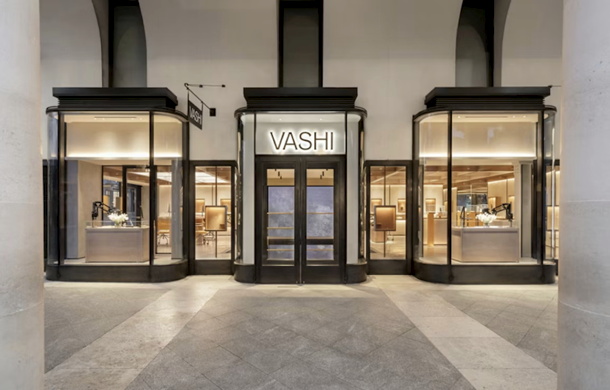
The UK’s Serious Fraud Office (SFO) decided not to investigate the luxury diamond jewelry brand Vashi, which subsequently collapsed in 2023 with debts of $220m, according to the BBC.
The company gained attention for its innovative approach to selling high-quality diamonds directly to consumers, and for its flamboyant founder, chairman and CEO Vashi Dominguez. But it was declared bankrupt in April 2023 after a court ruling forced it into liquidation.
But the company’s former chief technology officer John Ames reportedly warned the SFO that Vashi was defrauding investors and falsifying accounts in May 2022, almost a year earlier.
The SFO decided not to investigate, according to a BBC report, despite documentation which allegedly showed the company had made sales worth £5.5m ($7.2m) in 2020, rather than the £53.6m ($70m) boasted of in marketing materials and filed in the company accounts.
Mr Ames contacted the SFO in May 2022. In an online form he said: “I discovered (Vashi) to be defrauding their investors, they are also likely to be misstating information on their statutory reporting, both through inflated stock holdings and failing to provide details on revenue sources.”
Dominguez reportedly left for Dubai on the day the company went into liquidation. His whereabouts are not known.
Dominguez (pictured) attracted investment from high-profile backers, including mobile phones billionaire John Cauldwell, and Nick Wheeler, founder of British shirtmaker Charles Tyrwhitt.
The Spanish-born entrepreneur also had a flair for self-publicity, positioned himself as a diamond expert in national newspapers and appeared with celebrities on TV.
India’s cut and polished exports fell sharply in October to $1.026bn, down 27 per cent year-on-year and down 25 per cent on the previous month, according to new figures from GJEPC (Gems and Jewellery Export Promotion Council).
Exports peaked in September at $1.368bn, as manufacturers raced to beat US deadlines. They then fell back in October to around where they were in July and August.
The US imposed a 25 per cent tariff on 7 August, rising to 50 per cent on 27 August. The grace period (25 rather than 50 per cent) for goods in transit before August 27, ended on 17 September.
“The decline in overall exports in October was mainly due to demand being pushed forward before the US tariff was implemented,” GJEPC chairman Kirit Bhansali told the PTI news agency.
“Most of the stocking up for the festivals took place before August 27, therefore, in October the demand was down.”
Overall gross exports of all gems and jewelry fell by 30.6 per cent year-on-year to $2.168bn, that’s a drop of 25.6 per cent compared with the previous month.
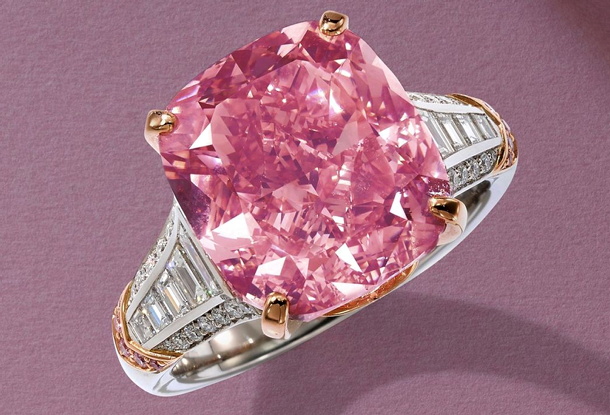
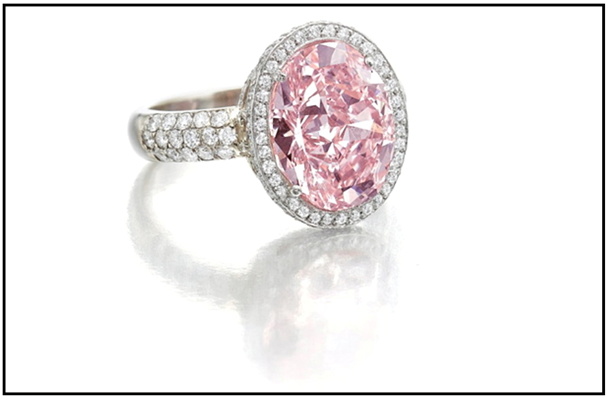
The Glowing Rose, a 10.08-carat vivid pink diamond that was expected to sell for around $20m was pulled from Sotheby’s High Jewelry Sale in Geneva last week.
It was withdrawn prior to the sale on 12 November. A notice on the Sotheby’s website simply says: “This lot is no longer available.”
The cushion-modified brilliant VVS2 stone (pictured), set in a platinum band featuring baguette and brilliant cut white diamonds, would have been only the third vivid pink cushion-cut diamond over 10 carats to come to auction in the last 10 years.
It was cut from a 21-carat Type IIa rough stone recovered in 2023, from a mine in Angola and was due to appear at auction for the first time.
Two days earlier (10 November) another pink diamond pulled from another sale, The old-cut Golconda 6.95-carat fancy vivid purplish pink diamond was due to lead the sale was withdrawn by Phillips from its Geneva Jewels Auction: V event, in agreement with the consignor.
The Sotheby’s High Jewelry Sale generated around $37m, with 94 per cent of lots sold and 98 per cent of the sold lots exceeding their estimates.
Top lot was a 4.50-carat internally flawless oval mixed-cut fancy vivid blue diamond that achieved more than $5.9m.
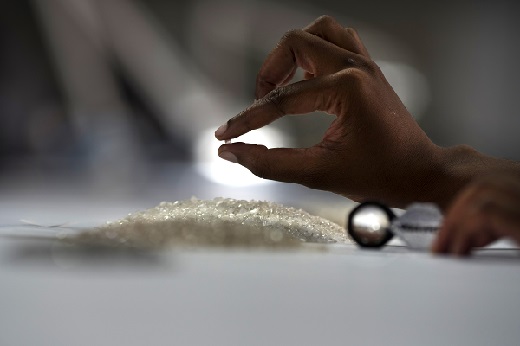
De Beers Global Sightholder Sorting a parcel of rough diamonds over a light box using a hand loupe.
Angola has signalled its intention to buy back the 85% stake in De Beers currently held by Anglo American, in a move that has immediately captured global industry attention. The proposal, made through Angola’s state-owned diamond company Endiama, comes at a time when the diamond sector has struggled to regain momentum after the downturn that began in 2022.
The announcement positions Angola decisively on the world stage. The country produced 10.7 million carats in the first nine months of the year and is targeting a record 14.8 million carats by 2025. According to the Kimberley Process, Angola’s expected 14 million carats in 2024 place it above Botswana in rough-diamond output for the first time in two decades. This surge, driven by the vast Catoca open-pit mine and other major deposits, underscores Angola’s long-term strategy of advancing local beneficiation and resource industrialisation.
Against this backdrop, Endiama has formally expressed interest in acquiring Anglo American’s controlling stake as the parent company restructures and divests assets following its 2024 strategic review. Should the transaction proceed, it would mark one of the most consequential ownership shifts in the diamond industry’s modern history.
Complicating the landscape is Botswana’s position. The country currently holds the remaining 15% stake in De Beers and announced in September its intention to increase its shareholding to more than 50%. Botswana relies heavily on diamonds, which account for roughly one-third of government revenue and 80% of exports, while Angola is seeking to reduce dependence on oil through expansion of its mining sector.
The implications of an Angolan takeover are far-reaching. De Beers remains one of the world’s most influential suppliers of rough diamonds, with 2024 revenues of US$2.7 billion and a valuation near US$4.9 billion. Its sales cycles, production planning, and market guidance shape between one-quarter and one-third of global rough supply, giving the company significant influence over pricing, availability, and the high-end jewellery pipeline.
A shift in control could potentially redirect more value-added processes to Africa, including sorting, cutting, and polishing — areas historically dominated by centres outside the continent. Increased localisation could boost employment, strengthen regional economies, and reshape supply-chain dynamics at a time when Botswana has reduced output and seen fiscal pressure rise, while Angola’s production profile continues to accelerate.
However, questions remain. Angola has stated that the acquisition would not be funded through its national budget, leaving the structure and financing mechanism yet to be clarified. Diplomatic tension with Botswana is another risk factor, particularly if competing bids emerge or national interests collide.
On a global scale, the outcome could introduce both opportunity and volatility. Greater African control over rough supply may support local markets, but the broader diamond industry continues to face challenges, including subdued demand, geopolitical instability, and mounting competition from lab-grown diamonds, which have disrupted consumer expectations and pricing patterns.
If Angola’s bid succeeds, it would mark a historic realignment of influence within the natural-diamond sector — one with the potential to reshape trade flows, pricing dynamics, and the strategic balance of power for years to come.
A 6.17-carat fancy pink diamond is expected to fetch up to $1.8m in an online auction.
The Angelina belonged to Willa Dean Lyon, wife of Maj Gen William Lyon, and was named after their granddaughter.
Maj Gen Lyon was a successful businessman and real estate magnate from Southern California who built over 100,000 homes across the US. He died in 2020, aged 97. His wife died last year, aged 92.
The VVS2 oval modified brilliant diamond is set in an 18k white and rose gold ring, with about 1.00-cts of near-colorless diamonds.
It is being sold by Heritage Auctions, based in Dallas, as part of its Holiday Fine Jewelry Signature Auction, which closes on 3 December. The estimate is $1.2m to $1.8m.
According to the Fancy Color Research Foundation (FCRF), fancy pinks have appreciated by roughly 116 per cent over the past decade, outpacing all other fancy color categories for their investment potential.
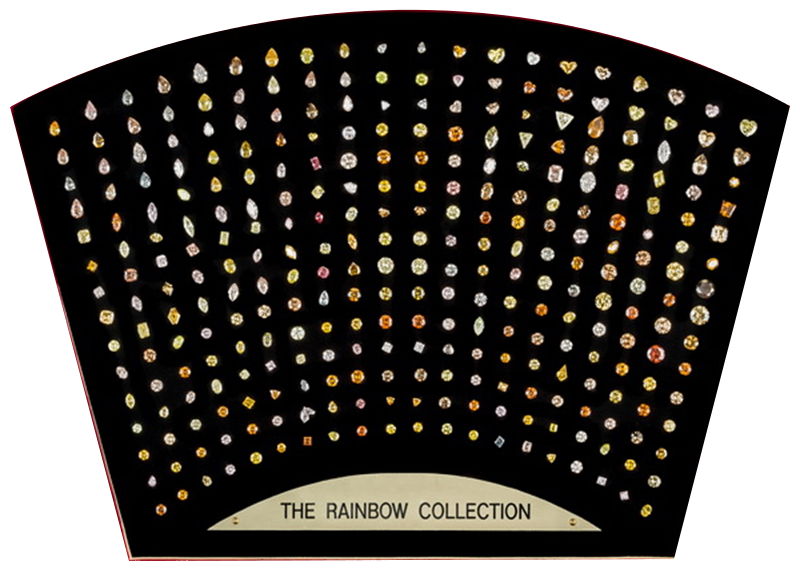
The legendary Rainbow Collection more than 300 fancy coloured diamonds amassed over four decades by the late Eddy Elzas sold for just above its low estimate at Christie’s Geneva on 11 November, achieving $2.19 million against a pre-sale estimate of $1.98 million to $2.98 million.
Comprising around 350 carats and spanning the full colour spectrum, the collection was once hailed as one of the world’s most extraordinary private assemblages of fancy coloured diamonds. Over the years, press reports placed its value between $60 million and $100 million.
Elzas, affectionately known as “The King of Coloured Diamonds,” famously declined a lavish offer from a Saudi prince who reportedly wished to purchase the collection as a wedding gift for Prince Charles and Lady Diana.
A true pioneer in the fancy colour diamond trade, Eddy Elzas was instrumental in elevating global recognition of coloured diamonds during his 40-year career. He passed away in November 2021 at the age of 79.
Christie’s described the Rainbow Collection as “an impressive collection of unmounted coloured and treated coloured diamonds,” featuring 300 stones across an array of hues and shapes. The lot included 291 GIA reports dated between 2008 and 2025, with diamonds ranging from 0.24 carats to 4.89 carats in yellow, orange, blue, pink, red, brown, and grey tones.
For the DCLA, this sale highlights not only the enduring fascination with fancy colour diamonds but also the evolving market perception of rarity and provenance in today’s auction landscape.