Showing posts with label Geneva Jewellery Auction. Show all posts

Friday, 30 October 2026

Inherited Jewellery and Family Valuables, Why Expert Assessment Matters

 Protecting the Value of an InheritanceWhen a loved one passes away, their estate may contain a lifetime of accumulated possessions, including diamond rings, gold chains, bracelets, watches, coins, precious stones and other valuable jewellery. Some pieces may have been purchased recently, while others may have been passed down through several generations.

Inherited jewellery, diamonds, gold and family heirlooms can represent significant financial and sentimental value. Before dividing an estate, selling precious items or passing them on to the next generation, it is essential to understand exactly what you own. With three generations of gold and diamond industry experience and the specialist capabilities of the Diamond Certification Laboratory of Australia (DCLA), families, estate lawyers and executors can access the expertise they need to make informed decisions with confidence.

Protecting the Value of an Inheritance

When a loved one passes away, their estate may contain a lifetime of accumulated possessions, including diamond rings, gold chains, bracelets, watches, coins, precious stones and other valuable jewellery. Some pieces may have been purchased recently, while others may have been passed down through several generations.

Many of these items carry stories, memories and emotional significance. However, their financial value is not always obvious.

An old engagement ring may contain a significant natural diamond. A collection of gold jewellery may be worth considerably more than its owner realised. A brooch, pendant or inherited watch may contain valuable materials or gemstones that have never been professionally examined.

Equally, a piece that looks impressive may have a lower resale value than expected, while an older valuation may no longer accurately reflect current market conditions.

The first step in protecting an inheritance is establishing what the estate actually contains and obtaining an appropriate professional assessment of its value.

The DCLA and The Gold Company provide specialist expertise to help clients understand their diamonds, jewellery and precious metals, with services suited to individual owners, families and professional estate representatives.

For a broader overview of the available services, visit The Gold Company’s Jewellery and Diamond Valuation and Estate Services.

Why Professional Assessment Matters

Diamonds, gemstones and precious metals require different forms of examination. A visual inspection alone cannot reliably establish every characteristic that may influence an item’s value.

A diamond’s quality depends on several factors, including its cut, colour, clarity and carat weight. Its origin, treatments, proportions and other characteristics may also be relevant.

The distinction between natural and laboratory-grown diamonds is particularly important. Both are genuine diamonds, but their origins and market characteristics differ. A stone’s appearance or a basic diamond tester cannot reliably establish whether it formed naturally or was grown in a laboratory.

The DCLA provides independent diamond grading and identification services using qualified gemmological expertise and specialised laboratory equipment.

Learn more about the DCLA Diamond Grading Report and Certification Service.

Professional assessment is equally important when dealing with gold and other precious metals. Jewellery may contain different purities of gold, mixed metals, gemstone settings, replacement components or materials that are not immediately apparent. Hallmarks can provide useful clues, but they should not always be treated as conclusive evidence of an item’s composition.

The Gold Company offers professional precious-metal testing, including X-ray fluorescence (XRF) technology, which can analyse the metal composition of suitable items without the need for destructive testing.

Read more about XRF Gold Testing and Understanding the Gold Content of Jewellery.

Combining practical industry experience with appropriate testing helps reduce uncertainty and gives owners a more reliable basis for deciding what to do next.

Three Generations of Gold and Diamond Expertise

The DCLA’s approach is supported by a heritage of gold and diamond industry knowledge spanning three generations, from mining and manufacturing through to diamond processing, jewellery, trading and professional laboratory assessment.

This experience provides a perspective that extends well beyond the appearance of a finished piece of jewellery. It includes an understanding of how diamonds are cut and polished, how precious metals are used in jewellery manufacturing, and how quality, condition and market demand can influence value.

That depth of practical knowledge matters when examining inherited items because every piece is different.

A diamond may require specialist laboratory identification. A gold bracelet may need its metal purity established. An antique ring may warrant consideration of its gemstones, craftsmanship, condition and design, rather than simply calculating the weight of its gold.

The DCLA combines this industry heritage with modern gemmological technology and independent assessment.

Its Sydney laboratory uses specialised equipment to examine diamond characteristics, including instruments that assist with diamond screening, microscopic examination, growth-pattern analysis and precise measurement.

Explore the DCLA Laboratory and its Testing Technology.

The principle is straightforward: experience helps identify the questions that need to be asked, while appropriate testing provides evidence to support the assessment.

For clients entrusted with valuable family assets, that combination offers an important level of reassurance.

Inherited Diamonds: Know Exactly What You Have

Diamonds are often among the most significant assets found in inherited jewellery. Yet many families have little documentation about the stones they own.

An engagement ring may have been purchased decades ago, with no original invoice or laboratory report. A diamond necklace may have been passed down through several generations. A loose stone may have been removed from an old setting without any accompanying paperwork.

In these circumstances, assumptions can be costly.

A diamond’s size alone does not determine its value. Two diamonds of similar carat weight can have very different values because of differences in colour, clarity, cut quality, proportions, treatments and market demand.

It is also important to establish whether the stone is natural or laboratory-grown where that distinction is relevant.

An independent grading report can document a diamond’s examined characteristics, providing a reference for future insurance, estate administration, sale or personal records.

The DCLA’s Diamond Certification FAQs explain the purpose of diamond reports, the grading process and the distinction between certification and valuation.

What if the diamond is still set in a ring?

Many inherited diamonds remain mounted in their original jewellery. Depending on the setting and the examination required, accurate grading may require the stone to be removed so that its weight, measurements, colour and clarity can be assessed more precisely.

This should not be undertaken casually. Removing a stone can affect the setting, particularly where the jewellery has a complex or delicate construction. The appropriate procedure should be discussed with the laboratory and a suitably qualified jeweller before any work is undertaken.

The DCLA explains these considerations in its Diamond Grading Report information.

The objective is to obtain reliable information while treating the jewellery with appropriate care.

Gold Jewellery: More Than Just Its Weight

Gold jewellery is another common component of an inheritance. Chains, rings, bracelets, earrings, brooches and watches may contain substantial quantities of precious metal, even when they are damaged, unfashionable or no longer worn.

However, the value of a gold item depends on more than its overall weight.

The purity of the gold, the amount of actual gold present, current market prices and the terms offered by a prospective buyer all influence its potential resale value. Gemstones, design, craftsmanship and collectability may also matter, meaning some pieces should be assessed as jewellery rather than simply as scrap metal.

For example, an inherited diamond ring may contain both valuable gold and a diamond that deserves independent examination. Selling the entire item solely on the basis of its gold content could overlook other sources of value.

Professional assessment helps determine whether an item is best considered for its precious-metal content, its gemstones, its craftsmanship or a combination of these factors.

The Gold Company provides specialist assistance with gold, silver, platinum, diamonds and jewellery. Its team can explain the available options before a client decides whether to retain, sell or otherwise deal with an item.

For further information, see The Gold Company’s Gold Buying and Testing Services.

Estate Lawyers, Executors and Trustees: Establishing Clarity

For estate lawyers, executors and trustees, inherited jewellery can introduce additional responsibilities.

Before an estate can be distributed, the relevant assets may need to be identified, assessed and documented. Where several beneficiaries are involved, a clear record of the items and their assessed values can help establish a more informed basis for distribution.

Without appropriate documentation, disagreements can arise. One beneficiary may believe a diamond ring is worth considerably more than another family member’s jewellery, while an executor may have no reliable evidence to support either assumption.

A structured assessment can help clarify the assets involved and identify items that require further specialist examination.

Depending on the circumstances, the work may include:

  • Identifying and recording individual jewellery items.
  • Examining diamonds and other gemstones.
  • Testing gold and other precious metals.
  • Obtaining independent diamond grading reports where appropriate.
  • Preparing written valuations for the intended purpose.
  • Documenting findings to assist estate administration and discussions with beneficiaries.
  • Explaining options for retaining, distributing or realising the assets.

The appropriate scope of work depends on the estate and the requirements of the legal representative. A grading report, an estate inventory and a formal valuation serve different purposes, so it is important to establish what documentation is required before the assessment begins.

The Gold Company offers a dedicated Jewellery and Diamond Estate Service for families, executors, trustees and solicitors requiring confidential assessments, documented reporting and assistance in understanding their options.

For significant diamonds, the DCLA’s independent laboratory services can provide additional gemmological information to support the process.

Together, these capabilities help make the handling of precious estate assets more transparent and better informed.

Dividing an Inheritance Fairly

Even within close families, dividing an inheritance can be difficult. Sentimental attachment often plays a significant role, and the perceived value of a treasured item may not correspond to its financial value.

One family member may wish to retain a parent’s engagement ring, while another prefers to receive gold jewellery or the proceeds from the sale of a valuable diamond.

Having the items professionally assessed before making these decisions can help everyone understand the assets involved.

A written valuation, where appropriate, provides a reference point for discussions about distribution. Independent diamond grading can also help distinguish between stones that might otherwise appear similar.

This does not remove the emotional considerations associated with inheritance, nor does it determine how a family should divide its possessions. Rather, it provides useful information to help family members and their advisers make their own decisions.

Where the estate contains substantial or particularly valuable diamonds, obtaining appropriate independent documentation before distribution can also make future insurance, sale or transfer arrangements easier to manage.

The objective is to protect the interests of the estate and its beneficiaries by ensuring that important decisions are made with a proper understanding of the items involved.

Understanding the Difference Between a Grading Report and a Valuation

One of the most important distinctions in professional jewellery assessment is the difference between identifying a diamond’s characteristics and determining its monetary value.

A diamond grading report describes the characteristics established during the examination. It is not, by itself, a statement of what the diamond is worth in dollars.

A valuation, on the other hand, estimates monetary value for a particular purpose and at a particular point in time.

For example, an insurance replacement valuation may estimate the cost of replacing an item with a comparable piece through an appropriate retail channel. A resale assessment considers a different question: what the item might realistically achieve in the relevant second-hand or trade market.

These figures can differ substantially.

The original retail price is not necessarily the amount an owner will receive when selling inherited jewellery, and an old insurance valuation should not automatically be treated as a current resale value.

Understanding the purpose of the assessment is therefore essential.

The DCLA explains this distinction in its article, Is a Diamond Valuation the Same as a Diamond Certificate?.

For broader information about professional valuations and their uses, visit the DCLA Appraisal and Valuation Information.

By establishing the correct purpose from the outset, clients can obtain documentation suited to their actual needs rather than relying on a report that answers a different question.

What If You Want to Sell Inherited Jewellery?

Not every family wants to retain all the jewellery they inherit. Some beneficiaries prefer to keep selected pieces and sell the remainder, while others may choose to sell an entire collection.

Before making that decision, it is worth understanding what the items contain and how they are likely to be assessed by prospective buyers.

An item containing a significant diamond may warrant independent grading. Gold jewellery may need to be tested for purity and weight. Pieces with unusual designs, important provenance or collectable characteristics may require a different approach from ordinary scrap gold.

The selling process should begin with knowledge, not assumptions.

The DCLA’s article, Selling a Diamond? Here’s the Paperwork You Need to Know About, explains why independent documentation can help establish a common reference point when discussing a diamond with prospective buyers.

For those considering the sale of inherited gold jewellery, The Gold Company’s guide, Selling Inherited Jewellery in Australia: What You Need to Know, provides further information about the practical considerations involved.

Having an informed assessment does not oblige an owner to sell. It simply provides a stronger basis for deciding whether to retain, insure, distribute or sell the items.

Protecting Your Own Valuables for the Future

The same principles apply even when no inheritance is involved.

Many people own jewellery accumulated over decades, including engagement rings, wedding bands, diamond earrings, necklaces, watches and family heirlooms. Important documents may be missing, descriptions may be incomplete, and valuations may no longer reflect current replacement costs.

Maintaining appropriate records can make a difference when dealing with insurance, estate planning or the eventual transfer of valuables to family members.

Depending on the item and its purpose, useful records may include photographs, descriptions, purchase documentation, independent diamond reports and current valuations.

Owners should also review whether their existing insurance documentation remains suitable and whether the values recorded reflect the purpose of the policy.

The DCLA provides information about Jewellery Valuations, including the importance of maintaining records for valuable possessions.

Taking these steps while the owner is still able to explain the history of each item can help future family members understand what they have inherited and what further assessment may be needed.

Experience, Technology and Personal Service

Precious jewellery deserves more than a cursory inspection or an assumption about its worth. It deserves to be examined by people who understand diamonds, gold and the jewellery industry.

The DCLA brings specialist gemmological expertise and advanced laboratory technology to the identification and grading of diamonds. The Gold Company provides practical assistance with jewellery, precious-metal testing, valuations and inherited assets.

The group’s three generations of gold and diamond industry knowledge provide valuable context for understanding the materials, craftsmanship and market considerations behind these possessions.

Whether you are an estate lawyer managing a deceased estate, an executor responsible for distributing family assets, a family dividing an inheritance or an individual seeking clarity about a treasured possession, the objective remains the same: to help you understand what you own and make informed decisions about what comes next.

There is no need to guess, and there is no obligation to sell simply because an item has been assessed.

Professional advice should give you the information and options you need, allowing you to decide what is right for you and your family.

DCLA and The Gold Company: Expertise When It Matters

From a single inherited engagement ring to a substantial estate containing diamonds, gold and other precious valuables, the right assessment can make an important difference.

With three generations of gold and diamond industry experience, decades of practical knowledge and the specialist capabilities of the DCLA laboratory, we are here to help families and professional advisers navigate the complexities of precious assets.

Before you divide it, sell it, insure it or pass it on, make sure you know what you have.

Visit DCLA for independent diamond grading, identification and laboratory services, or visit The Gold Company to learn more about jewellery and precious-metal assessments, valuations and estate services.

DCLA and The Gold Company — generations of knowledge, specialist expertise and professional guidance to help protect the value of your diamonds, jewellery and family valuables.

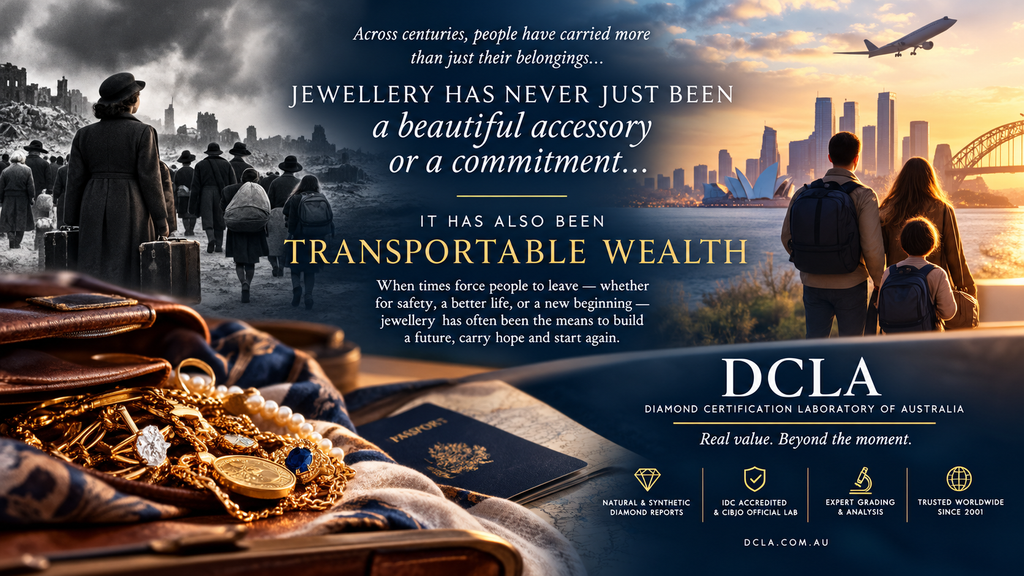
Tuesday, 29 September 2026

How Jewellery Became the Wealth That Travels

 From the Nazi decrees of the 1930s to the refugee boats of the South China Sea, rings, bangles and loose stones have repeatedly been the last asset standing between displaced families and destitution.

From the Nazi decrees of the 1930s to the refugee boats of the South China Sea, rings, bangles and loose stones have repeatedly been the last asset standing between displaced families and destitution.

We tend to think of jewellery in terms of beauty and meaning: an engagement ring marking a promise, a necklace handed from grandmother to granddaughter, earrings bought to celebrate a milestone. Those meanings are real. But history shows that jewellery has also served a harder, more practical purpose. When war, persecution or economic collapse forces people to leave their homes, jewellery is often the only form of wealth they can take with them.

A house cannot be packed into a suitcase. Land cannot be carried across a border. Bank accounts can be frozen, currencies can collapse overnight, and property can be seized by a hostile government. A diamond, a gold chain or a handful of rings, by contrast, can be worn, hidden in a hem, or sewn into a coat lining, and later sold in almost any city in the world. That simple fact has shaped the fate of millions.

Why jewellery works as portable wealth

Three qualities give jewellery its role as an emergency reserve. The first is density: few objects hold so much value in so little space, and by weight a quality diamond can be worth far more than gold. The second is universality: a gold bangle or a set of stones is recognised as valuable from Johannesburg to Toronto, so a refugee who cannot speak the local language or prove their qualifications can still find a buyer. The third is independence: jewellery sits outside the banking system, beyond the reach of frozen accounts and collapsing currencies.

These same qualities explain why regimes that want to strip people of their wealth so often target jewellery directly.

The Second World War: when jewellery became a target

The clearest and most chilling illustration comes from Nazi Germany. In the years leading up to the war, German authorities worked systematically to remove Jewish citizens from economic life and seize their assets. In April 1938 Jews were compelled to register all their assets and portable wealth, and after the Kristallnacht pogrom that November, a collective fine of one billion marks was imposed on the German-Jewish community. Families trying to emigrate also faced a punitive “flight tax” on their assets, designed to ensure that those who escaped left most of their wealth behind.

Jewellery, precisely because it was so easy to carry, was singled out. On February 21, 1939, the Decree concerning the Surrender of Precious Metals and Stones in Jewish Ownership required Jews to turn in gold, silver, diamonds, and other valuables to the state without compensation. Persecutees had two weeks from the regulation’s entry into force on 22 February 1939 to hand over gold, platinum or silver objects, precious stones and pearls to designated purchasing centres.

The bureaucracy was grimly precise. German Jews were permitted to keep their wedding rings, one silver watch, a four-piece silver cutlery setting per person, and a silver napkin ring each. Everything else was taken. The goods were sent to the Central Pawn Office in Berlin and melted down by the Degussa company, while the best pieces of jewellery were set aside and sold to Swiss dealers in exchange for industrial diamonds. The scale was enormous: twenty tons of silver were confiscated in Hamburg alone.

A US diplomat reporting from Berlin at the time noted something revealing. He observed that the decree made little practical difference to what emigrants could take with them, because emigrating Jews had for some time already been strictly forbidden to take possessions of this kind out of the country. In other words, the regime understood exactly what jewellery meant to a family trying to escape, and it moved to close that door.

This is why so many survivors’ accounts from the period describe diamonds stitched into clothing, rings hidden in shoe heels, or stones concealed in the bodies of toys. Carrying them was illegal and dangerous. Yet for families facing the loss of everything, it was sometimes the only way to arrive in a new country with the means to survive the first months.

Once the war began, the pattern spread. The same process was repeated across occupied Europe from 1939 onwards, and in the ghettos and camps the plunder reached its most horrific conclusion, with precious metals, jewelry, precious or semiprecious stones, pearls, dental gold, and scrap gold delivered to the SS for transfer to the Reichsbank.

Russia, 1917: fortunes sewn into seams

Two decades before the Nazi decrees, the Russian Revolution sent a wave of aristocratic and middle-class families into exile. Many who settled in Paris, Berlin, Constantinople and Shanghai survived their early years abroad by selling family jewellery piece by piece. The Romanov family themselves had gems sewn into their clothing during their captivity, a detail that has become one of the most poignant symbols of how instinctively people turn to jewellery when the future becomes uncertain.

Vietnam: an exodus paid for in gold

After the fall of Saigon in 1975, and especially during the mass departures of 1978 and 1979, gold became the currency of escape. A CIA assessment from the period recorded that passage generally cost between six and 10 taels of gold per adult, roughly $1,800 to $3,000 at the time, with half that charged for children. The same report noted bluntly that a refugee must pay in gold, that a great deal of gold was in private hands when Saigon fell, and that a covert banking system had evolved to move it to those who needed it.

Individual stories show what this meant in practice. In one documented case, a Hoa man paid for the passage of himself and his large family with a bag of gold bars obtained from the liquidation of his estate. The trade in escape attracted syndicates running derelict freighters. Aboard the Skyluck in early 1979, each refugee paid between 10 and 15 taels of gold, and only ten days earlier, Hong Kong authorities had confiscated close to 4,000 troy ounces of gold, then worth US$1 million, from the refugee ship Huey Fong. Many of these families had converted a lifetime of savings, including jewellery, into gold for a single dangerous voyage.

Uganda, 1972: one suitcase and £55

When Idi Amin expelled Uganda’s South Asian community in 1972, he gave them ninety days to leave and very little to leave with. The Ugandan Government allowed each family to leave with only £55 and one suitcase. The authorities also moved to stop wealth leaving in portable form. As one historian of the community later described it, there were army checkpoints on all major roads, and any gold, jewellery or money Asians were carrying was taken, while they were also unable to access their bank accounts.

Many families nonetheless tried to hide small pieces, often a woman’s wedding gold, knowing it might be all they would have on arrival. Around 27,000 Ugandan Asians resettled in Britain, and the community’s later success, particularly in cities such as Leicester, is often told as a story of rebuilding from almost nothing.

A woman’s wealth

In many cultures, the link between jewellery and financial security is deliberate. Across South Asia, the Middle East and parts of Africa, gold given to a bride has traditionally been regarded as her own property, a personal safety net that belongs to her rather than to her husband’s family. In India this is known as stridhan, literally “a woman’s wealth.”

These customs recognise something that formal financial systems have often failed to provide: an asset a woman controls herself, which she can draw on in a crisis, whether that crisis is widowhood, divorce or flight. In displacement after displacement, it has frequently been the gold worn on women’s wrists and around their necks that carried families through.

Diamonds and the trading communities

Diamonds hold a special place in this story. Their extraordinary value by weight has long made them a preferred store of wealth among communities who knew, from experience, that political fortunes can turn quickly. Traders in diamond centres such as Antwerp, Amsterdam, Tel Aviv and Johannesburg have long understood a parcel of stones as wealth that could travel with its owner. A lifetime of savings, converted into a few carats, could leave a country in a way that no property deed or bank balance ever could.

The same questions today

The issue has not faded into history. In January 2016, as large numbers of asylum seekers arrived in Europe, Denmark passed what became known as its “jewellery law.” The legislation allows the seizure of valuables worth more than 10,000 Danish kroner, about $1,453 at the time, from arriving asylum seekers to help cover their costs. After public backlash, items of special sentimental value, such as wedding rings and engagement rings, were exempted.

The law drew international criticism, with some commentators drawing comparisons with Nazi practices during the Second World War. In practice it has been used sparingly: the Danish Immigration Service concluded 194 cases under the law between January 2016 and June 2025. Critics have argued its purpose was largely symbolic, a signal to would-be arrivals. Whatever one’s view, the debate showed that the question of what displaced people may carry, and keep, remains very much alive.

Meanwhile, people fleeing conflict in Syria, Afghanistan, Sudan and elsewhere have continued to describe selling gold bangles, wedding sets and inherited pieces to pay smugglers, rent rooms in neighbouring countries, or cover the cost of reaching safety.

The hidden cost

Portable wealth is no guarantee of safety. People fleeing under pressure rarely get a fair price, and dealers at transit points know a desperate seller cannot wait. Jewellery can be stolen at checkpoints, confiscated by officials, or taken by the smugglers who were paid to help. For many families, selling a grandmother’s ring or a wedding necklace also carries an emotional cost that no sum of money can repay.

More than ornament

The next time you see an old family brooch or a worn gold bangle, it is worth considering the journeys such pieces may have made. Behind many heirlooms lies a story of departure: a family that left home with little more than what they could wear, and used it to begin again. Jewellery has always been beautiful. For countless families across the last century, it has also been the difference between losing everything and having something left to start over with.

When it comes time to sell jewellery or realise its value, choosing who you deal with matters. Look for an established, reputable and ethical company that provides transparent valuations, fair pricing and professional service.

In Sydney, the GoldCompany is an established family-owned business with experience in gold, jewellery and diamonds. Their approach is based on transparency and providing customers with a professional and private environment when selling or valuing their precious items.

When your jewellery represents not only sentimental value but potentially portable wealth, dealing with a company you can trust is an important part of the process.

Source: DCLA

Tuesday, 28 April 2026

Geneva Set to Dazzle as Rare Blue Diamonds Headline May Auctions


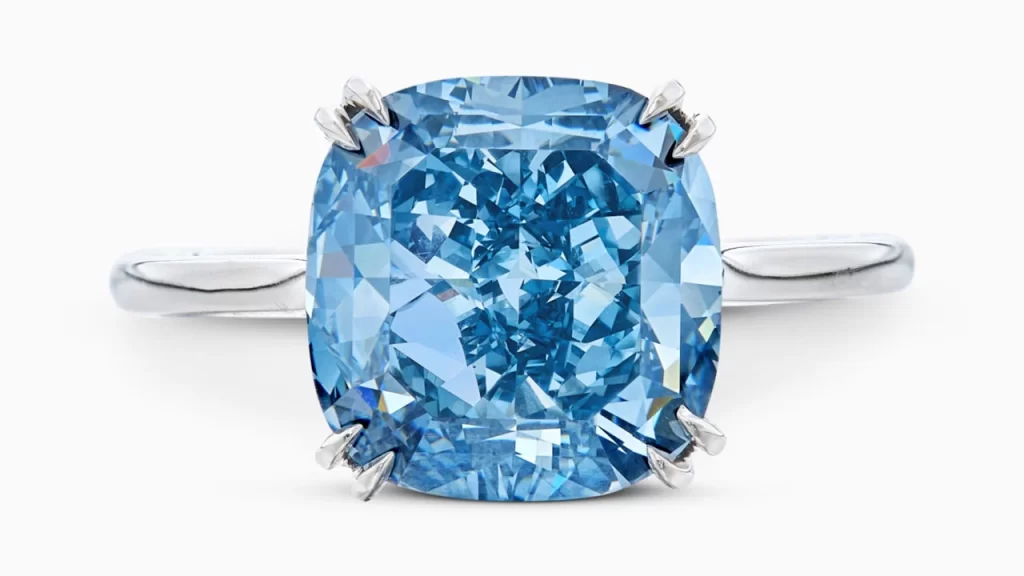
6.03-Carat Fancy Vivid Blue Diamond

The global diamond market will turn its attention to Sotheby’s and Christie’s this May, as two exceptional blue diamonds each representing the pinnacle of rarity and natural beauty prepare to go under the hammer in Geneva.


Sotheby’s to Offer 6.03-Carat Fancy Vivid Blue Diamond

A 6.03-carat cushion-shaped fancy vivid blue diamond is expected to achieve up to CHF 9.5 million (approximately USD $12.2 million) at Sotheby’s High Jewellery auction on May 12 in Geneva.

The diamond is graded internally flawless and classified as a Type IIb stone a category that includes some of the rarest and most chemically pure diamonds in the world. Type IIb diamonds are distinguished by the presence of boron, which imparts their highly sought-after blue colour and exceptional optical properties.

This important piece will headline a broader offering of high jewellery from renowned maisons including Van Cleef & Arpels, Bucherer, and Cartier, alongside a curated selection of coloured diamonds and rare gemstones.


“The Ocean Dream” Returns to Christie’s

The Ocean Dream Diamond


Also commanding global attention is the reappearance of the legendary “Ocean Dream,” a 5.50-carat fancy vivid blue-green diamond, set to headline Christie’s Magnificent Jewels auction on May 13 at the Four Seasons Hotel des Bergues in Geneva.

Certified by the Gemological Institute of America, the Ocean Dream holds the distinction of being the largest known fancy vivid blue-green diamond in the world. Its unique hue reminiscent of tropical seawater places it among the rarest colour expressions ever documented in natural diamonds.

Unlike the Type IIb blue offered at Sotheby’s, the Ocean Dream is classified as a Type Ia diamond. While Type Ia stones account for approximately 95% of all natural diamonds, they are rarely associated with such intense and unusual colour saturation, making this specimen an extraordinary anomaly.

The diamond, cut into a distinctive triangular shape, originated from an 11.70-carat rough discovered in Central Africa during the 1990s. It is expected to achieve between CHF 7 million and CHF 10 million (USD $8.9 million to $12.7 million).


A Stone of Museum-Level Importance

The Ocean Dream first gained international recognition during the 2003 “Splendor of Diamonds” exhibition at the Smithsonian National Museum of Natural History, where it was showcased among eight of the rarest diamonds ever discovered.

Max Fawcett, Global Head of Jewellery at Christie’s, has described the stone as “an exceptional jewel of profound rarity and allure,” underscoring its importance not only within the auction market but also in the broader gemological landscape.

This upcoming sale marks the diamond’s second appearance at auction. It was previously sold by Christie’s in 2014 for CHF 7.7 million, achieving approximately $1.4 million per carat at the lower end of its estimate at the time.


Market Significance

The simultaneous offering of two world-class blue diamonds each representing different diamond types and colour origins highlights continued strength at the top end of the coloured diamond market. For collectors and investors alike, these stones underscore the enduring appeal of rarity, provenance, and gemological significance.

As Geneva once again becomes the focal point of the high jewellery world, the results of these sales will provide further insight into pricing dynamics for the rarest natural diamonds, particularly as supply remains constrained and global demand for exceptional stones continues to grow.

Source: DCLA

Friday, 14 November 2025

Iconic Rainbow Collection Sells Just Above Low Estimate at Christie’s Geneva

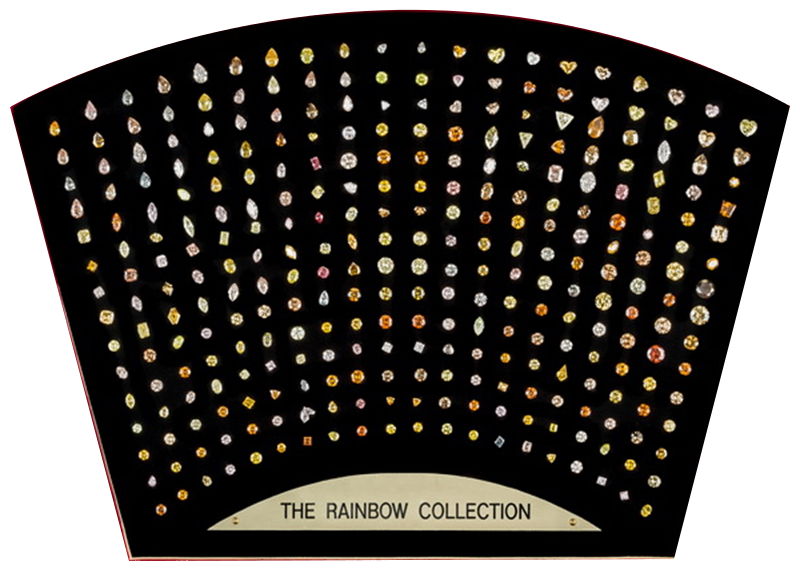
Rainbow Diamond Collection

The legendary Rainbow Collection more than 300 fancy coloured diamonds amassed over four decades by the late Eddy Elzas sold for just above its low estimate at Christie’s Geneva on 11 November, achieving $2.19 million against a pre-sale estimate of $1.98 million to $2.98 million.

Comprising around 350 carats and spanning the full colour spectrum, the collection was once hailed as one of the world’s most extraordinary private assemblages of fancy coloured diamonds. Over the years, press reports placed its value between $60 million and $100 million.

Elzas, affectionately known as “The King of Coloured Diamonds,” famously declined a lavish offer from a Saudi prince who reportedly wished to purchase the collection as a wedding gift for Prince Charles and Lady Diana.

A true pioneer in the fancy colour diamond trade, Eddy Elzas was instrumental in elevating global recognition of coloured diamonds during his 40-year career. He passed away in November 2021 at the age of 79.

Christie’s described the Rainbow Collection as “an impressive collection of unmounted coloured and treated coloured diamonds,” featuring 300 stones across an array of hues and shapes. The lot included 291 GIA reports dated between 2008 and 2025, with diamonds ranging from 0.24 carats to 4.89 carats in yellow, orange, blue, pink, red, brown, and grey tones.

For the DCLA, this sale highlights not only the enduring fascination with fancy colour diamonds but also the evolving market perception of rarity and provenance in today’s auction landscape.


Thursday, 13 November 2025

Vanderbilt Sapphire Brooch Sells for $3.6 Million at Phillips Geneva

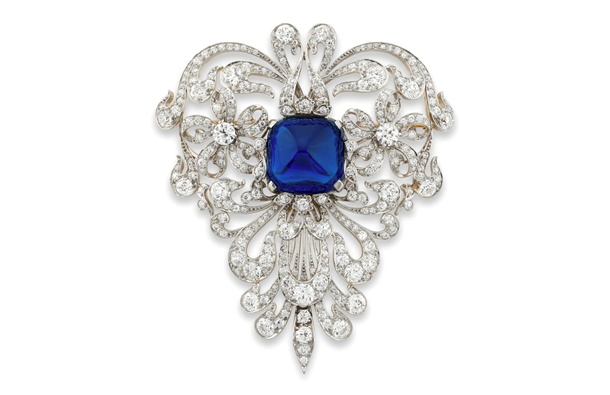
Vanderbilt Sapphire Brooch

The magnificent 42.68-carat Vanderbilt Sapphire, a gem steeped in the legacy of the Vanderbilt shipping and railroad dynasty, achieved an impressive $3.6 million at Phillips Geneva Jewels Auction: V more than double its high estimate of $1.5 million.

This sugarloaf-cut, unheated Kashmir sapphire, renowned for its velvety royal blue hue, was mounted in a 20th-century Tiffany & Co. brooch of elegant openwork scroll design, accented with white diamonds.

The sapphire was the undisputed highlight of the Geneva sale, held on 10 November, which totalled $17 million with 85% of the 114 lots sold.

While the highly anticipated 6.95-carat Golconda fancy vivid purplish pink diamond was withdrawn by mutual agreement between Phillips and the consignor, other notable results included a 10.08-carat light pink-brown diamond that achieved an auction record for its colour category, selling for $881,000 against an estimate of $650,000.

The event drew over 1,600 visitors to the preview and sale, with bidders from 44 countries, underscoring the strong global demand for exceptional natural gemstones and historic jewels.

Benoit Repellin, Phillips’ Worldwide Head of Jewellery, commented:

“The results of today’s sale attest to the enduring appeal of period jewels and the discerning eye of our international clients. To bring the jewels of the Vanderbilt family to the world’s stage was a moment of profound privilege.”

For collectors and connoisseurs, the Vanderbilt Sapphire’s result reaffirms the continued strength of the market for unheated Kashmir sapphires and heritage pieces with notable provenance a testament to their rarity, beauty, and timeless allure.

Inherited Jewellery and Family Valuables, Why Expert Assessment Matters

  Inherited jewellery, diamonds, gold and family heirlooms can represent significant financial and sentimental value. Before dividing an est...