Showing posts with label DCLA rough diamond services. Show all posts

Monday, 25 May 2026

Diamond Shapes and the Impact of Rough Recovery on Pricing


Round Brilliant Cut: The Lowest Yield but Highest Demand

Insights from the Diamond Certification Laboratory of Australia (DCLA)

In the diamond industry, shape is far more than an aesthetic choice. It plays a direct role in value, pricing structure, and how efficiently a rough diamond can be transformed into a polished stone. At the Diamond Certification Laboratory of Australia Diamond Certification Laboratory of Australia (DCLA), one of the key considerations in diamond assessment is how much of the original rough crystal is recovered during polishing.

This recovery rate, often referred to as yield, is one of the hidden drivers behind diamond pricing and helps explain why different shapes are priced differently in the wholesale and retail markets.


Understanding Rough Diamond Recovery

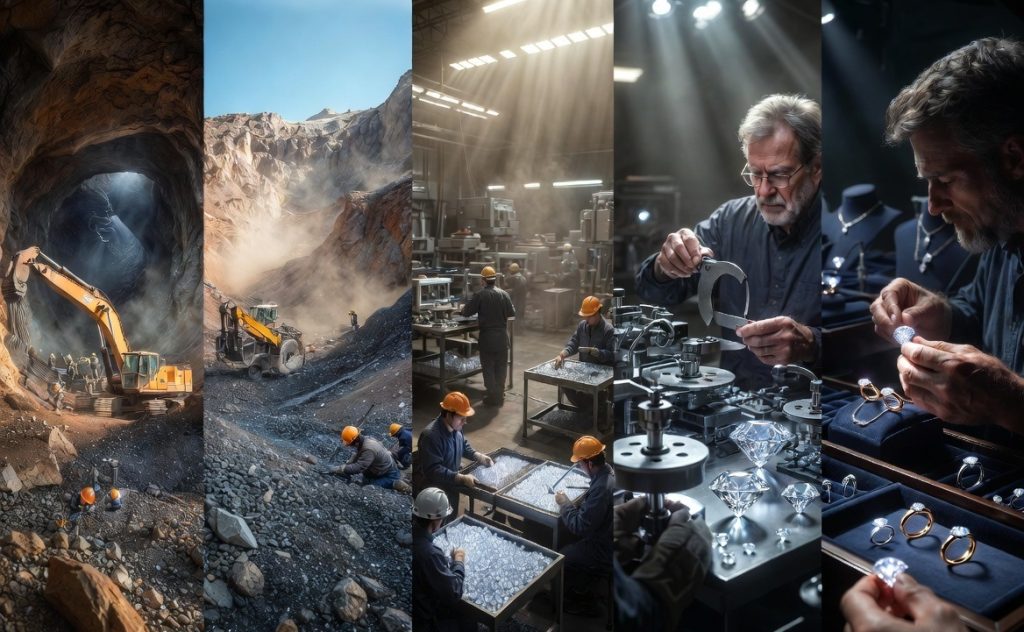
When a rough diamond is cut and polished, a significant portion of the original crystal is lost. This loss is unavoidable due to the need to remove inclusions, shape the stone, and maximise brilliance.

Different shapes produce different recovery percentages:

  • Higher yield shapes retain more of the original rough
  • Lower yield shapes sacrifice more material to achieve optical performance and symmetry

This difference directly impacts cost efficiency for cutters and ultimately influences market pricing.


Round Brilliant Cut: The Lowest Yield but Highest Demand

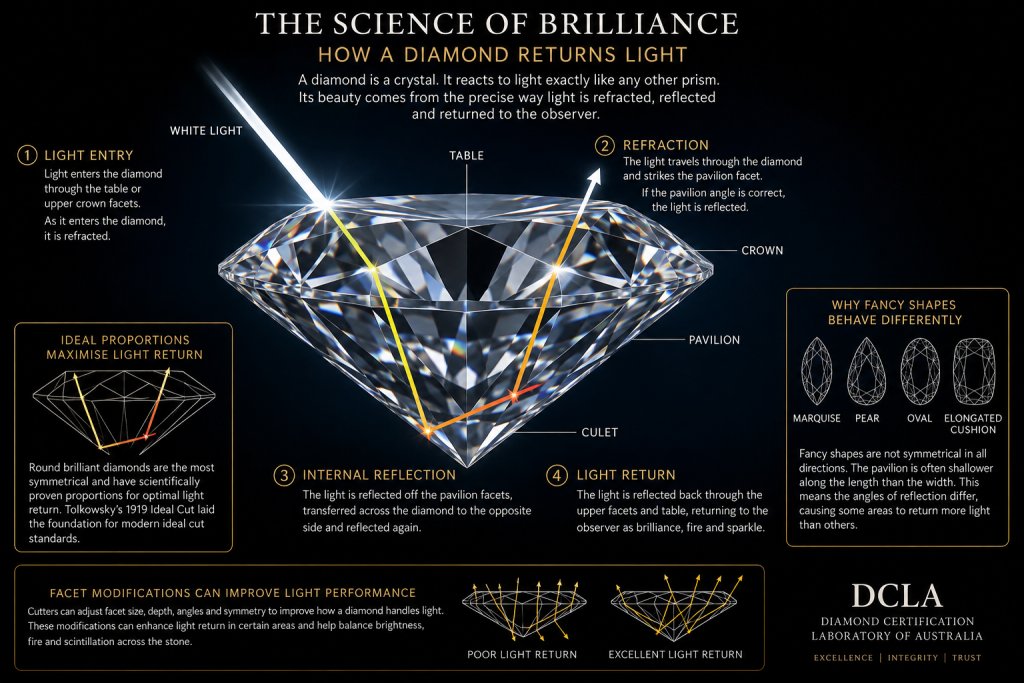
The round brilliant cut remains the most popular diamond shape globally due to its unmatched brilliance and light performance. However, it also has the lowest average recovery rate, typically ranging from 40 percent to 45 percent of the original rough diamond.

This means that more than half of the rough stone is lost during cutting. As a result, cutters must allocate more rough carat weight to produce a finished round brilliant diamond.

Because of this inefficiency, round diamonds carry a distinct pricing structure. They are often listed on a separate price sheet compared to fancy shapes, reflecting their lower yield and consistently strong market demand.

In practice, this means:

  • Higher cost per polished carat
  • Separate pricing benchmarks in global diamond trading
  • Strong liquidity due to consumer preference

Fancy Shapes and Higher Recovery Efficiency

Fancy shaped diamonds generally achieve higher recovery rates, often between 50 percent and 70 percent depending on the specific shape and quality of the rough stone.

Common fancy shapes include:

  • Oval
  • Cushion
  • Princess
  • Emerald
  • Pear
  • Marquise
  • Radiant
  • Asscher

These shapes allow cutters to follow the natural structure of the rough diamond more efficiently, reducing waste and improving yield.

Because more of the rough diamond is preserved, fancy shapes are generally more cost efficient to produce. This efficiency is reflected in their pricing, which is typically lower per carat compared to round brilliant diamonds of equivalent quality.


Why Shape Drives Price Differences

The difference in pricing between round and fancy shapes is not simply a matter of popularity. It is fundamentally linked to manufacturing economics.

Key factors include:

1. Rough Utilisation

Round diamonds require significantly more rough material per finished carat, increasing production cost.

2. Cutting Strategy

Fancy shapes are often designed to maximise retention of weight from irregular rough crystals, improving overall yield.

3. Market Demand

Round brilliant diamonds remain the most in demand, which further strengthens their premium pricing structure.

4. Inventory and Supply Chain

Because fewer polished carats are produced from the same amount of rough, round diamonds are less efficient to supply, reinforcing their separate pricing benchmarks.


Separate Pricing Structure for Round Brilliant Diamonds

Due to their unique combination of high demand and low recovery efficiency, round brilliant diamonds are typically priced using a dedicated pricing list in the wholesale market.

This separation reflects:

  • Higher manufacturing loss during cutting
  • Consistent global demand for round brilliance
  • Different valuation dynamics compared to fancy shapes

Fancy shapes, by contrast, are generally grouped within broader pricing frameworks that account for their higher yield and more flexible cutting outcomes.


Diamond shape is not only a design choice but a critical economic factor in the diamond industry. Recovery rates from rough stone directly influence pricing structures, with round brilliant diamonds standing apart due to their lower yield and strong consumer demand.

At DCLA, understanding these differences is essential for accurate valuation, certification, and market analysis. As the diamond trade continues to evolve, the relationship between rough recovery and polished pricing remains one of the most important principles shaping global diamond values.

Source: DCLA

Wednesday, 4 June 2025

DCLA to Continue Full Grading of All Diamonds, Including Laboratory-Grown

DCLA to Continue Full Grading of All Diamonds

The Diamond Certification Laboratory of Australia (DCLA) reaffirms its commitment to providing precise and comprehensive grading for all diamonds, including laboratory-grown stones. This approach ensures consistency, transparency, and informed decision-making across the industry.

While the GIA has announced it will introduce a simplified classification system for lab-grown diamonds — using the categories “Premium” and “Standard” — the DCLA will maintain its tradition of detailed grading across the full range of quality characteristics. This includes reporting actual colour, clarity, cut, and carat weight for every diamond submitted, regardless of its origin.

The GIA’s new system, expected later this year, will group lab-grown diamonds based on overall appearance and finish, with certificates including carat and cut details but without specific colour and clarity grades.

DCLA recognises that both natural and laboratory-grown diamonds hold unique value and significance. By continuing to offer full grading reports, the DCLA supports both the trade and consumers in understanding and appreciating the distinct qualities of each stone.

At DCLA, we believe that consumers and the trade deserve full and detailed grading information, regardless of the diamond’s origin. Misrepresentation and confusion are more likely to arise when simplified or vague grading systems are used — especially as laboratory-grown diamonds become more prevalent in the market.

As Australia’s official CIBJO laboratory, DCLA remains dedicated to upholding the highest international standards in diamond certification and grading.

Wednesday, 25 September 2024

India’s Polished Exports Fall Again in August

India’s Polished Exports Fall Again in August

Diamond polisher in a factory

India’s exports of polished diamonds fell by 23.8 per cent year-on-year in August, according to the latest figures from the GJEPC (Gem and Jewellery Export Promotion Council). 

Total foreign sales were $1.04bn, compared to $1.36bn last August. Exports in July were $908m, down 22.7 per cent.

Polished diamond exports have fallen every month this year, down 20 per cent in January, 28 per cent in February, 27 per cent in March, 17 per cent in April, 15 per cent in May and 26 per cent in June. All figures are for US dollars.

Gross exports of all gems and jewelry fell by 18.8 per cent during August – a slower rate of decline than diamonds – to $2.01bn.

Rough imports for the April to August period were down 22.6 per cent to $4.98bn.

Source: DCLA

Wednesday, 1 August 2018

Blue diamonds may be blue because of where they are formed


Blue Diamonds are the world’s most expensive diamonds,  some stones worth tens of millions.

Why they are blue has long been know, But until now nobody has known how rare blue diamonds are made or where they come from.

Now scientists have discovered that they are formed 400 miles below the surface of the Earth, around four times the depth of cape series or white diamonds.

This is where the element boron can combine with carbon in such extreme pressure and heat that it crystallizes into the world’s most precious stone.

And because boron is mostly found on the Earth’s surface, scientists believe that it must have traveled down into the mantle when tectonic plates slipped beneath each other.

 Eventually volcanic action brought the diamonds up closer to the surface.

Blue Diamond is categorized as type IIb crystal and due to their extreme valuable, it is very rare to find one for scientific research purposes. An rare to find one that contains inclusions.

Source: DCLA

Blue diamonds may be blue because of where they are formed


Blue Diamonds are the world’s most expensive diamonds,  some stones worth tens of millions.

Why they are blue has long been know, But until now nobody has known how rare blue diamonds are made or where they come from.

Now scientists have discovered that they are formed 400 miles below the surface of the Earth, around four times the depth of cape series or white diamonds.

This is where the element boron can combine with carbon in such extreme pressure and heat that it crystallizes into the world’s most precious stone.

And because boron is mostly found on the Earth’s surface, scientists believe that it must have traveled down into the mantle when tectonic plates slipped beneath each other.

 Eventually volcanic action brought the diamonds up closer to the surface.

Blue Diamond is categorized as type IIb crystal and due to their extreme valuable, it is very rare to find one for scientific research purposes. An rare to find one that contains inclusions.

Source: DCLA

Monday, 30 July 2018

Gem Diamonds Recovers 101ct. Stone


Gem Diamonds has unearthed a 100.50-carat diamond from its Letšeng mine in Lesotho, it said Friday.

The white, type IIa stone is the 11th over 100 carats the miner has recovered from the asset so far this year.

Gem Diamonds owns 70% of the Letšeng mine, with the state holding the remaining shares. The company also owns the Ghaghoo mine in Botswana, which it plans to sell.

Source: DCLA 

Gem Diamonds Recovers 101ct. Stone


Gem Diamonds has unearthed a 100.50-carat diamond from its Letšeng mine in Lesotho, it said Friday.

The white, type IIa stone is the 11th over 100 carats the miner has recovered from the asset so far this year.

Gem Diamonds owns 70% of the Letšeng mine, with the state holding the remaining shares. The company also owns the Ghaghoo mine in Botswana, which it plans to sell.

Source: DCLA 

Monday, 12 February 2018

Lucapa recovers more diamonds at Lesotho mine


Australia’s Lucapa Diamond has announced workers at its 70% owned Mothae mine in Lesotho have recovered diamonds sourced from residual material and kimberlite stockpiles.

The company said the rough diamonds were recovered through the existing bulk sampling plant and infrastructure at Mothae, which has been refurbished ahead of schedule as part of a previously announced bulk sampling program.
According to the statement the largest rough diamond recovered in the test run is 6.6 carats.

Source: DCLA

Lucapa recovers more diamonds at Lesotho mine


Australia’s Lucapa Diamond has announced workers at its 70% owned Mothae mine in Lesotho have recovered diamonds sourced from residual material and kimberlite stockpiles.

The company said the rough diamonds were recovered through the existing bulk sampling plant and infrastructure at Mothae, which has been refurbished ahead of schedule as part of a previously announced bulk sampling program.
According to the statement the largest rough diamond recovered in the test run is 6.6 carats.

Source: DCLA

Monday, 15 January 2018

Historic 910 carat, The Fifth Largest Diamond Recovered


Gem Diamonds has recovered a 910 carat rough diamond at its Letšeng mine in Lesotho, the fifth largest rough ever found.

The D colour  type IIa diamond is the largest to be unearthed at LetÅ¡eng, outranking the 603 carat Lesotho Promise recovered in 2006.

That stone was sold for $12.4 million, to Graff Diamonds, which owns a 15% stake in Gem Diamonds.

Last year, Graff bought the 1,109 carat Lesedi la Rona, the second largest rough diamond in history, for $53 million, or $47,790 per carat.

The discovery follows a recent revival of exceptionally large stones recovered at LetÅ¡eng, which is known for its high value production.

Source: DCLA 

Historic 910 carat, The Fifth Largest Diamond Recovered


Gem Diamonds has recovered a 910 carat rough diamond at its Letšeng mine in Lesotho, the fifth largest rough ever found.

The D colour  type IIa diamond is the largest to be unearthed at LetÅ¡eng, outranking the 603 carat Lesotho Promise recovered in 2006.

That stone was sold for $12.4 million, to Graff Diamonds, which owns a 15% stake in Gem Diamonds.

Last year, Graff bought the 1,109 carat Lesedi la Rona, the second largest rough diamond in history, for $53 million, or $47,790 per carat.

The discovery follows a recent revival of exceptionally large stones recovered at LetÅ¡eng, which is known for its high value production.

Source: DCLA 

Monday, 18 December 2017

Jewelry Buyers Still Desire In-Store Experience


Consumers still prefer speaking with jewelers before making a purchase, despite the recent rise in online purchases, a survey has found.
Some 64% of people who bought jewelry visited a store to consult with an expert while deciding what to buy, according to a study released last week by Jewelers of America (JA). That’s 26% more than for other luxury items, the trade body’s online survey of 2,019 consumers showed.
Consumers who talk to a jeweler during the research process are also more likely to buy from a local store rather than online, the organization added.
“For consumers, seeing is believing, and they still rely on the expertise and knowledge of their jeweler,” said David Bonaparte, CEO of JA. “The jewelry shopping experience is different from other luxury purchases, and even in the rise of e-commerce, customers increasingly prioritize the in-store shopping experience.”
Even so, the brick-and-mortar trade is fearful of the impact of online sellers. In a separate JA survey of 257 of its members, spanning retailers and suppliers, 39% of jewelry retailers considered e-commerce to be their biggest competition.
However, only 34% of retailers surveyed actually have an online sales platform. At the same time, jewelers are working on improving their in-store experience by ensuring they have well-trained sales staff and high-quality customer service, the trade association added.
Jewelry self-purchasing is more popular for precious-metal products, JA found, with 56% of consumers considering gold jewelry to be a good choice as something to buy for oneself. Some 40% put sterling-silver jewelry in this category, while pieces containing diamonds and gemstones were more likely to be a candidate for gifting. Overall, 50% of consumers thought fine jewelry had sentimental value and helped to mark special occasions, JA said.

Source: diamonds.net

Jewelry Buyers Still Desire In-Store Experience


Consumers still prefer speaking with jewelers before making a purchase, despite the recent rise in online purchases, a survey has found.
Some 64% of people who bought jewelry visited a store to consult with an expert while deciding what to buy, according to a study released last week by Jewelers of America (JA). That’s 26% more than for other luxury items, the trade body’s online survey of 2,019 consumers showed.
Consumers who talk to a jeweler during the research process are also more likely to buy from a local store rather than online, the organization added.
“For consumers, seeing is believing, and they still rely on the expertise and knowledge of their jeweler,” said David Bonaparte, CEO of JA. “The jewelry shopping experience is different from other luxury purchases, and even in the rise of e-commerce, customers increasingly prioritize the in-store shopping experience.”
Even so, the brick-and-mortar trade is fearful of the impact of online sellers. In a separate JA survey of 257 of its members, spanning retailers and suppliers, 39% of jewelry retailers considered e-commerce to be their biggest competition.
However, only 34% of retailers surveyed actually have an online sales platform. At the same time, jewelers are working on improving their in-store experience by ensuring they have well-trained sales staff and high-quality customer service, the trade association added.
Jewelry self-purchasing is more popular for precious-metal products, JA found, with 56% of consumers considering gold jewelry to be a good choice as something to buy for oneself. Some 40% put sterling-silver jewelry in this category, while pieces containing diamonds and gemstones were more likely to be a candidate for gifting. Overall, 50% of consumers thought fine jewelry had sentimental value and helped to mark special occasions, JA said.

Source: diamonds.net

Sunday, 17 December 2017

Ideal Diamonds

Prefect in every way !


DCLA diamonds are professionally selected to be a cut above the rest.

Ideal Cut Triple Excellent 

Ideal Diamonds

Prefect in every way !


DCLA diamonds are professionally selected to be a cut above the rest.

Ideal Cut Triple Excellent 

Thursday, 23 November 2017

Letšeng Finds Seventh Big Diamond of the Year


Diamond Miner Gem Diamonds has found a 202 carat rough diamond at its  LetÅ¡eng mine in Lesotho, Sothern Africa. The rough diamond is the latest of seven recovered over 100 carats this year. 

The D colour type IIa diamond was recovered when they mine switched to the higher grade K6 section of the main pipe earlier this year.

The LetÅ¡eng mine is one of the highest diamond deposits by value in the world with the an average price of $2,397 per carat for the July tender.

Source: DCLA 

Letšeng Finds Seventh Big Diamond of the Year


Diamond Miner Gem Diamonds has found a 202 carat rough diamond at its  LetÅ¡eng mine in Lesotho, Sothern Africa. The rough diamond is the latest of seven recovered over 100 carats this year. 

The D colour type IIa diamond was recovered when they mine switched to the higher grade K6 section of the main pipe earlier this year.

The LetÅ¡eng mine is one of the highest diamond deposits by value in the world with the an average price of $2,397 per carat for the July tender.

Source: DCLA 

Wednesday, 22 November 2017

Debmarine Splashes $142M on Diamond Ship


De Beers is planning to add the world’s largest custom built diamond mining vessel to its fleet at a cost of $142 million.
The ship will be the sixth belonging to Debmarine Namibia, a 50/50 joint venture between the miner and the Republic of Namibia, De Beers said Tuesday. Expected to begin operations in 2021, it will enhance the company’s ability to recover diamonds off the southern African country’s Atlantic coast, the rough producer added.
“There is a great amount of potential in Namibia’s marine diamond deposits, and this new vessel will support our strategy to continue to grow our offshore operations,” said De Beers CEO Bruce Cleaver.
Earlier this year, De Beers launched the MV SS Nujoma, the world’s largest diamond sampling and exploration vessel. Acquiring the new ship will help the company capitalize on that vessel’s work, and support the long-term future of Namibia’s diamond sector, Cleaver added.
Kleven Verft, a Norwegian ship-building company that constructed the Nujoma, will also build the new vessel, and has signed a memorandum of understanding with De Beers.

Source: DCLA 

Debmarine Splashes $142M on Diamond Ship


De Beers is planning to add the world’s largest custom built diamond mining vessel to its fleet at a cost of $142 million.
The ship will be the sixth belonging to Debmarine Namibia, a 50/50 joint venture between the miner and the Republic of Namibia, De Beers said Tuesday. Expected to begin operations in 2021, it will enhance the company’s ability to recover diamonds off the southern African country’s Atlantic coast, the rough producer added.
“There is a great amount of potential in Namibia’s marine diamond deposits, and this new vessel will support our strategy to continue to grow our offshore operations,” said De Beers CEO Bruce Cleaver.
Earlier this year, De Beers launched the MV SS Nujoma, the world’s largest diamond sampling and exploration vessel. Acquiring the new ship will help the company capitalize on that vessel’s work, and support the long-term future of Namibia’s diamond sector, Cleaver added.
Kleven Verft, a Norwegian ship-building company that constructed the Nujoma, will also build the new vessel, and has signed a memorandum of understanding with De Beers.

Source: DCLA 

US Consumers Continue to Prefer Natural Diamonds, De Beers Study Reveals

  New research from De Beers highlights continued strong consumer demand for natural diamonds in the United States, with natural diamond jew...