Thursday, 20 August 2026

Choosing the Right Precious Metal for Jewellery: Durability, Purity and Performance

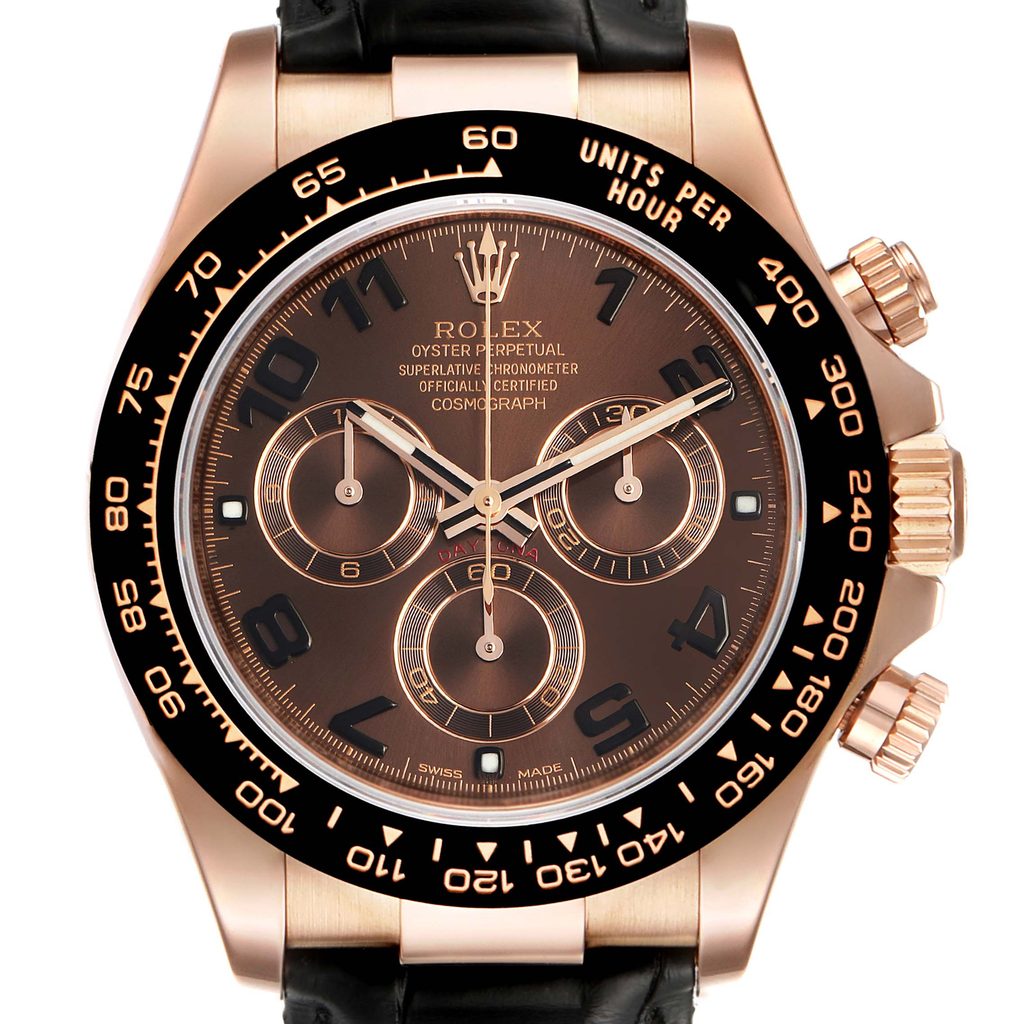
 The choice of metal affects far more than colour and price. It influences durability, hardness, scratch resistance, maintenance, weight, wear characteristics, setting security and how the piece will look after years of use.

When buying or commissioning fine jewellery, much of the attention naturally goes to the diamond or gemstone, the design and the craftsmanship. Yet one of the most important decisions is often overlooked: which precious metal should the jewellery be made from?

The choice of metal affects far more than colour and price. It influences durability, hardness, scratch resistance, maintenance, weight, wear characteristics, setting security and how the piece will look after years of use.

There is no single precious metal that is best for every piece of jewellery. The correct choice depends on what the jewellery is, how it will be worn and what demands will be placed upon it.

At the Diamond Certification Laboratory of Australia (DCLA), we believe consumers should understand these differences before making an important jewellery purchase.


Gold Is an Alloy, Not Just Gold

Pure gold is exceptionally soft. For this reason, virtually all gold jewellery is alloyed with other metals to increase its hardness, strength and workability.

Gold purity is measured in carats:

GoldPure Gold ContentGeneral Characteristics
9ct37.5%Harder, economical, less rich in colour
14ct58.3–58.5%Excellent balance of durability and gold content
18ct75.0%Rich colour, high gold content, softer
22ct91.7%Very rich colour, considerably softer
24ct99.9%+Extremely pure but generally too soft for most jewellery

The World Gold Council notes that alloying gold with other metals increases its durability and can also alter its colour.

This is an important point: a higher carat does not automatically mean a stronger piece of jewellery.

In fact, increasing the gold content generally makes the alloy softer, although the exact hardness depends on the particular alloy and manufacturing process.


9ct Gold — Practical and Affordable

9ct gold contains 37.5% pure gold, with the balance made up of alloy metals.

Its relatively high alloy content can make it harder than higher-carat gold alloys, and it is widely used for jewellery where price and everyday wear are important considerations.

Advantages

  • Lower material cost
  • Good resistance to everyday scratching
  • Available in yellow, white and rose gold
  • Suitable for many bracelets, earrings, pendants and everyday jewellery
  • Practical for consumers looking for a lower entry price

Disadvantages

  • Contains considerably less gold than 18ct or 22ct
  • Colour can be less rich and saturated
  • Alloy composition can be important for people with metal sensitivities
  • Some 9ct alloys can be relatively brittle rather than simply being “stronger”

This last point is important. Hardness and toughness are not the same thing.

A very hard alloy can resist scratching but may be less forgiving when subjected to bending or impact. Jewellery designers therefore need to consider the specific alloy, not simply the carat stamp.


14ct Gold — The Practical Sweet Spot

14ct gold contains approximately 58.3–58.5% pure gold.

For jewellery that is going to receive significant daily wear, 14ct can provide an excellent balance between gold content, durability, appearance and cost.

It is generally harder than 18ct gold, making it particularly attractive for jewellery that experiences continual movement, friction and contact with other objects.

Advantages

  • Good hardness and wear resistance
  • More gold content than 9ct
  • Generally more durable than 18ct
  • Excellent for everyday jewellery
  • Particularly useful for bracelets, rings and other pieces exposed to continual wear
  • Lower cost than 18ct for the same volume of metal

Disadvantages

  • Less rich gold colour than 18ct yellow gold
  • Contains more alloy metals
  • Exact performance depends on the alloy formulation and manufacturing technique

For many jewellery applications, 14ct represents an excellent engineering compromise.


18ct Gold — Luxury, Richness and High Gold Content

18ct gold contains 75% pure gold and 25% alloy metals.

It is a traditional choice for fine jewellery because of its rich colour, high gold content and luxurious appearance.

18ct yellow gold has a noticeably deeper and warmer colour than lower-carat gold, while 18ct rose gold has a softer, more refined pink tone depending on its alloy composition.

Advantages

  • 75% pure gold
  • Rich, luxurious colour
  • High intrinsic precious-metal content
  • Excellent for fine and high-value jewellery
  • Traditionally associated with premium jewellery
  • Often preferred for heirloom pieces and important jewellery

Disadvantages

  • Softer than many 14ct alloys
  • More susceptible to scratches and dents
  • Can show signs of everyday wear more quickly
  • May require more care where continual friction occurs

This does not mean that 18ct gold is unsuitable for everyday jewellery. Far from it.

Rather, the designer needs to understand the application.

An 18ct gold engagement ring can be an excellent choice. But an 18ct gold bracelet consisting of hundreds of small articulated components may experience very different stresses from a simple ring.


22ct Gold — Beautiful but Soft

22ct gold contains approximately 91.7% pure gold.

It has a distinctive, highly saturated yellow colour that is particularly prized in some jewellery markets.

The problem is that the higher gold content also means there is less alloy available to increase hardness and strength.

Advantages

  • Very high gold content
  • Exceptional rich yellow colour
  • High intrinsic precious-metal value
  • Highly desirable for traditional and cultural jewellery

Disadvantages

  • Relatively soft
  • More easily scratched and deformed
  • Less suitable for delicate settings exposed to constant mechanical stress
  • Requires greater consideration when used for everyday jewellery

22ct can be beautiful, but it is not necessarily the best choice simply because it contains more gold.

More gold does not automatically mean better jewellery.


Platinum — A Completely Different Metal

Jewellery platinum is commonly used at around 95% purity, often referred to as Pt950.


Platinum should not be thought of simply as “higher-carat white gold”.

It is a completely different precious metal.

Jewellery platinum is commonly used at around 95% purity, often referred to as Pt950. It is naturally white and does not require rhodium plating to create its characteristic appearance.

One of platinum’s major advantages is its density and wear characteristics. Platinum tends to deform and develop a patina rather than behaving like a softer gold alloy that is progressively worn away.

Advantages

  • Naturally white
  • No rhodium plating required
  • Very high purity
  • Dense and substantial
  • Excellent for important gemstone settings
  • Does not require the same replating maintenance as white gold
  • Often a good choice for people concerned about certain alloy sensitivities

Disadvantages

  • More expensive
  • Heavier than gold
  • More difficult and demanding to manufacture and repair
  • Develops a visible patina with wear
  • Can scratch, although the metal behaves differently from gold

The development of a platinum patina is not necessarily a defect. Many owners actually appreciate it because it records the history of the jewellery.


18ct White Gold vs Platinum

This is one of the most common decisions when purchasing diamond jewellery.

At first glance, the two metals can look almost identical.

They are not.

18ct White Gold

18ct white gold contains 75% gold combined with whitening alloy metals. It is normally finished with rhodium plating to produce a bright, highly reflective white surface. The World Gold Council explains that rhodium plating is commonly used on white gold to create a brighter and harder surface.

The disadvantage is that rhodium is a surface coating.

Over time, friction can wear the rhodium away, particularly on rings and areas that receive constant contact. The underlying white-gold alloy can then become visible, and the jewellery may require professional cleaning and re-rhodium plating.

Platinum

Platinum is naturally white.

There is no rhodium layer that needs to be periodically replaced.

It will still scratch and develop a patina, but the colour of the metal itself remains white.

For consumers wanting the brightest possible white finish, 18ct white gold can be extremely attractive. For those wanting a naturally white metal without rhodium maintenance, platinum has a significant advantage.


The Tennis Bracelet: A Perfect Example of Why Metal Selection Matters

The tennis bracelet is an excellent example of why the metal should be selected according to the engineering requirements of the jewellery, rather than simply its perceived prestige.

A tennis bracelet is not a static piece of jewellery.

It contains numerous articulated links, settings, joints and moving components. Every time the bracelet moves around the wrist, components can rub against one another.

The bracelet can also encounter:

  • clothing
  • desks and tables
  • watches
  • handbags
  • other jewellery
  • skin
  • accidental impacts
  • repeated flexing

Over many years, these small movements can add up to significant wear.

Why 14ct Can Be an Excellent Choice

A well-designed 14ct gold tennis bracelet can offer a very good combination of hardness, strength and durability.

Compared with many 18ct gold alloys, 14ct is harder and can be better suited to jewellery that experiences continuous mechanical wear.

This is why a 14ct tennis bracelet can, in practical terms, be a better engineering choice than an 18ct version when maximum resistance to everyday wear is the priority.

However, it would be incorrect to say that every 14ct bracelet will automatically outlast every 18ct bracelet.

The alloy formulation, construction, thickness, setting design, quality of manufacture and maintenance are all critical.

Design and engineering matter just as much as carat.


Hardness Is Not the Same as Durability

This distinction is particularly important for consumers.

Hardness generally refers to a material’s resistance to scratching or indentation.

Durability is broader.

A piece of jewellery must also withstand:

  • bending
  • impact
  • repeated movement
  • fatigue
  • deformation
  • wear at joints
  • wear around stone settings

A harder material is not automatically tougher in every application.

For this reason, professional jewellery manufacturers select alloys according to the intended use of the finished piece.


The Importance of Jewellery Design

The metal is only one part of the equation.

A poorly engineered piece made from platinum can perform worse than a well-engineered piece made from 14ct gold.

For example, a tennis bracelet should be assessed for:

Link thickness
Thin links can wear more quickly regardless of metal.

Setting construction
The way diamonds are secured is critical.

Hinge and joint design
Movement places continual stress on these areas.

Clasp security
A strong bracelet is of little value if the clasp is poorly designed.

Metal thickness around stones
Very fine metal can wear through over time.

Manufacturing quality
Precision and finishing can make a substantial difference to longevity.

This is why consumers should not judge jewellery solely by the carat stamp.


Other Precious Metals

Silver

Sterling silver is approximately 92.5% silver and is widely used because it is attractive and relatively affordable.

Its disadvantages are that it is softer than many gold alloys and can tarnish through interaction with the environment.

Silver is excellent for many earrings, pendants, fashion pieces and larger designs, but it generally requires more maintenance than gold or platinum.

Palladium

Palladium is a member of the platinum group of metals and has been used in jewellery, including as an alloy in white gold.

It is naturally white and relatively lightweight compared with platinum.

Its use in jewellery varies by market and application, but it remains an interesting alternative for designers looking for a naturally white precious metal.


Maintenance: What Owners Should Expect

Different metals require different maintenance.

9ct and 14ct Yellow or Rose Gold

Generally straightforward to maintain. Regular cleaning and professional inspection are recommended, particularly for jewellery containing gemstones.

18ct Yellow or Rose Gold

Also relatively straightforward to maintain, although the softer alloy can show scratches and surface marks more readily.

White Gold

Requires additional attention because the rhodium plating can wear away. Periodic professional inspection, cleaning and replating may be required depending on how frequently the piece is worn.

Platinum

Does not require rhodium plating. It will develop a patina and can be polished when the owner wants to restore a brighter finish.


There Is No “Best” Precious Metal

The most important lesson for jewellery buyers is that the highest gold content is not necessarily the best choice for every piece of jewellery.

A 22ct gold bracelet may contain far more gold than a 14ct bracelet, but the 14ct piece may be better suited to constant mechanical wear.

An 18ct gold engagement ring may be exactly the right choice for someone who values its rich colour and high gold content.

A platinum ring may be preferred by someone who wants a naturally white metal and a substantial, high-purity material.

A 14ct tennis bracelet may be the more practical choice for someone who wants a bracelet that will tolerate considerable everyday wear.

The correct question is therefore not:

“Which metal is the best?”

It is:

“Which metal is best for this piece of jewellery and the way it will be worn?”


DCLA’s View: Design the Jewellery Around Its Purpose

At DCLA, we believe that understanding precious metals is an essential part of understanding jewellery.

The choice between 9ct, 14ct, 18ct, 22ct gold and platinum should be based on a combination of:

  • Purity
  • Colour
  • Hardness
  • Toughness
  • Wear resistance
  • Design
  • Stone security
  • Frequency of wear
  • Maintenance requirements
  • Budget
  • Personal preference

A beautiful piece of jewellery should not only look exceptional when it leaves the jeweller’s workshop. It should be appropriate for the way it will actually be worn.

The best jewellery is where the gemstone, metal, design and craftsmanship are considered as one complete system.

Because when it comes to fine jewellery, more precious does not always mean more durable and the right metal is the one that performs best for its purpose.

This article is intended for general educational purposes. The actual performance of a jewellery alloy depends on its precise composition, manufacturing process, design, dimensions, finishing and method of wear. Consumers should consult a qualified jeweller or jewellery professional when selecting a metal for a particular application.

Wednesday, 19 August 2026

Georgina Rodríguez Sparkles in More Than 250 Carats of Diamonds at Wedding to Cristiano Ronaldo

 Her earrings were equally impressive, featuring two 25 carat pear-shaped diamonds, complemented by 26 carats of heart-shaped diamonds and 4.35 carats of brilliant-cut diamonds.

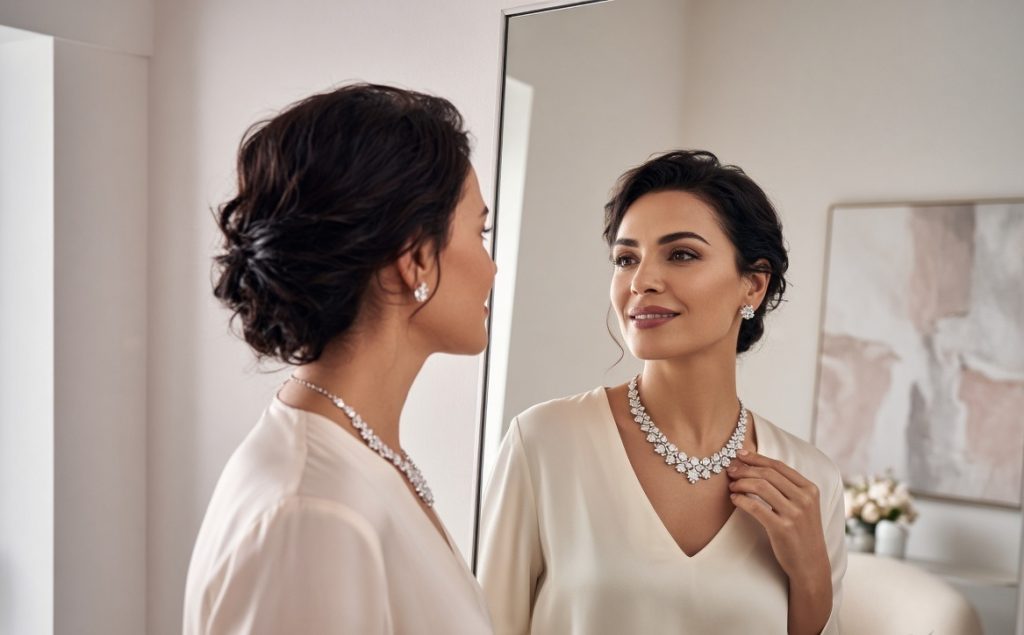
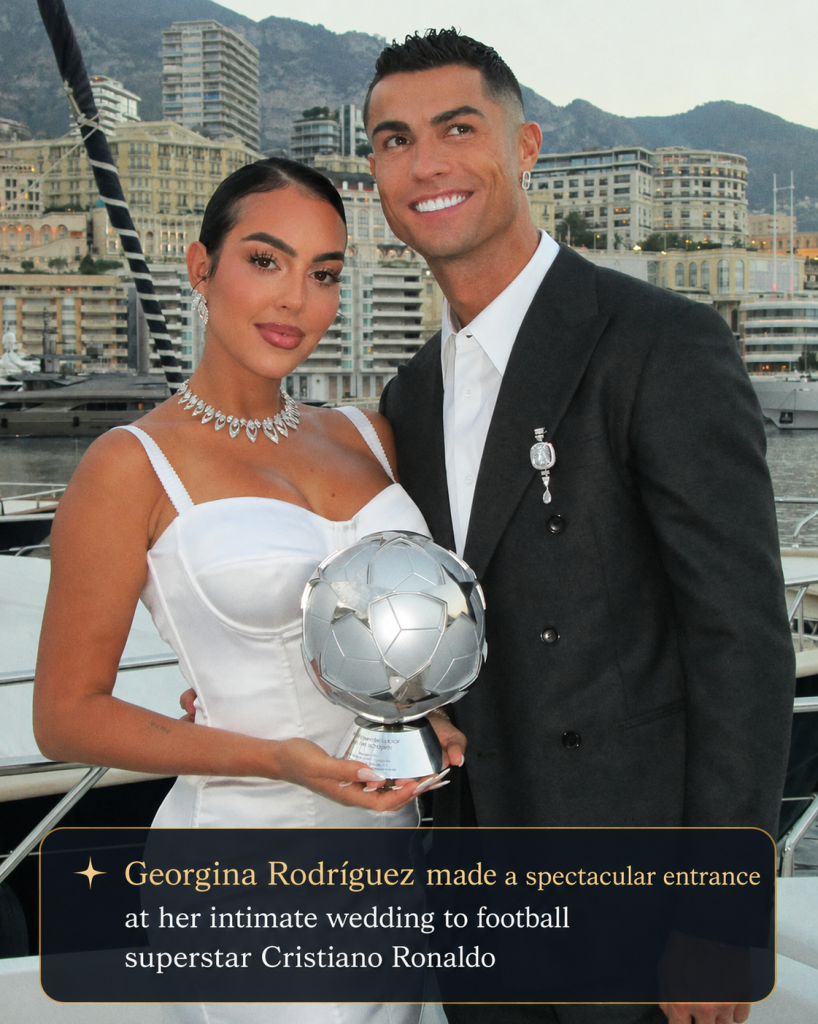
Georgina Rodríguez made a spectacular entrance at her intimate wedding to football superstar Cristiano Ronaldo, wearing an extraordinary collection of Chopard jewellery featuring more than 250 carats of diamonds.

The centrepiece of Rodríguez’s bridal jewellery was an exceptional necklace incorporating a 50 carat brilliant-cut diamond, alongside a 6.41-carat brilliant-cut diamond, approximately 98 carats of pear-shaped diamonds, 40 carats of brilliant-cut diamonds and 2 carats of marquise-cut diamonds.

Her earrings were equally impressive, featuring two 25 carat pear-shaped diamonds, complemented by 26 carats of heart-shaped diamonds and 4.35 carats of brilliant-cut diamonds.

Rodríguez completed the ensemble with two diamond rings one from Chopard’s renowned Garden of Kalahari collection and another from its Haute Joaillerie collection together with a diamond bracelet.

The extraordinary jewellery collection has been estimated by some reports to be worth up to US$55 million, although the true value of such exceptional pieces would depend on factors including diamond quality, provenance, design and craftsmanship.

Rodríguez, 32, married Portuguese football star Cristiano Ronaldo, 41, in a private civil ceremony in Cascais, Portugal, on 11 August 2026. The intimate celebration was attended by the couple’s five children.

Ronaldo marked the occasion on social media with a photograph of the couple’s hands displaying their wedding bands, accompanied by the simple caption: “C❤️G”.

The wedding took place exactly one year after Rodríguez announced their engagement on 11 August 2025, when she revealed her spectacular oval-shaped engagement ring.

A Showcase of Exceptional Diamond Jewellery

Georgina Rodríguez and  Cristiano Ronaldo


From a diamond perspective, Rodríguez’s bridal jewellery demonstrates the extraordinary scale and diversity that can be achieved in high jewellery. The combination of large centre stones with pear, heart, marquise and brilliant cuts creates a dramatic display while highlighting the importance of precision cutting and craftsmanship.

Pieces featuring diamonds of this magnitude are exceptionally rare. Beyond carat weight, their value is influenced by the 4Cs colour, clarity, cut and carat weight as well as rarity, provenance and the reputation of the jewellery house.

For the diamond industry, celebrity jewellery such as this provides a fascinating insight into the upper end of the international luxury diamond market, where exceptional stones can become as much works of art and symbols of rarity as they are jewellery.

DCLA, Diamond Certification Laboratory of Australia
Independent diamond expertise, grading and education.

Tuesday, 18 August 2026

GIA Alert: CVD Rough Made to Mimic Natural Diamond

 The Gemological Institute of America (GIA) has issued an important warning after examining a 6.87-carat, near-colourless CVD laboratory-grown diamond that had been deliberately fashioned to resemble a natural rough diamond crystal.

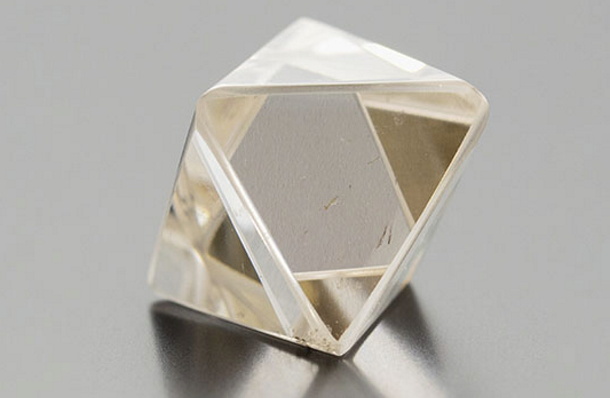
A 6.87 ct CVD-grown synthetic diamond Photo by Danny Bowler.

The Gemological Institute of America (GIA) has issued an important warning after examining a 6.87-carat, near-colourless CVD laboratory-grown diamond that had been deliberately fashioned to resemble a natural rough diamond crystal.

The unusual stone was submitted to GIA as a rough diamond and initially displayed a shape remarkably similar to the familiar octahedral form associated with natural diamond crystals. However, advanced laboratory testing revealed that its origin was very different.

The finding is detailed in the latest issue of Gems & Gemology and highlights an emerging challenge for the diamond industry: laboratory-grown diamonds can be deliberately fashioned to imitate the appearance of natural rough diamonds before they ever reach the cutting stage.

A CVD Diamond Designed to Look Natural

CVD, or Chemical Vapour Deposition, is one of the two principal technologies used to produce laboratory-grown diamonds. Unlike natural diamonds, which form deep within the Earth’s mantle over geological timescales, CVD diamonds are grown in controlled laboratory environments from a carbon-rich gas.

The GIA researchers believe this particular stone represents the first known example, to their knowledge, of a CVD laboratory-grown diamond being deliberately shaped into the approximate form of a natural rough diamond crystal.

The significance is not simply that the material was laboratory-grown. It is the deliberate attempt to make the synthetic material visually resemble natural rough.

According to the researchers, there appears to be little practical reason to produce a CVD diamond in this form other than an attempt at deception.

Advanced Testing Revealed Its True Origin

While its external appearance suggested a natural crystal, sophisticated laboratory analysis told a different story.

GIA used Raman spectroscopy, a powerful analytical technique capable of identifying the molecular and structural characteristics of diamond material.

The testing confirmed that the stone was CVD-grown diamond, rather than a natural diamond crystal.

This demonstrates why visual examination alone cannot always establish the origin of a rough diamond.

Natural diamond crystals can exhibit characteristic crystal forms, surface features and growth patterns. However, a laboratory-grown diamond can potentially be cut, shaped or modified to imitate some of those characteristics.

It Wasn’t Actually a True Octahedron

Closer examination also revealed that the stone was not a genuine natural octahedral crystal.

Only one pair of opposite faces was parallel, while the surfaces did not correspond to the crystallographic planes normally associated with natural diamond crystals.

In other words, the stone had been fashioned to create the impression of a natural crystal rather than actually possessing the crystallographic geometry of one.

For an experienced diamond professional, such inconsistencies may provide important clues. But the case demonstrates how sophisticated the presentation of laboratory-grown material can become.

Why Producing This Stone Would Be Difficult

Interestingly, manufacturing a CVD diamond in this form is not a simple or efficient process.

CVD diamonds are generally grown as larger blocks or plates of material. Producing a rough-looking crystal from that material requires additional cutting and shaping.

The GIA researchers noted that attempting to create a finished diamond from a CVD block while maintaining the required crystal structure would be difficult and wasteful.

A significant amount of material would be lost in the process, and the eventual polished diamond would be considerably smaller than one cut directly from the original as-grown CVD block.

That makes the decision to create a crystal-shaped CVD diamond particularly significant.

From a commercial perspective, it would make little sense to sacrifice valuable CVD material simply to create a rough crystal appearance unless there were another objective.

A Warning for the Rough Diamond Trade

The discovery is particularly relevant to the rough diamond market, where the first assessment of a stone can be based heavily on its external appearance, crystal morphology and surface characteristics.

For generations, experienced diamond buyers have learned to recognise natural crystal forms and the features associated with different types of rough.

But laboratory-grown technology is evolving rapidly.

The GIA case demonstrates that the industry cannot assume that a convincing natural-looking crystal is necessarily natural.

Appearance is not proof of origin.

This is an important distinction for dealers, manufacturers, wholesalers, retailers and consumers alike.

Could This Lead to New Rough-Diamond Screening Technology?

Perhaps the most significant aspect of the GIA report is that the researchers believe the industry could respond if stones of this type become more common.

They suggest that an immediate screening solution for rough diamonds could potentially be developed by adapting existing instruments currently used to screen polished diamonds.

This could become increasingly important as laboratory-grown diamond production expands and techniques for disguising laboratory-grown material become more sophisticated.

The diamond industry already relies on a combination of spectroscopy, fluorescence, photoluminescence and other advanced analytical technologies to separate natural diamonds from laboratory-grown diamonds.

The challenge now is ensuring that these technologies remain effective before a diamond reaches the polishing stage.

What This Means for the Diamond Industry

The GIA discovery is a reminder that the distinction between natural and laboratory-grown diamonds is not simply a matter of appearance.

A laboratory-grown diamond can possess the same basic chemical composition and crystal structure as a natural diamond. The crucial difference is origin.

As laboratory-grown diamond manufacturing becomes more sophisticated, the industry must continue to develop reliable methods for establishing that origin.

For professional diamond buyers, this reinforces the importance of purchasing rough and polished diamonds through reputable channels and using appropriate laboratory testing when the provenance or origin of a stone is in question.

For consumers, it reinforces another important principle:

If the origin matters, test the stone.

A diamond may look natural.

It may have been deliberately shaped to look natural.

It may even convince an experienced eye at first examination.

But sophisticated laboratory analysis can reveal what the eye cannot.

The Bigger Picture

The GIA case should not be interpreted as evidence that every unusual rough diamond is suspicious, nor does it suggest that CVD technology itself is a problem.

Laboratory-grown diamonds are a legitimate category of diamond material and can be accurately identified when appropriate testing is undertaken.

The concern arises when laboratory-grown material is intentionally presented in a manner designed to create the impression that it is natural.

That is where the industry’s established systems of disclosure, screening, verification and independent grading become critical.

As technology advances on both sides of the industry, the race between diamond-growing technology and diamond-identification technology is likely to continue.

The 6.87-carat CVD crystal examined by GIA may be an unusual case today. But it provides a valuable warning about what could become a more significant challenge tomorrow.

For the modern diamond industry, the lesson is clear: a natural-looking rough crystal is not necessarily a natural diamond. Advanced scientific testing remains the ultimate safeguard.

Monday, 17 August 2026

The changing romance of diamonds and jewellery

 Laboratory-grown diamonds have accelerated this change. As production costs and retail prices have fallen, diamond-set jewellery has become accessible to a broader customer base.

Swarovski’s chief executive has told the Financial Times that falling prices for laboratory-grown diamonds are enabling more women to buy diamond jewellery for themselves, rather than waiting for it to be given as a romantic gift.

The comments highlight a wider shift in the way consumers relate to diamonds and fine jewellery. Traditionally associated with engagements, anniversaries and other relationship milestones, diamond jewellery is increasingly being positioned as a form of personal expression, self-reward and financial independence. The romance of the diamond is not disappearing; it is becoming more personal and less dependent on a partner or a formal occasion.

Laboratory-grown diamonds have accelerated this change. As production costs and retail prices have fallen, diamond-set jewellery has become accessible to a broader customer base. Consumers who may previously have considered diamond jewellery unattainable can now enter the category at a lower price point, while those purchasing for themselves can choose pieces based on personal style rather than the expectations attached to a traditional gift.

For Swarovski, which operates across crystal, fashion jewellery and fine jewellery, laboratory-grown diamonds provide an opportunity to move further into the premium sector without the price barriers associated with natural stones. The company can present diamonds as contemporary, wearable and attainable appealing to customers who may be buying a meaningful piece to mark a personal achievement, career milestone or simply a moment of self-indulgence.

This shift towards self-purchase is one of the most closely watched developments in jewellery and watches. Brands ranging from De Beers to newer laboratory-grown specialists are adapting their communications to focus less exclusively on romance between couples and more on individuality, empowerment and personal reward. The message is increasingly that a diamond does not need to be given by someone else to be emotionally significant.

The trend also creates challenges for the natural diamond sector. Producers are already facing pressure from weaker rough-diamond prices, changing consumer expectations and growing scrutiny around provenance and sustainability. If consumers buying for themselves increasingly choose laboratory-grown diamonds because of their affordability and compatibility with modern messaging, natural diamond companies will need to work harder to communicate the value of rarity, origin, longevity and heritage.

The key question for the industry is whether self-purchase becomes a permanent pillar of jewellery marketing rather than a temporary response to changing consumer behaviour. As the boundaries between romantic gifting and personal luxury continue to blur, the meaning of the diamond itself is evolving from a symbol primarily of commitment between two people to one that can also represent ambition, independence and self-expression.

For the DCLA, this changing relationship with diamonds underlines the importance of communicating the distinct qualities of natural diamonds while recognising the broader cultural shift taking place across the jewellery market. The future of the category may depend on its ability to preserve the emotional power of the diamond while expanding the occasions, customers and stories connected to it.

Friday, 14 August 2026

GIA Examines a Remarkable Colour-Treated Purple Diamond

 Irradiation and Annealing Created the Purple ColourGIA determined that the diamond had undergone a combination of irradiation followed by low-temperature annealing to produce its intense purple bodycolour.

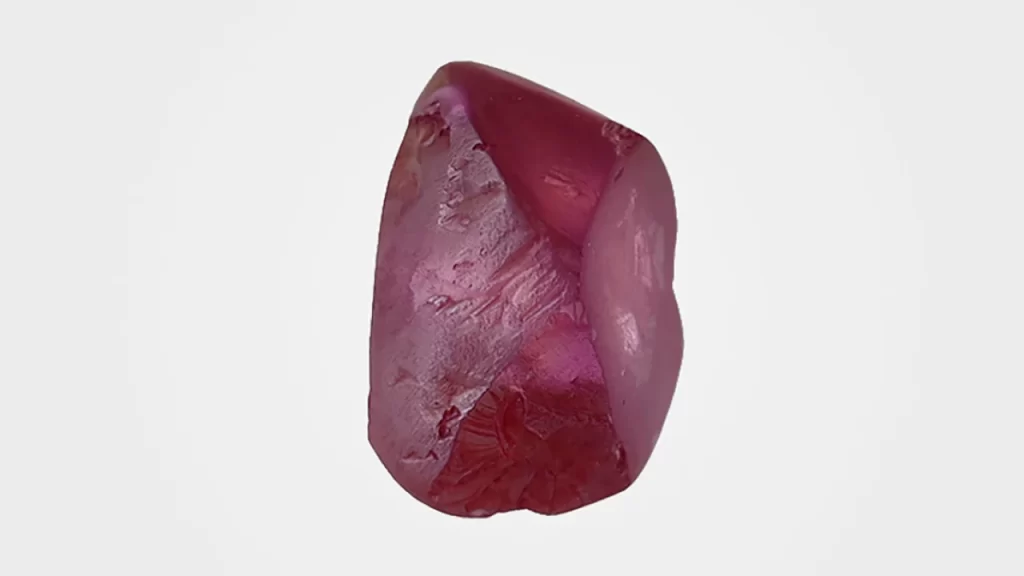
The Gemological Institute of America (GIA) has examined a fascinating 3.93-carat Type Ib purple diamond that had undergone colour treatment involving irradiation and annealing, revealing unusual internal growth patterns and a distinctive arrow-like feature visible under deep ultraviolet light.

The rough purple diamond was submitted to the GIA laboratory in Dubai for analysis. Its unusual appearance and internal characteristics prompted further examination, with the findings published in the spring 2026 issue of Gems & Gemology.

Irradiation and Annealing Created the Purple Colour

GIA determined that the diamond had undergone a combination of irradiation followed by low-temperature annealing to produce its intense purple bodycolour.

The conclusion was based on several factors, including the diamond’s intense colour, its Type Ib classification, and the presence of nitrogen-vacancy (NV) centres. These defects within the diamond’s crystal structure play an important role in producing its unusual colour.

Purple diamonds can display colour as a result of transmission windows in the blue and red regions of the visible spectrum. In this particular stone, however, the introduction of NV centres produced an intense, relatively pure purple bodycolour without the pink component that is commonly associated with NV-related coloration.

DiamondView Reveals a Hidden Arrow

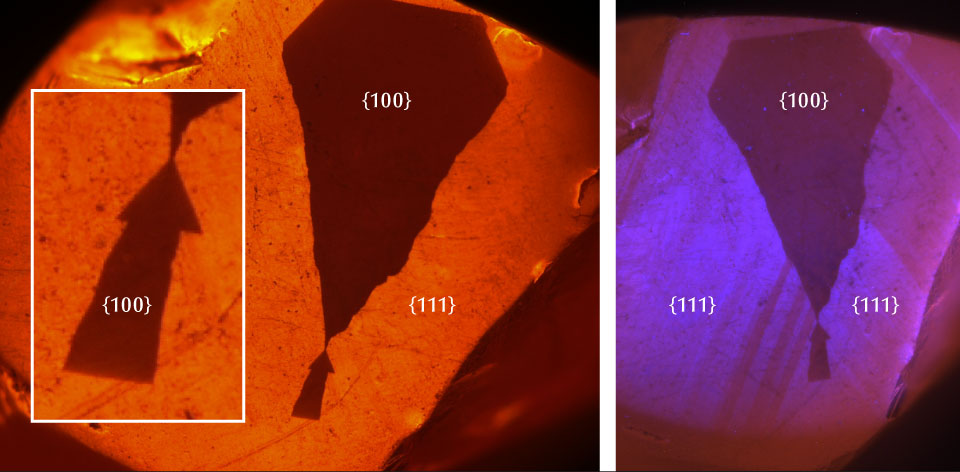
One of the most intriguing aspects of the examination was revealed through DiamondView imaging. Under deep ultraviolet (UV) illumination, the diamond displayed a dark, nonfluorescing area resembling an arrow pointing towards the profile of an elongated diamond.

One of the most intriguing aspects of the examination was revealed through DiamondView imaging. Under deep ultraviolet (UV) illumination, the diamond displayed a dark, nonfluorescing area resembling an arrow pointing towards the profile of an elongated diamond.

The remainder of the stone displayed a bright orange fluorescence, which was likely associated with NV defects.

The contrast between the fluorescent and nonfluorescent areas provided a remarkable view of the diamond’s internal growth history. GIA concluded that the distinctive pattern reflected multiple growth sectors formed naturally as the diamond developed.

A Natural Pattern That Looks Like an Arrow

Why Advanced Laboratory Testing Matters


The arrow-like feature is particularly interesting from a gemological perspective. Arrow patterns produced through precise diamond polishing can be highly valued for their optical appearance, but this example is very different.

Here, the arrow appears to be a form of pareidolia a phenomenon where the human eye recognises a familiar shape within an otherwise random pattern.

The feature is not an inclusion deliberately positioned or created during polishing. Instead, it is the result of contrasting growth sectors within the diamond and becomes visible because of their different fluorescence responses under deep UV illumination.

Why Advanced Laboratory Testing Matters 

This diamond is an excellent example of why sophisticated laboratory techniques are essential when examining unusual or treated diamonds.

Its colour, diamond type, NV centres, fluorescence characteristics and growth patterns all contributed to GIA’s determination that the purple colour was artificially induced through irradiation and subsequent low-temperature annealing.

For consumers and the diamond trade, identifying whether a colour is natural or treated can have a significant impact on a diamond’s description, rarity and value. Features that may be invisible under normal lighting can become highly revealing when examined using advanced instruments such as DiamondView and other spectroscopic techniques.

This remarkable purple diamond demonstrates that every diamond has a story and sometimes, that story can literally appear as an arrow hidden inside the stone.

At DCLA, we believe every diamond deserves to be examined, documented and understood, not simply admired.

DCLA — independent gemmological expertise and diamond testing in Australia since 2001.

 Source: DCLA

Thursday, 13 August 2026

Diamond Light Return: How Cut, Angles and Facets Control the Way a Diamond Performs

 How Cut, Angles and Facets Control the Way a Diamond Performs

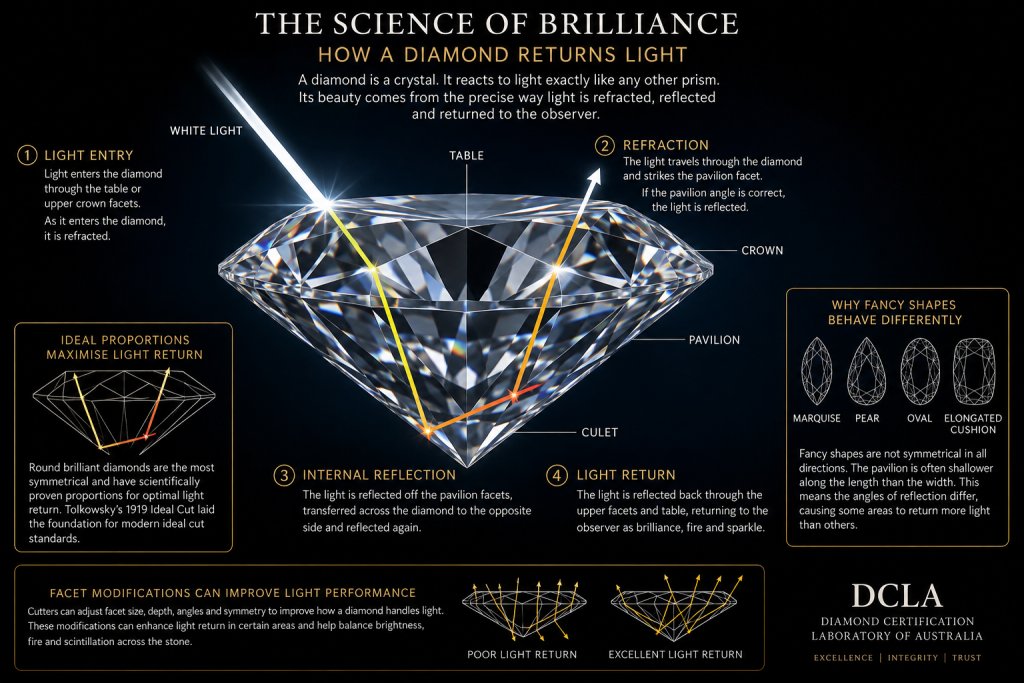
A diamond is far more than a beautiful gemstone. It is a precisely engineered optical crystal, and the way it interacts with light is governed by the same fundamental principles that apply to a prism.

When light enters a diamond through one of its facets, it does not simply travel straight through the stone. As it passes from air into diamond, the change in optical density causes the light to refract, or change direction. From there, the internal angles of the diamond determine whether that light continues through the stone, escapes, or is reflected back through the diamond.

This interaction between refraction, reflection and facet geometry is fundamental to a diamond’s brightness, fire and overall visual performance.

The Critical Role of Diamond Angles

The angles within a diamond are critical because light must follow a carefully controlled path through the stone.

When light enters through the table or upper crown facets, it is refracted as it enters the diamond. The light then travels towards the pavilion, the lower portion of the stone. If the pavilion angle is appropriate, the light strikes the pavilion facet at an angle that allows it to be reflected rather than immediately escaping through the bottom of the diamond.

The reflected light is then redirected across the stone towards another pavilion facet, where it can be reflected again. From there, it travels back towards the crown and eventually exits through the upper facets and table, returning light towards the observer.

This process is commonly referred to as light return.

In simple terms, the diamond is acting as a sophisticated optical system. The facets are the surfaces that control the direction of the light, while the angles determine whether the light is retained, reflected and ultimately returned to the viewer.

Refraction and Reflection Working Together

Two optical principles are particularly important.

Refraction occurs when light changes direction as it passes from one material into another, such as from air into diamond.

Reflection occurs when light strikes an internal surface and is redirected rather than passing through it.

The relationship between these two principles is what gives a well-cut diamond its characteristic brightness.

The pavilion is particularly important. If the pavilion is too shallow, light can escape through the bottom of the stone rather than being reflected back towards the crown. If it is too deep, light can also be directed away from the viewer.

The objective is therefore not simply to make a diamond deeper or shallower. The pavilion, crown, table and other facets must work together within appropriate proportional relationships.

Why Proportions Matter

A diamond can contain excellent material and still appear dull if it has been cut with proportions that do not manage light effectively.

A well-proportioned diamond allows a significant amount of the light entering through the crown to be redirected back towards the observer.

This is one of the reasons round brilliant diamonds have become so highly developed from an optical and scientific perspective. Their high degree of symmetry makes it possible to study and define their proportions with considerable precision.

The round brilliant is generally regarded as the most symmetrical of the major diamond shapes, allowing established proportion systems and ideal-cut concepts to be applied more consistently.

One of the historic milestones in the development of ideal-cut theory was Tolkowsky’s 1919 Ideal Cut, developed by Marcel Tolkowsky. His work examined the mathematical relationship between a diamond’s proportions and its ability to return light, helping establish the foundations for modern diamond-cut analysis.

Why Fancy-Cut Diamonds Behave Differently

Fancy shapes introduce a much more complicated optical challenge.

Unlike the round brilliant, many fancy shapes are not symmetrical in all directions. This includes elongated oval, marquise, pear and elongated cushion-cut diamonds.

The length and width of these diamonds can have significantly different proportions. Consequently, the pavilion geometry along the length of the diamond may not behave in exactly the same way as the pavilion geometry across its width.

This can produce differences in light return across different areas of the stone.

For example, an elongated oval may have one optical response along its length and another across its width. The same principle can apply to marquise and pear shapes, where the geometry changes considerably from the centre towards the points.

This is one reason why two diamonds of the same shape, carat weight and colour can look noticeably different when viewed side by side.

The Pavilion Is the Engine Room of Light Return

When examining diamond performance, the pavilion deserves particular attention.

The pavilion facets are responsible for much of the internal reflection that sends light back towards the crown. Their angles determine the path that light takes once it has entered the stone.

In an elongated diamond, achieving consistent light return across the entire stone can be particularly challenging. The cutter must balance the pavilion angles, crown facets, table and overall depth to manage light across different sections of the diamond.

A change in one area can influence another.

This is why diamond cutting is both an art and a science. The cutter is not simply removing material to create a particular outline. They are creating a three-dimensional optical structure in which thousands of possible light paths interact.

Facet Modifications Can Influence Light Return

Modern cutting techniques allow cutters to modify facet arrangements and proportions to improve the visual performance of a diamond.

Changes to facet size, placement, depth and symmetry can influence the way light travels through the stone. In some designs, modifications can help compensate for the optical challenges created by an elongated or unusual shape.

A cutter may adjust the geometry of the stone so that particular areas interact with light more effectively. However, these modifications always involve compromises. Improving light performance in one area can potentially affect another.

The goal is therefore to find the best balance between shape, proportions, symmetry, weight retention and optical performance.

Why Two Diamonds Can Look Completely Different

This explains why carat weight alone is never enough to judge a diamond.

Two diamonds can both weigh one carat, have the same colour and clarity grades, and yet appear very different when placed next to each other.

One may look bright and lively, while the other may appear darker or have areas where light escapes.

The difference can be found in the way each stone has been cut.

The combination of table size, crown angle, pavilion angle, total depth, girdle proportions, facet arrangement and symmetry determines how the diamond interacts with incoming light.

For fancy shapes, the challenge becomes even greater because the optical behaviour can vary across the stone.

Looking Beyond the Sparkle

When you look at a diamond and see flashes of white light, coloured fire and areas of brightness and contrast, you are seeing the result of physics occurring inside the crystal.

The diamond has not simply been polished to look attractive. Its facets have been arranged to control light.

Understanding this is important for both consumers and professionals. A diamond should be evaluated not only by its carat weight, colour and clarity, but also by the quality of its cut and the way its proportions and facets work together.

At the Diamond Certification Laboratory of Australia (DCLA), understanding the relationship between a diamond’s proportions, symmetry and optical behaviour is an important part of professional diamond assessment.

The next time you look into a well-cut diamond, remember what is happening beneath the surface: light enters, changes direction, travels through carefully calculated angles, reflects from pavilion facets and is redirected back towards you.

That journey of light is what creates the life and brilliance we see in a diamond.

Fancy Colour Diamonds, From Hollywood Statement to the Ultimate Collectable

  For generations, the traditional diamond engagement ring has been dominated by the classic colourless stone. But the world of exceptional ...