From the Tolkowsky Ideal to Modern Cut Grades, Why Proportions Still Matter
For more than a century, diamond cutters, gemologists and scientists have attempted to answer one fundamental question:
What makes a diamond well cut?
The answer has evolved considerably.
What began with the scientific study of diamond proportions and the development of the Ideal Cut has become a sophisticated system of modern cut grading that considers light performance, proportions, symmetry, polish, durability and the way the human eye perceives brilliance and scintillation.
Yet beneath all of the modern technology, one fundamental principle remains:
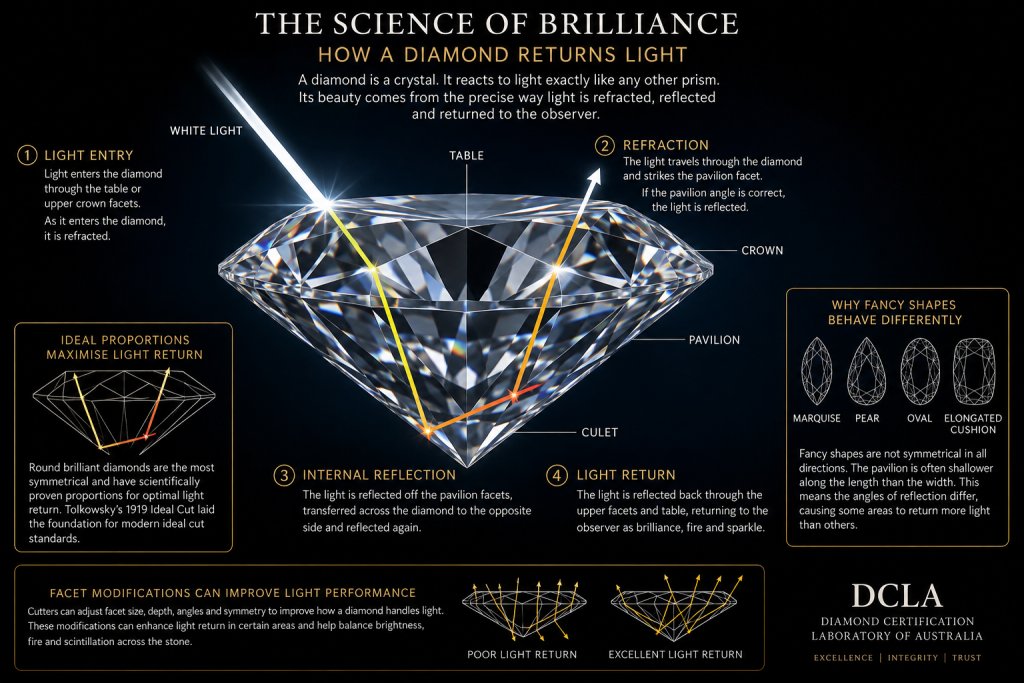
A diamond is a three-dimensional optical instrument, and its proportions determine how light travels through it.
This is why the measurement of proportions remains such an important part of understanding diamond cut.
The beginning of scientific diamond proportions
Long before today’s sophisticated computer modelling, diamond cutters were experimenting with angles and proportions to improve the appearance of the round brilliant.
In the late nineteenth century, Henry Morse used a goniometer to investigate diamond angles and proportions and developed cutting principles intended to maximise brilliance. His work became associated with what was subsequently known as the American Cut, Scientific Cut and eventually the Ideal Cut.
This work was followed by the mathematical and optical studies of Herbert Whitlock, Frank Wade and, most famously, Marcel Tolkowsky.
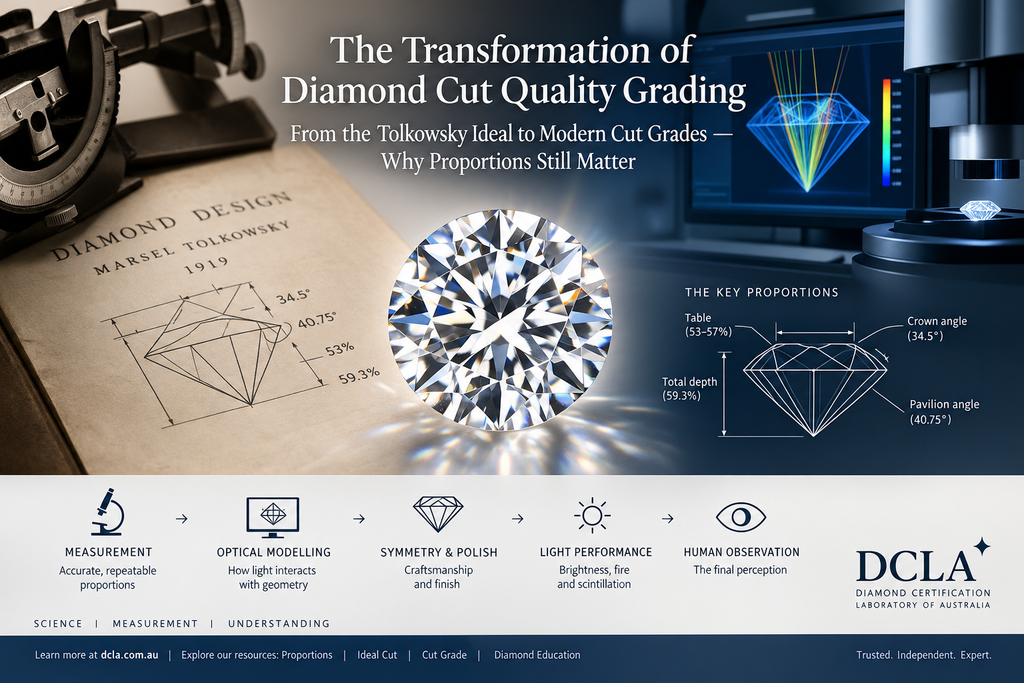
In 1919, Tolkowsky published Diamond Design, analysing the geometry of the round brilliant and the relationship between its proportions, angles and the return of light.
The importance of this work was not simply that Tolkowsky produced a set of numbers.
It was that diamond cutting was increasingly being treated as a measurable optical science rather than simply an artistic craft.
DCLA’s own educational material traces this development and explains how the Ideal Cut became associated with variations of the original Tolkowsky model.
What is the Tolkowsky Ideal?
The Tolkowsky model became one of the most influential references in modern round-brilliant cutting.
The principle was relatively straightforward: the pavilion and crown geometry, together with the table and other proportions, must work together so that light entering the diamond has the greatest opportunity to be reflected internally and returned through the crown.
The commonly referenced Tolkowsky proportions are approximately:
- Crown angle: approximately 34.5°
- Pavilion angle: approximately 40.75°
- Table: approximately 53–57%
- Total depth: approximately 59.3%
These figures should not, however, be treated as a rigid recipe.
Modern research has demonstrated that the optical performance of a diamond is determined by the relationship between its proportions, rather than by one measurement considered in isolation.
DCLA similarly explains that table, depth, crown angle, pavilion geometry and other elements work together to determine the diamond’s interaction with light.
This is an important distinction.
The science is in the relationships.
From proportion analysis to cut grading

For much of the twentieth century, diamond professionals relied heavily on measured proportions when assessing the quality of a round brilliant.
A diamond could be measured, its angles calculated and its proportions compared with recognised standards.
That created something extremely valuable for the trade:
repeatability.
If two qualified people measured the same diamond correctly, they could arrive at essentially the same numerical proportions.
The diamond did not change because the person looking at it had a different opinion.
The pavilion angle remained the pavilion angle.
The crown angle remained the crown angle.
The table remained the table.
The depth remained the depth.
This is one of the great strengths of proportion analysis.
DCLA describes proportions as the relationships between the dimensions and angles of a finished diamond and identifies them as fundamental to understanding brilliance, fire and scintillation.
The arrival of modern cut grades
The development of modern grading systems changed the way diamond cut was communicated to consumers.
Rather than presenting the purchaser with a collection of angles, percentages and measurements, laboratories increasingly sought to reduce the information into a single overall grade.
Today, major laboratories use cut-grading systems that combine measurable characteristics with assessments of the diamond’s overall appearance and performance.
GIA’s research into cut grading illustrates how the industry moved from proportion-based approaches towards increasingly sophisticated systems incorporating three-dimensional modelling and human observation.
This was a major development.
It made cut quality easier to communicate.
But it also introduced an important philosophical difference between measuring a diamond’s physical proportions and assigning an overall quality grade to the diamond.
They are not necessarily the same thing.
A grade is a category — proportions are measurements
This distinction is frequently misunderstood.
A cut grade is a classification.
A proportion measurement is a physical observation.
For example, diamonds can fall within the same broad cut-grade category while having different crown angles, pavilion angles, table sizes and other proportions.
GIA’s research into cut grading specifically recognises that diamonds within a single grade can have variations in appearance and proportion combinations.
This means that a broad cut grade does not describe one exact geometry.
It describes a range of diamonds that fall within the laboratory’s defined parameters and assessment methodology.
Consequently, two diamonds carrying the same broad cut grade are not necessarily proportionally identical.
Why scientific proportions remain important
This is where proportion analysis remains particularly valuable to the professional.
A numerical proportion report tells us what the diamond actually is.
It provides the measurable geometry of the stone.
For a round brilliant, this can include:
- Table percentage
- Total depth percentage
- Crown angle
- Crown height
- Pavilion angle
- Pavilion depth
- Star length
- Lower-half percentage
- Girdle thickness
- Culet
- Diameter measurements
These measurements provide a permanent technical record of the diamond’s physical construction.
They can be independently measured, compared and reproduced.
That makes them particularly valuable to manufacturers, cutters, gemologists and laboratories.
DCLA’s educational material on proportion grading explains the importance of these measurements in assessing the balance of a round brilliant diamond.
Proportions are not simply numbers
It would also be wrong to suggest that one number determines whether a diamond is beautiful.
A pavilion angle cannot be assessed independently from the crown angle.
A table percentage cannot be considered without considering the crown and pavilion geometry.
Likewise, total depth alone does not tell us whether a diamond will perform well optically.
Modern research has reinforced this point.
GIA’s work demonstrates that the various proportion parameters are interrelated and that a complete understanding of diamond appearance requires more than looking at one measurement in isolation.
Therefore, the correct scientific approach is not:
“What is the table?”
or:
“What is the pavilion angle?”
It is:
“How do all of these proportions work together?”
The Tolkowsky model and modern science
It is important to recognise that Tolkowsky’s work was conducted using the scientific knowledge and optical modelling available in the early twentieth century.
Modern diamond science has gone considerably further.
Three-dimensional ray tracing, computer modelling, automated proportion measurement and optical-performance analysis allow researchers to model an enormous range of possible combinations.
GIA’s current historical review of cut grading describes the transition from early two-dimensional ray tracing to increasingly sophisticated three-dimensional approaches to understanding how light travels through a round brilliant diamond.
That does not make the Tolkowsky principles obsolete.
Rather, it places them into their historical context.
The fundamental concept that diamond geometry controls the behaviour of light remains central.
The science has simply become considerably more sophisticated.
Where modern grading becomes more subjective
Modern cut grading has another important dimension:
human perception.
A diamond does not exist in isolation from the person viewing it.
Brightness, fire and scintillation are visual phenomena.
GIA therefore incorporated extensive observation testing into the development of its cut system, recognising that appearance is ultimately experienced by the human observer.
That is an important scientific distinction.
It means there is a difference between:
What can be measured
and
What a person perceives.
The first can be quantified.
The second involves human observation.
Consistency is the strength of proportion grading
This is why proportion grading remains so important in professional diamond assessment.
A proportion measurement is not an opinion about whether somebody likes the diamond.
It is a measurement of the diamond’s physical geometry.
When modern non-contact scanners and optical measuring systems are used correctly, the diamond can be measured with a high degree of precision.
This creates an important bridge between traditional craftsmanship and modern technology.
The cutter can see what has been produced.
The manufacturer can compare stones.
The laboratory can record the geometry.
And the consumer can be given measurable information rather than relying entirely on terminology.
The difference between a scientific measurement and a grade
This distinction deserves emphasis.
A proportion is a measurement.
A cut grade is an interpretation based on a grading methodology.
Both can be useful.
But they answer different questions.
A proportion analysis asks:
What are the physical dimensions and angles of this diamond?
A cut grade asks:
How does this diamond fit within a particular laboratory’s definition of cut quality?
Neither question should automatically be confused with:
Which diamond will an individual person find most beautiful?
That final question involves visual preference, lighting, movement and perception.
The modern laboratory approach
Today, the most comprehensive understanding of diamond cut comes from combining the disciplines.
Measurement tells us the geometry.
Optical modelling helps us understand how light interacts with that geometry.
Symmetry and polish tell us about execution and finish.
Light-performance analysis examines brightness, fire and scintillation.
Human observation helps establish how those differences are actually perceived.
This progression can be seen in the development of modern cut-grading research, where numerical proportions have increasingly been combined with optical modelling and observations of diamond appearance.
Why proportions still matter at DCLA
At the Diamond Certification Laboratory of Australia, we believe that understanding a diamond begins with understanding what the diamond actually is.
A laboratory report should not replace knowledge of the stone.
It should enhance it.
DCLA’s educational material explains that cut refers to proportions, symmetry and finish, and that these characteristics influence how light travels through the diamond and ultimately its brilliance and fire.
The modern transformation of cut grading has given the industry valuable tools for communicating diamond quality.
But a single word such as “Excellent” cannot communicate every physical characteristic of a diamond.
The actual proportions remain important.
They tell us how the diamond has been constructed.
They allow professionals to compare diamonds on a consistent technical basis.
They assist manufacturers in analysing cutting decisions.
And they provide a numerical record that can be independently measured and reproduced.
From the Ideal Cut to the diamond of today
The history of diamond cutting is therefore not a story of old science being replaced by new grading.
It is a progression.
Morse, Wade, Whitlock and Tolkowsky helped establish the scientific study of diamond proportions.
Modern laboratories expanded that work through computer modelling, ray tracing, observation testing and sophisticated measurement technology.
The result is a much deeper understanding of diamond appearance.
But one principle remains unchanged:
The beauty we see in a diamond begins with the geometry we cannot see.
A diamond’s proportions determine the pathways available to light.
The cutter determines those proportions.
The measuring instrument records them.
The scientist can model them.
The laboratory can assess them.
And ultimately, the observer sees the result.
For more than a century, the industry has continued to refine the relationship between proportion, light and beauty.
The Tolkowsky Ideal was an important milestone in that journey.
Modern cut grading is the next chapter.
And at DCLA, understanding both is essential to understanding the diamond itself.
Further reading and DCLA resources
DCLA — Diamond Proportions
Understanding Diamond Proportions
DCLA — Proportion Grade
How DCLA assesses proportion grade
DCLA — Ideal Cut
The Ideal Cut and the Tolkowsky model
DCLA — Diamond Cut
DCLA guide to diamond cut
DCLA — Cut Grade
Understanding Diamond Cut Grade
DCLA — Diamond Light Return
How cut, angles and facets control diamond light return
DCLA — Buying a Diamond: Cut, Colour, Clarity & Carat
DCLA’s guide to buying a diamond
GIA — The Transformation of Diamond Cut Quality Grading
GIA research on the evolution of diamond cut grading
GIA — A Foundation for Grading the Overall Cut Quality of Round Brilliant Cut Diamonds
GIA’s foundational research into round brilliant cut grading