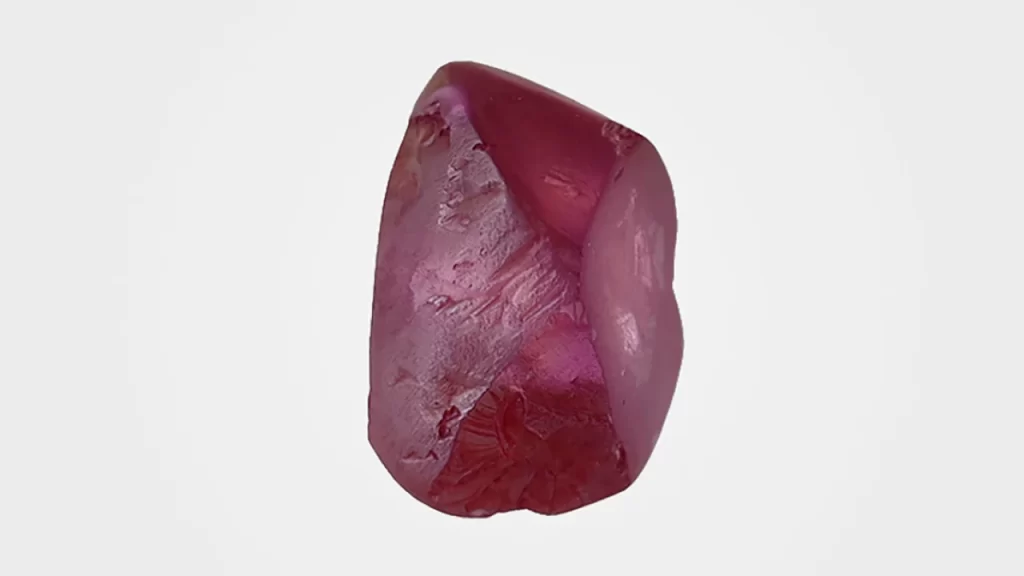
The Gemological Institute of America (GIA) has examined a fascinating 3.93-carat Type Ib purple diamond that had undergone colour treatment involving irradiation and annealing, revealing unusual internal growth patterns and a distinctive arrow-like feature visible under deep ultraviolet light.
The rough purple diamond was submitted to the GIA laboratory in Dubai for analysis. Its unusual appearance and internal characteristics prompted further examination, with the findings published in the spring 2026 issue of Gems & Gemology.
Irradiation and Annealing Created the Purple Colour
GIA determined that the diamond had undergone a combination of irradiation followed by low-temperature annealing to produce its intense purple bodycolour.
The conclusion was based on several factors, including the diamond’s intense colour, its Type Ib classification, and the presence of nitrogen-vacancy (NV) centres. These defects within the diamond’s crystal structure play an important role in producing its unusual colour.
Purple diamonds can display colour as a result of transmission windows in the blue and red regions of the visible spectrum. In this particular stone, however, the introduction of NV centres produced an intense, relatively pure purple bodycolour without the pink component that is commonly associated with NV-related coloration.
DiamondView Reveals a Hidden Arrow
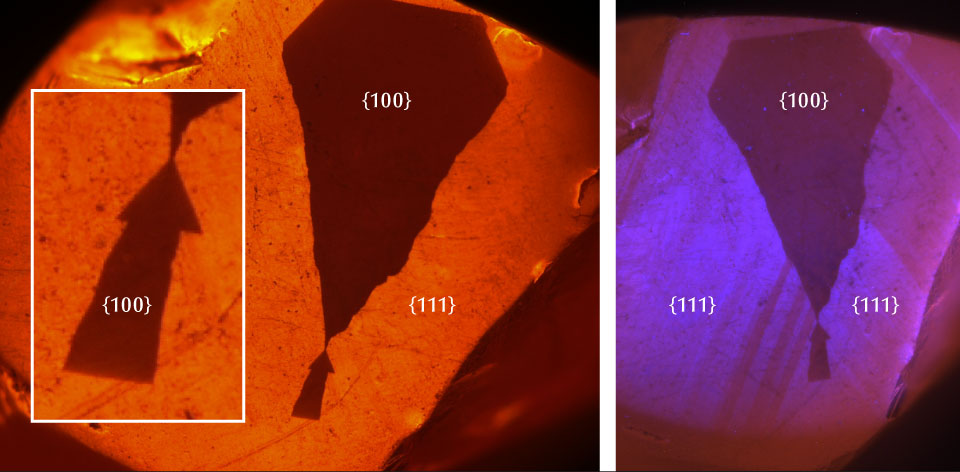
One of the most intriguing aspects of the examination was revealed through DiamondView imaging. Under deep ultraviolet (UV) illumination, the diamond displayed a dark, nonfluorescing area resembling an arrow pointing towards the profile of an elongated diamond.
The remainder of the stone displayed a bright orange fluorescence, which was likely associated with NV defects.
The contrast between the fluorescent and nonfluorescent areas provided a remarkable view of the diamond’s internal growth history. GIA concluded that the distinctive pattern reflected multiple growth sectors formed naturally as the diamond developed.
A Natural Pattern That Looks Like an Arrow

The arrow-like feature is particularly interesting from a gemological perspective. Arrow patterns produced through precise diamond polishing can be highly valued for their optical appearance, but this example is very different.
Here, the arrow appears to be a form of pareidolia a phenomenon where the human eye recognises a familiar shape within an otherwise random pattern.
The feature is not an inclusion deliberately positioned or created during polishing. Instead, it is the result of contrasting growth sectors within the diamond and becomes visible because of their different fluorescence responses under deep UV illumination.
Why Advanced Laboratory Testing Matters
This diamond is an excellent example of why sophisticated laboratory techniques are essential when examining unusual or treated diamonds.
Its colour, diamond type, NV centres, fluorescence characteristics and growth patterns all contributed to GIA’s determination that the purple colour was artificially induced through irradiation and subsequent low-temperature annealing.
For consumers and the diamond trade, identifying whether a colour is natural or treated can have a significant impact on a diamond’s description, rarity and value. Features that may be invisible under normal lighting can become highly revealing when examined using advanced instruments such as DiamondView and other spectroscopic techniques.
This remarkable purple diamond demonstrates that every diamond has a story and sometimes, that story can literally appear as an arrow hidden inside the stone.
At DCLA, we believe every diamond deserves to be examined, documented and understood, not simply admired.
DCLA — independent gemmological expertise and diamond testing in Australia since 2001.
Source: DCLA