Monday, 3 August 2026

Buying Jewellery for Babies and Young Children: What Every Parent and Grandparent Should Know

 Buying Jewellery for Babies and Young Children

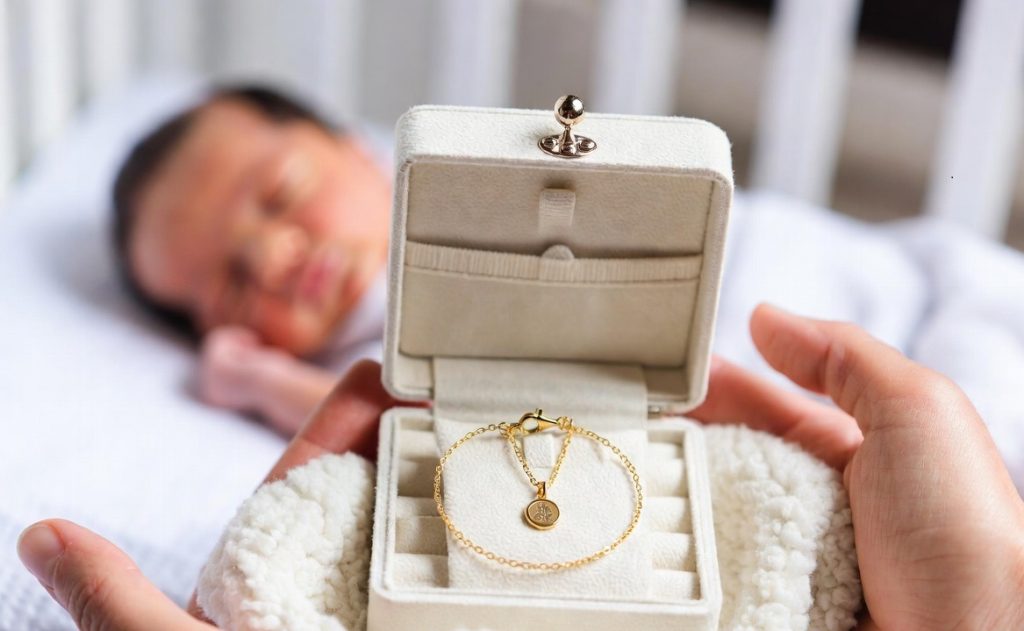
Giving a piece of jewellery to a newborn or young child is a tradition that has been passed down through generations. A small gold bracelet, an engraved pendant, or a delicate necklace often becomes a treasured keepsake that can remain in a family for decades.

However, while jewellery can be a beautiful and meaningful gift, it is important to remember that babies and young children have very different safety requirements than adults. What may appear to be a harmless piece of jewellery can present serious risks if worn too early.

At the Diamond Certification Laboratory of Australia (DCLA), we believe that understanding these risks helps families make informed decisions while preserving the sentimental value of these special gifts.

Necklaces – Best Kept as Keepsakes

One of the most common gifts given to infants is a gold necklace with a religious symbol, nameplate, or small pendant.

While these necklaces are beautiful, they are generally not recommended for babies or toddlers to wear.

Potential risks include:

  • Strangulation if the necklace catches on furniture, bedding, prams or playground equipment.
  • Choking hazards if a clasp, pendant or decorative element becomes detached.
  • Injury if another child pulls on the necklace during play.
  • Entanglement during sleep.

For these reasons, a necklace is best kept safely stored until the child is older and able to understand how to wear jewellery responsibly.

Bracelets – Not Always as Safe as They Look

Baby bangles and identity bracelets have been popular gifts for generations.

Although they may seem safer than necklaces, they can still present hazards.

A bracelet may:

  • Catch on clothing, blankets or toys.
  • Become trapped while crawling or climbing.
  • Cause cuts or bruising if it is too tight.
  • Slip off and become a choking hazard if too loose.

If a child is going to wear a bracelet, it should only be under close adult supervision and removed during sleep or active play.

Earrings

Parents often ask about ear piercing for young children.

From a jewellery safety perspective:

  • Earrings should only be fitted once the ears have fully healed.
  • Small plain studs are generally safer than hoops or dangling earrings.
  • Hoop earrings can catch on clothing, towels or playground equipment.
  • Larger decorative earrings may be pulled by curious children or playmates.

Professional piercing and high-quality hypoallergenic jewellery can help reduce the risk of infection or allergic reactions.

Rings

Children’s rings are generally not recommended for infants or toddlers.

A ring that fits today may become dangerously tight as fingers grow, restricting circulation.

Conversely, a loose ring can easily fall off and become a choking hazard.

Most jewellers recommend waiting until a child is significantly older before wearing rings regularly.

What Makes a Good Gift?

If you’re looking for a meaningful jewellery gift for a newborn or young child, consider pieces that are intended to become lifelong keepsakes rather than everyday jewellery.

Excellent choices include:

  • An engraved gold or silver identity bracelet to be worn later in childhood.
  • A quality gold pendant kept safely until the child is older.
  • A birthstone pendant.
  • A commemorative coin or small investment-grade gold or silver piece to celebrate their birth.
  • A jewellery box containing a family heirloom to be passed on in the future.

These gifts retain all of their sentimental value without exposing the child to unnecessary risks.

If You Receive Jewellery as a Gift

Many parents receive jewellery from grandparents, relatives and close friends shortly after the birth of a child.

While the gesture is thoughtful and generous, there is no obligation to have the baby wear the jewellery immediately.

In fact, the safest option is often to:

  • Store the jewellery securely.
  • Keep any certificates, receipts and valuations.
  • Photograph the item for insurance purposes.
  • Present it to the child when they are mature enough to wear it safely.

The gift remains just as meaningful, and in many cases becomes even more special when the child is old enough to appreciate its significance.

Choosing Quality Matters

When purchasing jewellery intended to become a lifelong keepsake, quality is far more important than fashion.

Look for:

  • Solid precious metals rather than plated jewellery.
  • Secure soldering and high-quality craftsmanship.
  • Reliable clasps and settings.
  • Appropriate hallmarks indicating metal purity.
  • Pieces made by reputable jewellers.

Well-made jewellery can last for generations, becoming a treasured family heirloom.

The DCLA Recommendation

Jewellery given at birth is often one of the first heirlooms a child will ever own. While these gifts carry enormous sentimental value, they should always be balanced against the child’s safety.

For infants and toddlers, jewellery is generally best regarded as a keepsake rather than an item for everyday wear. Waiting until a child is older significantly reduces the risks associated with necklaces, bracelets, rings and earrings while ensuring that the gift can be enjoyed safely for many years to come.

A beautiful piece of jewellery should create lifelong memories—not unnecessary hazards. Choosing quality, storing it safely, and waiting until the appropriate age allows families to enjoy both the emotional and lasting value that fine jewellery was always intended to provide.

Disclaimer: This article is provided for general educational and informational purposes only and should not be considered medical, paediatric, or safety advice. Recommendations regarding children’s jewellery may vary depending on a child’s age, development, and individual circumstances. Parents and caregivers should always follow current product safety guidelines and consult an appropriate healthcare or child safety professional if they have concerns about a child’s use of jewellery. DCLA recommends that jewellery intended for infants and young children be selected with safety as the primary consideration and used under appropriate adult supervision where applicable.

Sunday, 2 August 2026

Men's Jewellery: From Kings and Warriors to Everyday Style

 From Kings and Warriors to Everyday Style

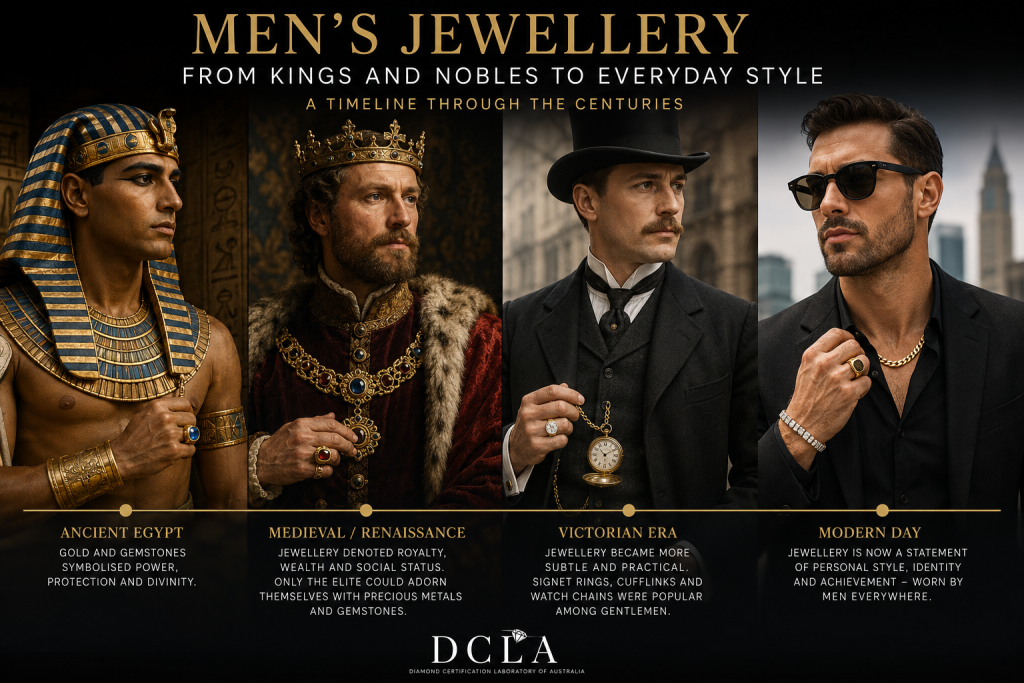
For thousands of years, jewellery has been a symbol of power, wealth, achievement and identity. Yet unlike today, there was a time when only kings, emperors, warriors and the wealthy elite had the privilege of wearing precious metals and gemstones. What was once reserved for royalty has evolved into an everyday expression of personal style, with men’s jewellery now enjoying one of the strongest revivals in modern history.

The Ancient Origins of Men’s Jewellery

Long before jewellery became associated with fashion, it represented status and survival.

Ancient Egyptian pharaohs wore elaborate gold collars, bracelets and gemstone-encrusted rings as symbols of divine authority. Gold was considered the flesh of the gods, while lapis lazuli, turquoise and carnelian were believed to offer protection and spiritual power.

In Ancient Rome, signet rings identified influential families, while decorated armour, gold wreaths and ceremonial jewellery distinguished military leaders and senators. The ability to wear precious metals was often regulated by social class.

Across Asia, jade carvings, gold ornaments and finely crafted jewellery denoted wisdom, prosperity and noble birth. In many cultures, jewellery was more than decoration—it was a visible declaration of rank.

Jewellery of Kings and Nobility

Throughout the Middle Ages and Renaissance, jewellery became increasingly exclusive.

European monarchs commissioned master jewellers to create crowns, chains of office, gemstone rings and ceremonial swords adorned with diamonds, rubies, emeralds and sapphires. These magnificent pieces were designed not simply to display wealth but to reinforce authority.

Sumptuary laws in many countries even dictated who could wear certain gemstones or precious metals. Diamonds, pearls and gold were often restricted to royalty and aristocracy, making jewellery an unmistakable marker of privilege.

Portraits of kings such as Henry VIII or Louis XIV reveal men lavishly adorned with necklaces, brooches, rings and precious stones—far removed from today’s understated image of masculine fashion.

The Victorian Shift

The Industrial Revolution dramatically changed society.

As manufacturing expanded and a growing middle class emerged, jewellery slowly became more accessible. Men’s fashion, however, became increasingly conservative. Dark suits replaced ornate clothing, and jewellery was reduced largely to practical or symbolic items such as:

  • Wedding bands
  • Pocket watches and chains
  • Cufflinks
  • Tie pins
  • Signet rings

For much of the twentieth century, Western men’s jewellery remained restrained, with elegance replacing extravagance.

Cultural Traditions Never Disappeared

While Western fashion became more conservative, many cultures continued to celebrate men’s jewellery.

Indian weddings remain famous for elaborate gold necklaces, bracelets and rings worn by grooms. Middle Eastern cultures have long valued gold jewellery as both adornment and a store of wealth. African tribal jewellery continues to represent heritage, leadership and identity.

These traditions helped preserve the idea that jewellery could remain an important part of masculine identity.

The Modern Renaissance

Over the past two decades, men’s jewellery has undergone a remarkable transformation.

Today’s man is no longer limited to a wedding ring and watch. Jewellery has become a form of self-expression, confidence and individuality.

Professional athletes, musicians, actors and entrepreneurs have normalised the wearing of luxury jewellery. Diamond tennis bracelets, layered necklaces, pinky rings, signet rings, earrings and diamond-set watches are now common across all age groups.

Social media has accelerated this trend, exposing consumers to international fashion and encouraging personal style rather than strict dress codes.

What was once seen as extravagant has become mainstream.

Jewellery for Every Man

Modern jewellery collections cater for every personality and lifestyle.

Some men prefer understated elegance with a platinum wedding band and classic cufflinks.

Others embrace bold fashion with diamond earrings, Cuban link chains, coloured gemstone rings or oversized tennis bracelets.

Materials have also diversified:

  • Yellow Gold offers timeless luxury.
  • White Gold provides a contemporary appearance.
  • Rose Gold delivers warmth and individuality.
  • Platinum remains the premium choice for durability and prestige.
  • Diamonds continue to symbolise strength, success and permanence.
  • Coloured gemstones allow men to express personality through sapphires, emeralds, rubies and even black diamonds.

The result is unprecedented choice, allowing jewellery to reflect the individual rather than social status alone.

Jewellery as a Statement of Success

Historically, jewellery represented inherited wealth.

Today it more often represents personal achievement.

A successful entrepreneur may purchase a diamond ring to celebrate a milestone. An athlete may invest in a custom chain after winning a championship. A father may receive an engraved bracelet marking the birth of a child.

These pieces become deeply personal, commemorating life’s important moments rather than simply displaying wealth.

Quality Matters More Than Ever

As men’s jewellery grows in popularity, consumers are becoming increasingly knowledgeable about craftsmanship and authenticity.

Understanding the quality of diamonds, coloured gemstones and precious metals has never been more important. Independent grading and certification provide buyers with confidence that their jewellery matches the quality they are paying for.

Whether purchasing a diamond ring, gemstone pendant or bespoke bracelet, expert assessment ensures transparency, accuracy and long-term value.

The Future of Men’s Jewellery

The evolution of men’s jewellery reflects broader changes in society. Personal style is no longer defined by rigid traditions but by individuality, confidence and self-expression.

The distinction between formal jewellery and everyday jewellery continues to blur, with men comfortably wearing pieces that previous generations reserved for special occasions.

In many ways, history has come full circle. Jewellery has once again become an important part of masculine identity—but unlike the days of kings and nobles, it is no longer reserved for the privileged few. Today, every man has the opportunity to express his personality, celebrate his achievements and invest in beautifully crafted jewellery that can be worn, treasured and eventually passed on to future generations.

At DCLA, we believe that understanding the quality and authenticity of diamonds and gemstones is just as important as appreciating their beauty. As men’s jewellery continues to evolve, independent grading and expert knowledge remain essential for anyone investing in fine jewellery designed to last a lifetime.

Thursday, 30 July 2026

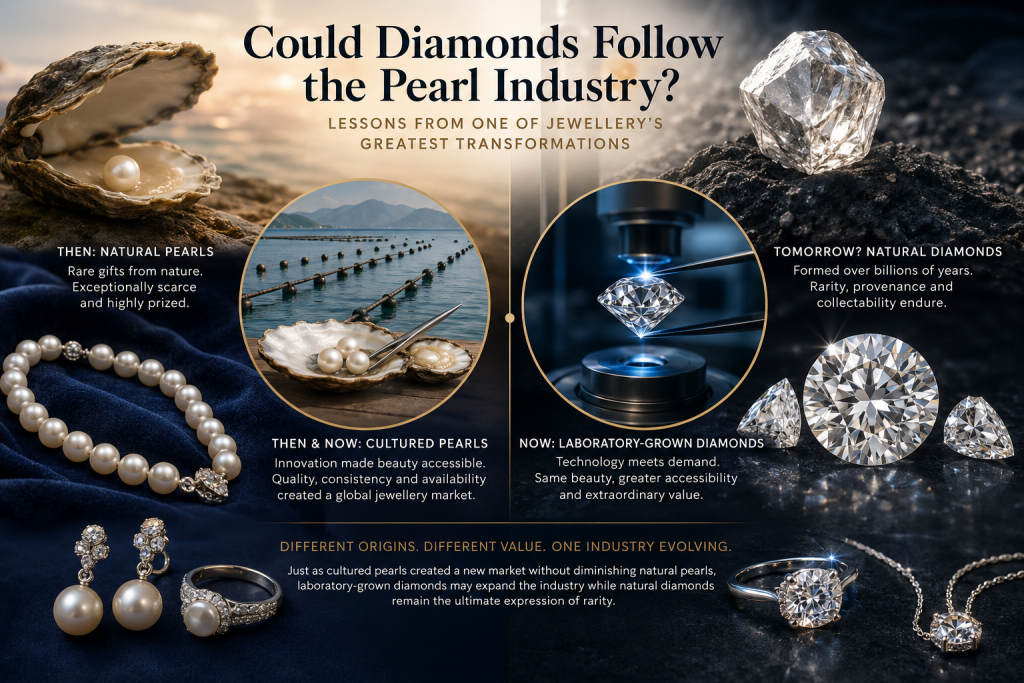
Could Diamonds Follow the Pearl Industry? Lessons from One of Jewellery's Greatest Transformations

 Could Diamonds Follow the Pearl Industrym, When Nature Could No Longer Meet Demand

For more than a century, natural diamonds have represented rarity, permanence and prestige. Yet today, the diamond industry is experiencing one of the most significant periods of change in its history. The rapid rise of laboratory-grown diamonds has challenged long-held assumptions about rarity, value and production.

While many compare laboratory-grown diamonds to synthetic gemstones, perhaps a more relevant comparison lies elsewhere. The transformation of the pearl industry offers an intriguing historical precedent.

Could diamonds be following a similar path?

When Nature Could No Longer Meet Demand

Before the early twentieth century, every pearl was natural.

Finding a single fine pearl required divers to open thousands of wild oysters, making exceptional pearls extraordinarily rare and valuable. As demand increased, natural oyster beds became depleted through over-harvesting, pollution and environmental change. The jewellery market faced an obvious problem: consumers wanted pearls, but nature simply could not supply them in sufficient quantity.

The solution came through cultured pearls.

By introducing a tiny nucleus into a living oyster, pearl farmers could encourage the oyster to produce a genuine pearl under controlled conditions. The process still relied on nature, but it dramatically increased consistency, availability and affordability.

Initially, cultured pearls were met with scepticism. Many believed they would destroy the value of natural pearls.

Instead, something quite different happened.

Two Markets Emerged

Rather than replacing natural pearls entirely, cultured pearls created an entirely new market.

Millions of consumers who had never been able to afford fine pearls suddenly could.

Natural pearls, however, became even rarer. As natural harvesting declined, truly exceptional natural pearls became increasingly desirable to collectors, museums and high-end jewellery houses.

Today, important natural pearl necklaces regularly achieve extraordinary auction results because of their rarity and historical significance.

The market effectively separated into two distinct categories:

  • Cultured pearls became the mainstream jewellery product.
  • Natural pearls became exceptional collector’s items.

Both markets survived—but they served different customers.

Diamonds May Be Facing a Similar Evolution

When Nature Could No Longer Meet Demand Before the early twentieth century, every pearl was natural.


Laboratory-grown diamonds are not imitation diamonds.

They possess the same crystal structure, chemical composition and optical properties as natural diamonds. Modern technology can produce exceptionally high-quality stones in a matter of weeks rather than over billions of years beneath the Earth’s surface.

Production efficiencies continue to improve.

Prices have fallen dramatically.

Quality has become increasingly consistent.

For many jewellery buyers, laboratory-grown diamonds offer larger sizes and higher specifications at significantly lower prices than natural diamonds.

This has fundamentally changed the entry-level diamond jewellery market.

The Difference is Rarity

Where the comparison becomes interesting is the concept of rarity.

Natural diamonds are finite geological creations formed over billions of years under immense heat and pressure.

Laboratory-grown diamonds can be manufactured repeatedly whenever production facilities are expanded.

This distinction mirrors the difference between natural and cultured pearls.

One derives its rarity from nature.

The other derives its availability from technology.

Neither is inherently “better” in every situation they simply satisfy different consumer priorities.

Luxury Has Always Valued Scarcity

History shows that luxury markets rarely disappear simply because a more affordable alternative becomes available.

Mechanical watches continue to thrive despite the accuracy of digital watches.

Original artworks remain valuable despite the existence of perfect reproductions.

Vintage wines command remarkable prices despite modern winemaking techniques.

Natural pearls retained their prestige after cultured pearls became mainstream.

Collectors often place a premium on objects that cannot simply be reproduced.

The same principle may continue to apply to exceptional natural diamonds.

Large, rare coloured diamonds, historically significant gemstones and stones with remarkable provenance are unlikely to lose their appeal simply because laboratory-grown diamonds become increasingly common.

Will Natural Diamonds Become More Exclusive?

As mining becomes more challenging and fewer new diamond deposits are discovered, the supply of natural diamonds may gradually tighten.

Several major mines are approaching the end of their productive lives, while fewer world-class discoveries have been made over the past two decades.

If production continues to decline while the finest stones remain desirable, natural diamonds could increasingly occupy a position similar to that of natural pearls—less common, more exclusive and primarily sought by collectors and connoisseurs.

Rather than competing directly with laboratory-grown diamonds, they may simply occupy a different market.

What Happens to Everyday Diamond Jewellery?

This may be where laboratory-grown diamonds reshape the industry most dramatically.

Consumers purchasing jewellery primarily for its appearance, design or sentimental value may increasingly choose laboratory-grown diamonds because they provide greater size and quality within a given budget.

Jewellery designers gain greater creative freedom.

Consumers gain more choice.

The overall market for diamond jewellery could even expand as affordability improves.

This is remarkably similar to what occurred with cultured pearls, which transformed pearls from an occasional luxury into an everyday jewellery category.

The Importance of Transparency

One lesson from the pearl industry is particularly relevant.

Consumers accepted cultured pearls because the industry clearly distinguished them from natural pearls.

Each category developed its own identity.

The same principle is essential for diamonds.

Natural and laboratory-grown diamonds are both genuine diamonds, but they have different origins, different rarity profiles and different market dynamics.

Clear disclosure, accurate grading and transparent terminology allow consumers to make informed purchasing decisions based on their own priorities rather than confusion or marketing.

The Future May Not Be Either-Or

The history of jewellery suggests that technological innovation rarely eliminates natural luxury products.

Instead, it often creates broader markets with distinct categories serving different needs.

Natural pearls and cultured pearls now coexist successfully.

It is entirely possible that natural and laboratory-grown diamonds will do the same.

Natural diamonds may increasingly represent geological rarity, heritage and long-term collectability.

Laboratory-grown diamonds may continue to dominate fashion jewellery, bridal markets and value-conscious consumers seeking exceptional visual beauty.

Rather than one replacing the other, both could become permanent parts of the modern jewellery landscape.

Conclusion

The transformation of the pearl industry demonstrates that innovation does not necessarily diminish the value of natural treasures. Instead, it can redefine their place within the luxury market.

Whether diamonds ultimately follow the same path remains to be seen, but the parallels are compelling. Laboratory-grown diamonds have undoubtedly changed accessibility and affordability, much as cultured pearls did generations ago.

History suggests that when technology makes luxury more accessible, the rarest natural examples often become even more distinctive.

For the jewellery industry, the future may not be about choosing between natural and laboratory-grown diamonds. Instead, it may be about recognising that each serves a different purpose, a different customer and a different definition of value.

As with pearls, the industry may simply be witnessing the emergence of two complementary markets one built on the rarity of nature, the other on the possibilities of technology.

Source: DCLA

Wednesday, 29 July 2026

From an $18 Billion Giant to a $1 Billion Sale: The Rise and Reinvention of De Beers

 De Beers was the undisputed leader of the global diamond industry.

For more than a century, De Beers was the undisputed leader of the global diamond industry. It transformed diamonds from a relatively rare luxury into the world’s most desired gemstone, creating the modern diamond market through visionary marketing, strict supply management and consumer confidence.

Today, that same company may be sold for as little as US$1 billion, marking one of the most remarkable reversals in the history of the luxury goods industry.

Anglo American Nears Historic Sale

Mining giant Anglo American is reportedly close to selling De Beers as it continues its restructuring following the failed takeover attempt by BHP in 2024.

According to reports, the preferred bidder is the Global Diamond Consortium (GDC), led by former De Beers Chief Executive Gareth Penny and backed by the governments of Namibia and Angola.

The proposed agreement would see GDC pay approximately US$750 million upfront, followed by a further US$250 million at a later stage. Additional performance-based payments may also form part of the final transaction, although negotiations remain ongoing and no final agreement has yet been reached.

The consortium also intends to inject approximately US$500 million into De Beers following the acquisition to strengthen operations and refocus the company on the mining and marketing of natural diamonds.

A Dramatic Fall in Valuation

The potential sale price is extraordinary considering De Beers’ former worth.

When Anglo American acquired the Oppenheimer family’s remaining stake in 2011, the transaction valued De Beers at nearly US$13 billion. During its strongest years, analysts estimated the company’s value exceeded US$18 billion.

However, a combination of falling rough diamond prices, weak Chinese luxury demand, changing consumer spending and the rapid emergence of laboratory-grown diamonds has dramatically reduced profitability across the sector.

Anglo has written down the value of De Beers three times in just three years, reducing its book value to approximately US$2.3 billion earlier this year.

The Company That Built the Modern Diamond Industry

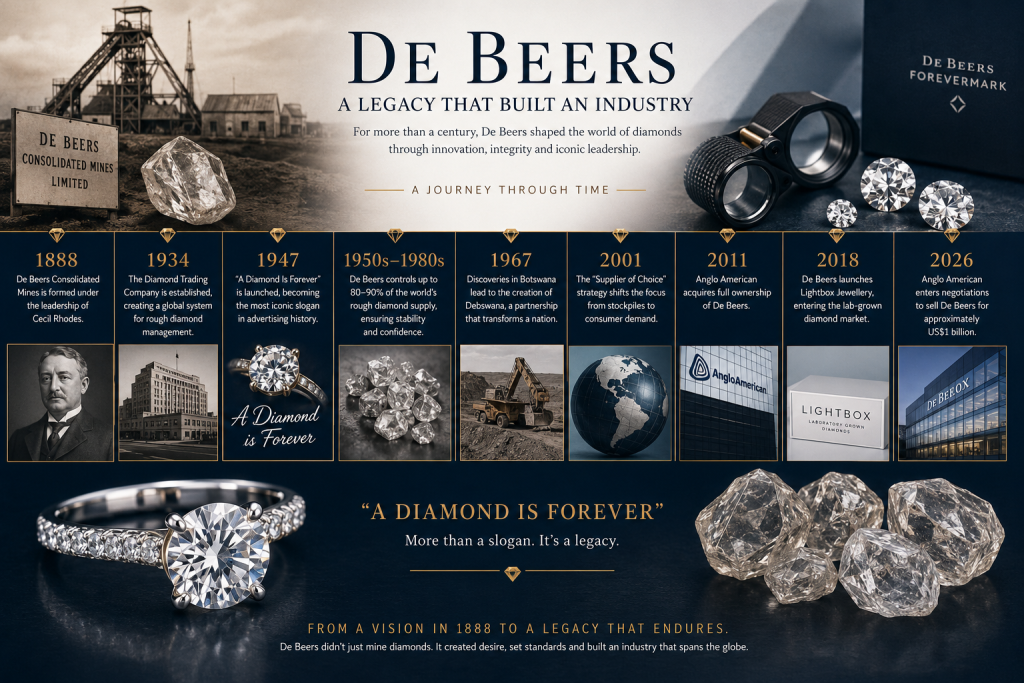
The iconic slogan "A Diamond Is Forever"


While today’s headlines focus on declining valuations, they should not overshadow De Beers’ extraordinary contribution to the global diamond trade.

Few companies have influenced an entire industry as profoundly.

Throughout most of the twentieth century, De Beers controlled the overwhelming majority of the world’s rough diamond supply. Through the Central Selling Organisation (CSO), it managed production, stabilised prices and created confidence that diamonds would retain their value.

Perhaps even more influential was its marketing.

In 1947, De Beers launched the now legendary slogan:

“A Diamond Is Forever.”

That simple phrase fundamentally changed consumer behaviour.

It established the diamond engagement ring as the global symbol of love and commitment and remains one of the most successful advertising campaigns ever created.

For decades, De Beers also invested heavily in consumer education, retailer training, grading standards and worldwide promotional campaigns that helped grow demand across Europe, North America, Japan and later China.

Without De Beers, the global diamond jewellery market as we know it today would likely never have existed.

Botswana Remains Central

Any transaction must also satisfy the Government of Botswana, which owns 15% of De Beers and jointly owns Debswana, the partnership responsible for producing most of Botswana’s diamonds.

President Duma Boko has previously expressed interest in increasing Botswana’s ownership of De Beers, although recent reports suggest the country may instead accept a larger minority stake.

Botswana remains one of the world’s most important diamond-producing nations, and its future relationship with De Beers will be crucial to any successful acquisition.

Gareth Penny Returns

Leading the proposed acquisition is Gareth Penny, who served as Chief Executive of De Beers between 2006 and 2010.

During the Global Financial Crisis, Penny successfully guided the company through one of the most difficult periods in diamond history by temporarily suspending mining operations, reducing supply and securing approximately US$1 billion through a rights offering.

His return signals an intention to restore De Beers’ focus on natural diamonds while adapting to today’s very different market conditions.

Milestones in De Beers History

1888 – Cecil Rhodes consolidates South African diamond mining companies to form De Beers Consolidated Mines.

1934 – The Diamond Trading Company is established, laying the foundations for centralised rough diamond distribution.

1947 – The iconic slogan “A Diamond Is Forever” is created by advertising agency N.W. Ayer, forever changing the jewellery industry.

1950s–1980s – De Beers controls as much as 80–90% of the world’s rough diamond supply, creating unprecedented market stability.

1967 – Major discoveries in Botswana eventually lead to the formation of Debswana, transforming Botswana into one of Africa’s greatest economic success stories.

1990s – Increasing production outside the De Beers system begins reducing the company’s market dominance.

2001 – De Beers introduces its “Supplier of Choice” strategy, shifting from stockpiling diamonds to demand-driven marketing.

2011 – Anglo American acquires full ownership of De Beers after purchasing the Oppenheimer family’s stake.

2018 – De Beers launches Lightbox Jewellery to enter the laboratory-grown diamond market, recognising changing consumer trends.

2025 – Lightbox is wound down as De Beers recommits its strategy to natural diamonds.

2026 – Anglo American enters negotiations to sell De Beers for approximately US$1 billion.

A New Beginning Rather Than the End

Although the proposed valuation represents a dramatic decline from De Beers’ former glory, the company still possesses some of the world’s most recognised diamond brands, valuable mining assets and decades of expertise.

More importantly, De Beers leaves behind a legacy that reshaped the global jewellery industry. It pioneered diamond marketing, built international confidence in natural diamonds and helped establish universal grading standards that continue to underpin the modern trade.

The challenge for new ownership will not be rebuilding history—but adapting that remarkable legacy to a new generation of consumers in a market where natural diamonds must increasingly differentiate themselves through rarity, provenance and enduring value.

Source: DCLA

Jewellery Costs vs Selling Prices: How to Buy Smart, Protect Your Investment, and Know Your Options When It’s Time to Sell

  Understanding the Difference Between What Jewellery Costs and What It Is Worth Buying a piece of jewellery is often an emotional decision....