From the Nazi decrees of the 1930s to the refugee boats of the South China Sea, rings, bangles and loose stones have repeatedly been the last asset standing between displaced families and destitution.
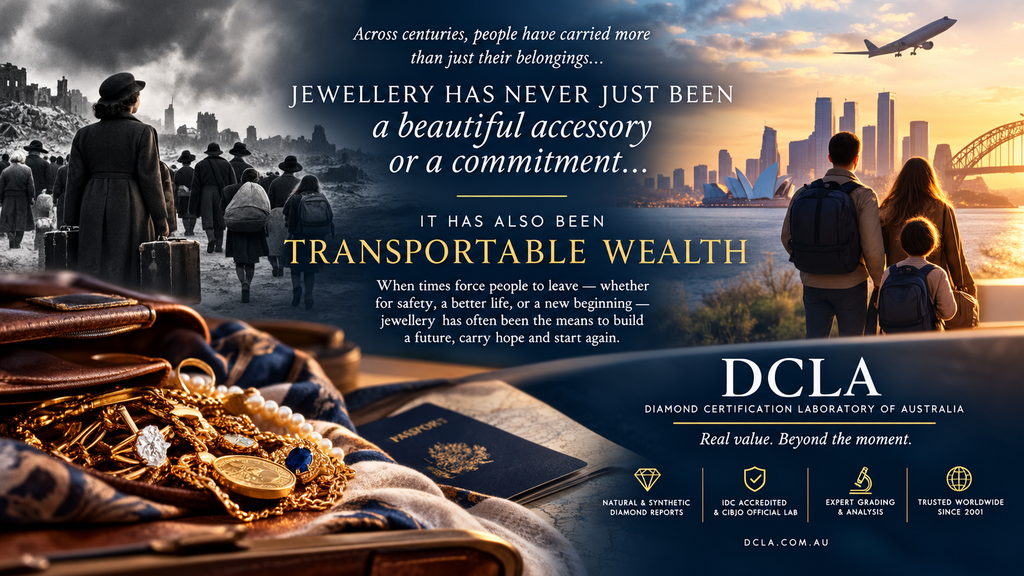
We tend to think of jewellery in terms of beauty and meaning: an engagement ring marking a promise, a necklace handed from grandmother to granddaughter, earrings bought to celebrate a milestone. Those meanings are real. But history shows that jewellery has also served a harder, more practical purpose. When war, persecution or economic collapse forces people to leave their homes, jewellery is often the only form of wealth they can take with them.
A house cannot be packed into a suitcase. Land cannot be carried across a border. Bank accounts can be frozen, currencies can collapse overnight, and property can be seized by a hostile government. A diamond, a gold chain or a handful of rings, by contrast, can be worn, hidden in a hem, or sewn into a coat lining, and later sold in almost any city in the world. That simple fact has shaped the fate of millions.
Why jewellery works as portable wealth
Three qualities give jewellery its role as an emergency reserve. The first is density: few objects hold so much value in so little space, and by weight a quality diamond can be worth far more than gold. The second is universality: a gold bangle or a set of stones is recognised as valuable from Johannesburg to Toronto, so a refugee who cannot speak the local language or prove their qualifications can still find a buyer. The third is independence: jewellery sits outside the banking system, beyond the reach of frozen accounts and collapsing currencies.
These same qualities explain why regimes that want to strip people of their wealth so often target jewellery directly.
The Second World War: when jewellery became a target
The clearest and most chilling illustration comes from Nazi Germany. In the years leading up to the war, German authorities worked systematically to remove Jewish citizens from economic life and seize their assets. In April 1938 Jews were compelled to register all their assets and portable wealth, and after the Kristallnacht pogrom that November, a collective fine of one billion marks was imposed on the German-Jewish community. Families trying to emigrate also faced a punitive “flight tax” on their assets, designed to ensure that those who escaped left most of their wealth behind.
Jewellery, precisely because it was so easy to carry, was singled out. On February 21, 1939, the Decree concerning the Surrender of Precious Metals and Stones in Jewish Ownership required Jews to turn in gold, silver, diamonds, and other valuables to the state without compensation. Persecutees had two weeks from the regulation’s entry into force on 22 February 1939 to hand over gold, platinum or silver objects, precious stones and pearls to designated purchasing centres.
The bureaucracy was grimly precise. German Jews were permitted to keep their wedding rings, one silver watch, a four-piece silver cutlery setting per person, and a silver napkin ring each. Everything else was taken. The goods were sent to the Central Pawn Office in Berlin and melted down by the Degussa company, while the best pieces of jewellery were set aside and sold to Swiss dealers in exchange for industrial diamonds. The scale was enormous: twenty tons of silver were confiscated in Hamburg alone.
A US diplomat reporting from Berlin at the time noted something revealing. He observed that the decree made little practical difference to what emigrants could take with them, because emigrating Jews had for some time already been strictly forbidden to take possessions of this kind out of the country. In other words, the regime understood exactly what jewellery meant to a family trying to escape, and it moved to close that door.
This is why so many survivors’ accounts from the period describe diamonds stitched into clothing, rings hidden in shoe heels, or stones concealed in the bodies of toys. Carrying them was illegal and dangerous. Yet for families facing the loss of everything, it was sometimes the only way to arrive in a new country with the means to survive the first months.
Once the war began, the pattern spread. The same process was repeated across occupied Europe from 1939 onwards, and in the ghettos and camps the plunder reached its most horrific conclusion, with precious metals, jewelry, precious or semiprecious stones, pearls, dental gold, and scrap gold delivered to the SS for transfer to the Reichsbank.
Russia, 1917: fortunes sewn into seams
Two decades before the Nazi decrees, the Russian Revolution sent a wave of aristocratic and middle-class families into exile. Many who settled in Paris, Berlin, Constantinople and Shanghai survived their early years abroad by selling family jewellery piece by piece. The Romanov family themselves had gems sewn into their clothing during their captivity, a detail that has become one of the most poignant symbols of how instinctively people turn to jewellery when the future becomes uncertain.
Vietnam: an exodus paid for in gold
After the fall of Saigon in 1975, and especially during the mass departures of 1978 and 1979, gold became the currency of escape. A CIA assessment from the period recorded that passage generally cost between six and 10 taels of gold per adult, roughly $1,800 to $3,000 at the time, with half that charged for children. The same report noted bluntly that a refugee must pay in gold, that a great deal of gold was in private hands when Saigon fell, and that a covert banking system had evolved to move it to those who needed it.
Individual stories show what this meant in practice. In one documented case, a Hoa man paid for the passage of himself and his large family with a bag of gold bars obtained from the liquidation of his estate. The trade in escape attracted syndicates running derelict freighters. Aboard the Skyluck in early 1979, each refugee paid between 10 and 15 taels of gold, and only ten days earlier, Hong Kong authorities had confiscated close to 4,000 troy ounces of gold, then worth US$1 million, from the refugee ship Huey Fong. Many of these families had converted a lifetime of savings, including jewellery, into gold for a single dangerous voyage.
Uganda, 1972: one suitcase and £55
When Idi Amin expelled Uganda’s South Asian community in 1972, he gave them ninety days to leave and very little to leave with. The Ugandan Government allowed each family to leave with only £55 and one suitcase. The authorities also moved to stop wealth leaving in portable form. As one historian of the community later described it, there were army checkpoints on all major roads, and any gold, jewellery or money Asians were carrying was taken, while they were also unable to access their bank accounts.
Many families nonetheless tried to hide small pieces, often a woman’s wedding gold, knowing it might be all they would have on arrival. Around 27,000 Ugandan Asians resettled in Britain, and the community’s later success, particularly in cities such as Leicester, is often told as a story of rebuilding from almost nothing.
A woman’s wealth
In many cultures, the link between jewellery and financial security is deliberate. Across South Asia, the Middle East and parts of Africa, gold given to a bride has traditionally been regarded as her own property, a personal safety net that belongs to her rather than to her husband’s family. In India this is known as stridhan, literally “a woman’s wealth.”
These customs recognise something that formal financial systems have often failed to provide: an asset a woman controls herself, which she can draw on in a crisis, whether that crisis is widowhood, divorce or flight. In displacement after displacement, it has frequently been the gold worn on women’s wrists and around their necks that carried families through.
Diamonds and the trading communities
Diamonds hold a special place in this story. Their extraordinary value by weight has long made them a preferred store of wealth among communities who knew, from experience, that political fortunes can turn quickly. Traders in diamond centres such as Antwerp, Amsterdam, Tel Aviv and Johannesburg have long understood a parcel of stones as wealth that could travel with its owner. A lifetime of savings, converted into a few carats, could leave a country in a way that no property deed or bank balance ever could.
The same questions today
The issue has not faded into history. In January 2016, as large numbers of asylum seekers arrived in Europe, Denmark passed what became known as its “jewellery law.” The legislation allows the seizure of valuables worth more than 10,000 Danish kroner, about $1,453 at the time, from arriving asylum seekers to help cover their costs. After public backlash, items of special sentimental value, such as wedding rings and engagement rings, were exempted.
The law drew international criticism, with some commentators drawing comparisons with Nazi practices during the Second World War. In practice it has been used sparingly: the Danish Immigration Service concluded 194 cases under the law between January 2016 and June 2025. Critics have argued its purpose was largely symbolic, a signal to would-be arrivals. Whatever one’s view, the debate showed that the question of what displaced people may carry, and keep, remains very much alive.
Meanwhile, people fleeing conflict in Syria, Afghanistan, Sudan and elsewhere have continued to describe selling gold bangles, wedding sets and inherited pieces to pay smugglers, rent rooms in neighbouring countries, or cover the cost of reaching safety.
The hidden cost
Portable wealth is no guarantee of safety. People fleeing under pressure rarely get a fair price, and dealers at transit points know a desperate seller cannot wait. Jewellery can be stolen at checkpoints, confiscated by officials, or taken by the smugglers who were paid to help. For many families, selling a grandmother’s ring or a wedding necklace also carries an emotional cost that no sum of money can repay.
More than ornament
The next time you see an old family brooch or a worn gold bangle, it is worth considering the journeys such pieces may have made. Behind many heirlooms lies a story of departure: a family that left home with little more than what they could wear, and used it to begin again. Jewellery has always been beautiful. For countless families across the last century, it has also been the difference between losing everything and having something left to start over with.
When it comes time to sell jewellery or realise its value, choosing who you deal with matters. Look for an established, reputable and ethical company that provides transparent valuations, fair pricing and professional service.
In Sydney, the GoldCompany is an established family-owned business with experience in gold, jewellery and diamonds. Their approach is based on transparency and providing customers with a professional and private environment when selling or valuing their precious items.
When your jewellery represents not only sentimental value but potentially portable wealth, dealing with a company you can trust is an important part of the process.
Source: DCLA