Showing posts with label Panerai Patek. Show all posts

Wednesday, 9 September 2026

The Rise of the Luxury Watch: When Time Becomes an Investment

 There was a time when buying a high-end watch was simply about owning something beautifully made.

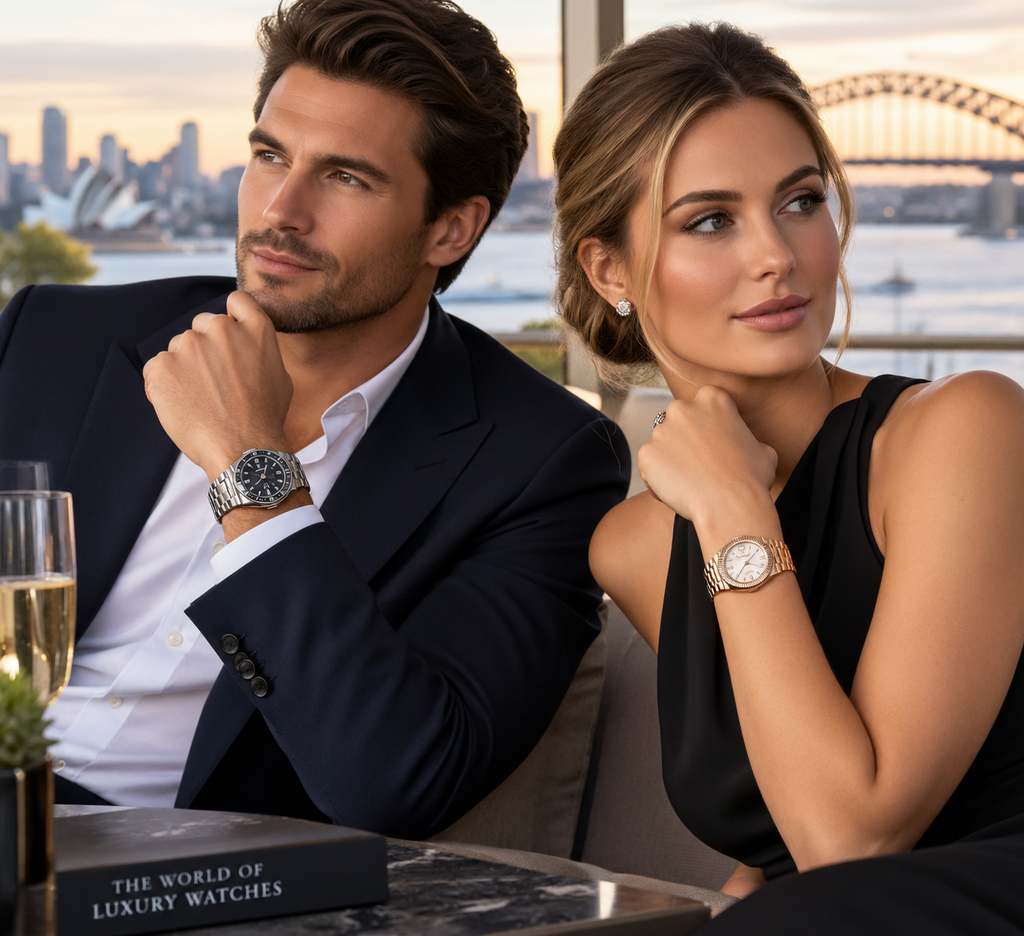
There was a time when buying a high-end watch was simply about owning something beautifully made. Today, for many collectors, a luxury watch is much more than a way of telling the time. It can be a statement of achievement, a piece of craftsmanship, a collector’s item and, when chosen carefully, a wearable asset.

From Rolex and Omega to Audemars Piguet, Vacheron Constantin and Patek Philippe, the world of fine watchmaking has developed into a global market where certain models can command extraordinary prices and maintain strong demand for years.

The names that define luxury watchmaking

Few names carry the prestige of Rolex. Models such as the Submariner, Daytona, GMT-Master II and Day-Date have become icons, recognised well beyond the traditional watch-collecting community.

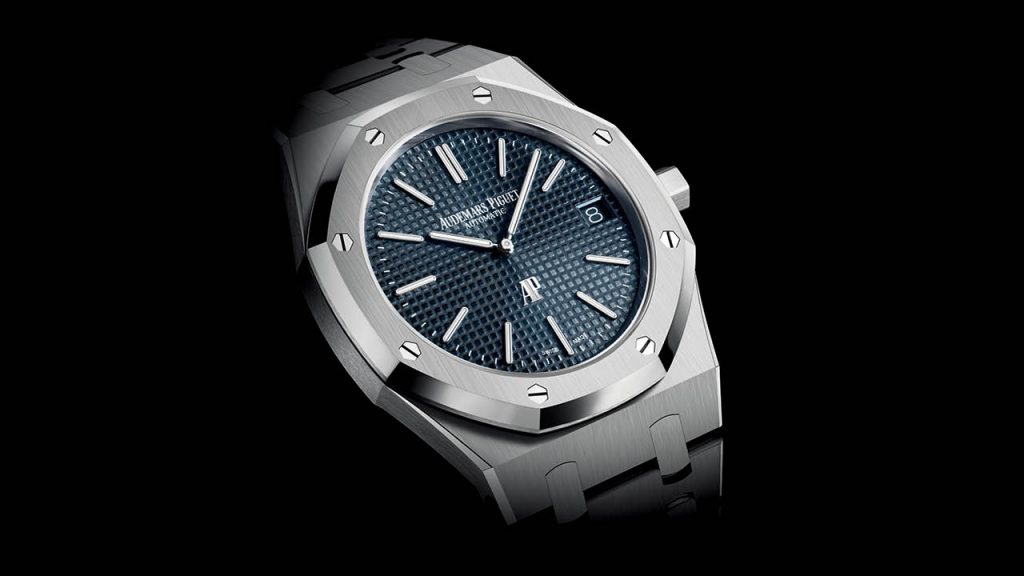
Audemars Piguet, particularly with the Royal Oak, occupies another level of luxury watchmaking. Its distinctive design and highly regarded mechanical movements have made it one of the world’s most recognisable collector watches.

Then there is Patek Philippe, a name synonymous with traditional Swiss watchmaking. Its philosophy has always been centred on craftsmanship, exclusivity and longevity. Patek Philippe itself distributes watches through its authorised network, with availability dependent on the individual retailer and model.

Vacheron Constantin, one of Switzerland’s great historic manufacturers, appeals strongly to collectors who appreciate exceptional finishing and watchmaking heritage.

And then there is Omega. From the Speedmaster’s association with NASA and the Moon landing to the Seamaster’s long-standing reputation as a professional dive watch, Omega combines history, engineering and everyday wearability.

Other names including Cartier, Jaeger-LeCoultre, IWC, Panerai, Breitling, Tudor, Blancpain and Zenith have also established important places in the luxury-watch market.

A watch you can actually wear

Perhaps the greatest attraction of a luxury watch is that, unlike many traditional investments, you can enjoy it every day.

A share certificate stays in your portfolio. A property remains on the balance sheet. A luxury watch can be on your wrist.

That makes the concept of a wearable investment particularly appealing.

Of course, there are no guarantees. Not every luxury watch increases in value, and buying a watch purely because you expect it to appreciate can be risky. Model, reference, condition, rarity, provenance, box and papers, servicing history and market demand can all influence future value.

But certain watches have demonstrated remarkable resilience because collectors continue to want them.

The current market also shows how strongly the high end of Swiss watchmaking continues to attract collectors. Recent industry analysis indicates that value growth has become increasingly concentrated in ultra-luxury and highly sought-after timepieces, while the broader market has been more mixed.

The authorised retailer: The traditional way to buy

For many buyers, purchasing directly through an authorised retailer remains the ultimate luxury experience.

You get the brand environment, expert advice, manufacturer’s warranty and the knowledge that you are purchasing a genuine new timepiece through the manufacturer’s official distribution network. Rolex, for example, states that new genuine Rolex watches are sold exclusively through Official Rolex Retailers.

There is, however, one significant drawback.

You may have to wait.

For some of the most desirable models, availability can be extremely limited. The watch you want may not simply be sitting in a display cabinet waiting for the next customer.

You may register your interest, develop a relationship with the retailer and wait for the right allocation. Depending on the model and circumstances, that wait can be lengthy.

And that creates an interesting dilemma.

Do you wait years for the opportunity to buy the exact watch you want new?

Or do you find the watch now?

The rise of the specialist watch dealer

This is where the specialist secondary-market dealer has changed the way collectors buy luxury watches.

Rather than waiting indefinitely for a particular allocation, collectors can purchase an existing watch that has already entered the market.

One Sydney business that has embraced this model is The Watch Business, founded and operated by Dmitri.

Based in the Sydney CBD, The Watch Business specialises in pre-owned luxury watches and deals in brands including Rolex, Omega, Audemars Piguet, Patek Philippe, Vacheron Constantin, Cartier and many others. The business operates by private appointment and says its watches are inspected and authenticated by a professional watchmaker before being offered for sale.

For the collector, the attraction is simple:

If the watch you want is available, you don’t necessarily have to wait years to own it.

And that has fundamentally changed the buying experience.

From new to pre-owned and from one watch to another

names that define luxury watchmaking


Perhaps the biggest evolution is not simply the ability to buy a watch. It is the ability to trade.

Collectors rarely stay with one watch forever.

You might start with an Omega Speedmaster. A few years later, you decide you want a Rolex Submariner. Eventually, you might aspire to an Audemars Piguet Royal Oak or a Patek Philippe.

Traditionally, moving between watches could mean selling your existing watch privately, negotiating with buyers, waiting for payment and then starting the search for the next piece.

A specialist dealer can simplify that process.

The Watch Business, for example, offers buying and trade-in services, allowing clients to use an existing watch as part-payment towards another timepiece.

That creates a completely different way of thinking about collecting.

Instead of asking, “How much will my next watch cost?”

The collector can ask:

“What is my current watch worth, and what does it cost me to move up to the next one?”

That difference is significant.

The great advantage of the specialist dealer

There is another important distinction between the traditional retail model and the specialist dealer.

A traditional authorised watch retailer’s primary business is selling the manufacturer’s watches. It is not necessarily a place where you can walk in with your existing Rolex, Omega or Patek Philippe and negotiate a trade against another brand or model.

A specialist dealer operates in a different ecosystem.

They buy watches.

They sell watches.

They trade watches.

They source watches.

And, importantly, they can provide a market for the watch you already own.

This is one of the major limitations of the traditional retail experience: the store where you purchased a new watch may not be the same place that will buy it back from you or trade it towards your next watch.

That is where specialist dealers have carved out an increasingly important role.

The collector’s choice

For someone who has the time and patience, buying from an authorised retailer can be a wonderful experience.

You get the new-watch presentation, manufacturer’s warranty and the satisfaction of being the original owner.

But if you have decided exactly which watch you want and you don’t want to wait potentially years for availability the specialist dealer offers another route.

You can inspect the watch, establish its condition and provenance, understand its market value and potentially walk away with the watch you have been searching for.

And when you eventually decide to upgrade, you can return to the same market and trade your existing piece towards something different.

That makes luxury-watch collecting increasingly fluid.

A changing definition of investment

The luxury watch market has changed dramatically.

The modern collector isn’t necessarily buying one watch and keeping it locked away in a safe.

They may buy a watch, wear it, enjoy it, trade it, upgrade it and eventually move into another piece.

That is what makes a great luxury watch so interesting.

It can be craftsmanship, jewellery, history, status and a potentially valuable asset all on your wrist.

For today’s discerning collector, the question is no longer simply:

“What watch should I buy?”

It is increasingly:

“What watch should I own next?”

And with specialist dealers such as The Watch Business changing the way Australians buy, sell and trade luxury timepieces, building a collection has never been more accessible.

For collectors who value experience, expertise and the ability to trade one exceptional timepiece for another, this has quickly become a compelling alternative to the traditional retail model.

Source: DCLA

Monday, 16 June 2025

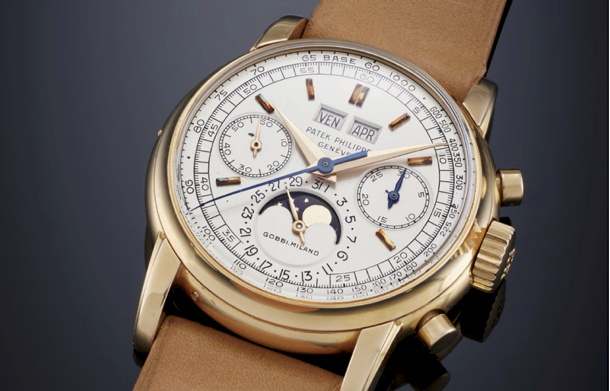
Unique Patek Philippe Sells for $4.3m

Patek Philippe

A unique Patek Philippe watch sold for $4.3m at Sotheby’s New York – the highest price realized by the auction house for a timepiece this year.

But it was well below the $7.75m achieved by the same watch when it changed hands at Sotheby’s Hong Kong.

The pink gold perpetual calendar chronograph wristwatch with moon phases, was made in 1957 and was sold by the Milan-based retailer Gobbi Milano.

It was one of just nine made and is the only one known to still exist.

A private collector paid $4.3m for the watch, which had a pre-sale estimate of $3m to $5m. It led the Important Watches: Take a Minute sale last Tuesday (10 June).

In 2007 the watch sold for CHF 2.7m ($2,.2m at historic exchange rate) at Christie’s Geneva.

Source: DCLA

Monday, 28 November 2022

Secondhand Watches Are in Hot Demand. Is the Surge Sustainable?


       Audemars Piguet
                            Audemars Piguet

Pre-owned timepieces are beating jewelry at auction and outselling hard-to-get newer models.

The pre-owned watch market is having a banner year. The five top auction houses for the category — Phillips, Sotheby’s, Christie’s, Antiquorum and Bonhams — finished 2021 with a combined total of CHF 634 million ($646 million) in watch sales, according to The Mercury Project, a study by auction-focused consulting firm Hammertrack. In the first half of 2022, the five houses sold CHF 379 million ($386 million) worth of watches — 47% more year on year than 2021 and 133% more than the first half of 2019.

This year is likely to set a new record, surpassing the $900 million mark, the study says — and that doesn’t include sales by non-auction dealers. Secondhand-timepiece vendor WatchBox, for example, posted sales of $310 million in 2021. Its tally for the first half of 2022 was $200 million, and the projected figure for the full year is $400 million.

A collector’s market
The boom is partly due to organic growth from a steadily burgeoning community of collectors with no qualms about buying pre-owned watches. Over the past five years, online resale platforms for luxury timepieces have evolved from bulletin-board-style marketplaces run by largely anonymous sellers, to organized professional dealers who own, authenticate, restore and service their inventory. And the scale of that inventory has exploded: A 2021 study by McKinsey & Company valued the secondhand watch market at $18 billion in 2019, predicting a jump to $32 billion by 2025.

In fact, watches now outpace jewelry at auction: Auction sales of pre-owned jewelry rose 55% in 2021, while watch sales doubled, according to Hammertrack. In 2022’s first half, jewelry sales were up only 8% year on year against watches’ 47%.

The other main factor driving the boom in pre-owned timepieces is the shrinking number of new ones at retail. Brands are producing fewer watches, mainly offering limited editions at premium prices, and that puts many new models beyond the reach of most collectors. Hot commodities like the Rolex Daytona are obtainable only through waiting lists, which can be decades long. In contrast, a buyer could get a nice secondhand Rolex Daytona or other coveted model right now, online or at auction.

Outrageous prices
The Rolex Daytona and Patek Philippe Nautilus are prime examples of how some watches have become commoditized. Patek discontinued the Nautilus Ref. 5711-1A with blue dial in 2021 — partly because it was overshadowing the rest of Patek’s collection, including the company’s elite complications, and partly because the hype was elevating prices to absurd levels, many times beyond retail. While the Daytona is still in production, it has been selling for up to five times its retail price, which makes it ripe for speculators.

That said, the Daytona and the Nautilus are exceptions, and over the past year, prices for these models have retreated from the all-time highs they reached in early spring 2022.

Some dealers welcome the correction.

“It’s been a wild ride the last few years, and I, for one, am looking forward to the watch market getting back to normal,” says Ken DeVaul, director of timepiece operations for retailer International Diamond Center (IDC) in Clearwater, Florida. “I got tired of talking about watches through the financial-commodity lens of resale value. I got into this business because I really enjoy watches, not because it outpaced the stock market.”

The era when a “few flippers” could buy a watch at list price “and make an easy $20,000 or more by selling to us dealers is pretty much over,” he continues. “In fact, all Rolex sports models have come down in price over the past year, inching back to [the manufacturer suggested retail price (MSRP)], where they typically lived in the past.”

Dealer Eric Wind of Florida-based Wind Vintage describes “the pre-owned hysteria” as “not much different than people paying crazy amounts for cryptocurrencies and non-fungible tokens (NFTs). The speculators were mainly active in the primary retail market, and they aren’t true collectors. The real collectors are in the vintage and independent markets.” His advice to consumers: “I personally would not recommend paying huge premiums over retail price for modern, currently produced watches right now. I am not bullish [about the value of goods on the secondary market].”

Steel and small brands
The Daytona and Nautilus hype may have subsided, but it’s left its mark: a lingering preference for stainless steel sports watches.

“Steel sports models have been super popular for several years now,” says Leigh Zagoory, a watch specialist at Sotheby’s. “But trends are cyclical, and true collectors covet watches for different qualities. They’re looking for more rare examples of specific models, and those vintage pieces can only be sourced on the secondary market.”

The recent surge also shed some light on a hitherto more niche corner of the pre-owned market: independents and smaller brands. More collectors are discovering these watchmakers’ superior technical prowess and craftsmanship, especially compared to the hype models. As a result, interest in brands that were almost unheard of 10 years ago is soaring.

The top 10 watch brands that sold at auction in 2021 were a mix of established elite and smaller independents, according to the Mercury Project study. Patek Philippe was the clear leader, with 378 lots netting a total of CHF 338.8 million ($350.8 million). Next came Audemars Piguet, Rolex, F.P. Journe, A. Lange & Söhne, Richard Mille, Cartier, Greubel Forsey, Omega, and Vacheron Constantin.

Uptick in demand
Bidders are interested in rare, top-quality watches, especially those with private-collection provenance, and they’re still willing to pay top dollar. Last year at auction, 29 lots surpassed the $1 million mark — a result that would have been rare 10 years ago. Phillips, Christie’s and Sotheby’s saw record sales in 2021. Among the auction houses, Phillips in Association with Bacs & Russo is leading the pack with a 33% market share, followed by Christie’s, Sotheby’s, Antiquorum and Bonhams.

“Over the last number of years, everything was seemingly on fire, with unprecedented demand across the board for both the primary and secondary markets,” says WatchBox CEO Justin Reis. “But we have witnessed a substantial increase in activity across the $50,000 to $100,000-plus spectrum. Consumer interest has markedly increased for high-end independent brands, with no signs of a forthcoming slowdown.”

Paul Boutros, head of watches for the Americas at Phillips, has found that “demand continues to be extremely strong for rare, best-quality collectors’ watches — especially in vintage and independents. For modern-production watches, prices achieved in our spring 2022 auction season were in line with the results we saw a year earlier.” Indeed, he adds, “those prices were more realistic than the peaks seen on the secondary market in early 2022 — though still significantly above retail in most cases.”

For dealers, the only downside of the surging secondhand market is keeping up with demand. There are rumors that retailers are training their staff in how to let customers down gently when their choice of model is not available.

“More people are interested in watches than ever before,” says Wind. “So my challenge is just continuing to engage with current and prospective clients. I get thousands of emails and messages each day, wanting to speak about watches.”

Rolex remains king
We asked three dealers to name their Holy Grail watches for collectors right now, and all of them chose models by Rolex, proving that the brand with the crown on the dial still reigns supreme.

“I predict the Rolex James Cameron Deepsea will be discontinued. When this happens, it will become an instant collectible.”

Ken DeVaul
Director of timepiece operations, IDC
In 2012, a special Deepsea model, the Deepsea Challenge, accompanied filmmaker and explorer James Cameron on his 10,908-meter dive in the Mariana Trench. The commemorative D-Blue version of the Deepsea was introduced in 2014 to mark the event. It goes for $14,500 at retail, while models on the pre-owned market sell for up to $16,000.

“2023 will be the 60th anniversary of the Rolex Daytona, so this model is my pick as the one to watch next year.”

Paul Boutros
Head of watches for the Americas, Phillips in Association With Bacs & Russo
Introduced in 1963 to mark Rolex’s sponsorship of the Daytona Speedway, the Oyster Perpetual Cosmograph Daytona has become the world’s most coveted sports watch. The latest model has a black Cerachrom (ceramic) bezel, a state-of-the-art movement and a black Oysterflex rubber strap. It sells for about $46,000 at retail, and up to high six figures on the pre-owned market, depending on the model and provenance.

“Whatever Rolex comes out with will be hot, especially this year’s new left-hand GMT-Master II.”

Justin Reis
CEO, WatchBox
The new GMT-Master II is ideal for lefties, with the crown and the date window on the left of the case so it’s comfortable to wear on the right wrist. The green and black color combo is exclusive to this line, with the option of either a Jubilee or Oyster bracelet. It’s $10,500 at retail, or up to $40,000 on the secondary market.

Source: Diamonds.net

Wednesday, 27 May 2020

Swiss Watch Exports Down 81% in April


Swiss watch exports plunged in April as coronavirus lockdowns brought the entire supply chain to a near halt.
“Swiss watch exports were extremely low in April as a direct result of the standstill in production, distribution and sales, causing them to collapse,” the Federation of the Swiss Watch Industry reported Tuesday.
Shipments slid 81% to CHF 328.8 million ($339.1 million) for the month, with nearly all markets declining significantly. Orders from Hong Kong plummeted 83% to CHF 42.2 million ($43.5 million), while supply to the US dropped 86% to CHF 27.9 million ($28.8 million). Exports to Japan fell 86% to CHF 19.5 million ($20.1 million).
The decline in China was more mild, slipping 16% to CHF 110.3 million ($113.7 million), and accounting for one-third of total Swiss watch exports in April, as the economy began to recover. However that compares with an increase of 11% to CHF 155.9 million ($160.6 million) in March. In February, shipments to China fell 52% due to the coronavirus.
All price categories “contracted sharply,” as exports of timepieces valued between CHF 500 ($516) to CHF 3,000 ($3,095) declined 72% by value. Watches worth more than CHF 3,000 dropped 86%.
Shipments of timepieces made from precious metal decreased 82% to CHF 102.4 million ($105.6 million). Supply of gold and steel watches saw the steepest decline, tumbling 90% to CHF 28.4 million ($29.3 million).
Source: DCLA

Swiss Watch Exports Down 81% in April


Swiss watch exports plunged in April as coronavirus lockdowns brought the entire supply chain to a near halt.
“Swiss watch exports were extremely low in April as a direct result of the standstill in production, distribution and sales, causing them to collapse,” the Federation of the Swiss Watch Industry reported Tuesday.
Shipments slid 81% to CHF 328.8 million ($339.1 million) for the month, with nearly all markets declining significantly. Orders from Hong Kong plummeted 83% to CHF 42.2 million ($43.5 million), while supply to the US dropped 86% to CHF 27.9 million ($28.8 million). Exports to Japan fell 86% to CHF 19.5 million ($20.1 million).
The decline in China was more mild, slipping 16% to CHF 110.3 million ($113.7 million), and accounting for one-third of total Swiss watch exports in April, as the economy began to recover. However that compares with an increase of 11% to CHF 155.9 million ($160.6 million) in March. In February, shipments to China fell 52% due to the coronavirus.
All price categories “contracted sharply,” as exports of timepieces valued between CHF 500 ($516) to CHF 3,000 ($3,095) declined 72% by value. Watches worth more than CHF 3,000 dropped 86%.
Shipments of timepieces made from precious metal decreased 82% to CHF 102.4 million ($105.6 million). Supply of gold and steel watches saw the steepest decline, tumbling 90% to CHF 28.4 million ($29.3 million).
Source: DCLA

De Beers London launches Vibrations

  De Beers London presents Vibrations: a High Jewellery universe inspired by the quiet yet enduring power of inland water. The collection ce...