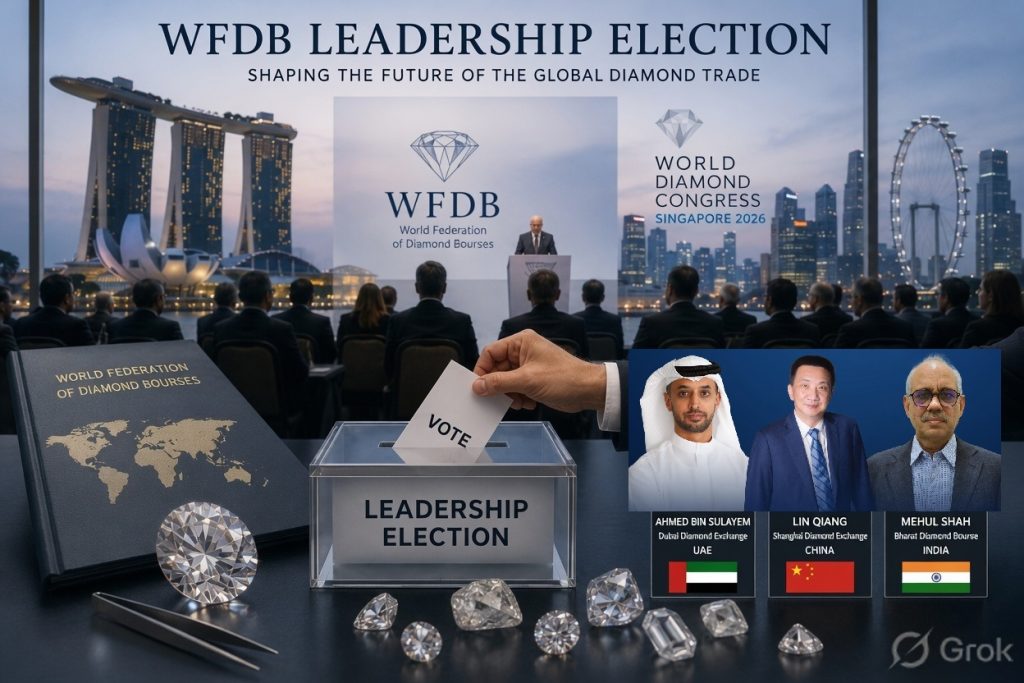
The World Federation of Diamond Bourses (WFDB) is preparing for one of its most closely watched presidential elections in decades, with three prominent industry figures competing to lead the organisation at a time when the natural diamond sector faces unprecedented change.
Delegates will cast their votes during the World Diamond Congress in Singapore, where a new president will succeed Yoram Dvash after he completes the maximum two consecutive three-year terms.
While leadership contests have traditionally attracted little public attention, this year’s election has become a reflection of much larger issues confronting the international diamond industry.
A Federation at a Crossroads
For more than 80 years, the WFDB has represented the world’s diamond exchanges and promoted ethical trading standards, cooperation and confidence in the natural diamond market.
Today, however, the role of traditional diamond bourses has evolved significantly.
Digital trading platforms, changing supply chains, direct manufacturer-to-retailer relationships and the rapid growth of laboratory-grown diamonds have transformed the industry. Many market participants now question how the WFDB should adapt to remain relevant in a rapidly changing commercial landscape.
The next president will inherit an organisation that must redefine its purpose while maintaining unity among members from vastly different markets and business models.
Three Candidates, Three Perspectives
The election features candidates representing three of the world’s most influential diamond centres.
- Mehul Shah of India’s Bharat Diamond Bourse brings decades of experience within both the WFDB and the international natural diamond trade. His campaign focuses on strengthening existing institutions, preserving industry traditions and gradually introducing new leadership through experience and mentorship.
- Lin Qiang, President of the Shanghai Diamond Exchange, advocates greater international cooperation while seeking fresh strategies to stimulate global consumer demand for natural diamonds. His emphasis is on building consensus and maintaining stability across the federation.
- Ahmed Bin Sulayem, Chairman of the Dubai Diamond Exchange, represents a more modern and commercially aggressive approach. Having helped establish Dubai as one of the world’s fastest-growing diamond trading hubs, he has attracted support from younger industry members calling for structural reform and renewed relevance for the federation.
Rather than simply choosing between individuals, member exchanges are effectively deciding which strategic direction the WFDB should follow over the coming decade.
Experience Versus Modernisation
One of the defining themes of the campaign has been the balance between experience and innovation.
Supporters of established leadership argue that governing an international federation requires decades of industry knowledge, trusted relationships and an understanding of the complex political and commercial issues affecting the global diamond trade.
Others believe the organisation must modernise more rapidly, attracting younger leadership capable of responding to changing consumer behaviour, digital commerce and increased competition from alternative luxury products.
The debate mirrors similar discussions taking place throughout the jewellery industry, where many long-established organisations are reassessing their relevance in a rapidly evolving marketplace.
The Lab-Grown Diamond Challenge
Perhaps no issue better illustrates the industry’s changing landscape than laboratory-grown diamonds.
Natural diamonds remain the core focus of the WFDB, yet the commercial reality is that many member companies now operate in both natural and laboratory-grown sectors.
This creates a delicate balancing act.
Some industry leaders believe the federation should remain exclusively focused on protecting and promoting natural diamonds.
Others argue that ignoring the growing laboratory-grown sector risks reducing the organisation’s influence over a significant portion of today’s diamond market.
The differing views among the candidates highlight the broader debate taking place throughout the global jewellery industry.
Shifting Centres of Influence
The election also reflects changing geographical power within the diamond business.
India continues to dominate cutting and polishing, while China remains one of the world’s largest consumer markets despite softer demand in recent years.
Meanwhile, Dubai has rapidly emerged as a major international trading hub, attracting significant volumes of rough and polished diamonds through its strategic location, favourable business environment and expanding infrastructure.
These shifting trade flows have altered the traditional balance of influence once dominated by historic centres such as Antwerp, Tel Aviv and New York.
More Than a Presidential Election
Beyond selecting a new president, the World Diamond Congress will consider broader initiatives aimed at strengthening international cooperation among member exchanges.
Delegates are also expected to discuss expanding membership and improving collaboration as the industry responds to changing market conditions, evolving consumer expectations and ongoing economic uncertainty.
The outcome of the election will not determine the future of the diamond industry on its own. However, it will provide a clear indication of how the world’s leading diamond exchanges believe the sector should respond to one of the most significant periods of transformation in its history.
Whether the federation chooses continuity, reform or a balance between the two, the decision will help shape the direction of the natural diamond trade for years to come.
Disclaimer: This article is provided for industry news and informational purposes only. The views expressed by election candidates and industry representatives are their own and do not necessarily reflect the opinions of DCLA. Leadership outcomes and organisational policies remain subject to the official decisions of the World Federation of Diamond Bourses (WFDB).