Showing posts with label wfdb. Show all posts

Thursday, 9 July 2026

WFDB Leadership Vote Signals a Turning Point for the Global Diamond Trade

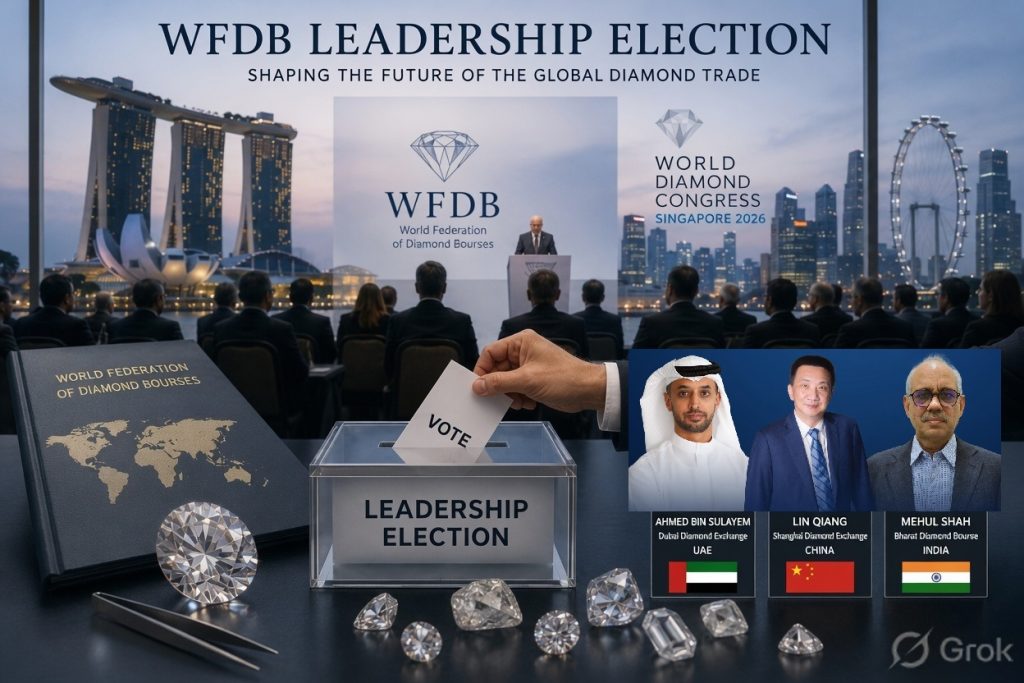
 The World Federation of Diamond Bourses (WFDB) is preparing for one of its most closely watched presidential elections in decades, with three prominent industry figures competing to lead the organisation at a time when the natural diamond sector faces unprecedented change.

The World Federation of Diamond Bourses (WFDB) is preparing for one of its most closely watched presidential elections in decades, with three prominent industry figures competing to lead the organisation at a time when the natural diamond sector faces unprecedented change.

Delegates will cast their votes during the World Diamond Congress in Singapore, where a new president will succeed Yoram Dvash after he completes the maximum two consecutive three-year terms.

While leadership contests have traditionally attracted little public attention, this year’s election has become a reflection of much larger issues confronting the international diamond industry.

A Federation at a Crossroads

For more than 80 years, the WFDB has represented the world’s diamond exchanges and promoted ethical trading standards, cooperation and confidence in the natural diamond market.

Today, however, the role of traditional diamond bourses has evolved significantly.

Digital trading platforms, changing supply chains, direct manufacturer-to-retailer relationships and the rapid growth of laboratory-grown diamonds have transformed the industry. Many market participants now question how the WFDB should adapt to remain relevant in a rapidly changing commercial landscape.

The next president will inherit an organisation that must redefine its purpose while maintaining unity among members from vastly different markets and business models.

Three Candidates, Three Perspectives

The election features candidates representing three of the world’s most influential diamond centres.

  • Mehul Shah of India’s Bharat Diamond Bourse brings decades of experience within both the WFDB and the international natural diamond trade. His campaign focuses on strengthening existing institutions, preserving industry traditions and gradually introducing new leadership through experience and mentorship.
  • Lin Qiang, President of the Shanghai Diamond Exchange, advocates greater international cooperation while seeking fresh strategies to stimulate global consumer demand for natural diamonds. His emphasis is on building consensus and maintaining stability across the federation.
  • Ahmed Bin Sulayem, Chairman of the Dubai Diamond Exchange, represents a more modern and commercially aggressive approach. Having helped establish Dubai as one of the world’s fastest-growing diamond trading hubs, he has attracted support from younger industry members calling for structural reform and renewed relevance for the federation.

Rather than simply choosing between individuals, member exchanges are effectively deciding which strategic direction the WFDB should follow over the coming decade.

Experience Versus Modernisation

One of the defining themes of the campaign has been the balance between experience and innovation.

Supporters of established leadership argue that governing an international federation requires decades of industry knowledge, trusted relationships and an understanding of the complex political and commercial issues affecting the global diamond trade.

Others believe the organisation must modernise more rapidly, attracting younger leadership capable of responding to changing consumer behaviour, digital commerce and increased competition from alternative luxury products.

The debate mirrors similar discussions taking place throughout the jewellery industry, where many long-established organisations are reassessing their relevance in a rapidly evolving marketplace.

The Lab-Grown Diamond Challenge

Perhaps no issue better illustrates the industry’s changing landscape than laboratory-grown diamonds.

Natural diamonds remain the core focus of the WFDB, yet the commercial reality is that many member companies now operate in both natural and laboratory-grown sectors.

This creates a delicate balancing act.

Some industry leaders believe the federation should remain exclusively focused on protecting and promoting natural diamonds.

Others argue that ignoring the growing laboratory-grown sector risks reducing the organisation’s influence over a significant portion of today’s diamond market.

The differing views among the candidates highlight the broader debate taking place throughout the global jewellery industry.

Shifting Centres of Influence

The election also reflects changing geographical power within the diamond business.

India continues to dominate cutting and polishing, while China remains one of the world’s largest consumer markets despite softer demand in recent years.

Meanwhile, Dubai has rapidly emerged as a major international trading hub, attracting significant volumes of rough and polished diamonds through its strategic location, favourable business environment and expanding infrastructure.

These shifting trade flows have altered the traditional balance of influence once dominated by historic centres such as Antwerp, Tel Aviv and New York.

More Than a Presidential Election

Beyond selecting a new president, the World Diamond Congress will consider broader initiatives aimed at strengthening international cooperation among member exchanges.

Delegates are also expected to discuss expanding membership and improving collaboration as the industry responds to changing market conditions, evolving consumer expectations and ongoing economic uncertainty.

The outcome of the election will not determine the future of the diamond industry on its own. However, it will provide a clear indication of how the world’s leading diamond exchanges believe the sector should respond to one of the most significant periods of transformation in its history.

Whether the federation chooses continuity, reform or a balance between the two, the decision will help shape the direction of the natural diamond trade for years to come.

Disclaimer: This article is provided for industry news and informational purposes only. The views expressed by election candidates and industry representatives are their own and do not necessarily reflect the opinions of DCLA. Leadership outcomes and organisational policies remain subject to the official decisions of the World Federation of Diamond Bourses (WFDB).

Tuesday, 19 May 2026

Botswana and Angola Governments Join WFDB as Industry Seeks Closer Producer Links


The governments of Botswana and Angola have officially become affiliated members of the World Federation of Diamond Bourses in a significant move that strengthens ties between major diamond producing nations and the global trading sector.

The announcement was made on 18 May during the WFDB International Summit held in Gaborone.

Although neither country currently operates a fully established standalone diamond bourse, both nations have sought representation within the WFDB due to the critical role diamonds play in their economies. Botswana remains the world’s second largest producer of natural diamonds, while Angola continues to expand its position as a major African diamond producer and trading hub.

This marks the first time governments have been admitted into the WFDB, which represents the world’s leading diamond bourses and trading centres. Botswana and Angola have initially been granted affiliate membership status, with both countries expected to participate as full WFDB members at the World Diamond Congress 2026 in Singapore this July.

Bogolo Kenewendo, Botswana’s Minister of Minerals and Energy, said the membership demonstrates the country’s commitment to international co operation, responsible industry growth, and strengthening the position of natural diamonds in an increasingly competitive market shaped by synthetic stones.

For Botswana, direct engagement with the trading community is expected to enhance collaboration around transparency, traceability, and the differentiation of natural diamonds from lab grown products.

Diamantino Azevedo, Angola’s Minister of Mineral Resources, described the move as an important step in deepening Angola’s engagement with the international diamond trade while supporting broader industry collaboration. Angola has spent several years developing plans for its own diamond exchange as part of wider reforms aimed at modernising the country’s diamond sector.

Kimberley Process Faces Renewed Criticism Ahead of Mumbai Meeting

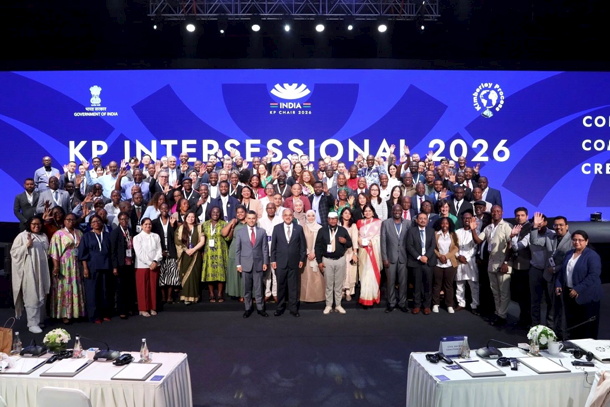
Meanwhile, the Kimberley Process has come under renewed pressure from civil society groups ahead of last week’s intersessional meeting in Mumbai.

The Kimberley Process Civil Society Coalition issued a strongly worded assessment criticising what it described as another failed reform cycle. The group argued that the KP continues to struggle with redefining conflict diamonds, addressing compliance concerns, and delivering meaningful transparency measures.

Farai Maguwu, vice coordinator of the KP Civil Society Coalition, said the natural diamond industry often focuses on competition from lab grown diamonds while failing to confront long standing structural issues within the sector itself.

He stated that the Kimberley Process must move beyond “superficial marketing adjustments” and instead become more transparent, accountable, and capable of responding to modern diamond related abuses.

However, World Diamond Council president Ronnie VanderLinden offered a far more optimistic assessment following the conclusion of the meeting.

VanderLinden praised the co operation shown by participants and said the KP demonstrated its ability to work through difficult issues under pressure. He also commended India’s leadership and its focus on the “3Cs” vision of Confidence, Credibility, and Compliance.

He added that the industry must now find the determination to modernise the definition of conflict diamonds so it better reflects current global realities and expectations surrounding responsible sourcing and ethical trade.

Source: DCLA

Wednesday, 6 November 2024

WFDB Call for Five-Year Marketing Campaign

WFDB Call for Five-Year Marketing Campaign

The natural diamond industry needs coordinated and consistent marketing campaigns to counter declining demand, says Yoram Dvash, president of the World Federation of Diamond Bourses (WFDB).

In an open letter he calls on every member of the industry to help create a five-year plan, rather than relying on “short-term initiatives when the situation is particularly dire”.

He acknowledges that De Beers and the Natural Diamond Council are both spending millions of dollars on campaigns with leading retailers, but says it’s not enough.

“I am concerned that this is too little and too late,” he says. “To be successful, campaigns need to be coordinated and to be consistent throughout the year.”

He says there hasn’t been a major generic marketing campaign for natural diamonds for almost 20 years, when De Beers halted its “A Diamond is Forever” promotion.

“An entire generation of consumers has come of age without having been exposed to promotional campaigns with positive messages about natural diamonds,” he says in a letter to all the WFDB’s 29 member bourses.

Source: DCLA

Thursday, 14 May 2020

Ernie Blom Wins First Round of WFDB Court Fight


Ernie Blom has won the first stage of a legal battle against the World Federation of Diamond Bourses (WFDB), from which he stepped down as president last month. 
A court has threatened the WFDB with a $27m fine if it complies with a request to suspend him as a bourse member.
Mr Blom challenged the right of the WFDB to have him banned from one of its member bourses, the Dubai Diamond Exchange (DDE).
A commercial court in Antwerp has now made an interim ruling that prohibits the WFDB from having him suspended or excluded from the DDE, pending a further hearing.

Mr Blom, a diamond trader based in South Africa, clashed with the WFDB, of which he was long-standing president after a business disagreement. 
He insisted that the dispute resolution committee of the DDE did not have international jurisdiction to rule in a dispute between his two companies and three plaintiffs – Angel Diamonds, KMA Diamonds and Diampex –  in December 2019. 

He’d been ordered to pay $331,500 but refused to comply and initiated legal proceedings. As a result, in February 2020 the DDE announced it was suspending him.

It then asked WFDB to tell all 29 member bourses of the suspension.
But Mr Blom responded via his attorney, claiming the DDE had violated its own statutes as he had NOT in fact been formally suspended.
On 17 April Mr Blom announced that he was stepping down temporarily as president of the WFDB, a position he’d held since 2012, ahead of a court hearing that took place in Antwerp on 5 May.

At the time  Marc De Block, his Belgian lawyer, said: “While the DDE is well aware to have committed very grave errors against my client, and even explicitly acknowledged this, they stubbornly refuse to correct such actions.”
In its 12-page judgement, the court concludes that Mr Blom’s claims are admissible and well-founded.

It “prohibits the WFDB from having Mr Ernest Blom posted throughout the world as a suspended or excluded member of the Dubai Diamond Exchange (Diamond Bourse in Dubai) to all its members until such time as  a final judgement has been handed down on the merits of the case against WFDB.”
It goes on to warn the WFDB that it faces a penalty of 25m Euro ($27m) if it fails to comply.
Source: DCLA

Ernie Blom Wins First Round of WFDB Court Fight


Ernie Blom has won the first stage of a legal battle against the World Federation of Diamond Bourses (WFDB), from which he stepped down as president last month. 
A court has threatened the WFDB with a $27m fine if it complies with a request to suspend him as a bourse member.
Mr Blom challenged the right of the WFDB to have him banned from one of its member bourses, the Dubai Diamond Exchange (DDE).
A commercial court in Antwerp has now made an interim ruling that prohibits the WFDB from having him suspended or excluded from the DDE, pending a further hearing.

Mr Blom, a diamond trader based in South Africa, clashed with the WFDB, of which he was long-standing president after a business disagreement. 
He insisted that the dispute resolution committee of the DDE did not have international jurisdiction to rule in a dispute between his two companies and three plaintiffs – Angel Diamonds, KMA Diamonds and Diampex –  in December 2019. 

He’d been ordered to pay $331,500 but refused to comply and initiated legal proceedings. As a result, in February 2020 the DDE announced it was suspending him.

It then asked WFDB to tell all 29 member bourses of the suspension.
But Mr Blom responded via his attorney, claiming the DDE had violated its own statutes as he had NOT in fact been formally suspended.
On 17 April Mr Blom announced that he was stepping down temporarily as president of the WFDB, a position he’d held since 2012, ahead of a court hearing that took place in Antwerp on 5 May.

At the time  Marc De Block, his Belgian lawyer, said: “While the DDE is well aware to have committed very grave errors against my client, and even explicitly acknowledged this, they stubbornly refuse to correct such actions.”
In its 12-page judgement, the court concludes that Mr Blom’s claims are admissible and well-founded.

It “prohibits the WFDB from having Mr Ernest Blom posted throughout the world as a suspended or excluded member of the Dubai Diamond Exchange (Diamond Bourse in Dubai) to all its members until such time as  a final judgement has been handed down on the merits of the case against WFDB.”
It goes on to warn the WFDB that it faces a penalty of 25m Euro ($27m) if it fails to comply.
Source: DCLA

Choosing the Right Precious Metal for Fine Diamond Jewellery

  Why Gold Purity, Colour and Craftsmanship Matter When purchasing a fine diamond, most buyers focus on the stone itself its cut, colour, cl...