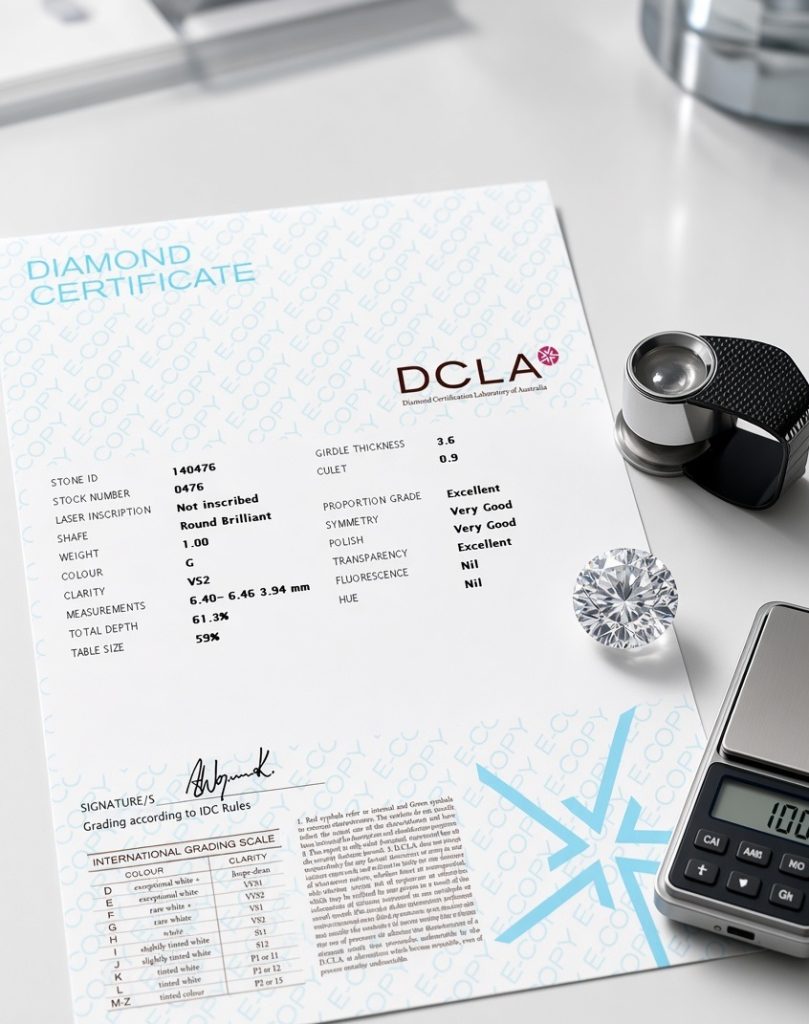
Selling a diamond is very different from selling an ordinary piece of jewellery. A diamond can be worth thousands, tens of thousands, or considerably more, but its value depends on characteristics that cannot simply be judged by looking at the stone.
If you are thinking about selling a diamond, one of the most important questions you should ask is:
“Do I have an independent diamond grading report for my stone?”
If the answer is no, obtaining an independent report before you sell can be one of the smartest steps you take.
What paperwork do you need to sell a diamond?
There is no single piece of paperwork that every seller must have in every situation. However, the more information you can provide about a diamond, the easier it is for a potential buyer to establish exactly what they are purchasing.
Ideally, you should have:
- An independent diamond grading report or certificate
- Your original purchase invoice, if available
- Any previous valuation or insurance documentation
- Details of the jeweller or supplier from whom the diamond was purchased
- Any previous laboratory report
- Information about whether the diamond is natural or laboratory-grown
- Any documentation relating to treatments or enhancements
- The original jewellery purchase paperwork, if the diamond is still mounted
Not having these documents does not mean you cannot sell your diamond.
However, it can make the process more difficult.
A buyer may have to conduct their own examination and testing before being prepared to make an offer. Until the diamond’s identity and quality have been independently established, there may be uncertainty surrounding its value.
What if I don’t have a diamond certificate?
This is extremely common.
Many people inherit diamonds, purchase jewellery years ago, lose the original paperwork, or simply were never given an independent grading report when they bought the diamond.
You may have a valuation from an insurance company or jeweller, but it is important to understand that a valuation and a diamond grading report are not the same thing.
A valuation generally provides an estimated monetary value for a particular purpose and point in time.
A grading report describes the diamond itself.
It can document characteristics such as carat weight, colour, clarity, measurements, cut, polish, symmetry, fluorescence and other identifying characteristics. DCLA also identifies whether a diamond is natural or laboratory-grown and records relevant treatments or enhancements.
That distinction becomes particularly important when you are trying to sell.
Why an independent diamond report matters
Imagine trying to sell a car without knowing its exact model, engine size, year or service history.
The buyer may still be interested, but they have less information and therefore more uncertainty.
Diamonds work in a similar way.
A reputable independent laboratory removes much of that uncertainty by providing an objective assessment of the stone.
Instead of telling a potential buyer:
“I was told this is a 1.50-carat G colour VS1 diamond.”
you can provide an independent laboratory report documenting the diamond’s characteristics.
That gives the buyer something they can examine, verify and compare.
DCLA reports include a unique certificate identification number, detailed diamond characteristics and are securely archived, with an online certificate verification service available.
Why certification can help you sell internationally
One of the biggest advantages of having a recognised independent laboratory report is that you are no longer relying solely on your own description of the diamond.
A properly documented diamond can be presented to jewellers, dealers, insurers and potential buyers in different markets with a much greater level of confidence.
This is particularly important if you are considering selling outside Australia.
DCLA is an internationally recognised Australian diamond grading laboratory, established in 2001 to provide certification in Australia according to International Diamond Council (IDC) standards. DCLA states that its reports are produced in accordance with IDC and CIBJO standards and that the laboratory is internationally accredited and recognised.
DCLA is also listed on RapNet and IDEX, giving its reports additional recognition within the international diamond trade.
The result is simple: a properly documented diamond is easier for a potential buyer to understand, verify and compare.
Why choose DCLA?
If you have a diamond without a report, having it independently graded by a recognised laboratory can give you a significant advantage when you eventually decide to sell.
DCLA has been operating since 2001 and was established specifically to bring internationally compliant diamond grading to the Australian market.
The laboratory grades diamonds according to International Diamond Council standards and uses advanced testing technology to identify natural and laboratory-grown diamonds, detect treatments and assess the diamond’s characteristics.
Just as importantly, DCLA operates independently.
The diamond is assigned a unique identification number when it enters the laboratory, with customer information removed from the grading process. This helps ensure that the grading assessment is independent and not influenced by the commercial interests of a buyer or seller.
Consistency is important when selling a diamond
Diamond grading is not simply about putting a number on a stone.
Small differences in colour, clarity, cut and other characteristics can have a significant effect on market value.
This is why consistency and recognised grading standards matter.
A report from an independent laboratory gives the market a common reference point.
Instead of different buyers relying on different descriptions, they can refer to the same documented characteristics.
That can be particularly valuable when a diamond is being offered to buyers outside your local market.
A certificate is not a valuation
There is one important point every diamond owner should understand.
A diamond grading report is not a valuation.
The report describes the diamond; it does not guarantee what somebody will pay for it.
The eventual selling price depends on many factors, including current market conditions, the diamond’s characteristics, demand, the buyer, and whether the stone is being sold privately, through the trade or as part of a jewellery piece.
However, knowing exactly what you have puts you in a much stronger position when discussing price.
What happens if the diamond is still in a ring?
If your diamond is mounted in a ring or other jewellery, the laboratory may need to examine the stone carefully and, depending on the setting, remove it to provide an accurate grading assessment.
DCLA notes that accurate grading of the diamond itself can require the stone to be loose. Simple claw settings may sometimes be removed in the laboratory, while more complex settings such as bezel settings may require additional consideration because removal can potentially affect the jewellery.
This is another reason to have the diamond assessed professionally before you begin the selling process.
Don’t rely on paperwork produced by the seller
An important principle when buying or selling diamonds is independence.
A document produced by a retailer, dealer or other party with a financial interest in the diamond is not the same as an independent laboratory grading report.
The purpose of an independent laboratory is to assess the diamond objectively rather than to sell it.
DCLA specifically recommends checking that a diamond report comes from an independent laboratory rather than from a merchant or retailer with a financial interest in the stone.
Your diamond may be worth more than you think — or less
One of the biggest mistakes diamond owners make is assuming that an old valuation or the price originally paid tells them what their diamond is worth today.
Neither necessarily reflects today’s market.
The diamond market changes, and the price originally paid for a piece of jewellery can include manufacturing, design, retail margins, branding, GST and other costs that may not be recoverable when the item is sold.
Before selling, it is therefore important to establish exactly what you own.
What is the diamond?
Is it natural or laboratory-grown?
What is its carat weight?
What are its colour and clarity grades?
How has it been cut?
Is it treated?
Does it have an identifiable laboratory report?
Once these questions have been answered, you can approach the selling process with considerably more information.
Have a diamond but no certificate?
Don’t assume you have a problem.
If you have inherited a diamond, lost the original paperwork, bought an older diamond without certification, or simply want to establish exactly what you own before selling, an independent DCLA grading report can provide the documentation you need.
With DCLA’s international recognition, IDC-based grading standards, secure report records and verification system, your diamond can have documentation that is meaningful beyond simply having a piece of paper in your hand.
Before you sell your diamond, know what you have.
A professional, independent diamond grading report can give you the confidence to approach the market with accurate information and can make it easier for potential buyers to assess your stone whether they are in Australia or looking at the diamond from an international market.
DCLA Independent Diamond Certification Since 2001
If your diamond does not have a current independent grading report, DCLA can assess and certify the stone, providing a detailed record of its characteristics and identity.
Don’t sell your diamond based on what you think it is worth.
Get the diamond independently assessed, documented and certified first.