Showing posts with label sell engagement ring. Show all posts

Tuesday, 25 August 2026

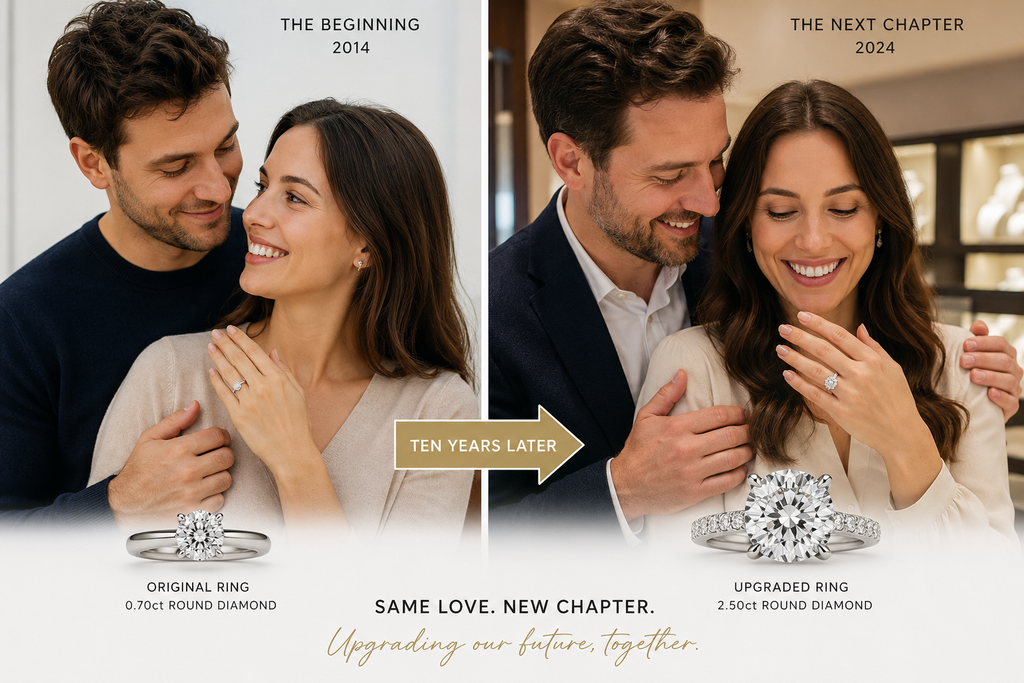
Should You Upgrade Your Engagement Diamond?

 An engagement ring is one of the most sentimental pieces of jewellery a person can own. It represents a promise, a relationship and a moment in time. But what happens when life changes?

An engagement ring is one of the most sentimental pieces of jewellery a person can own. It represents a promise, a relationship and a moment in time. But what happens when life changes?

Perhaps the couple’s financial position has improved significantly. Perhaps the original diamond was chosen when money was tighter, and she has always secretly dreamed of a larger stone or a completely different diamond shape. Or perhaps jewellery styles have changed and the original setting no longer reflects her personal taste.

This raises an interesting question: Should you upgrade an engagement diamond, or is the original stone too sentimental to replace?

At the Diamond Certification Laboratory of Australia (DCLA), we believe there is no single right answer. The decision comes down to the meaning attached to the original diamond, its quality and value, and what the owner wants from the jewellery today.

The Diamond May Be Sentimental — But the Memory Is Not Only in the Stone

There is a common belief that the original engagement diamond should never be changed because it represents the beginning of the marriage.

That is certainly a valid view.

For some couples, the original diamond is an important family heirloom in the making. It is the stone that was present when the proposal happened, and no larger or more valuable diamond could replace that emotional significance.

But jewellery can also evolve.

A diamond is a precious asset, but it is also a piece of jewellery designed to be worn and enjoyed. If circumstances change, there is nothing inherently wrong with changing the stone, redesigning the ring or even selling the original diamond.

The sentimental value does not necessarily disappear simply because the jewellery changes.

What If She Has Always Wanted a Different Shape?

Diamond shapes are highly personal.

Perhaps the original engagement ring contains a round brilliant diamond, but she has always preferred an oval, emerald cut, pear, cushion or radiant cut.

If the couple can now comfortably afford the diamond she always wanted, upgrading can be an opportunity to create the ring that reflects her personality today.

A larger diamond is not necessarily a better diamond. Shape, proportions, cut quality, colour, clarity and the overall design of the ring all influence its appearance.

This is where professional diamond advice becomes particularly important.

A significant increase in size may look impressive, but changing shape can sometimes produce an even more dramatic transformation without simply buying the biggest stone available.

Should You Trade In the Original Diamond?

There are several options.

1. Trade the Original Diamond Toward the New One

This is probably the simplest solution.

The original diamond can be professionally assessed and valued, with its value contributing toward the purchase of the replacement diamond.

However, owners should understand that the original retail purchase price is not necessarily what the diamond is worth when it is traded.

The diamond’s current quality, certification, market demand, proportions, colour, clarity and overall desirability will influence its value.

This is why an independent assessment and proper diamond grading can be extremely useful before making a decision.

2. Keep the Original Diamond

For some couples, this is the best of both worlds.

The original diamond can be removed from the engagement ring and preserved, while a new diamond becomes the centrepiece of the redesigned engagement ring.

The original stone can then remain with the family as an heirloom.

One day it might become a pendant, a dress ring or even another family member’s engagement ring.

The important point is that the original diamond does not have to disappear simply because the engagement ring has been upgraded.

3. Remodel the Original Diamond

Sometimes the diamond is not the problem the setting is.

An old-fashioned setting can make a beautiful diamond look dated.

A new setting can completely transform the appearance of the original diamond.

This can be particularly attractive when the diamond itself has strong sentimental value.

Instead of replacing the stone, the couple can create an entirely new piece of jewellery around it.

4. Create Another Piece of Jewellery

There is also the possibility of taking the original diamond out of the engagement ring and creating something completely different.

A diamond that has spent decades in an engagement ring could become a pendant, earrings or another ring.

This can be a wonderful way of preserving the original diamond while allowing the owner to enjoy a new design.

Is the Original Diamond an Heirloom?

If the diamond was passed down from a parent or grandparent, its emotional value may far exceed its monetary value.


This is perhaps the most important question.

If the diamond was passed down from a parent or grandparent, its emotional value may far exceed its monetary value.

In that situation, selling or replacing it may not make sense.

But if the diamond was purchased specifically for the original engagement and has no previous family history, the decision may be different.

A diamond can become an heirloom because of the story attached to it not simply because of its age.

Keeping the original stone means preserving that story.

But creating a new piece of jewellery from it can also preserve the story.

Jewellery Trends Will Change — But Quality Should Remain

Fashion inevitably changes.

The popularity of particular diamond shapes, settings, metal colours and jewellery styles can move in cycles.

What looks contemporary today may look dated in twenty years.

That does not mean an engagement ring should be changed every time fashion changes. Good jewellery should have longevity.

However, there is nothing wrong with updating a piece when the owner genuinely wants something different.

The key is not to confuse a temporary fashion trend with a genuine change in personal preference.

The Emotional Decision


Ultimately, upgrading an engagement diamond is not simply a financial decision.

It is worth asking:

Does the original diamond still make you happy?

Would you regret selling it?

Have you always wanted a different shape or larger diamond?

Would keeping the original diamond as an heirloom be meaningful to your family?

Could the original diamond be remodelled into another piece that you would actually wear?

If the answer is that the original diamond has enormous sentimental value, keep it.

If the answer is that it is simply an old piece of jewellery that no longer suits your taste, upgrading may make perfect sense.

And sometimes the best answer is both: buy the diamond you always wanted and preserve the original diamond for the next generation.

There Is No Rule That Says Jewellery Cannot Evolve

An engagement ring marks the beginning of a marriage. It does not have to remain frozen in time for the next fifty years.

People change. Relationships grow. Financial circumstances change. Tastes develop. Jewellery can change too.

The original engagement diamond may remain the most important diamond you ever owned even if it eventually becomes a pendant or is carefully stored as a family heirloom.

Alternatively, it may simply be a piece of jewellery that has served its purpose and can be traded toward something that better reflects your life today.

The right decision is the one that balances sentimental value, financial value and personal enjoyment.

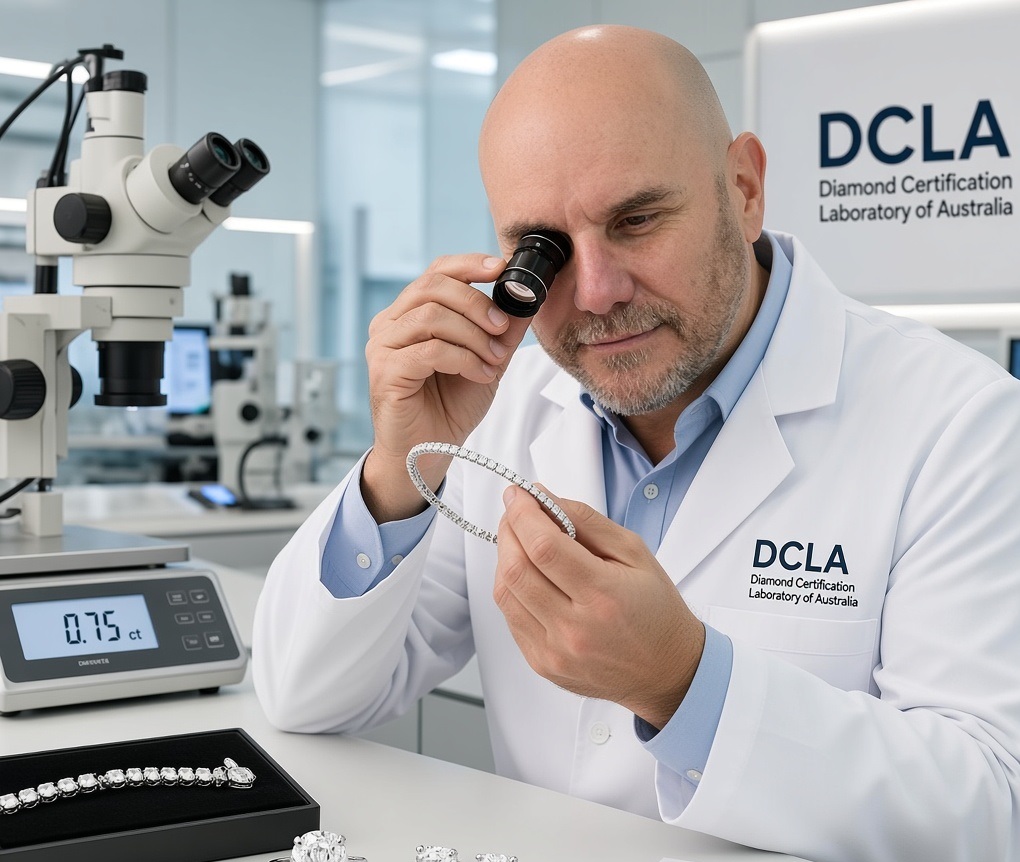
At DCLA, we believe the most important step is to understand exactly what you have before deciding what to do with it. Professional diamond grading and identification can help establish the characteristics of the original stone, allowing you to make an informed decision about keeping, remodelling, trading or upgrading it.

After all, an engagement diamond is valuable but the story surrounding it can be priceless.

Wednesday, 12 August 2026

Selling a Diamond? Here’s the Paperwork You Need to Know About

 Selling a diamond is very different from selling an ordinary piece of jewellery. A diamond can be worth thousands, tens of thousands, or considerably more, but its value depends on characteristics that cannot simply be judged by looking at the stone.

Selling a diamond is very different from selling an ordinary piece of jewellery. A diamond can be worth thousands, tens of thousands, or considerably more, but its value depends on characteristics that cannot simply be judged by looking at the stone.

If you are thinking about selling a diamond, one of the most important questions you should ask is:

“Do I have an independent diamond grading report for my stone?”

If the answer is no, obtaining an independent report before you sell can be one of the smartest steps you take.

What paperwork do you need to sell a diamond?

There is no single piece of paperwork that every seller must have in every situation. However, the more information you can provide about a diamond, the easier it is for a potential buyer to establish exactly what they are purchasing.

Ideally, you should have:

  • An independent diamond grading report or certificate
  • Your original purchase invoice, if available
  • Any previous valuation or insurance documentation
  • Details of the jeweller or supplier from whom the diamond was purchased
  • Any previous laboratory report
  • Information about whether the diamond is natural or laboratory-grown
  • Any documentation relating to treatments or enhancements
  • The original jewellery purchase paperwork, if the diamond is still mounted

Not having these documents does not mean you cannot sell your diamond.

However, it can make the process more difficult.

A buyer may have to conduct their own examination and testing before being prepared to make an offer. Until the diamond’s identity and quality have been independently established, there may be uncertainty surrounding its value.

What if I don’t have a diamond certificate?

This is extremely common.

Many people inherit diamonds, purchase jewellery years ago, lose the original paperwork, or simply were never given an independent grading report when they bought the diamond.

You may have a valuation from an insurance company or jeweller, but it is important to understand that a valuation and a diamond grading report are not the same thing.

A valuation generally provides an estimated monetary value for a particular purpose and point in time.

A grading report describes the diamond itself.

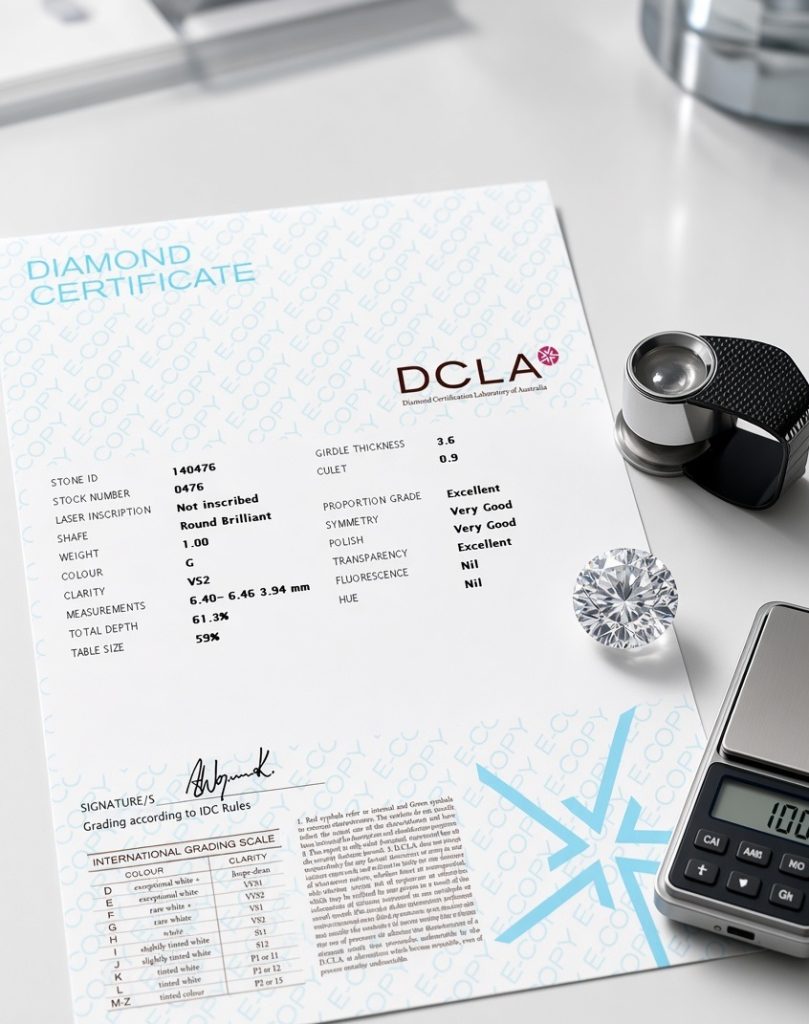
It can document characteristics such as carat weight, colour, clarity, measurements, cut, polish, symmetry, fluorescence and other identifying characteristics. DCLA also identifies whether a diamond is natural or laboratory-grown and records relevant treatments or enhancements.

That distinction becomes particularly important when you are trying to sell.

Why an independent diamond report matters

Imagine trying to sell a car without knowing its exact model, engine size, year or service history.

The buyer may still be interested, but they have less information and therefore more uncertainty.

Diamonds work in a similar way.

A reputable independent laboratory removes much of that uncertainty by providing an objective assessment of the stone.

Instead of telling a potential buyer:

“I was told this is a 1.50-carat G colour VS1 diamond.”

you can provide an independent laboratory report documenting the diamond’s characteristics.

That gives the buyer something they can examine, verify and compare.

DCLA reports include a unique certificate identification number, detailed diamond characteristics and are securely archived, with an online certificate verification service available.

Why certification can help you sell internationally

One of the biggest advantages of having a recognised independent laboratory report is that you are no longer relying solely on your own description of the diamond.

A properly documented diamond can be presented to jewellers, dealers, insurers and potential buyers in different markets with a much greater level of confidence.

This is particularly important if you are considering selling outside Australia.

DCLA is an internationally recognised Australian diamond grading laboratory, established in 2001 to provide certification in Australia according to International Diamond Council (IDC) standards. DCLA states that its reports are produced in accordance with IDC and CIBJO standards and that the laboratory is internationally accredited and recognised.

DCLA is also listed on RapNet and IDEX, giving its reports additional recognition within the international diamond trade.

The result is simple: a properly documented diamond is easier for a potential buyer to understand, verify and compare.

Why choose DCLA?

If you have a diamond without a report, having it independently graded by a recognised laboratory can give you a significant advantage when you eventually decide to sell.

DCLA has been operating since 2001 and was established specifically to bring internationally compliant diamond grading to the Australian market.

The laboratory grades diamonds according to International Diamond Council standards and uses advanced testing technology to identify natural and laboratory-grown diamonds, detect treatments and assess the diamond’s characteristics.

Just as importantly, DCLA operates independently.

The diamond is assigned a unique identification number when it enters the laboratory, with customer information removed from the grading process. This helps ensure that the grading assessment is independent and not influenced by the commercial interests of a buyer or seller.

Consistency is important when selling a diamond

Diamond grading is not simply about putting a number on a stone.

Small differences in colour, clarity, cut and other characteristics can have a significant effect on market value.

This is why consistency and recognised grading standards matter.

A report from an independent laboratory gives the market a common reference point.

Instead of different buyers relying on different descriptions, they can refer to the same documented characteristics.

That can be particularly valuable when a diamond is being offered to buyers outside your local market.

A certificate is not a valuation

There is one important point every diamond owner should understand.

A diamond grading report is not a valuation.

The report describes the diamond; it does not guarantee what somebody will pay for it.

The eventual selling price depends on many factors, including current market conditions, the diamond’s characteristics, demand, the buyer, and whether the stone is being sold privately, through the trade or as part of a jewellery piece.

However, knowing exactly what you have puts you in a much stronger position when discussing price.

What happens if the diamond is still in a ring?

If your diamond is mounted in a ring or other jewellery, the laboratory may need to examine the stone carefully and, depending on the setting, remove it to provide an accurate grading assessment.

DCLA notes that accurate grading of the diamond itself can require the stone to be loose. Simple claw settings may sometimes be removed in the laboratory, while more complex settings such as bezel settings may require additional consideration because removal can potentially affect the jewellery.

This is another reason to have the diamond assessed professionally before you begin the selling process.

Don’t rely on paperwork produced by the seller

An important principle when buying or selling diamonds is independence.

A document produced by a retailer, dealer or other party with a financial interest in the diamond is not the same as an independent laboratory grading report.

The purpose of an independent laboratory is to assess the diamond objectively rather than to sell it.

DCLA specifically recommends checking that a diamond report comes from an independent laboratory rather than from a merchant or retailer with a financial interest in the stone.

Your diamond may be worth more than you think — or less

One of the biggest mistakes diamond owners make is assuming that an old valuation or the price originally paid tells them what their diamond is worth today.

Neither necessarily reflects today’s market.

The diamond market changes, and the price originally paid for a piece of jewellery can include manufacturing, design, retail margins, branding, GST and other costs that may not be recoverable when the item is sold.

Before selling, it is therefore important to establish exactly what you own.

What is the diamond?

Is it natural or laboratory-grown?

What is its carat weight?

What are its colour and clarity grades?

How has it been cut?

Is it treated?

Does it have an identifiable laboratory report?

Once these questions have been answered, you can approach the selling process with considerably more information.

Have a diamond but no certificate?

Don’t assume you have a problem.

If you have inherited a diamond, lost the original paperwork, bought an older diamond without certification, or simply want to establish exactly what you own before selling, an independent DCLA grading report can provide the documentation you need.

With DCLA’s international recognition, IDC-based grading standards, secure report records and verification system, your diamond can have documentation that is meaningful beyond simply having a piece of paper in your hand.

Before you sell your diamond, know what you have.

A professional, independent diamond grading report can give you the confidence to approach the market with accurate information and can make it easier for potential buyers to assess your stone whether they are in Australia or looking at the diamond from an international market.

DCLA Independent Diamond Certification Since 2001

If your diamond does not have a current independent grading report, DCLA can assess and certify the stone, providing a detailed record of its characteristics and identity.

Don’t sell your diamond based on what you think it is worth.

Get the diamond independently assessed, documented and certified first.

Tuesday, 17 February 2026

Natural Diamond Engagement Ring Prices Surge in the US – What Australian Buyers Need to Know

 Natural Diamond Engagement Ring Prices Surge in the US – What Australian Buyers Need to Know

The average price of a natural diamond engagement ring in the United States rose by 9 per cent to US$7,346 in 2025, according to the Natural Diamond Council (NDC). In its latest report, Natural Diamond Trends: A 2025 Overview, the NDC notes that the average centre stone size increased by 5 per cent to 1.16 carats, reflecting continued consumer preference for larger, statement diamonds.

Round brilliant diamonds maintained their dominant position, accounting for 62 per cent of all engagement ring sales, unchanged from the previous year. Oval cuts eased slightly to 14 per cent, down from 16 per cent, while long fancy shapes such as marquise and cushion continued to gain traction. SI1 clarity was the most commonly purchased grade, although the report did not specify the leading colour category.

Diamond engagement rings — including complete rings, loose centre stones and bridal semi-mounts — represented 38 per cent of all natural diamond jewellery sales by volume in 2025. The data, compiled by Tenoris from more than four million anonymised point-of-sale transactions across 2,500 US specialty retailers, highlights a market driven by quality upgrades and larger stones. Across the broader natural diamond jewellery category, the 2.00–2.24 carat and 1.50–1.59 carat segments recorded the fastest unit sales growth, contributing to a 10 per cent rise in average jewellery prices. Seasonal gifting periods — notably November and December, together with Valentine’s Day and Mother’s Day — accounted for 46 per cent of annual diamond jewellery volume.

How does this compare with Australia?

In Australia, the average spend on a natural diamond engagement ring is generally lower than in the US, typically ranging between AUD $5,000 and AUD $8,000 depending on city, retailer positioning and diamond specifications. While the Australian market also shows strong demand for round brilliant cuts, there has been a noticeable shift toward oval and elongated fancy shapes, particularly among younger buyers seeking distinctive designs.

From a grading perspective, Australian consumers — particularly those purchasing through independent jewellers and specialist laboratories such as Diamond Certification Laboratory of Australia (DCLA) — tend to place strong emphasis on accurate certification, cut quality and value retention. Carat weights commonly centre around the 1.00 to 1.20 carat range, closely mirroring US trends, although there remains a solid market for well-cut diamonds just under key weight thresholds (e.g. 0.90–0.99 carats) where value optimisation is a priority.

Overall, the US data confirms a global pattern: consumers are gravitating toward larger stones, higher specifications and enduring classic shapes. In Australia, while total average spend remains slightly below US levels when adjusted for currency, the qualitative trends — preference for natural diamonds, round brilliants and milestone gifting seasons — remain closely aligned with international markets.

Source: DCLA

Wednesday, 9 February 2022

Sell Platinum, Diamonds, Gold and Silver

We ensure you are always in the best position to #sell your #gold and #silver with our price advantage.


Visit our office in the Sydney CBD and meet with one of our trained gold buyer specialists.

Sell Gold Jewellery


We will be delighted to have a chat with you about the gold market and how you can use your old gold and silver to find a financial solution. 💰💰💰

Sell Gold and Silver


Call us for a price or appointment. 02 9020 5150

Website: GoldCompany

Friday, 28 January 2022

Diamond Buying And Selling Tips

 You may experience uncertainty when purchasing a diamond, particularly an engagement diamond. This is not unjustified with the increased incidence of treated diamonds, synthetic diamonds and diamond simulants, no to mention incorrectly certified or graded diamonds.


Some Quick Tips

Buy from a reputable jeweller. A reputable jeweller sells with genuine Diamond Grading Reports or Certificates.

Buy with a diamond grading report or certificate from an independent and recognised diamond grading laboratory. This ensures you have a natural, untreated diamond that has been graded accurately. DCLA is the only independent and internationally recognised laboratory in Australia.

Note that a “valuation” or “appraisal” is NOT a certificate.

Read the certificate carefully to ensure that you make an informed decision

Price comparison is only possible if you are comparing certified diamonds. Diamond Grading Reports and Certification allows you to compare prices without unknowingly sacrificing quality or natural origin.

Be cautious of “sales” which appear to be genuine but are nothing more than a large discount off an inflated price. If it seems to good to be true, it probably is.

Be cautious of internet retailers offering a huge selection of diamonds. Often many are not available – this is a classic baiting scam.

Buy a diamond that is cold laser inscribed. This identifies the diamond and ensures you get the one described by the diamond’s report or certificate.

Do not buy your diamond overseas, buy locally. This ensures you have recourse if anything is wrong.

Diamonds are priced the same way worldwide -there are no cheap diamonds, only lower quality.


Read more: DCLA

Diamond Buying And Selling Tips

 You may experience uncertainty when purchasing a diamond, particularly an engagement diamond. This is not unjustified with the increased incidence of treated diamonds, synthetic diamonds and diamond simulants, no to mention incorrectly certified or graded diamonds.


Some Quick Tips

Buy from a reputable jeweller. A reputable jeweller sells with genuine Diamond Grading Reports or Certificates.

Buy with a diamond grading report or certificate from an independent and recognised diamond grading laboratory. This ensures you have a natural, untreated diamond that has been graded accurately. DCLA is the only independent and internationally recognised laboratory in Australia.

Note that a “valuation” or “appraisal” is NOT a certificate.

Read the certificate carefully to ensure that you make an informed decision

Price comparison is only possible if you are comparing certified diamonds. Diamond Grading Reports and Certification allows you to compare prices without unknowingly sacrificing quality or natural origin.

Be cautious of “sales” which appear to be genuine but are nothing more than a large discount off an inflated price. If it seems to good to be true, it probably is.

Be cautious of internet retailers offering a huge selection of diamonds. Often many are not available – this is a classic baiting scam.

Buy a diamond that is cold laser inscribed. This identifies the diamond and ensures you get the one described by the diamond’s report or certificate.

Do not buy your diamond overseas, buy locally. This ensures you have recourse if anything is wrong.

Diamonds are priced the same way worldwide -there are no cheap diamonds, only lower quality.


Read more: DCLA

Protect Your Jewellery, How to Check Your Jewellery Before You Lose It.

  Fine jewellery is designed to be worn and enjoyed, but even the best-made piece will experience wear over time. The metal that holds your ...