Jewellery is meant to be worn, enjoyed and treasured. But for some people, wearing a ring, necklace, bracelet or pair of earrings can result in redness, itching, irritation or even a rash.
When this happens, many people immediately assume they are allergic to gold, silver or another precious metal. That is not always the case.
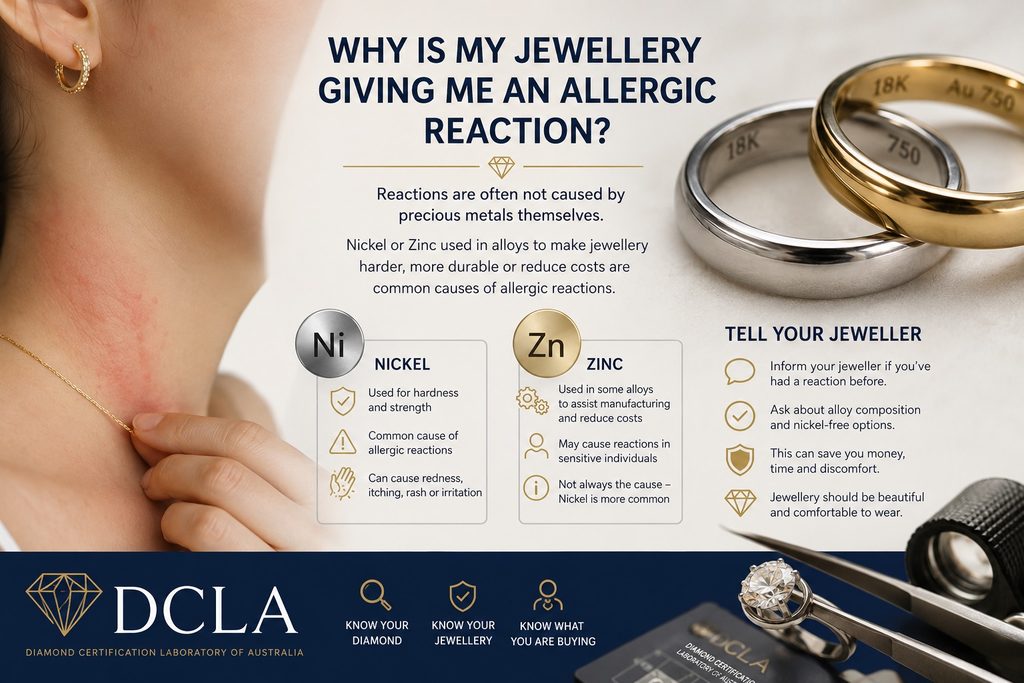
In many instances, the reaction may be caused by another metal contained within the jewellery alloy particularly nickel, and in some circumstances zinc or other alloying metals.
Precious Metals Are Rarely Used Completely Pure
Most jewellery is manufactured from alloys rather than pure precious metals.
Pure gold, for example, is extremely soft and is generally mixed with other metals to create an alloy that is harder, more durable and suitable for everyday wear. The same principle applies to many other precious metals.
The metals added to an alloy can affect its:
- Hardness and durability
- Colour
- Strength
- Manufacturing characteristics
- Weight
- Cost
This is where understanding exactly what is in your jewellery becomes important.
Nickel: One of the More Common Causes
Nickel is well known as a cause of allergic contact dermatitis.
It has historically been used in jewellery alloys because it can provide hardness, strength and particular colour characteristics. White gold is one example where alloy composition is particularly important, although modern jewellery manufacturers have a number of nickel-free alternatives.
A person who is sensitive to nickel may develop irritation where the jewellery contacts the skin. This can include redness, itching, dryness, swelling or a rash.
The reaction does not necessarily mean that the jewellery itself is poorly made. It may simply mean that the wearer is sensitive to one of the metals contained in the alloy.
What About Zinc?
Zinc can also be used as an alloying metal in jewellery manufacturing. It can assist with casting and manufacturing characteristics and may form part of certain lower-cost alloys.
It is important, however, not to automatically assume that zinc is responsible for every jewellery reaction. Nickel sensitivity is much more commonly recognised as a cause of allergic contact dermatitis, while irritation can also have other causes.
This is why identifying the actual composition of the jewellery can be valuable.
Is It Possible to Be Allergic to Gold?

Yes, although reactions specifically to gold are less common than nickel allergy.
Some people can develop a sensitivity to gold itself or to particular gold compounds, while others may actually be reacting to one of the other metals present in the alloy.
For example, two pieces of jewellery can both be described as 18-carat gold, yet have different alloy compositions depending on the manufacturer and the metals used to create the final colour and properties.
This is particularly relevant when comparing yellow, white and rose gold.
Don’t Assume the Jewellery Is the Problem
A reaction can also be caused by factors other than the metal.
Moisture, soap, cosmetics, perspiration, dirt trapped underneath a ring and prolonged contact with the skin can all contribute to irritation. In some cases, what appears to be a metal allergy may actually be contact irritation from something else.
If you repeatedly experience a reaction when wearing a particular piece of jewellery, it is worth discussing it with a medical professional or dermatologist rather than simply guessing which metal is responsible.
Tell Your Jeweller Before You Buy
This is one of the most important pieces of advice for anyone who has previously experienced a reaction to jewellery:
Tell your jeweller before the jewellery is made.
If you know that you have a nickel sensitivity, for example, make sure the jeweller knows before they recommend an alloy or manufacture a ring, earrings or other piece specifically for you.
The same applies if you have previously reacted to a particular type of gold, white gold or other jewellery.
Your jeweller can then discuss alternative materials and alloys that may be more appropriate.
Why This Can Save You Money
A custom piece of jewellery can represent a significant investment.
Imagine ordering a beautiful ring, having it manufactured and paying for the finished piece only to discover that you cannot comfortably wear it because your skin reacts to the alloy.
A remake may be possible, but it can involve additional manufacturing costs, time and inconvenience.
A simple conversation before the jewellery is made can potentially prevent an expensive problem later.
Ask What Is Actually in the Alloy
Don’t be afraid to ask questions.
If you have sensitive skin or have previously experienced a reaction, ask your jeweller:
- What metals are contained in the alloy?
- Is the alloy nickel-free?
- What karat or fineness is the precious metal?
- Is the jewellery plated, and if so, with what?
- What will happen if the plating wears through?
- Is there an alternative alloy available?
A reputable jeweller should be able to explain the materials being used and discuss suitable alternatives.
Jewellery Should Be Beautiful and Comfortable
Buying jewellery is about much more than appearance. The metal, alloy, construction and intended use all matter.
If you have experienced an allergic reaction in the past, don’t keep it a secret from your jeweller. Tell them before you purchase or commission your next piece.
At DCLA, we believe that understanding jewellery begins with understanding what you are actually buying. Whether it is a diamond, a precious metal or a finished piece of jewellery, knowledge gives you confidence.
And when it comes to jewellery that sits directly against your skin every day, knowing what is in the metal can be just as important as knowing what is on the outside.
DCLA — Know Your Diamond. Know Your Jewellery. Know What You Are Buying.