Thursday, 14 July 2022

How a 910ct. Rough Became a Sparkling Van Cleef Collection

  
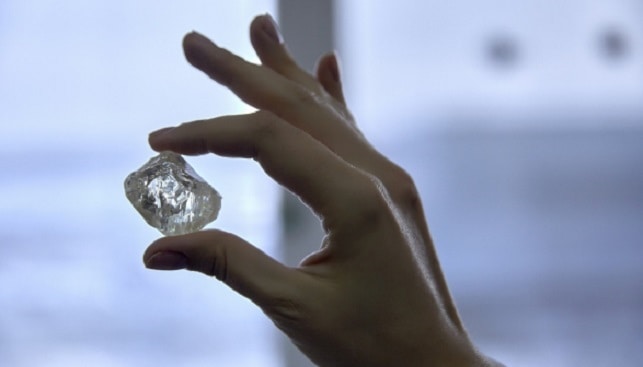
Lesotho Legend, a 910-carat, type IIa

The Baselworld fair has received much criticism in recent years, but one of the final shows before its public implosion appears to have facilitated a diamond deal that counts among the biggest in history.

Antwerp-based manufacturers Taché and Samir Gems came to the March 2018 exhibition with the exquisite Lesotho Legend, a 910-carat, type IIa diamond they had bought together from Gem Diamonds for $40 million earlier that month. At the time, jewelers such as Graff and Harry Winston dominated the big-stone market. Displaying the massive rough at the prestigious Swiss event could help drum up broader interest in the category, Taché and Samir believed.

“We felt that the market was a bit saturated between one or two players,” says Jean-Jacques Taché, managing director for sales at Taché, from his office in Tel Aviv, Israel. “So we thought, let’s bring it to Basel, let’s…showcase the [rough], and let’s see the reactions.”

Plenty of visitors wanted selfies with the stone, which came from the famous Letšeng mine in Lesotho. Some suggested buying a sliver of the piece — polished of, say, 5 to 20 carats, Taché recalls. However, “none of them were really committed at that point to enter into a venture.”

The exception was Van Cleef & Arpels, a Richemont-owned luxury brand that, Taché explains, had been somewhat pulling back from big stones in recent years.

“From the minute they saw it, [Van Cleef] started to talk about the idea that they had,” the executive adds. The timing was perfect: The luxury brand had just finished a ruby collection and was seeking a new project on which to spend a few years. “Sometimes you need a lot of things to happen at the same time in order to make it a success.”

The buying executive representing Van Cleef needed approval from Nicolas Bos, the brand’s CEO, and the Richemont team. Not long after the event, Taché, Samir and Van Cleef signed an agreement calling for the jeweler to buy the final polished. The condition was that the finished goods met the French house’s high quality criteria.

Long wait

Only this month did Van Cleef reveal the finished jewelry, more than four years after the initial pitch. The result was a unique collection of 25 Mystery Set jewels featuring 67 D-flawless diamonds. The largest is an oval, 79.35-carat stone that takes pride of place in a necklace called Atours Mystérieux, meaning “mysterious attire.” The smallest is 0.29 carats. The parties have not disclosed the polished sale price.

Taché and Samir both took heavy risks by splurging on the rough back in 2018. (Gem Diamonds publicly named Samir as the buyer: As is often the case, a miner only invoices one entity, but the purchase was really a 50:50 partnership.)
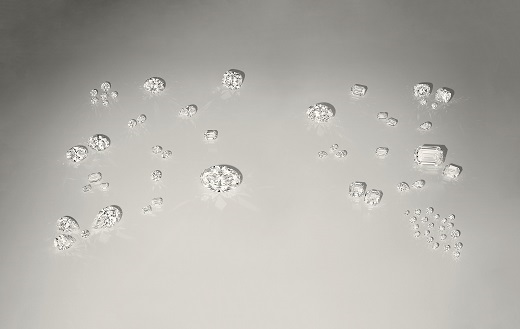
The two companies have a long-standing collaboration, having also bought the 341.9-carat Queen of Kalahari together from Lucara Diamond Corp. a few years earlier. They sold that polished to Chopard. Samir has its expertise in purchasing large rough stones; Taché specializes more in relationships with the top jewelry brands.

“We’re the most successful Jewish-Indian partnership on the market, by far,” says Taché.

They outsourced the cutting and polishing to Diamcad, an Antwerp firm that also manufactured the Lesedi La Rona for Graff. The goods went for grading at the Gemological Institute of America (GIA) in New York, where all the stones received Diamond Origin Reports stating that they were from the Lesotho Legend.

Van Cleef took delivery of the polished as each stone was ready between January 2019 and March 2020, Taché notes. However, Covid-19 delayed the launch, as Van Cleef had been hoping to hold roadshows.
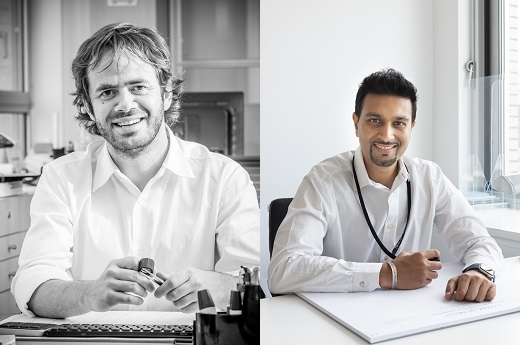
Jean-Jacques Taché and Anjal Bhansali
          Jean-Jacques Taché and Anjal Bhansali

Quality over size

The manufacturers agreed to include Van Cleef throughout the process, including in the planning and design. The Taché and Samir teams even traveled with Van Cleef’s Bos to Lesotho in May 2019 to experience the Letšeng mine and learn about the local community there.

The brand would accept only flawless goods, so quality became a higher priority than size. The planning process, which took about seven months in 2018, saw the parties review around 180 possible combinations of outcomes. None of them included any “monster” stones, they note.

“Instead of 67 stones, you could also have a model with probably 12 pieces only, but [it would have been] much less interesting in terms of creation,” Taché continues.

There were other complicating factors. Van Cleef tends to avoid round and heart-shaped diamonds. It also wanted matching pairs: “Practically every stone in this collection between 10 and 30 carats is a couple,” he points out.

“If we went for something which was 100-carats-plus, we would have had to go into the VS range,” comments Antwerp-based Anjal Bhansali, managing director at Samir. The team even broke up a stone of roughly 75 carats into two matching stones weighing around 30 carats each, Bhansali reveals.

Boost for big stones

The manufacturers hope the collection will succeed in reinvigorating the large-diamond sector, expanding it beyond the traditional two giants.

“The goal is to create more awareness for big stones in the market and to bring in new players,” Taché concludes. “We started it with Chopard. We [are continuing] this now with Van Cleef.”

It’s unclear whether the Basel show will ever return. However, everyone involved in the Lesotho Legend project will agree that the 2018 edition was well worth it.
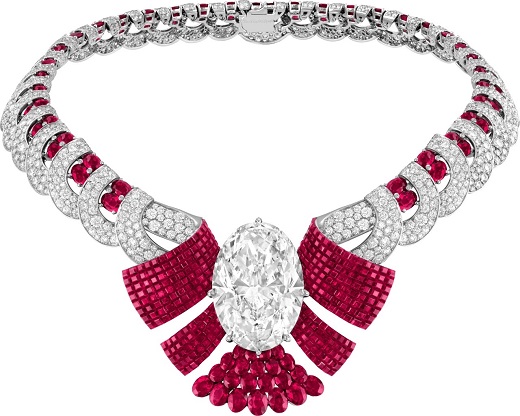
Atours Mystérieux necklace.
 Atours Mystérieux necklace.

Source: DCLA

Thursday, 7 July 2022

Luxury jeweler Graff Diamonds pays $7.5 million worth of Bitcoin in ransom to Russian hackers

 Luxury jeweler Graff Diamonds pays $7.5 million worth of Bitcoin in ransom to Russian hackers


A damaging ransom attack has forced luxury British jeweler Graff Diamonds to pay $7.5 million worth of Bitcoin to a group of Russian hackers, a London lawsuit revealed.

In case of failure to pay, a group of hackers threatened to leak the private data of jeweler’s high-profile clients. Graff is known for its famous clientele, including Oprah Winfrey, the Sultan of Brunei, and royalty from the Middle East.

Graff is suing its insurer, Travelers, for refusing to cover the ransom, which is how more information about the hack came out. Graff is maintaining that the payout should have been covered by insurance.

The hack happened in September 2021, with ransomware group Conti taking responsibility and leaking data. The attack was somewhat unusual, with Conti issuing an apology to Graff’s clients from Saudi Arabia, UAE, and Qatar while also threatening to leak more data.

“We found that our sample data was not properly reviewed before being uploaded to the blog,” the hackers wrote back in October. “Conti guarantees that any information pertaining to members of Saudi Arabia, UAE, and Qatar families will be deleted without any exposure and review. Our Team apologizes to His Royal Highness Prince Mohammed bin Salman and any other members of the Royal Families whose names were mentioned in the publication for any inconvenience.”

Among the leaked data was private information on celebrities like David Beckham, Oprah Winfrey, and Donald Trump, The Daily Mail reported last year.

In November, Graff ended up paying half of Conti’s initial demand, which was $15 million worth of Bitcoin. The cryptocurrency was transferred to a Bitcoin wallet at a time when the digital currency was around its all-time high of $69,000.

“The criminals threatened targeted publication of our customers private purchases,” a Graff spokesperson said. “We were determined to take all possible steps to protect their interests and so negotiated a payment which successfully neutralized that threat.”

According to the spokesperson, Graff is “extremely frustrated and disappointed by Travelers’ attempt to avoid settlement of this insured risk. They have left us with no option but to bring these recovery proceedings at the High Court.”

Graff was founded in 1960 by billionaire Laurence Graff, who is now worth $5.8 billion, according to the Bloomberg Billionaire Index.

Source: DCLA

Monday, 4 July 2022

Report: Russia to Impose Zero VAT on Diamonds

 “The government has approved amendments to the Tax Code, said Deputy Finance Minister Alexei Moiseev 

230 carat diamond Russian miner Alrosa
Alrosa Rough Diamond

According to media reports quoted by Rough & Polished, Russia’s Deputy Finance Minister Alexei Moiseev said during the Cheboksary Economic Forum that the government of the Russian Federation “approved the introduction of a zero VAT rate on rough and polished diamonds.”

“The government has approved amendments to the Tax Code, which provide for the introduction of a zero VAT rate on rough and polished diamonds,” he said on the sidelines of the Cheboksary Economic Forum.

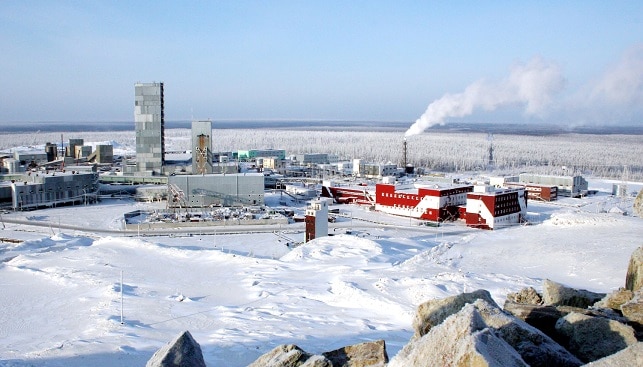
Diamond Mine snow Russia

This decision, he reportedly added, “will facilitate growth in demand for investment diamonds within Russia.”Credit: Alrosa

Source: DCLA

Thursday, 30 June 2022

Russia hits back at attempts to ‘politicise’ its diamonds


Alrosa rough diamonds
                     Alrosa rough diamonds

ussia condemned what it called a push to “politicise” its diamonds over the conflict in Ukraine and said attempts to question its compliance with the international diamond certification scheme were “totally unfounded” and “far-fetched”.

The Kimberley Process, a coalition of governments, the diamond industry and civil society responsible for certifying diamonds as conflict-free, is split over a push by Ukraine and others to expand its definition of conflict diamonds to include those funding aggression by states.

The KP Civil Society Coalition (CSC) and some member states sought to discuss whether Russia’s diamonds were helping to fund the war in Ukraine during a KP meeting in Botswana last week.

“The Russian Federation absolutely condemns the orchestrated attempts of CSC, backed by absolute minority of some Western participants, to politicize the work of the Kimberley Process by deliberately distorting or even openly replacing its basic principles,” Russia’s finance ministry said in an emailed statement. It did not specify which principles it felt were being distorted or replaced.

The CSC did not immediately respond to an emailed request for comment.

The KP defines conflict diamonds as those that fund rebel movements seeking to overthrow legitimate governments, a narrow definition that many have sought to widen since the KP was founded in 2003.

Russia, which was KP chair last year, has “championed” work on revising the definition of conflict diamonds for the past five years, the finance ministry said, and it is committed to continuing talks on the definition.

“We therefore call on our opponents to refrain from further speculative accusations, abstain from political demagoguery and concentrate on the substantive work of the KP,” the finance ministry said.

The KP makes all decisions by consensus and the rift over Russia and Ukraine could jeopardise its effectiveness.

Source: DCLA

Monday, 27 June 2022

Welcome to the top diamond jewellery insurance specialists

Why Certin ?

Because of the way we have designed the cover, we are able to offer very competitive premiums and guarantee no shortcuts in the quality of your replacement in the event of a loss or damage.

Diamond Jewellery Insurance Specialists


We offer 30 days complimentary cover


We offer 30 days complimentary cover to ensure you are covered from the day you pick up your precious diamond piece from one of our network jewellers. Fill in your details online, register your diamond and receive instant cover. Alternatively, give us a call and we can provide your cover over the phone Your policy is underwritten by Lloyd’s of London, the oldest and one of the most prestigious name in insurance.


Worldwide Cover

Diamond Jewellery Insurance


Worldwide Cover ensures you are covered anywhere in the world for trips up to 60 days.


Quick and equivalent replacement


We provide expert diamond advice in the event of replacement. We understand how important these items are to you and our expert team will ensure quick and equivalent replacement in the event of a loss.

Diamond Jewellery Insurance


We pride ourselves in providing an excellent claims service and making the process as easy and as quick as possible We provide dedicated insurance for your most sentimental and precious diamonds. We pride ourselves in offering Friendly and helpful first class service Our staffs are based in Australia and we are here to assist you with your insurance needs.


Complimentary Health Check for Your Item


As a preventative measure we offer a complimentary health check for your item with a network jeweler. If you have to make a claim under your policy we do not deduct any excess for specified items. We can add your other diamond Jewellery items to your policy by specifying them.


More information: Certin 

Friday, 24 June 2022

China backs Russia in opposing bid to redefine conflict diamonds


                     Russian rough diamonds

China has joined Russia in opposing an effort to redefine conflict diamonds to include those sold by individual nations, as a rift between Western and pro-Russia nations jeopardizes the process for certifying rough diamonds as conflict-free.

Ukraine, Australia, Britain, Canada, the European Union, the United States and civil society groups were pushing to place Russia on the agenda at this week’s Kimberley Process (KP) meeting in Botswana and to broaden the KP’s definition, under which only gems funding rebel movements are “conflict diamonds”.

Russia, the world’s biggest producer of diamonds, has said the situation in Ukraine has “no implications” for the Kimberley Process.

China agrees that the Ukraine issue falls outside the scope of the KP, the country representative told the meeting, according to three sources. China joins Belarus, Central African Republic, Kyrgyzstan and Mali in backing Russia’s stance within the body, which seems unlikely to come to any agreement.

“It’s clear that this is posing really an existential crisis for the Kimberley Process,” said Hans Merket, a researcher at Belgian non-governmental organisation IPIS, who is a member of the civil society group.

“It has become impossible to even discuss the KP’s problems and shortcomings, let alone that there would be any room for convergence on how they can be addressed.”

China’s KP representatives did not respond to an emailed request for comment.

The KP certification scheme, designed to eliminate the trade in so-called “blood diamonds”, was set up in 2003 after devastating civil wars in Angola, Sierra Leone, and Liberia, which were largely financed by the illicit diamond trade.

The Kimberley Process Civil Society Coalition and some member states have been arguing to broaden that definition for years, but it is difficult to do as the KP makes decisions by consensus.

Jacob Thamage of Botswana, the current KP chair, said that more participants now believe reform is needed.

Source: DCLA

Wednesday, 22 June 2022

Small diamond miners want big licence holders built in so they can grow sector together


Namaqualand, South Africa

Small diamond miners want to lock arms with all stakeholders through the South African Diamond Producers’ Organisation (Sadpo) to recover a large number of lost jobs and to realise the full potential value of alluvial diamonds.

“The role of Sadpo is to take on those big conversations and make sure that we not only have the right regulations, but also the right and the best relationships between the key stakeholders, not just government, but also that the big licence holders like De Beers are built in, so that we can grow the sector together and create jobs,” new Sadpo CEO Yamkela Makupula told Mining Weekly in a Zoom interview. (Also watch attached Creamer Media video with introduction by Sadpo chairperson Gert van Niekerk.)

As has been reported by Mining Weekly, the average value of the mines in which Makupula is personally invested is around $3 000/ct and sometimes upwards of $3 000/ct.

Sadpo has regularly pointed out that alluvial diamond mining has the potential to uplift rural communities in some of the poorest parts of South Africa by creating much-needed employment along with wealth.

It is an organisation set on taking the burden of compliance, bureaucracy and organised crime off the shoulders of small operators to enable them to do what they know best – find diamonds.

There has been a 90% decline in the number of small South African alluvial diamond miners. In 2004, there were 2 000 of them employing around 25 000 people compared with the current situation of only 200 small operators employing 5 000 people.

Makupula spoke of most of the communities around the well-endowed Middle Orange River, for example, being doomed without alluvial diamond mining, which has a potential lifespan of another 100 years, especially in the West Coast, and contributes a reported 25% of diamond gross domestic product.

“We’re hoping with the new proposed policy that is coming from government that we can start looking into some of the quick wins,” Makupula said.

In the past few months, Makupula and Van Niekerk have been speaking to the key licence holders on the West Coast and found the biggest issue to be illegal mining.

“We’ve been on sites where you walk in with a licence holder who is not able to do anything,” said Makupula.

The licence holder would be with them but fearful because of the visibility of guns.

“It’s organised crime that is affecting a lot of people who ask how they are going to enter this industry when it’s that risky,” she said, adding that current bureaucracy results in it taking more than a year to go through a licence application process, at a cost of about R200 000, with no guarantee of operation owing to organised crime.

Mining Weekly: When will the sharp decline in small South African diamond mine operators be reversed from its lowly 200 operations employing only 5 000 people?

Makupula: We’re hoping with the new proposed policy that is coming from government that we can start looking into some of the quick wins… we need to be able to get to a point where the one blanket approach is no longer on the table. I’ll just give you an example where Sadpo got involved with a previously disadvantaged individual who was actually looking for a mining permit on a 5 ha farm. When we looked into the process, we found that he had to pay R130 000 to get the licence. It took him 13 months to 15 months and that was with Sadpo involved on a day-to-day basis, assisting. That needs to go on the table. Our people don’t have R200 000 odd that they can put up front before they even open doors. Those are the types of issues that we are having and that are now affecting the employment rate.

What steps are being taken to ensure that diamonds are recovered in a responsible manner that protects the environment?

Currently, I can safely say, from all the meetings that we’ve had with our members, that we are not using any chemicals to extract our diamonds. We have been very compliant from a health and safety perspective. Hence, you have not seen a lot of issues coming specifically from our sector. That for me speaks volumes and from a rehabilitation perspective, we’re very compliant. Whenever an issue arises, Sadpo quickly speaks openly to its members to ensure compliance when it comes to our health and safety.

What will Sadpo do to encourage operators to make use of state-of-the-art geological modelling, novel earthmoving and screening techniques, and the latest recovery technology?

I’d love to think that at some point we will get to where our members are using this modern technology because this beautiful technology has quick turnaround times and is coming right across the world. But the reality for us is that we’re dealing here with small operators, who, by doing things the old school way, have the opportunity to create more jobs in communities. But also from a funding perspective, this new technology and machinery needs a lot of upfront funding. Sadpo has been doing research with the Council for Geoscience to see how we ensure that proper due diligence is done in some of our own operations for us to still be able to use the state-of-the-art technology, but in a much more affordable way.

How large is your own shareholding in active alluvial diamond operations?

I am operating in the Middle Orange River. That’s where my operations are. I’m a 30% shareholder. It’s alluvial. I’ve been there now for a year and also with a tender house in Schwarzer-Reineke, where I’m also a 30% shareholder. In the Middle Orange River, we have about five to six operations. We are on the middle tier, plus 500 people from a job perspective, and so that’s where I’m at. It’s been exciting. I’m still a new player in the industry and enjoying the growth of it. I have been dealing with regulations for most of my career life, not just in South Africa, but also in Angola and Ghana. I’ve been dealing with communities of work as an economic adviser in Parliament, from a rural settlements perspective, advising traditional leaders, and various other committees. That’s where my background comes from and my personal belief is that the regulations, the policies, they’re as guidelines. They give an operator an understanding of what needs to be done to comply, but I’m a big believer for all of that to happen, it comes down to people and relationships, and we can grow this country, as long as we don’t do it dividedly.

ALLUVIAL SOURCE

In officially announcing her appointment as CEO, Van Niekerk described Makupula as an international businesswoman who is currently the head of Africa growth strategy of international law firm Diaz, Reus & Targ and a former partner at PricewaterhouseCoopers.

As has been explained by Nastoplex shareholder and CEO Lyndon De Meillon, the source of the diamonds in the alluvial terraces of the Middle Orange River is mainly Lesotho, where the highest value per carat kimberlites are situated, and also the famous kimberlites in the Kimberley area.

Attrition during river transport, De Meillon pointed out, had ensured that the best quality stones were preserved in the terraces downstream of Douglas.

The area is well known for its exceptional white stones and regularly produces the highest value per carat stones sold in the world on an annual basis.

It is also a source of colour diamonds, and pinks and vivid yellows are often also recorded.

In terms of carats per hundred tonnes, the deposits can only be described as ultra-low grade, and the operators in this area are a special grade of entrepreneur with a high appetite for risk, while being exceptionally skilled at low-cost earthmoving.

See interview here: miningweekly

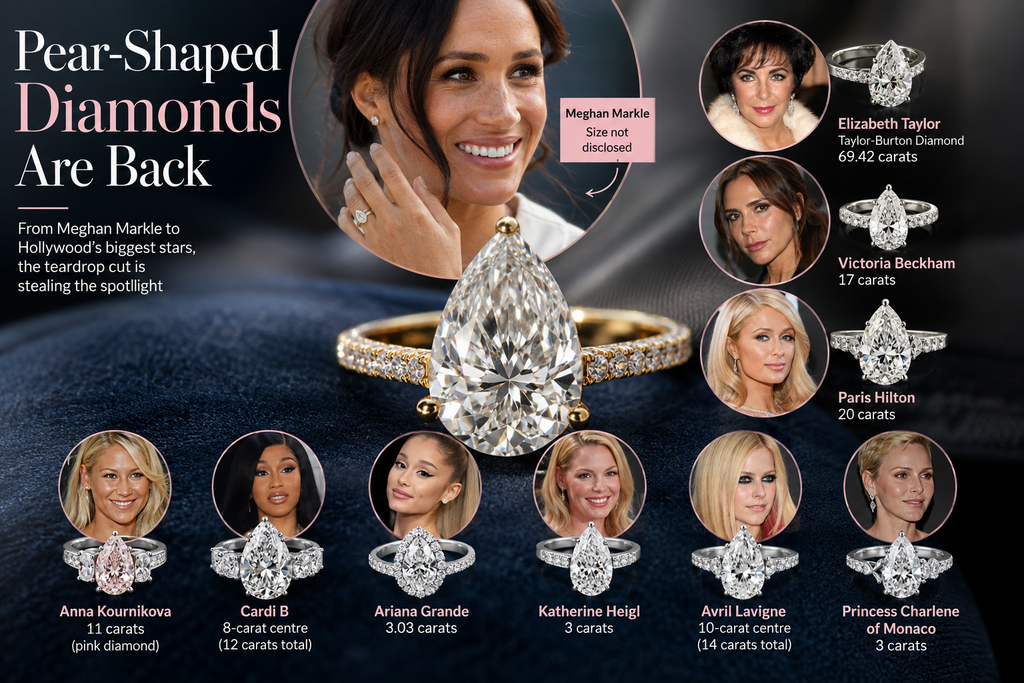
Pear-Shaped Diamonds Are Back, Meghan Markle and Hollywood’s Biggest Stars Put the Teardrop Cut Back in the Spotlight

  The pear-shaped diamond is having another moment. When Meghan Markle recently appeared wearing a previously unseen pear-shaped diamond rin...