
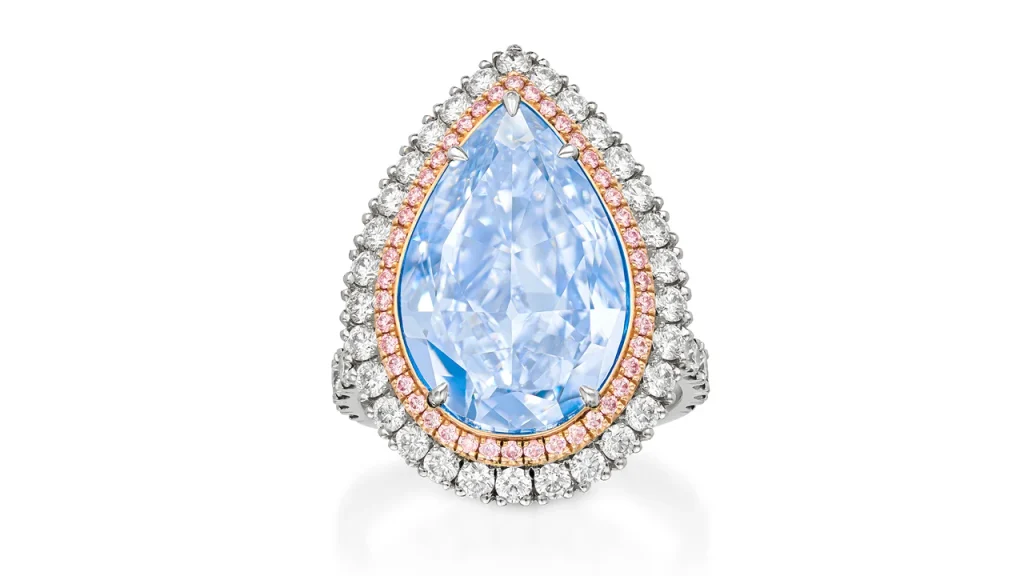
An exceptionally rare 8.03 carat blue diamond is expected to attract significant attention when it goes to auction in London, with an estimate of up to £2 million (approximately US$2.64 million).
The centre stone is a pear modified brilliant-cut Fancy Light Blue diamond, graded VS2 clarity by the Gemological Institute of America (GIA). It is mounted within concentric borders of round brilliant-cut pink and white diamonds, with additional round brilliant-cut white diamonds set into the shoulders.
According to Elmwood’s, the specialist auction house handling the sale, it is only the third blue diamond weighing more than eight carats ever offered at auction in the United Kingdom.
The diamond carries an estimate of £1.5 million to £2 million (approximately US$1.98 million to US$2.64 million) and is being sold on behalf of a collector in Glasgow.
The two previous examples include the legendary 70.21-carat Idol’s Eye, sold by Christie’s in London in 1865, and the Wittelsbach Diamond, sold by Sotheby’s in London in 2008.
At 8.03 carats, the new stone would also rank as the third-largest blue diamond sold at auction in British history, according to Elmwood’s. It is also described as the largest pear brilliant-cut blue diamond ever offered at auction in the UK.
What Makes a Diamond Blue?
Natural blue diamonds are among the rarest coloured diamonds in the world.
The blue colour is primarily caused by the presence of boron within the diamond’s crystal structure. Diamonds are composed almost entirely of carbon, but during their formation deep within the Earth, tiny amounts of other elements can become incorporated into the crystal lattice.
When boron atoms replace some carbon atoms, they alter the way the diamond absorbs and interacts with light. The boron absorbs portions of the visible spectrum, allowing the characteristic blue colour to dominate the diamond’s appearance.
DCLA explains that the distinctive blue colour of natural blue diamonds is caused by boron impurities in the crystal structure, with the amount and distribution of boron influencing the resulting colour.
DCLA’s recent article on the world’s most valuable coloured diamonds similarly explains that only a few boron atoms replacing carbon during crystal growth can produce colours ranging from pale blue to vivid blue.
The Gemological Institute of America also identifies Type IIb diamonds as a rare variety containing boron within the crystal structure, which can impart a blue colour.
Boron and a Diamond’s Reaction to UV Light
There is another fascinating aspect of diamond science: fluorescence.
When certain diamonds are exposed to ultraviolet radiation, including the UV component of sunlight or a black light, they can emit visible light. This phenomenon is known as fluorescence.
DCLA explains that diamond fluorescence is caused by trace elements and microscopic structures within the diamond. The most common fluorescence colour is blue, although other colours can occur.
The Gemological Institute of America describes fluorescence as visible light emitted by a diamond when it is exposed to invisible ultraviolet radiation. More than 95% of fluorescent diamonds in GIA’s data show blue fluorescence, although yellow, white and other colours can occasionally occur.
This creates an important distinction:
A blue diamond is not necessarily a diamond that fluoresces blue.
The permanent blue body colour of a natural blue diamond is primarily associated with boron within its crystal structure. Fluorescence, by contrast, is the visible reaction produced when the diamond is exposed to UV light.
A colourless diamond can therefore fluoresce blue under a black light, while a naturally blue diamond does not necessarily fluoresce.
DCLA specifically makes this distinction when explaining blue-white diamonds: blue diamonds have a natural blue body colour caused by boron, whereas blue-white diamonds are colourless or near-colourless diamonds that display blue fluorescence under appropriate lighting.
An Important Detail About This Diamond

This distinction is particularly interesting in the case of the 8.03-carat auction diamond.
Although its natural blue body colour is associated with boron, the published information accompanying the stone reports no fluorescence.
That means the diamond’s blue appearance should not be confused with the blue glow sometimes seen when diamonds are placed under ultraviolet or black light.
This is an excellent example of why gemological examination involves considerably more than simply observing a diamond’s colour. Laboratories can examine a diamond’s fluorescence, spectroscopy, crystal structure and other characteristics to understand the factors responsible for its appearance.
DCLA’s laboratory uses advanced analytical technology, including DiamondView™ fluorescence imaging, which can reveal fluorescence patterns and growth structures useful in distinguishing natural and laboratory-grown diamonds.
Blue Diamonds and the Deep Earth
The story of natural blue diamonds goes even deeper.
Research discussed by GIA has shown that many natural blue, boron-bearing diamonds originated at extraordinary depths within the Earth’s mantle. Their boron is believed to have been carried deep into the Earth through geological processes involving ancient oceanic crust.
This makes large natural blue diamonds remarkable not only because of their rarity and beauty, but because they can provide scientists with a glimpse into parts of the Earth that are otherwise inaccessible.
Fluorescence Is Not Phosphorescence
There is also a subtle but important scientific distinction between fluorescence and phosphorescence.
Fluorescence occurs while the diamond is being exposed to UV light and normally stops almost immediately when the UV source is removed.
Phosphorescence is different: the diamond can continue to emit visible light after the UV source has been switched off.
DCLA explains that phosphorescence involves energy remaining trapped within the diamond and being released over a longer period. Boron can also play a role in the optical behaviour of certain diamonds exhibiting phosphorescence.
This distinction is particularly interesting in blue diamonds. GIA research has documented both blue and red phosphorescence in natural Type IIb, boron-bearing diamonds.
A Remarkable Combination of Rarity and Science
The 8.03-carat diamond demonstrates why exceptional coloured diamonds fascinate both collectors and gemmologists.
Its blue body colour begins at the atomic level, with tiny quantities of boron incorporated into the diamond’s crystal structure billions of years ago. That microscopic difference can transform an otherwise colourless carbon crystal into one of the world’s rarest and most valuable gemstones.
And while this particular diamond reportedly does not fluoresce, the broader science of fluorescence provides another remarkable insight into the way diamonds interact with invisible ultraviolet radiation.
From boron and body colour, to fluorescence and phosphorescence, the science behind coloured diamonds is every bit as fascinating as the gemstones themselves.
Further Reading from DCLA
DCLA — Blue Diamond
Read DCLA’s Blue Diamond guide
DCLA — Fluorescence in Diamonds
Read DCLA’s guide to diamond fluorescence
DCLA — Blue-White Diamonds
Read DCLA’s Blue-White Diamond guide
DCLA — Phosphorescence
Read DCLA’s explanation of phosphorescence
DCLA — Diamond Education
Explore DCLA Diamond Education
DCLA — Our Laboratory & Technology
Explore DCLA’s laboratory and DiamondView™ technology
Independent Scientific References
The Gemological Institute of America (GIA) has also published extensive research on natural blue, boron-bearing diamonds and their unusual optical properties.




No comments:
Post a Comment