Showing posts with label certificates. Show all posts

Wednesday, 30 September 2026

Diamond Certification Australia, Where to Get a Diamond Certificate Worldwide & Why DCLA Leads

 diamond certification Australia, diamond grading laboratory Sydney, where to get a diamond certified, CIBJO accredited laboratory, independent diamond grading

Whether you’re buying an engagement ring, insuring a family heirloom or selling a stone, one document matters more than any other: an independent diamond grading certificate. It is the diamond’s passport, the record of its identity, quality and origin. But not all certificates carry equal weight, and where your diamond is graded can shape its value, its insurability and its resale prospects for decades.

Where to Get a Diamond Certificate Worldwide

Diamond certification is offered by a number of laboratories around the world. In the United States, the Gemological Institute of America (GIA) and the American Gem Society (AGS) are widely known. In Europe, Antwerp is home to HRD Antwerp and the headquarters of the International Gemological Institute (IGI), which also operates extensively across India and Asia. Each has its own strengths, and each serves markets primarily in its own region.

For Australian buyers, sellers and jewellers, however, sending a diamond overseas for grading introduces real complications: international shipping, insurance limitations, customs, weeks of waiting and, most importantly, no chance to see who is grading your stone or ask them questions. That is why a locally based, internationally accredited laboratory matters.

DCLA: 25 Years of Independent Diamond Grading in Australia

The Diamond Certification Laboratory of Australia (DCLA) was established in 2001 in Sydney, marking a quarter of a century serving the Australian diamond trade and public. From its laboratory at Suite 901, Level 9, Citisite House, 155 Castlereagh Street, Sydney, DCLA has become the benchmark for diamond certification in the country. Learn more about DCLA.

International Accreditation: CIBJO, WFDB and IDC

A certificate is only as credible as the standards behind it, and DCLA’s credentials are recognised at the highest levels of the international diamond industry.

CIBJO (The World Jewellery Confederation). DCLA is the official CIBJO laboratory for Australia and holds the CIBJO C2 AU Diamond Masterset for colour comparison. The Masterset is the reference set of stones against which diamond colour is graded, so every DCLA colour grade is anchored to an international standard.

IDC (International Diamond Council) and the WFDB. DCLA is a recognised IDC laboratory, as noted in the WorldFed Newsletter No 6. The IDC is the grading standards body established by the World Federation of Diamond Bourses (WFDB) together with the International Diamond Manufacturers Association, representing the world’s diamond bourses and manufacturers. DCLA’s grading protocols align with CIBJO and IDC standards, so its reports are directly comparable to certificates from other internationally recognised laboratories.

Listed on IDEX and RapNet

Credibility in the trade is measured by acceptance in the global marketplace. DCLA is listed on RapNet and IDEX, the two leading international diamond trading platforms. Diamonds carrying a DCLA report can be listed and traded by dealers worldwide, giving owners of DCLA-certified stones access to international markets, not just local ones.

What Sets DCLA Apart

A written full-replacement guarantee. DCLA is the only laboratory in Australia offering a written full-replacement guarantee on every report. Read about the DCLA Diamond Certificate.

Complete independence. DCLA is privately owned and operated, with no trade funding, influence or conflict of interest.

Transparency you can see. Every diamond is graded on-site in Sydney by qualified gemmologists, and clients can meet the team who grade their diamond. Your stone never disappears into a distant facility. See the technology and grading process.

Uncompromising standards on treatments and colour. DCLA screens every diamond for enhancements and issues grading certificates only for diamonds of natural colour origin. Learn about colour authentication and diamond treatments.

Natural and lab-grown expertise. DCLA certifies both natural and lab-grown diamonds, with clear origin disclosure. Understand synthetic diamonds.

Trusted where it counts. DCLA reports are relied on by jewellers, insurers and courts in Australia and beyond.

Beyond the Certificate

Owners can check a certificate online, protect their stone with cold laser inscription, and use diamond verification and traceability services. DCLA also provides diamond and jewellery valuations, rough and uncut diamond services, bespoke jewellery and independent advice on selling a diamond.

New to diamonds? Start with The 5 C’s of Diamonds, explore diamond shapes, or browse the glossary and picture library.

How to Get Your Diamond Certified in Australia

DCLA services are open to both the public and the trade. All diamonds submitted for grading must be loose, not set in jewellery. Stones can be submitted in person at the Sydney laboratory or by courier, with Secure National Couriers used within Australia and Brinks for international clients. See how to submit a diamond.

The Bottom Line

There are many places in the world to get a diamond certificate. For anyone buying, selling or insuring diamonds in Australia, DCLA offers what overseas laboratories cannot: CIBJO and IDC accreditation, acceptance on IDEX and RapNet, a written guarantee, and the chance to meet the gemmologists grading your stone. After 25 years, DCLA remains Australia’s foremost authority in diamonds.

Have questions? Read the FAQs

Monday, 26 August 2024

AI system grades diamonds faster, cheaper, more accurately

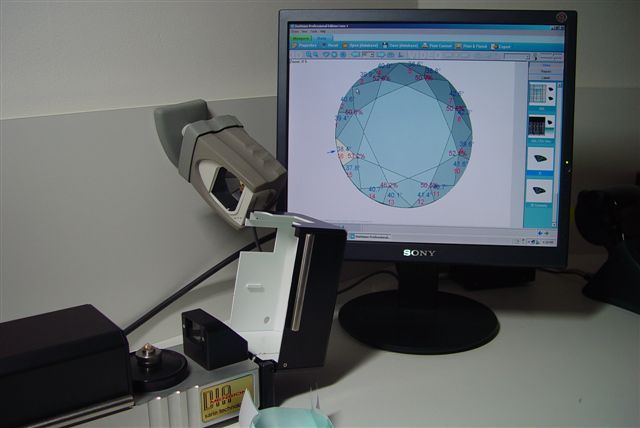
Sarine’s first eGrading machines

Assessing the value of a diamond is a job that’s been done by eye for centuries. 

But artificial intelligence (AI) is now so sophisticated that it can do the same task faster, cheaper and more accurately.

There can be a huge difference in value even between two diamonds of the same size. That’s why a whole industry has developed, dedicated to grading them.

But advances in machine learning have now made computers more reliable than humans, according to Sarine, a diamond-tech company based in Israel. 

Today the vast majority of diamond manufacturers – the businesses that cut and polish rough gems – send their loose stones to grading labs.

They wait a couple of weeks for the diamonds to be returned with certificates listing their key attributes. And they typically pay at least $100 per diamond for the service (depending on size).

Sarine aims to dramatically cuts cost and delays by locating its automated eGrading technology inside factories in a lease arrangement.

Staff operate the machine, which can grade and certify a diamond in a matter of minutes.

More on Innovation

It’s as convenient as using an ATM, says Roni Ben-Ari, deputy CEO & VP products at Sarine.

He says the machines consistently deliver higher quality results than the best grading labs, without the expense of employing gemologists (gemstone experts) or paying for premises, infrastructure and other overheads.

Can’t cheat the system

You may be thinking the diamond factory gets to “mark its own homework” if the grading machine is inhouse, and that it could cheat the system to get a better grade.

But Ben-Ari is adamant that the system’s security is so tight it’s simply not possible for anyone to interfere.

Every diamond is unique – like a fingerprint, a snowflake or DNA – and every diamond is identified by full 360-degree images.

The raw data that Sarine’s machines gather is securely uploaded to the cloud, and only then converted into a grading report.

like a fingerprint, a snowflake or DNA
Grading diamonds objectively with Sarine’s eGrading system.

It’s worth considering what’s at stake here. 

An absolute top-quality natural one-carat diamond (a popular size for engagement rings) could set you back $14,000. But you could get a poor-quality diamond of the same size for under $2,000. That’s why grading a diamond is so important.

The 4Cs

Four main criteria determine the value of a diamond. They’re known as the 4Cs – carat (weight), cut (how well the rough stone has been shaped), color (the best diamonds are colorless) and clarity (absence of flaws or blemishes).

AI system grades diamonds carat, cut, color and clarity faster, cheaper, more accurately
Diamonds are valued on the basis of carat, cut, color and clarity.

Color and clarity are the hardest criteria to determine. Labs give diamonds a letter for color (from D to Z) and a label indicating one of 11 levels of clarity (from IF, internally flawless, to I3 for diamonds with the worst flaws or “inclusions”). 

Weighing a diamond is straightforward, but the other three Cs can be subjective. 

“I can guesstimate that if you sent the same 100 diamonds to the lab over and over again, around 70 percent would get the same grade,” says Ben-Ari. 

That leaves 30% where a different lab, or a different day, or a different staff member could give the diamond a different grade – and a different value.

IF, internally flawless, to I3 for diamonds
Sarine’s system uses AI to grade clarity.

A lot of biases

“The human eye is a muscle; it gets tired,” says Ben-Ari. “It’s affected by your physical conditions, whether you’re tired or angry, or it’s the beginning of the shift or the second half of the shift. 

“There are a lot of biases. It’s very difficult to educate people from different cultures in different locations around the world to grade the same diamond in the same way.

“So the labs invented a very sophisticated process where two people grade the diamond. When they agree, that’s the diamond grade and when they don’t, they bring in a third person.”

But it’s a labor-intensive business. Sarine, already an established world leader in guiding diamond cutters to get the highest value from a rough gem, realized it could develop a better way of doing things.

world leader in guiding diamond cutters
Sarine’s loupe doesn’t get tired like a human eye would.

AI can grade diamonds

The company, founded in 1988 and based in Hod Hasharon, central Israel, embarked on the mammoth task of teaching AI how to grade diamonds.

That involved showing the AI model more than 30,000 diamonds that had already been graded by GIA (Gemological Institute of America) the world’s biggest lab. The more diamonds they showed it, the better the results.

Sarine introduced eGrading machines, using AI to grade diamonds. Photo courtesy of Sarine
Sarine introduced eGrading machines, using AI to grade diamonds.

Because Sarine deals in technology and not in physical diamonds, all those diamonds to train the computer model had to be borrowed.

That’s why Sarine’s first eGrading machines, installed in mid-2022, were located in factories in India, where over 90% of all diamonds are cut and polished. 

“We started in southern India, where we have a facility with 400 employees to provide customer support,” says Ben-Ari.” The next step will be a rollout to Botswana and Namibia, both counties which mine and manufacture diamonds.”

Lab-grown diamonds

We’ve been talking so far about “natural” diamonds, but what about lab-grown diamonds? 

Natural diamonds formed miles below the Earth’s surface under high pressure and high temperature in a process that took over more than a billion years.

Lab-grown diamonds are created within weeks, are optically and physically identical to natural diamonds, and now sell for a fraction of the price.

They have driven the need for cheaper grading because in many cases the cost of an ordinary certificate outweighs the cost of manufacturing the diamond.

There are, however, some complex technical differences between natural and lab-grown diamonds, which means Sarine technology can grade them in the lab but not yet remotely with eGrading at factories. Sarine is working on an AI fix for that.

Source: DCLA

The Diamond You Choose, Natural Rarity or Laboratory Grown Quality

  When the choice is yours, what matters most: rarity, size, beauty or simply the diamond you fall in love with? There was a time when choos...