Diamonds can survive for billions of years. Their stories, however, can sometimes disappear for generations.
Some diamonds become famous because of their extraordinary size, colour or quality. Others achieve legendary status because of the remarkable people who owned them kings, queens, emperors, wealthy families and, occasionally, thieves.
But there is another category of famous diamond: the stone that disappears.
Throughout history, extraordinary diamonds have been stolen, hidden during wars and revolutions, recut into new shapes, renamed and passed secretly from one generation to another. Some have eventually been found, while others remain missing to this day.
For gemmologists, these stories are more than historical curiosities. They demonstrate just how difficult it can be to establish the identity and provenance of an important diamond once its original documentation, cutting or ownership history has been lost.
The Florentine Diamond — Missing for Almost a Century
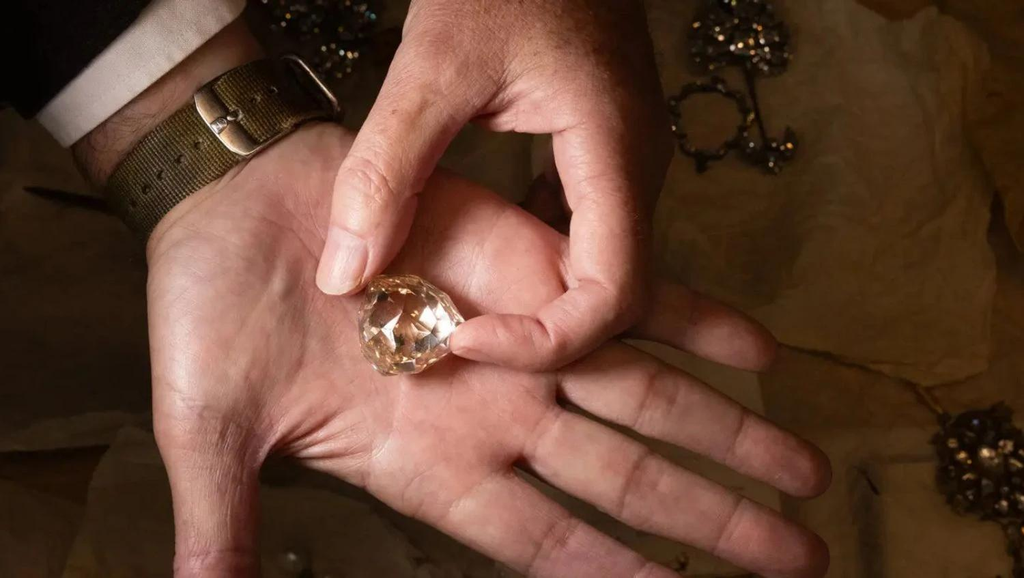
Few lost-diamond stories are more intriguing than that of the Florentine Diamond.
The approximately 137-carat pale-yellow diamond had an extraordinary history stretching back centuries. Believed to have originated in India’s famous Golconda region, it eventually became associated with the Medici family before passing into the Habsburg royal collection.
The diamond was incorporated into the Austrian imperial treasures and remained associated with European royalty until the final days of the Austro-Hungarian Empire.
In 1918, as the empire collapsed, Emperor Charles I arranged for royal valuables to be moved for safekeeping. The Florentine Diamond subsequently disappeared from public view.
For decades, nobody knew exactly what had happened to it.
Then, in 2025, reports emerged that the diamond had apparently survived inside a Canadian bank vault. According to the account, Empress Zita, widow of Emperor Charles, had taken important family jewels with her when she fled Europe and eventually secured them in Canada.
The story is a remarkable reminder that a diamond does not necessarily have to be stolen to become “lost”. Sometimes it is simply hidden so successfully that the outside world has no idea where it is.
The Florentine Diamond’s story also demonstrates the importance of provenance. A gemstone with a documented royal history can have significance far beyond its physical characteristics.
The Hope Diamond — From the French Crown to the Smithsonian
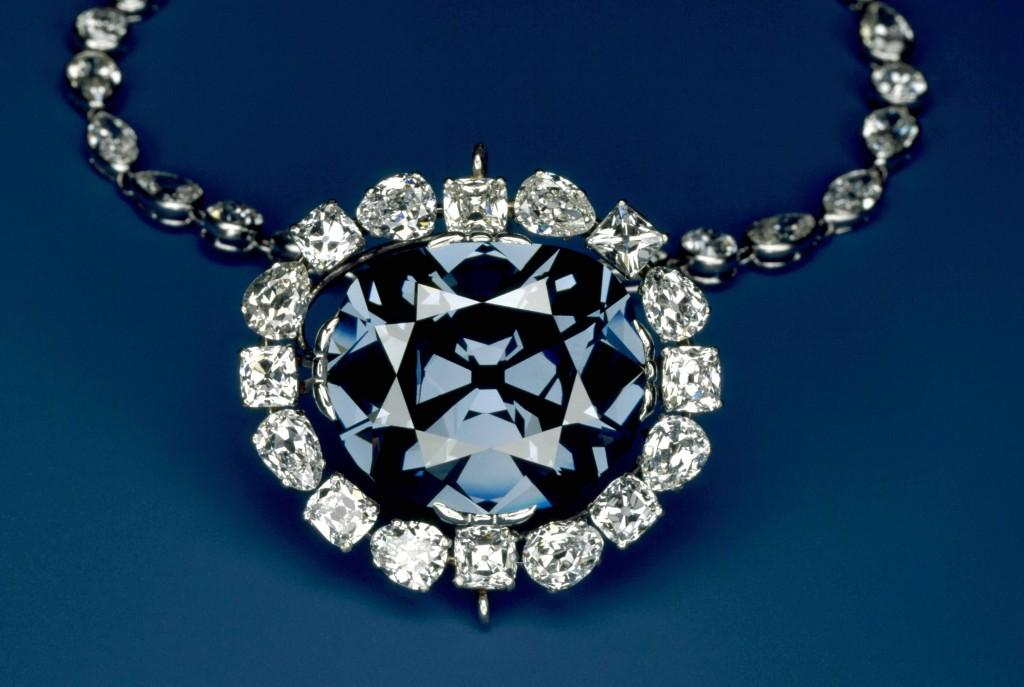
Few diamonds are more recognisable than the Hope Diamond.
The 45.52-carat blue diamond is famous today for its colour, size and fascinating history. But its story is believed to begin with another legendary gemstone — the French Blue.
The French Blue was reportedly a much larger blue diamond and formed part of the French Crown Jewels. During the chaos of the French Revolution, the crown jewels were stolen and the French Blue disappeared.
Years later, a smaller blue diamond appeared in London.
It eventually became known as the Hope Diamond.
For generations, historians debated whether the Hope was actually the missing French Blue. Modern computer modelling and examination of cutting characteristics have provided compelling evidence that the Hope Diamond was indeed created from the French Blue.
The stone passed through several prominent owners before eventually being donated to the Smithsonian Institution, where it remains today.
Its history highlights one of the central problems surrounding famous diamonds: cutting can change a diamond’s identity dramatically. A large stone can become several smaller stones, or its shape and proportions can be completely transformed, making historical identification considerably more difficult.
The Great Mughal — Did It Become the Orlov?
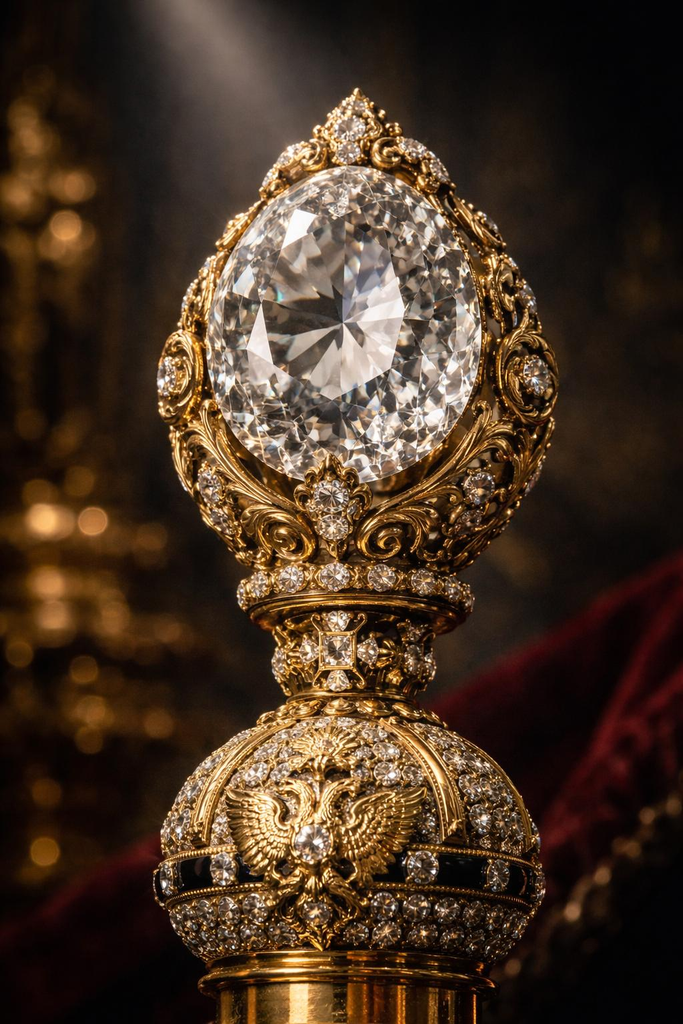
The Great Mughal Diamond is another of history’s great diamond mysteries.
The enormous stone, reportedly weighing approximately 787 carats, was described in detail by Jean-Baptiste Tavernier after he saw it in India.
Its subsequent history becomes uncertain.
One theory is that the Great Mughal was badly damaged or dramatically recut and ultimately disappeared under another identity.
That has led to speculation that it may have become the Orlov Diamond, the impressive stone now mounted in the Russian Imperial Sceptre.
The Orlov itself has an extraordinary history. It was reportedly associated with a Hindu temple before eventually making its way through Europe and into the possession of Catherine the Great of Russia.
In 1774, it was mounted in the Imperial Sceptre.
The similarity between historical descriptions of the Great Mughal and the Orlov has kept the theory alive. However, identifying a diamond centuries after it has been recut is extremely challenging, and the connection remains a historical theory rather than an established fact.
That uncertainty is part of what makes the story so fascinating. Perhaps one of the world’s most famous “lost” diamonds was never truly lost at all — it simply acquired a new identity.
The Daria-i-Noor — Another Diamond With a Hidden Past
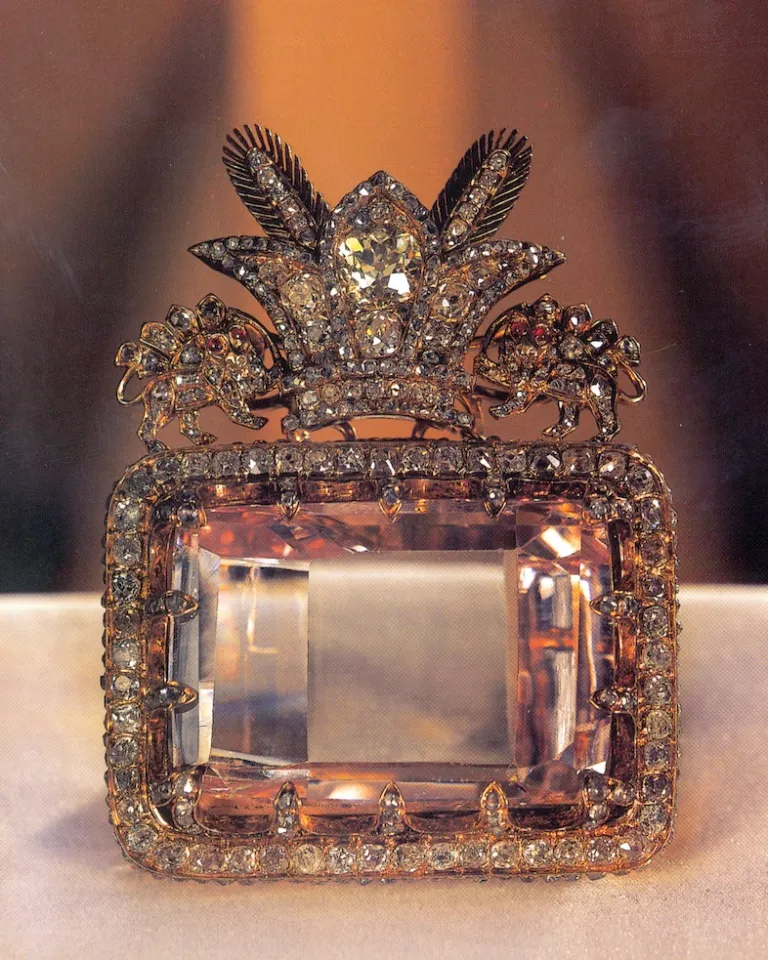
The Daria-i-Noor, meaning “Sea of Light”, is an approximately 182-carat pale-pink diamond and one of the most important stones in the Iranian national collection.
Its history is connected with India’s Golconda diamond fields and the treasures of the Mughal Empire.
Following the invasion of northern India by Nader Shah in 1739, enormous quantities of treasure were taken from the Mughal court. Among the treasures were legendary diamonds and jewels that would eventually become part of the Persian royal collection.
One of the continuing theories surrounding the Daria-i-Noor is that it may have formed part of another legendary stone — the Great Table Diamond, historically described as weighing around 242 carats.
Researchers have compared the characteristics of the Daria-i-Noor with historical descriptions of the Great Table, but the exact relationship remains uncertain.
Today the Daria-i-Noor remains part of Iran’s national jewels.
Once again, history presents us with the same fascinating question: was a famous diamond actually lost, or was it simply transformed and given a new identity?
The Sancy Diamond, Stolen, Pawned and Recovered

The 55.23-carat Sancy Diamond has survived more than five centuries of political upheaval, royal intrigue and theft.
Believed to have originated in India, the diamond became associated with European royalty and eventually took its name from Nicolas de Harlay, Seigneur de Sancy.
The stone was repeatedly used as financial collateral by European rulers.
One of the most extraordinary stories surrounding the Sancy concerns a servant carrying the diamond from France to England. According to the historical account, when the servant was confronted by thieves, he swallowed the diamond rather than surrender it.
He was killed, but the diamond was subsequently recovered.
The Sancy later became part of the French Crown Jewels and disappeared during the French Revolution along with other famous royal diamonds.
Unlike some lost stones, however, the Sancy eventually resurfaced.
It passed through several important collections before being acquired by the Louvre in 1978.
Its extraordinary history is a reminder that diamonds have often functioned as more than jewellery. For centuries, major gemstones were portable stores of wealth that could be pledged, transported or concealed during times of political instability.
The Regent Diamond — A Remarkable Survivor
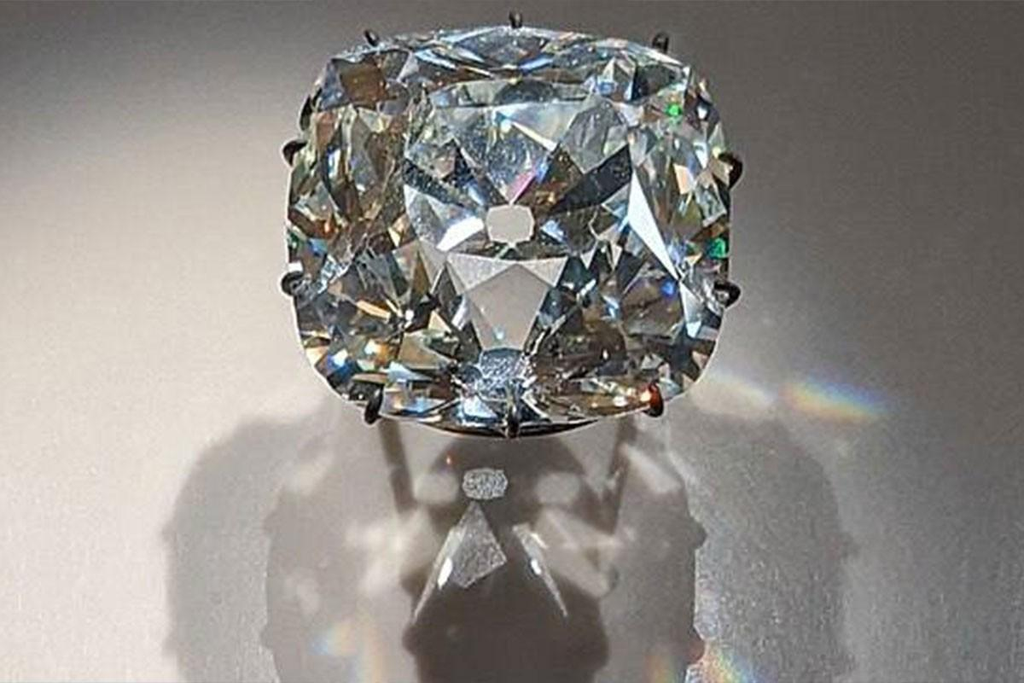
The Regent Diamond began life as a spectacular 410-carat rough diamond discovered in India.
Its early history was anything but straightforward.
After being smuggled from the mine, the stone eventually came into the possession of Thomas Pitt, Governor of Madras. Pitt sent the diamond to London, where it was cut into a magnificent 140.5-carat brilliant cushion-cut diamond.
The stone eventually became part of the French Crown Jewels and was renamed the Regent Diamond.
It was worn and displayed by successive French monarchs and became one of the most important stones in the royal collection.
During the French Revolution, however, the diamond was stolen.
Remarkably, it was later recovered after being discovered hidden in Paris.
The diamond survived further political upheaval and even served as financial collateral for France.
Today the Regent remains in the Louvre, where it is one of the great surviving treasures of the French Crown Jewels.
Its survival is remarkable when compared with the many historic gemstones that have disappeared completely.
Le Grand Mazarin — A Diamond That Bought a Man’s Life

Not every diamond theft ended with the stone disappearing.
Le Grand Mazarin, a 19.07-carat pink diamond associated with India’s Golconda mines, was named after Cardinal Mazarin, the powerful French statesman and collector of jewels.
Mazarin eventually left his collection of important diamond jewellery to the French Crown.
During the French Revolution, the Crown Jewels were stolen and Le Grand Mazarin disappeared.
According to the historical account, however, one of the thieves eventually surrendered the diamond in exchange for his life.
The stone survived and remained associated with French royalty for generations.
Following the eventual sale of the French Crown Jewels, Le Grand Mazarin entered private hands and was later sold at auction.
In 2017, Christie’s sold the diamond for more than US$14 million.
It is an extraordinary example of how the history of a diamond can become part of its value and fascination.
Some Diamonds Are Still Missing
While several famous diamonds have eventually resurfaced, others remain lost.
In 2019, the Green Vault robbery in Dresden, Germany, saw thieves break into one of Europe’s most important historic collections.
Among the stolen treasures was the Dresden White Diamond, reportedly weighing around 49 carats.
Although a significant number of the stolen objects were eventually recovered, the Dresden White remained missing according to the source material.
Then there are the more recent thefts of historic jewellery.
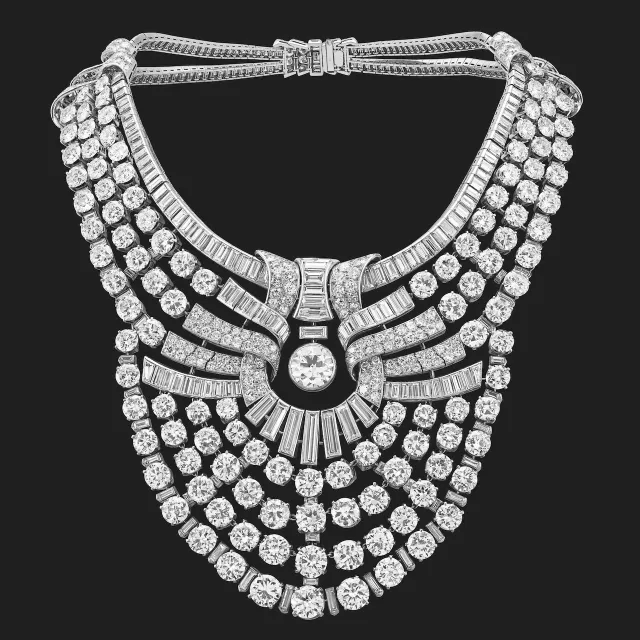
A spectacular Van Cleef & Arpels diamond and platinum necklace, once worn by Queen Nazli of Egypt, was stolen from an exhibition in Vienna. The necklace contains more than 600 natural diamonds weighing over 200 carats and has considerable historical significance beyond the value of its gemstones.
The theft illustrates that the problem of protecting important jewellery is not confined to history books. High-value diamonds and historic jewels remain attractive targets today.
The Value of a Diamond Is More Than Its Carat Weight
For the diamond industry, these stories provide an important lesson.
A diamond’s significance cannot always be reduced to carat, colour, clarity and cut.
For exceptional stones, provenance and historical documentation can be equally important. A diamond with a traceable royal history, documented ownership or an important historical association may have a very different significance from an apparently identical stone without that history.
At the same time, the stories of the world’s lost diamonds demonstrate the importance of accurate identification and documentation.
Once a diamond is recut, renamed or separated from its original paperwork, establishing its identity can become extremely difficult.
That is why professional grading, identification and documentation are so important particularly when dealing with valuable or historically significant diamonds.
Lost Forever — Or Simply Waiting to Be Found?
Perhaps the greatest fascination of these diamonds is that their stories are not always finished.
The Florentine Diamond demonstrated how a stone believed to be lost could potentially survive quietly in a private vault for generations.
The Hope Diamond shows how a famous stone can survive under a completely different identity.
The Orlov and Daria-i-Noor demonstrate how the identities of historic diamonds can remain the subject of debate centuries later.
And diamonds such as the Dresden White remind us that some mysteries remain unresolved.
A diamond can be cut, traded, hidden, stolen and renamed — but its history can survive.
For gemmologists, historians and diamond enthusiasts, that is what makes these stones so fascinating.
They are not simply pieces of crystallised carbon.
They are witnesses to royal dynasties, revolutions, wars, fortunes, thefts and extraordinary human stories.
And somewhere in the world, there may still be a famous diamond that disappeared decades or even centuries ago, quietly waiting to be identified.
Source: DCLA