
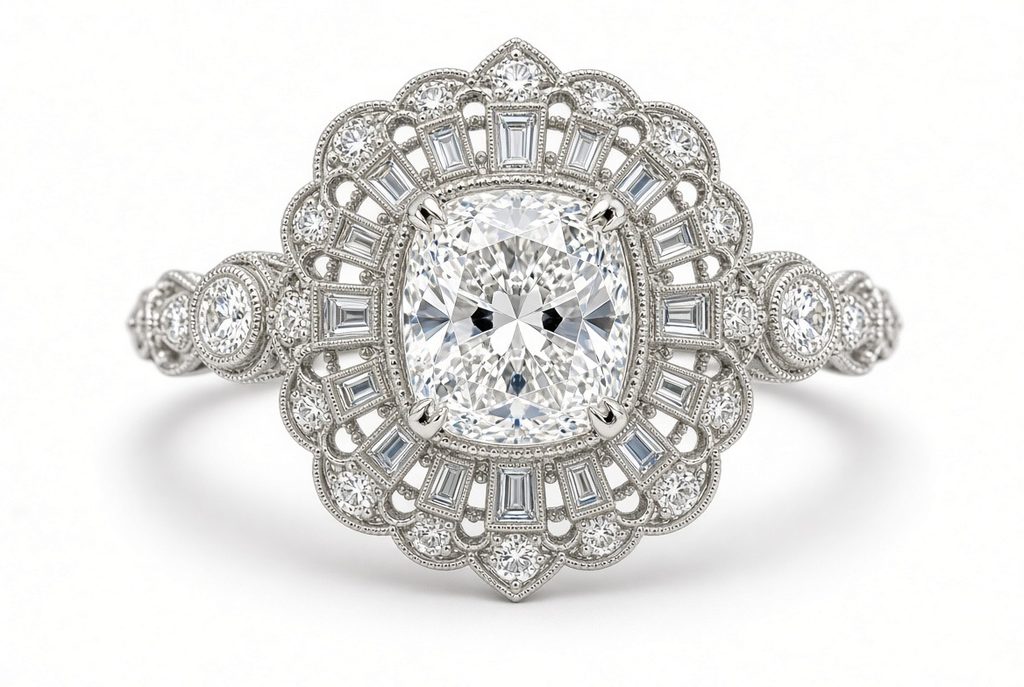
For centuries, diamonds have captivated people not only because of their rarity and beauty, but also because of the extraordinary skill required to transform a rough crystal into a polished gemstone. Long before modern diamond-cutting technology, master craftsmen developed ingenious techniques to reveal the beauty hidden within each stone.
Today, as jewellery trends increasingly embrace individuality, heritage and craftsmanship, antique and old-cut diamonds are enjoying renewed appreciation. From the soft, romantic shimmer of a Rose Cut to the distinctive chunky facets of an Old Mine Cut, these historic cutting styles offer something quite different from the precise, high-brilliance diamonds commonly seen in contemporary jewellery.
An old-cut diamond is not simply an outdated version of a modern brilliant. It represents a different philosophy of craftsmanship, shaped by the technology, tools, lighting conditions and aesthetic preferences of its time.
Understanding these historic cuts provides a fascinating insight into the evolution of the diamond industry and helps explain why some of these stones are now highly sought after by collectors, antique jewellery enthusiasts and those looking for something genuinely individual.
The Early History of
Diamonds were treasured for thousands of years before the development of modern cutting techniques. Initially, they were valued largely for their natural shape, exceptional hardness and rarity. Early diamond traders and jewellers often used polished natural crystals rather than attempting elaborate cutting.
The earliest documented diamond-cutting techniques were relatively simple. Craftsmen gradually discovered that diamonds could be shaped and polished using diamond powder, eventually developing more sophisticated methods to create facets and improve their appearance.
As trade routes expanded and diamond centres developed across Europe, particularly in Venice, Bruges, Antwerp, Paris and Amsterdam, cutting techniques became increasingly refined.
The development of diamond-cutting technology was closely connected to the availability of mechanical tools, the understanding of diamond crystal structure and the growing demand for more brilliant gemstones.
The following historic cuts represent important stages in this evolution.
The Historic Diamond Cuts and Their Characteristics
1. The Point Cut – 14th to 15th Century
The Point Cut is among the earliest recognised diamond-cutting styles.
Rather than creating a series of facets, the cutter followed the natural octahedral shape of the rough diamond, polishing its existing crystal faces while retaining much of its original form.
The result was a pointed, largely unmodified diamond that preserved the natural geometry of the crystal.
These early stones were often used in medieval jewellery, particularly in rings and religious ornaments. Their appearance was considerably different from the brilliant diamonds we recognise today.
2. The Table Cut – 15th to 16th Century
The Table Cut represented an important advancement in diamond cutting.
By removing the top point of an octahedral crystal, cutters created a flat table facet. The corners could also be slightly truncated, introducing additional facets and improving the stone’s appearance.
Table Cuts became popular during the Renaissance and were frequently used in European royal and aristocratic jewellery.
Some examples featured a relatively large table and a small culet, the flat facet at the bottom of the diamond.
Their understated appearance reflects an era when symmetry, shape and the natural character of the diamond were often more important than maximum brilliance.
3. The Rose Cut – 16th Century Onwards
<PRIVATE_PERSON>
The Rose Cut is one of the most recognisable and romantic antique diamond styles.
Unlike modern brilliant cuts, a traditional Rose Cut has a flat base and a domed crown covered in triangular or kite-shaped facets that rise towards a central point.
The number of facets varies. Traditional examples commonly have three, six, twelve or twenty-four facets, although more elaborate variations were also produced.
The Rose Cut does not have the deep pavilion of a modern brilliant diamond. Instead, its flat-backed construction creates a softer, more subtle appearance, with light moving across the surface rather than producing the intense flashes associated with modern brilliant cutting.
This construction can also make a Rose Cut appear larger across the finger than a modern diamond of comparable carat weight.
Rose Cuts became particularly popular during the Georgian and Victorian periods and were frequently incorporated into closed-back settings, often backed with silver or gold.
They were traditionally used in rings, earrings, brooches, pendants and elaborate floral jewellery designs.
There are several variations, including:
- Dutch Rose Cut: Often featuring a higher, more rounded dome with a greater number of facets.
- Antwerp Rose Cut: A traditional European variation with a flatter profile and triangular facets.
- Briolette Rose Cut: An elongated, fully faceted drop-shaped form, particularly popular in pendant and earring designs.
- Rose Brilliant: A more elaborate variation combining characteristics of rose and brilliant cutting.
The Rose Cut has experienced a significant revival in contemporary jewellery. Designers increasingly use it in modern bezel settings, asymmetrical designs and distinctive engagement rings.
Its appeal lies in its character rather than maximum sparkle. It offers softness, individuality and an unmistakable connection to jewellery history.
4. The Mazarin Cut – 17th Century
The Mazarin Cut is an early form of brilliant cutting, named after Cardinal Jules Mazarin, the French statesman and diamond collector.
It is generally associated with a cushion-shaped outline and an early arrangement of facets intended to improve the reflection of light.
The Mazarin Cut is an important milestone because it helped move diamond cutting away from simple geometric shapes towards the development of more sophisticated brilliant patterns.
5. The Peruzzi Cut – Late 17th Century
The Peruzzi Cut is traditionally attributed to Venetian cutter Vincenzo Peruzzi.
It developed the early brilliant-cut concept by introducing additional facets to the crown and pavilion.
The Peruzzi Cut is generally associated with a more developed cushion-shaped brilliant arrangement, often described as having 33 facets on the crown and 24 on the pavilion, excluding the culet.
Although these early brilliant cuts did not achieve the optical performance of modern diamonds, they represented a major advancement in the understanding of light reflection and diamond proportions.
6. The Old Mine Cut – 18th to 19th Century
The Old Mine Cut is one of the most desirable and recognisable antique diamond styles.
Popular during the Georgian and Victorian periods, it was generally cushion-shaped, with a relatively high crown, small table, rounded corners, deep pavilion and often a noticeably large culet.
Unlike modern brilliant diamonds, Old Mine Cuts were individually shaped by hand, with proportions that varied considerably from stone to stone.
Their facets were designed to perform under the candlelight and softer illumination of the period. The larger facets create distinctive flashes of light rather than the more uniform sparkle associated with modern cutting.
Many Old Mine Cuts have a slightly asymmetrical appearance, which is part of their charm.
These diamonds are particularly popular in antique engagement rings and heritage jewellery. Their individuality makes them attractive to collectors and buyers who appreciate traditional craftsmanship.
7. The Old European Cut – Late 19th to Early 20th Century
The Old European Cut represents another important development in diamond cutting and is the direct historical predecessor of the modern round brilliant.
It became particularly popular during the Victorian, Edwardian and early Art Deco periods.
Unlike the cushion-shaped Old Mine Cut, the Old European Cut has a more rounded outline. It generally features a small table, high crown, deep pavilion, relatively large culet and a symmetrical arrangement of facets.
Old European Cuts were designed to maximise the return of light using the cutting knowledge and technology available at the time.
As mechanical cutting methods improved, cutters were increasingly able to produce more consistent round shapes and symmetrical facet arrangements.
The Old European Cut remains highly sought after because of its distinctive appearance, historical significance and softer, more individual light performance.
8. The Cushion Cut – 19th Century and Earlier Origins
The Cushion Cut evolved from earlier antique diamond shapes, including the Old Mine Cut.
Its rounded corners and square or rectangular outline give it the appearance of a cushion.
Depending on the period and cutting style, cushion diamonds can have broad facets, smaller brilliant-style facets or a combination of both.
Modern cushion cuts continue to be popular, but antique cushion diamonds are particularly interesting because their proportions and facet arrangements often reveal the hand craftsmanship of their original cutters.
9. The Single Cut – 19th Century Onwards
The Single Cut is a relatively simple faceting style, generally consisting of 17 or 18 facets depending on the counting convention.
It has a small table, crown facets and a simple pavilion arrangement.
Single Cuts were widely used in smaller diamonds, particularly in pavé settings, watches and fine jewellery.
They were also commonly used in older jewellery where numerous small stones were required to complement a larger centre diamond.
Although less elaborate than a full brilliant cut, Single Cuts remain useful in contemporary jewellery manufacturing.
10. The French Cut – 17th Century Onwards
The French Cut is a distinctive square-shaped diamond cut with a geometric arrangement of triangular facets.
It is particularly associated with antique and Art Deco jewellery.
French Cuts were often used as side stones in rings and bracelets, where their straight edges and architectural appearance complemented the designs of the period.
Their popularity increased during the Art Deco movement, when geometric shapes, symmetry and strong architectural lines became central to jewellery design.
11. The Eight-Cut – 19th to 20th Century
The Eight-Cut is a simplified brilliant-style cut, generally featuring eight facets on the crown and eight on the pavilion, together with a table and culet.
It was particularly useful for small diamonds where a full brilliant arrangement was impractical or uneconomical.
Eight-Cuts were widely used in older jewellery, particularly in pavé and cluster settings.
They are still encountered in antique pieces and some modern jewellery manufacturing.
12. The Swiss Cut – 19th to 20th Century
The Swiss Cut is another simplified brilliant-style cut, generally incorporating a greater number of facets than an Eight-Cut.
It was commonly used for small diamonds and melee stones in jewellery settings.
These diamonds were designed to provide more sparkle than a basic single or eight-cut stone while remaining economical to manufacture.
13. The Transitional Cut – Early to Mid-20th Century
The Transitional Cut emerged as diamond-cutting technology advanced and the industry moved towards the modern round brilliant.
It combined features of the Old European Cut with improved symmetry, more refined proportions and a smaller culet.
These diamonds represent an important bridge between traditional hand-cut stones and modern precision cutting.
Many transitional diamonds have excellent visual character, combining the broad flashes of antique diamonds with increased brilliance.
14. The Modern Round Brilliant – 20th Century
The modern round brilliant cut represents the culmination of centuries of diamond-cutting development.
The work of Marcel Tolkowsky in 1919 helped establish a mathematical approach to diamond proportions and light performance.
Modern cutting technology, precision measuring equipment and advanced optical analysis have continued to refine the round brilliant.
The standard modern round brilliant typically has 57 facets, or 58 when a culet is present.
Its carefully calculated proportions, facet arrangement and symmetry are designed to maximise brilliance, fire and scintillation.
Although the modern brilliant is now the most familiar diamond shape, it is important to remember that it represents only one chapter in a much longer history of diamond craftsmanship.
Why Are Old-Cut Diamonds Becoming Popular Again?
There is a growing appreciation for jewellery that tells a story.
Modern consumers are increasingly interested in pieces that are individual, distinctive and connected to history. Antique diamonds offer exactly that.
Unlike many contemporary diamonds, which are cut to precise and consistent specifications, old cuts were often shaped individually by skilled craftsmen.
This means that two antique diamonds of similar size and cutting style may have noticeably different proportions, facet arrangements and optical characteristics.
There are several reasons for their renewed popularity.
Individuality: No two hand-cut antique diamonds are necessarily identical. Their subtle irregularities and distinctive proportions give them personality.
Historical significance: An antique diamond may have been cut more than a century ago, potentially passing through several generations of jewellery ownership.
Soft light performance: Rose Cuts, Old Mine Cuts and Old European Cuts produce a different visual effect from modern brilliant diamonds. Their broad facets and distinctive proportions create larger flashes and a softer appearance.
Larger face-up appearance: Some Rose Cuts and shallow antique diamonds can appear larger across the surface than a modern diamond of the same carat weight.
Sustainable jewellery: Reusing an existing antique diamond allows an old gemstone to be incorporated into a new design without requiring another diamond to be mined and manufactured.
Are Old-Cut Diamonds More Valuable Than Modern Diamonds?
The value of an antique diamond is not determined simply by its age.
A well-preserved Old Mine Cut or Old European Cut may attract considerable interest, particularly when it has attractive proportions, desirable colour and clarity, good condition and documented provenance.
However, not every old-cut diamond commands a premium.
Factors influencing value include:
- Carat weight and face-up measurements.
- Colour and clarity.
- Overall proportions and symmetry.
- Condition, including chips, abrasions and damaged facet junctions.
- Originality and evidence of previous repolishing.
- Rarity and desirability of the particular cutting style.
- Historical provenance and supporting documentation.
- Current demand among collectors and jewellery buyers.
It is also important to distinguish between an antique diamond and a modern diamond cut in an antique style. A newly manufactured Old Mine-style diamond may reproduce the appearance of an historic cut without having any genuine historical age.
Professional examination is essential when establishing what a diamond actually is.
The Importance of Professional Diamond Identification and Grading
One of the challenges with antique diamonds is that many were cut long before modern grading standards existed.
Old certificates, handwritten descriptions and jewellery valuations may not accurately describe the diamond according to today’s recognised grading terminology.
Furthermore, a diamond that has remained in its original setting for generations may have accumulated wear, damage or alterations that are difficult to identify without specialist examination.
At the Diamond Certification Laboratory of Australia (DCLA), diamond examination involves detailed assessment of the stone’s characteristics, including its weight, measurements, colour, clarity, proportions, polish, symmetry and identifying features.
The laboratory can also document the diamond’s cutting style and relevant characteristics, helping owners, collectors and the jewellery trade better understand the stone they possess.
A diamond grading report is not a monetary valuation. Rather, it provides an independent technical description that can assist with identification, insurance, resale and informed purchasing decisions.
Preserving the Past While Appreciating the Future
The history of diamond cutting is a history of human ingenuity.
From the simple Point Cut of medieval Europe to the elaborate Rose Cuts, Old Mine Cuts and Old European Cuts of later centuries, every development reflects the knowledge, craftsmanship and aesthetic preferences of its time.
The modern brilliant cut may offer extraordinary optical performance, but it does not make the earlier styles obsolete.
An antique diamond can possess something that cannot be reproduced simply by using modern cutting equipment: genuine age, historical character and a connection to the craftsmanship of another era.
Whether it is an inherited Victorian ring, an Edwardian engagement ring, an Art Deco jewel or a contemporary design incorporating a Rose Cut, these diamonds continue to demonstrate that beauty is not always about maximum sparkle.
Sometimes, it is about individuality, history and the story held within the stone.
At DCLA, we believe that understanding a diamond begins with understanding its characteristics, its craftsmanship and its history. Every diamond has a story, and the old cuts are among the most fascinating chapters in that story.


