
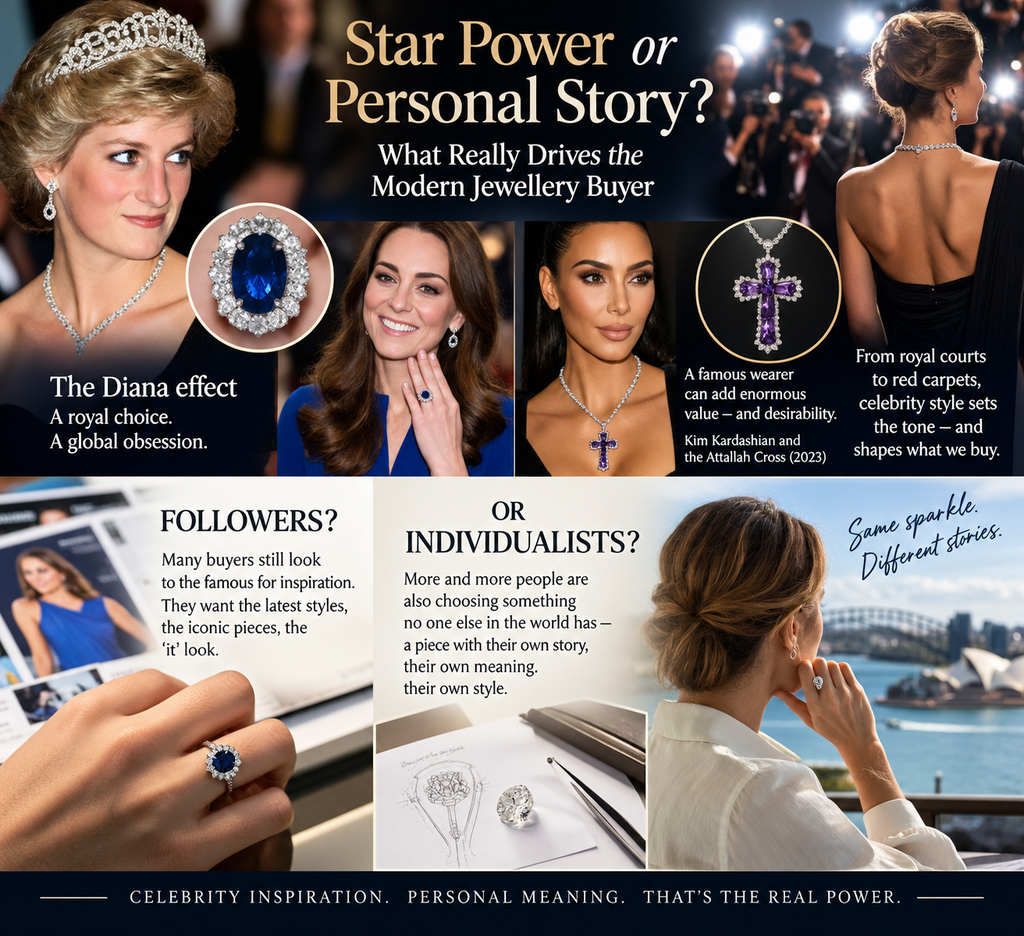
When a princess or a film star wears a jewel, the world notices. But does the average buyer want to copy them, or own something no one else in the world has?
For as long as jewellery has been worn, people have looked to the famous for cues. Royal courts set fashions across Europe for centuries, and today red-carpet events like the Oscars, the Emmys and the Met Gala do the same job, only faster, beamed instantly to millions of phones. Yet talk to any jeweller and you’ll hear another story too: more customers than ever are walking in wanting a piece that is entirely their own.
So which is it? Are jewellery buyers followers, or are they individualists? The answer, it turns out, is a bit of both.
The Diana effect
There’s no better example of celebrity influence than the engagement ring Prince Charles gave Lady Diana Spencer in 1981: a large oval Ceylon sapphire surrounded by diamonds, from the Crown Jewellers Garrard.
What’s remarkable is that the ring wasn’t a one-off commission. It was chosen from a catalogue, which at the time drew some criticism because, in theory, anyone with the money could buy the same design. Diana didn’t care. She chose it because she liked it, and in doing so she made the sapphire and diamond cluster one of the most copied engagement ring styles in history.
The ring’s influence doubled when Prince William proposed to Catherine Middleton with it in 2010. Jewellers around the world reported a surge of interest in sapphire engagement rings, and replicas at every price point flooded the market, from fine jewellery versions to inexpensive costume copies.
Diana’s influence continues today. In 2023, Kim Kardashian bought the Attallah Cross, an amethyst and diamond pendant Diana wore, at a Sotheby’s auction, a reminder that a jewel’s association with a famous wearer can add enormously to its desirability and value.
Hollywood’s red-carpet showroom
If royalty sets long-term trends, Hollywood sets the seasonal ones. Major jewellery houses have been lending pieces to stars for awards nights since the mid-20th century. Harry Winston, famously nicknamed “Jeweler to the Stars”, helped turn the Oscars into what is effectively the world’s most-watched jewellery showcase.
Some pieces become legends in their own right. Audrey Hepburn wore the Tiffany Yellow Diamond, a stone of more than 128 carats, in publicity photographs for Breakfast at Tiffany’s in 1961. Decades later, Lady Gaga wore the same diamond to the 2019 Oscars, and Beyoncé wore it in a Tiffany campaign, proof that a famous jewel can connect generations of fans.
Grace Kelly’s emerald-cut Cartier diamond engagement ring helped make that clean, elegant cut a symbol of old-Hollywood glamour, a style still popular with brides today. Elizabeth Taylor, meanwhile, showed that jewellery could be as much a part of a star’s persona as her films. Her enormous diamonds, many of them gifts from Richard Burton, made bold statement stones fashionable and turned her collection into one of the most celebrated ever sold at auction.
More recently, the red carpet has shifted what men wear too. Stars such as Harry Styles and Timothée Chalamet have popularised pearl necklaces, brooches and statement pieces for men, and jewellers have noticed younger male customers asking for pieces that would have seemed unusual a decade ago.
So are buyers just followers?
Not quite. Celebrity influence tends to work on styles rather than exact pieces. Very few people want an identical copy of Diana’s ring; what they want is the feeling of it: a coloured stone, a halo of diamonds, a touch of royal romance.
Television offers a good example. When Carrie Bradshaw wore her gold “Carrie” nameplate necklace in Sex and the City, name necklaces surged in popularity. But the whole point of the trend was personalisation, since everyone’s necklace spelled a different name. The celebrity sparked the idea, and the buyer made it their own. The nameplate style also had deep roots in Black and Latino communities and hip-hop culture long before it reached mainstream TV.
The rise of the one-of-a-kind piece
Several forces are pushing buyers towards bespoke jewellery. The first is meaning. Many customers want jewellery that tells their story: a birthstone, an engraving, a grandmother’s diamond reset into a modern design, or a stone sourced from a place with personal significance.
Even the royal family has moved in this direction. Prince Harry designed Meghan Markle’s engagement ring himself, with a centre diamond from Botswana, a country meaningful to the couple, flanked by diamonds from his mother Diana’s collection. It was a celebrity ring that couldn’t really be copied, because its meaning couldn’t be copied.
Technology has made the process easier. Computer-aided design and 3D printing mean customers can see and adjust a custom design before it’s made, and bespoke work is far more accessible than it once was. Lab-grown diamonds have changed budgets too, allowing more buyers to afford a larger or more unusual custom piece than they could with a mined stone of the same size.
Social media cuts both ways. Instagram and TikTok spread celebrity trends faster than ever, but they also make people wary of wearing exactly what everyone else is wearing. Seeing the same ring a thousand times on a feed can make a buyer want something different.
An Australian twist
Australia has its own relationship with star-studded jewellery, and its own gems that buyers seek out precisely because they’re rare.
When Crown Prince Frederik of Denmark proposed to Tasmanian-born Mary Donaldson in 2003, he chose an emerald-cut diamond flanked by two rubies, the red and white echoing the colours of the Danish flag. It was a ring with a story built in, and it drew enormous interest back home. Mary became Queen of Denmark in January 2024, and her ring remains a favourite example of royal jewellery that is personal rather than simply grand.
Western Australia’s Argyle mine was for decades the world’s main source of pink diamonds before it closed in 2020. With no new supply coming out of the ground, Argyle pinks have become some of the most sought-after stones on earth. For many buyers, owning one isn’t about copying anyone; it’s about owning something almost no one else can.
Opal, Australia’s national gemstone, is a natural fit for the personalisation trend. Black opals from Lightning Ridge and the vivid stones of Coober Pedy are never alike, so every opal ring is, by definition, one of a kind. And as male celebrities make pearls fashionable again, Australian South Sea pearls from Broome, prized for their size and lustre, are well placed to benefit from a trend that started on the world’s red carpets.
The verdict: inspired, not identical
Most jewellery buyers sit somewhere in the middle. Celebrities and fashion set the mood: they tell us sapphires are romantic, yellow diamonds are glamorous, and pearls are cool again. But when it comes to a piece a person will wear every day for the rest of their life, most want their own twist on the trend.
For jewellers, the lesson is clear. Keep an eye on the red carpet, because that’s where customers’ ideas are born. But be ready to turn that inspiration into something personal, because the modern buyer doesn’t just want to look like a star. They want a piece that could only ever belong to them.
Source: DCLA


