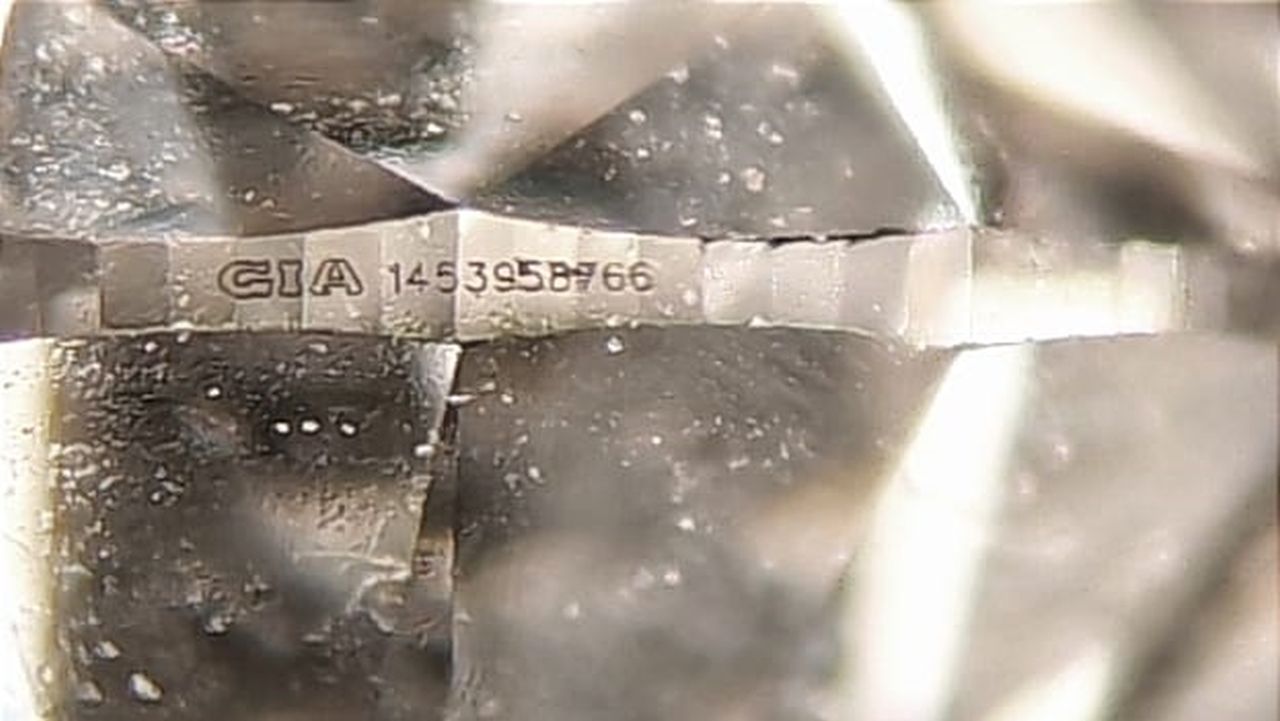
Recently, the Dubai laboratory encountered four stones submitted for update services inscribed with fraudulent GIA report numbers. Inconsistent font styles and placement indicated the numbers were not authentic GIA inscriptions.
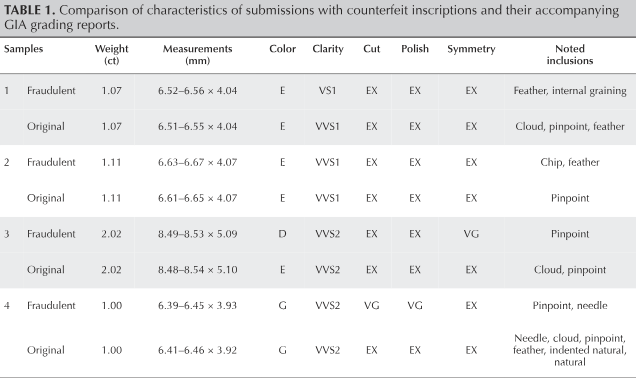
Table 1. Comparison of characteristics of submissions with counterfeit inscriptions and their accompanying GIA grading reports.
A careful comparison of their quality characteristics confirmed that these were not the same diamonds as described in their accompanying reports. Although the diamonds were carefully selected to closely match the features listed on the original reports, several subtle differences in their color grades, measurements, and other characteristics were identified (table 1). Even more obvious were the spectral differences between the fraudulent and original stones. The difference in the one-phonon region of the Fourier-transform infrared absorption spectroscopy clearly revealed a discrepancy in the diamond types. The diamonds from the original reports were type Ia with aggregated nitrogen impurities, while these submitted stones were all type IIa, confirming they were, in fact, different stones.
On fraudulent diamonds 1 and 2, photoluminescence (PL) spectra produced by 514 nm laser excitation at liquid-nitrogen temperature showed that 637 nm peaks were greater than 575 nm peaks. The 575 and 637 nm peaks are emissions from the nitrogen vacancy center in its neutral [NV]0 and negative [NV]− charge states, respectively. The 575:637 nm emission ratio of intensities of less than 1 (D. Fisher and R.A. Spits, “Spectroscopic evidence of GE POL HPHT-treated natural type IIa diamonds,” Spring 2000 G&G, pp. 42–49), along with other PL features, indicated that fraudulent diamonds 1 and 2 with the counterfeit inscriptions were natural diamonds that had undergone high-pressure, high-temperature (HPHT) treatment for color improvements.
The visible/near-infrared (Vis-NIR) absorption spectrum for fraudulent diamond 3, on the other hand, showed a 737 nm peak, which corresponds to the unresolved silicon vacancy [SiV]– defect at 736.6/736.9 nm commonly seen in laboratory-grown diamonds using the chemical vapor deposition (CVD) growth method (P. Martineau et al., “Identification of synthetic diamond grown using chemical vapor deposition (CVD),” Spring 2004 G&G, pp. 2–25). The observation of such features led to the determination that this stone was CVD-grown and subjected to post-grown HPHT processing.
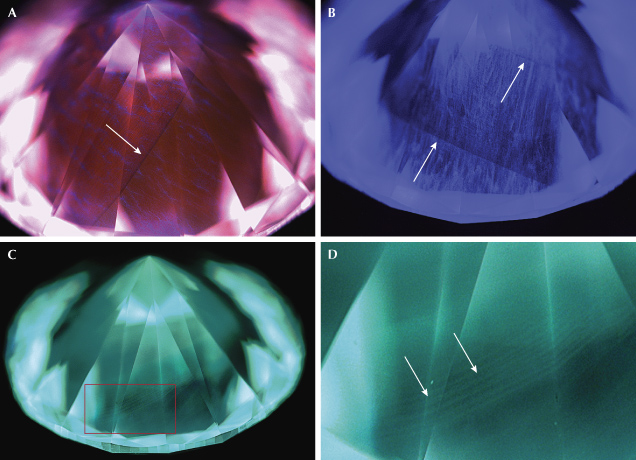
Further PL spectroscopy analysis on fraudulent diamonds 3 and 4 using 633 nm excitation confirmed the presence of the SiV– doublet feature on both diamonds. In alignment with the Vis-NIR and PL spectra, DiamondView images of these two fraudulent stones displayed clear striations with interruption layers indicative of CVD growth (figure 1). These patterns are consistent with the step-flow growth structure of CVD-grown diamond, which was also visible under the microscope using crossed polarizers and further supported their laboratory-grown origins. The other two fraudulent diamonds (1 and 2), however, showed a lack of such patterns and demonstrated natural-looking features, which confirmed them as HPHT-processed natural diamonds.
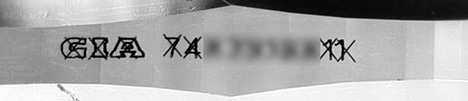
Figure 2. GIA’s standard procedure is to cross out the counterfeit inscription. Image by GIA staff.
Figure 2. GIA’s standard procedure is to cross out the counterfeit inscription. Image by GIA staff.
Considering all evidence, we concluded that two of the four stones were laboratory-grown diamonds, and the other two were HPHT-processed natural diamonds. All four diamonds were not the same natural diamonds as described in their accompanying GIA grading reports. In accordance with GIA procedures, the counterfeit inscriptions were crossed out (figure 2) and new report numbers were assigned. In addition, GIA inscribes “TREATED COLOR” on natural diamonds with post-treatment history and “LABORATORY-GROWN” along with a GIA report number and distinct GIA LG logo on laboratory-grown diamonds.
Deceptive practices have occurred previously in the trade; similar instances of diamonds with fraudulent inscriptions have been reported by GIA (e.g., Summer 2021 Lab Notes, pp. 150–152; Fall 2021 Lab Notes, pp. 258–259). Additionally, non-diamond materials, such as synthetic moissanite, with fraudulent GIA inscriptions have been submitted as diamonds to GIA (Fall 2020 Lab Notes, pp. 424–425; Fall 2022 Lab Notes, pp. 360–361). These cases highlight the importance of verifying inscription authenticity because a fraudulent inscription could be overlooked by simple visual examination. One possible solution is GIA’s Match iD, a device that compares a diamond’s inscription with its grading report in the GIA database.
Source: DCLA