
Diamond Science, Grading and Transparency
Introduction
Diamond clarity is often misunderstood as a straightforward measurement of the size of an inclusion relative to the size of the diamond. While inclusion size is an important grading consideration, it is only one component of a more comprehensive gemmological assessment.
Two diamonds containing inclusions of apparently identical size and colour may receive different clarity grades because the inclusions differ in position, nature, contrast and overall visual impact. The diamond’s shape, facet arrangement and optical behaviour can also influence how readily an inclusion is observed.
At the Diamond Certification Laboratory of Australia (DCLA), diamond grading follows established International Diamond Council (IDC) nomenclature and grading principles. DCLA also assesses transparency as a separate characteristic, helping to distinguish the visibility of individual inclusions from the degree to which internal features interfere with light transmission.
Understanding these distinctions is essential when interpreting a diamond grading report and evaluating the relationship between clarity, transparency and overall optical performance.
1. Diamond clarity is more than inclusion size
Diamond clarity describes the internal characteristics, known as inclusions, and external characteristics, known as blemishes, that are observed during examination.
The commonly used clarity scale ranges from Flawless (FL) and Internally Flawless (IF), through the VVS, VS and SI categories, to Included grades. The precise grade depends on the grading system applied and the combined assessment of relevant characteristics.
Although size is important, clarity grading is not determined by a simple calculation of inclusion diameter divided by the diamond’s dimensions. Instead, the grader evaluates the characteristics of the inclusion in the context of the individual stone.
Important considerations include:
- Size: The dimensions and apparent extent of the inclusion.
- Position: Where the inclusion is located within the diamond.
- Nature: The type, shape, structure and visual characteristics of the inclusion.
- Relief and contrast: How distinctly the inclusion stands out against its surrounding optical environment.
- Number and distribution: Whether there is one isolated feature or a number of inclusions distributed throughout the stone.
- Overall effect: The combined influence of these characteristics on the diamond’s appearance under the prescribed grading conditions.
These factors interact. An inclusion that is relatively inconspicuous in one diamond may be considerably more apparent in another, even where their measured dimensions are similar.
For further information, see DCLA’s Diamond Clarity Guide and Four Cs of Diamond Grading.
2. The influence of diamond shape and facet arrangement
The optical behaviour of a diamond is influenced by its cut style, proportions, facet arrangement and the conditions under which it is observed.
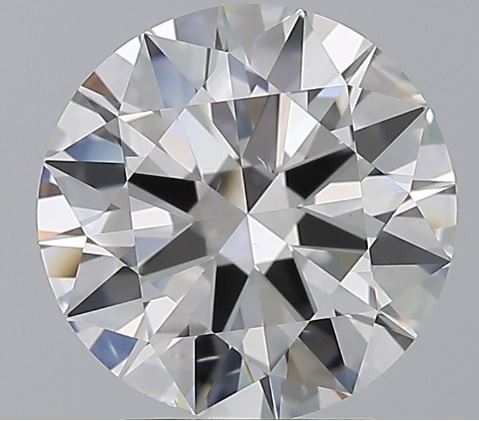
A round brilliant diamond has numerous facets arranged to produce characteristic patterns of brightness, contrast and scintillation. These changing patterns can make an inclusion less apparent in some viewing positions while making it more conspicuous in others.
By comparison, a step-cut diamond, such as an emerald cut, generally has larger, elongated facets arranged in parallel rows. This produces a different optical appearance, often described as a hall-of-mirrors effect.
The distinction is important because the same inclusion may appear differently in the two cuts. A small inclusion can be masked by the complex light and dark patterns of a brilliant cut, yet stand out more clearly against the relatively broad facets of a step cut.
However, this is not an absolute rule. An inclusion may be highly visible in a brilliant cut if it creates strong contrast or occupies a prominent position. Likewise, a step-cut diamond may conceal an inclusion under certain viewing conditions.
The relevant principle is that inclusion visibility depends on the interaction between the inclusion and the diamond’s optical environment, not solely on its physical dimensions.
3. Why the position of an inclusion matters
The location of an inclusion can substantially influence its apparent visibility and its contribution to the final clarity grade.
Beneath the table
The table is the large central facet on the crown of a typical brilliant-cut diamond. An inclusion positioned beneath the table may be readily visible when the diamond is viewed face-up, particularly if it is dark, sharply defined or surrounded by a contrasting facet pattern.
A centrally located inclusion is not automatically more serious than one elsewhere. Its actual impact depends on its dimensions, nature, contrast and visibility under grading conditions.
Within the crown region
Inclusions beneath the crown facets may interact with the diamond’s changing patterns of brightness and darkness. Depending on their position and contrast, they may be conspicuous from certain viewing angles and less apparent from others.
At or near the girdle
The girdle is the perimeter separating the crown from the pavilion. An inclusion close to this region may be less apparent when the diamond is viewed face-up, depending on its depth, orientation and relationship to the surrounding facets.
Some inclusions near the girdle may nevertheless be readily visible from the side or at particular viewing angles. Their location does not automatically justify a higher or lower clarity grade.
Within the pavilion
The pavilion is the lower portion of the diamond beneath the girdle. Inclusions located in this region can interact with reflected light and facet patterns in complex ways.
A pavilion inclusion may appear to have multiple visual counterparts because of internal reflections. These apparent repetitions are optical effects rather than necessarily separate inclusions.
The visibility of a pavilion inclusion therefore depends on its location, orientation, contrast and the optical behaviour of the stone.
At the culet
The culet is the small facet, or point where no culet facet is present, at the bottom of the diamond. An inclusion or other characteristic in this region may be influenced by the surrounding pavilion facets and viewing angle.
As with other positions, its contribution to clarity must be assessed in the context of the complete diamond.
These examples demonstrate why location is a significant part of clarity grading, but cannot be evaluated independently of the other grading factors.
For terminology relating to diamond structure and facet arrangement, consult the DCLA Diamond Glossary and Picture Library.
4. The nature of an inclusion
The term inclusion covers a broad range of internal features. Their appearance and optical effect can vary substantially, even when their dimensions are similar.
Dark mineral or crystal inclusions
Dark inclusions may create strong visual contrast against a bright facet. Their apparent prominence depends on their size, location, shape and the lighting and viewing conditions.
Light or colourless inclusions
Some inclusions are relatively light in appearance and may blend into their surroundings. Others become conspicuous when positioned against a dark facet or when their boundaries scatter or interrupt light.
Clouds
A cloud is a grouping of very small inclusions that may collectively create a hazy or diffuse appearance. Individual components can be difficult to resolve, particularly at lower magnification, while their combined effect may be more apparent.
The grading significance of a cloud depends on its density, distribution, extent and visual effect.
Pinpoints and minute crystals
Very small inclusions may be difficult to identify individually. When present in groups, however, they can contribute to a cloud-like appearance or affect the diamond’s overall visual character.
Internal graining and twinning wisps
Internal graining may appear as lines or bands associated with irregularities in the diamond’s crystal structure. Twinning wisps are a particular type of internal feature associated with twinning planes and may appear as fine, thread-like or cloud-like patterns.
These characteristics should not be confused with a simple description of unbonded carbon. Their precise nature must be established through appropriate gemmological examination.
Feathers and fractures
A feather is a feather-like internal fracture or break, often with a light appearance under certain viewing conditions. In the diamond trade, the term gletz is also used for certain fracture-like features.
The significance of a feather depends on its size, position, visibility and other characteristics. Its potential effect on durability is a separate consideration from its contribution to clarity grading.
The DCLA Diamond Clarity Guide provides further information about clarity characteristics and their role in grading.
5. Contrast: Why some inclusions are more visible than others
Contrast is an important consideration when evaluating the apparent visibility of an inclusion.
A well-cut diamond viewed face-up naturally displays alternating bright and dark areas. These patterns are part of its optical behaviour and are influenced by the diamond’s facet arrangement, proportions, lighting and viewing position.
An inclusion that appears dark against a bright facet may be particularly conspicuous. Similarly, a light inclusion against a dark facet can produce strong contrast and become readily identifiable.
Conversely, an inclusion may be less apparent when its appearance closely resembles that of the surrounding area.
Consider a hypothetical example: a dark inclusion in a diamond initially assessed as VS2 may become sufficiently prominent under the applicable grading conditions to support an SI1 grade. Conversely, a less conspicuous inclusion in a different position may have a smaller effect on the final assessment.
These examples are illustrative, not automatic grading rules. A grade cannot be changed solely because an inclusion is black, white, central or close to the girdle. The complete set of grading criteria must be considered.
This is one reason clarity grading requires trained observation and consistent application of established standards rather than a simple measurement of inclusion size.
6. Clouds and the distinction between clarity and transparency
An important distinction in diamond assessment is the difference between clarity and transparency.
Clarity evaluates the diamond’s internal and external characteristics according to the relevant grading methodology.
Transparency concerns the degree to which light can pass through the material without significant obstruction, haze or cloudiness.
A diamond can have a recognised clarity grade yet exhibit a degree of internal cloudiness that affects its transparency. Conversely, a diamond containing inclusions may still display very good or excellent transparency.
For example, a diamond graded VS2 may contain a dispersed cloud of microscopic features. Depending on the cloud’s density, distribution and optical effect, the stone may show a degree of haze even though individual inclusions are difficult to distinguish.
The relationship is not automatic: a cloud does not necessarily reduce transparency, and a lower clarity grade does not necessarily indicate poor transparency.
Magnification and lighting can also change how internal features are observed. A cloud may be difficult to resolve as separate inclusions under a standard 10× loupe yet appear more evident under a microscope or under particular illumination. This does not, by itself, establish a lower clarity grade. The grading assessment must follow the relevant examination procedure.
The important point is that clarity and transparency describe related but different properties. Neither should be used as a substitute for the other.
7. The DCLA Transparency Grading System
DCLA developed its Transparency Grading System to provide additional information about a diamond’s optical characteristics beyond its conventional quality grades.
The system assesses the degree of transparency and the extent to which haze, cloudiness or other internal features interfere with light transmission. This information can help distinguish between diamonds that share a similar clarity grade but have different transparency characteristics.
DCLA’s published transparency scale comprises five categories:
- Excellent: Completely transparent, with no significant haze or cloud affecting transparency.
- Very Good: Transparent, with minimal light interruption and only very slight haze or cloud.
- Good: Transparent, with slight detectable haze or cloud.
- Medium: Semi-transparent, with marked light interruption and more readily detectable haze or cloud.
- Poor: Semi-transparent, with substantial haze or cloud and very limited light transmission.
The assessment of transparency complements rather than replaces clarity grading. It offers additional context for understanding a diamond’s visual performance.
For the background to this approach, read DCLA’s Transparency Grading System.
8. Cut, brilliance and the overall assessment of a diamond
Clarity is only one aspect of diamond quality. The diamond’s cut and proportions influence how light interacts with its facets and contributes to its visual appearance.
Brilliance describes the return of white light, while fire refers to the dispersion of white light into spectral colours. Scintillation describes the flashes of light and dark that occur as the diamond, light source or observer moves.
These optical effects are influenced by cut quality, proportions, symmetry, polish and viewing conditions. Internal characteristics can also affect appearance, but clarity alone does not determine a diamond’s brilliance or fire.
A diamond with a high clarity grade may still have limited optical performance if its proportions or facet arrangement are unfavourable. Similarly, a diamond with a lower clarity grade may exhibit attractive brilliance and fire if its cut and transparency are favourable.
For this reason, a complete assessment should consider the diamond’s relevant characteristics together rather than treating any single grade as a definitive measure of overall beauty.
DCLA’s Diamond Grading Process explains the laboratory’s assessment of weight, measurements, colour, clarity, cut, polish, symmetry and transparency.
Conclusion: Understanding the complete diamond
Diamond clarity is a multifactorial assessment. Inclusion size matters, but its significance depends on the feature’s position, nature, contrast, number and distribution, together with the applicable grading methodology.
The optical characteristics of the diamond influence how inclusions appear, while clouds and other microscopic features may affect transparency in ways that are not fully expressed by a clarity grade alone.
DCLA’s approach recognises the value of assessing these characteristics separately. By combining conventional diamond grading with an additional transparency assessment, the laboratory provides a more comprehensive description of the stone.
For jewellers, diamond professionals and consumers, understanding the difference between clarity and transparency helps create a more informed interpretation of a diamond grading report.
Explore more diamond education resources: Diamond Clarity | Four Cs of Diamond Grading | Diamond Grading Reports | Diamond Glossary and Picture Library
DCLA Diamond Glossary: Clarity and Transparency
The following glossary can accompany this article and link readers to relevant entries in the DCLA Diamond Glossary and Picture Library.
Blemish: An external characteristic or mark on the surface of a polished diamond.
Brilliance: The appearance of white light returned by a diamond.
Cloud: A grouping of minute inclusions that may collectively create a diffuse or hazy appearance.
Clarity: The assessment of a diamond’s internal inclusions and external blemishes under the applicable grading methodology.
Contrast: The visual difference between an inclusion and its surrounding optical environment, which can influence its apparent visibility.
Crown: The upper portion of a polished diamond, extending from the girdle to the table.
Culet: The small facet, or point where no culet facet is present, at the bottom of a diamond.
Facet: A polished, flat surface on a cut diamond.
Feather: A feather-like internal fracture or break within a diamond.
Fire: The dispersion of white light into spectral colours as it passes through a diamond.
Girdle: The perimeter of a polished diamond separating the crown from the pavilion.
Inclusion: An internal characteristic within a diamond, such as a crystal, cloud, feather or internal graining feature.
Pavilion: The lower portion of a polished diamond, extending from the girdle towards the culet.
Scintillation: The flashes of light and dark observed as a diamond, light source or observer moves.
Step cut: A cutting style characterised by rows of elongated facets, commonly found in emerald-cut diamonds.
Table: The large upper facet of a typical brilliant-cut diamond.
Transparency: The degree to which light passes through a diamond without significant obstruction from haze, cloudiness or other internal features.
Twinning wisps: Fine, thread-like or cloud-like internal features associated with twinning planes within the diamond’s crystal structure.
VVS, VS, SI and Included: Categories within commonly used diamond clarity grading scales, representing different levels of inclusion visibility and significance under the applicable grading criteria.


