Showing posts with label Ashton Mining of Canada. Show all posts

Tuesday, 25 November 2025

Canada’s $92,000 Yellow Diamond Coins

Canada's $92,000 Yellow Diamond Coins

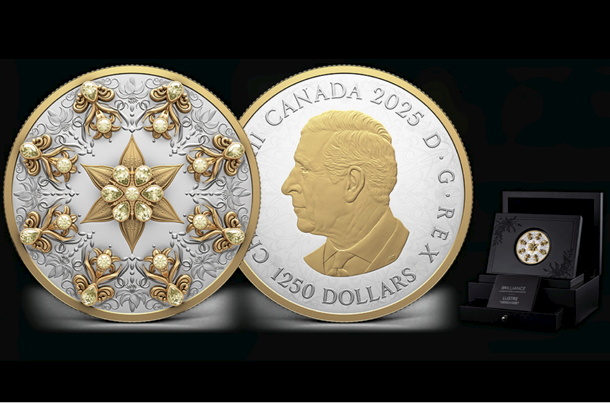
The Royal Canadian Mint has created a limited edition of 10 platinum coins, each set with at least 6.13 carats of fancy yellow diamonds from the Ekati mine, and priced at CAD 128,000 (USD 91,900).

The coins are legal tender, with a nominal value of CAD 1,250 (USD 900), crafted from 10oz of platinum with a Canada lily motif, highlighted with selective gold plating.

Each one is set with 14 pear-cut and nine round-cut fancy yellow diamonds. Seven of the diamonds form the center of the largest lily.

The 10oz coins, known as Brilliance, are a collaboration between Burgundy, the Calgary-based miner that owns and operates the Ekati mine in Northwest Territories, and the Royal Canadian Mint, the crown corporation that mints Canada’s coins.

The mint’s Opulence Collection also includes 30 gold coins, known as Radiance.

They weigh 1oz, feature approximately 1.14 carats of fancy yellow Ekati diamonds, plus white diamonds, and are priced at CAD 39,000 (USD 27,500).

“The Opulence Collection is a testament to the Royal Canadian Mint’s dedication to innovation and coin manufacturing excellence, and the addition of rare fancy yellow diamonds creates visually stunning collector pieces that also celebrate Canada’s vast mineral wealth,” said Marie Lemay, president and CEO of the Royal Canadian Mint.

Source: DCLA

Monday, 14 July 2025

Retailer Buys Canadian Diamond Project

Arctic Blue shows a fluorescent diamond under UV light.

Canadian retailer Arctic Blue has bought a controlling interest in the WO Diamond Project, in Northwest Territories, where explorations are at an advanced stage.

Arctic Blue Diamonds Ltd, a private diamond company that specializes in the rare blue fluorescent diamonds, says it operations at the mine could involve the use underwater remote mining (URM) technology.

It said had acquired an 89.7 per cent interest in the WO Diamond Project, primarily from Peregrine Diamonds, a subsidiary of De Beers Canada, for an undisclosed sum.

The”WO” in the WO Diamond Project stands for “West of”, as in west of the Ekati diamond mine (owned by Australia-based Burgundy Diamond Mines).

The WO Project, currently on care and maintenance, encompasses eight mining leases covering 5,815 hectares located about 11km off the seasonal ice road, 23km from the Diavik diamond mine and 53km from the Ekati diamond mine.

It hosts DO27, one of the largest diamond-bearing kimberlite pipes in Canada, with an indicated mineral resource of 18.2m carats. It has a surface area of about 9 hectares and lies below a shallow lake.

Based on independent rough diamond price indices, the average prices for DO27 diamonds are projected at $90 – $100 per carat.

“The extremely soft nature of the DO27 ore also opens the potential for the deployment of Underwater Remote Mining (URM) technology,” said Arctic Blue executive chair Patrick Evans.

He said it offered exceptionally low capital and operating cost opportunities, and was the most sustainable form of mining, with minimal impact on the environment.

Source: DCLA

Fluorescence

Fluorescence in Diamonds

Fluorescence in Diamonds: What It Is and How It Affects Your Diamond
Fluorescence in diamonds refers to the glow that a diamond emits when exposed to ultraviolet (UV) light. When a diamond has fluorescence, it can show a blueish glow (or, in rare cases, other colours) under UV light. This phenomenon is due to the presence of trace elements, typically boron or nitrogen, in the diamond’s crystal structure.

How Fluorescence Works in Diamonds
Ultraviolet Light Exposure:

Fluorescence occurs when a diamond is exposed to UV light—such as sunlight, certain types of lamps, or black lights—which excites the molecules in the diamond and causes them to emit visible light in a blue hue.
Intensity of Fluorescence:

The level of fluorescence can range from none to very strong. This is graded as follows:
None: No fluorescence under UV light.
Faint: The diamond shows a very slight fluorescence.
Medium: Noticeable fluorescence, but not very strong.
Strong: The diamond emits a noticeable glow when exposed to UV light.
Very Strong: The diamond gives off an intense glow in UV light.
Color of Fluorescence:

Monday, 7 April 2025

Canada's Big Three Mines Could Close Early

Canada's Big Three Mines Could Close

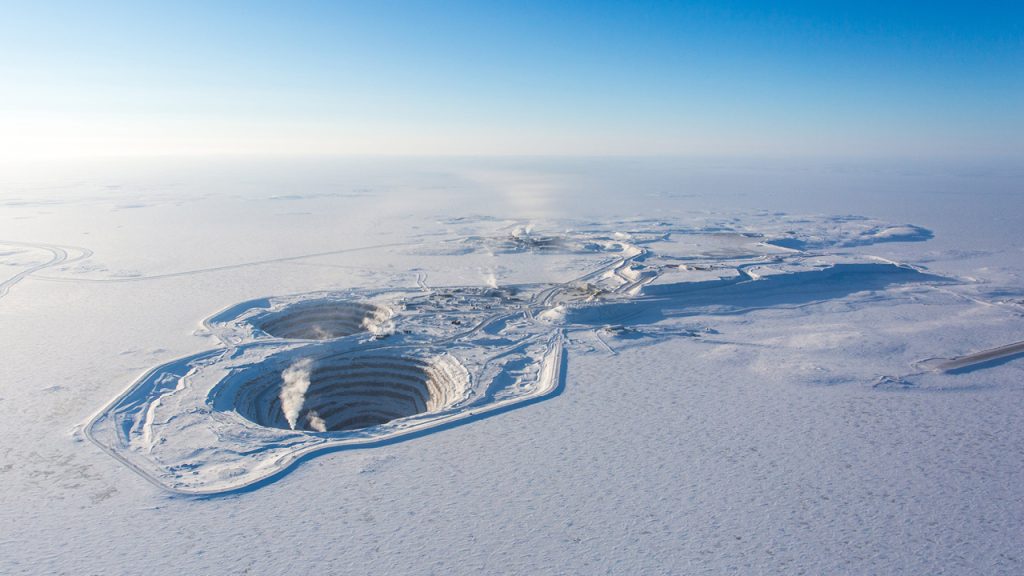
Canada’s three biggest diamond mines could be forced to close early, an economist has warned, amid the ongoing slump in prices.

Operators reported losses last year for Diavik, Ekati and Gahcho Kue, all in Canada’s Northwest Territories (NWT).

They are slated for closure as they reach the end of their lives – estimated at 2026, 2029 and 2030 respectively – but dwindling demand may render them uneconomic before those dates.

Graeme Clinton, an economist in Yellowknife, capital of NWT, told CBC, Canada’s national broadcaster : “I don’t think nearly enough is made of the state of the markets which are most important to our economy. These low prices could very well mean an early closure.”

He qualified his comments by saying that none of the miners had so far indicated that they’d bring forward their closing dates.

Diamond mining is key to NWT’s economy, representing over a quarter of its GDP, but miners have been hit hard by the downturn.

Rio Tinto’s Diavik mine lost CAD 127m (USD 94.6m) in 2024, Burgundy’s Ekati lost CAD 94.7m (USD 70.5m) and Mountain Province, minority-owner of Gahcho Kue lost CAD 81m (USD 60.0m).

Early closures would cost thousands of jobs, and would dent NWT’s economy.

Source: DCLA

Thursday, 7 November 2024

Mountain Province Losses Increase in "Challenging Market"

Mountain Province reported increased net losses for the latest quarter as prices keep on dropping in a "challenging market".

Mountain Province reported increased net losses for the latest quarter as prices keep on dropping in a “challenging market”.

The Canadian miner today (7 November) announced a net loss of $13.6m for the three months to 30 September, following on from a $4.7m loss in Q2 (all figures are in US dollars).

“In Q3 2024 our sales achieved 100 per cent sell-through with no unsold stock held at the end of September and a higher average selling price than the three preceding quarters,” said Reid Mackie, VP sales and marketing at Mountain Province.

The average price per carat was, however, down 21 per cent on a year ago – from $95 to $75.

The company sold a 679,599 carats were sold for $50.8m, compared to 478,653 carats in Q3 2023 for $45.3m. Year-on-year the number of carats sold was up almost 30 per cent, but revenue increased by just 12 per cent.

Adjusted EBITDA was $12.5m and loss from mine operations was $8m.

As for operations at the Gahcho Kue mine (pictured), the number of tonnes of ore treated increased 10 per cent year-on-year, but the number of carats recovered fell by 10 per cent.

CEO Mark Wall explained that this was “driven by planned lower grade in Q3 and unplanned lower grade in March and early Q2 of 2024”.

He said that while the diamond market had been disappointing, he was optimistic that the price environment would recover during 2025 and that it would be followed by a very strong production year in 2026.

Source: DCLA

Tuesday, 10 September 2019

Stornoway Diamond granted creditor protection


Stornoway Diamond Corp. of Montreal has been granted protection under the Companies’ Creditors Arrangement Act from the Superior Court of Quebec while the company restructures its business and financial affairs.
Protection is extended to subsidiaries Stornoway Diamonds Canada, Ashton Mining of Canada, and FCDC Sales and Marketing.
Stornoway has signed a letter of intent with creditors Osisko Gold Royalties and Diaquem, a wholly owned subsidiary of Ressources Quebec, concerning a bridge financing agreement entered into in June this year. The LOI confirms that the creditors intend to acquire all of the assets and properties of Stornoway and assume the debts and liabilities owed them as creditors. Stornoway will continue to be the operator of the mine 320 km north of Chibougamau in the James Bay region.
Osisko says that under the terms of the bridge loan, It will retain its 9.6% diamond stream on the Renard mine and continue to receive diamond deliveries. The proceeds of any diamond sales will be reinvested in the mine for a period of one year.
Osisko and certain of the secured creditors have also agreed to supply an initial C$20 million of working capital to Stornoway. The working capital is intended to keep the mine operating without interruption.
Source: DCLA

Stornoway Diamond granted creditor protection


Stornoway Diamond Corp. of Montreal has been granted protection under the Companies’ Creditors Arrangement Act from the Superior Court of Quebec while the company restructures its business and financial affairs.
Protection is extended to subsidiaries Stornoway Diamonds Canada, Ashton Mining of Canada, and FCDC Sales and Marketing.
Stornoway has signed a letter of intent with creditors Osisko Gold Royalties and Diaquem, a wholly owned subsidiary of Ressources Quebec, concerning a bridge financing agreement entered into in June this year. The LOI confirms that the creditors intend to acquire all of the assets and properties of Stornoway and assume the debts and liabilities owed them as creditors. Stornoway will continue to be the operator of the mine 320 km north of Chibougamau in the James Bay region.
Osisko says that under the terms of the bridge loan, It will retain its 9.6% diamond stream on the Renard mine and continue to receive diamond deliveries. The proceeds of any diamond sales will be reinvested in the mine for a period of one year.
Osisko and certain of the secured creditors have also agreed to supply an initial C$20 million of working capital to Stornoway. The working capital is intended to keep the mine operating without interruption.
Source: DCLA

How Efforts to Control the Diamond Trade Are Hurting the Very Communities They Were Supposed to Protect

For more than two decades, global policies aimed at restricting the flow of diamonds from conflict zones most notably through the “blood dia...